Category: About Horley

Horley – It’s Church and People through Ten Centuries

Explanatory Note


The booklet reproduced here was written by Elisabeth Lane, published in 1960 and is the follow up to another booklet entitled ‘Early Days in Horley, Sidlow and Salfords’ (1958) which is also accessible on this website.

The trio of historians responsible for much of Horley’s written early history, Elisabeth Lane, Jean Shelley and Os Brown are unlikely to be bettered by later members of Horley Local History Society and so this work is likely to remain as the most easily accessible research source for much of our early local history.

Due to the passage of time some of the names of locations described in this document may have changed but I doubt that anyone familiar with Horley will have any difficulty placing them.

I have not changed the monetary amounts from £.s.d. to decimal. Remember that our old currency started with pennies and their fractions and there were 12 pennies to a shilling, 20 shillings to a pound and that in 1800 as a benchmark £1 would now be the equivalent of £70 to us.

It was uploaded to the HLHS website by Doug Cox in November 2024 and the copyright is owned by Horley Local History Society.


HORLEY

IT’S CHURCH AND PEOPLE

THROUGH TEN CENTURIES


Elisabeth Lane

Author of Early Days in Horley, Sidlow and Salfords

Part author of Free men of Charlwood


© Horley Local History Society


Contents


         Chapter

  1. Foundations – Prior to 1300.
  2. Under Chertsey Abbey, 14th Century
  3. Horley Churchwardens – their work and accounts, 16th Century
  4. Horley and The Reformation, 16th Century
  5. The Bristow Family.
  6. Under the Ownership of Christ’s Hospital, 17th
  7. Sidelights on the 18th and 19th Centuries
  8. The Last Hundred Years 1860 – 1960.


Horley Church in the 18th Century


CHAPTER 1

Foundations prior to 1300

“God is law say the wise. Oh then my Soul rejoice, for if He thunder by law, the thunder is still His voice”.

TENNYSON.


THE HISTORY of a church is essentially the history of man’s search for fellowship with the Living God, of God’s response to man’s search through the Gracious Personality of Jesus Christ, and of man’s continued worship of God in Christ. The records are of the outward trappings, of buildings and finance, the care of the poor, books and candles for shrines, and of all the homely things of everyday existence, yet the essential unseen movements, of human questing and Divine response, are always the life-giving factor, the vitality that moves ever forward to constitute new thought and vision, through union with One who declared Himself to be “the Way, the Truth and the Life”.

This search is no new thing. Man’s attempt to lift even the corner of the curtain between this world and the Beyond—the Other world in which he has always believed—is age-long and world-wide. Always he has sought to discover the Power behind nature, the Creator behind creation. Primitive man, living immeasurably closer to nature, needed above all things her gifts of fruitfulness and rebirth; of succour and salvation from natural disasters, from storm and flood, fire and famine; and for that gift, so necessary to survival, victory over his enemies. For these he prayed to the Power behind the things he knew.

TEUTONIC BELIEFS

In northern Europe this was clearly true. Their gods were the spirits dominating nature and man’s sojourn on earth. Woden or Odin was the supreme god and creator, the dispenser of victory—and he, with his wife Frigga, are remembered in our Wednesday and Friday; Tyr or Ti, god of battles, has given his name to Tuesday; Frey and his more famous sister Freyia were givers of fruitfulness, sunshine and rain, and all plenteousness; and one, sometimes considered as Woden’s son, but often too ranking above him, Thor, whose voice was the thunder, who flashed in the brilliance of the lightning and flung the thunderbolts. Here was a god of power, giving his name not only to the fifth day of the week but also to Saxon settlements in England.

Our knowledge of these and many other gods comes largely from isolated references in the Icelandic sagas, handed on by word of mouth and only written down in the 12th and 13th centuries, so that the early belief in their powers is not easily defined, but undoubtedly Thor was held in great veneration from most primitive times. [page 4] He was pictured as a ruddy man of enormous strength, riding the storm in a car drawn by he-goats, wearing gauntlets of iron to grasp the thunderbolts, and a miraculous girdle which increased -his power when his wrath and his temper, which were notably quick, were aroused. Nevertheless, he was always a friend of man, and his many exploits were waged against the evil giants and demons, to whom he was an implacable enemy. He was considered a dispenser of justice and a giver of fecundity, so that his blessing was sought in the rite of marriage, and his name often added to a personal name to safeguard the bearer.

In the great pagan temple at Upsala in Sweden on the site of the present Cathedral, in which was an altar for sacrifice with perpetual fire, and a place for the great sacrificial feasts, Thor’s statue stood magnificently “all adorned with gold and silver”. Though temple buildings existed in England, it seems more likely that at Thunderfield, “the open space of the god Thor”, altar was in the more customary grove of sacred trees, among which the oak was pre – eminent. That there were priests in such places to carry out the rites is certain, for they are especially exempted from bearing arms.

The festivals seem to have been at fixed times, in the autumn, mid-winter and spring, and though human sacrifices were offered to Woden, there is little mention of them in the case of Thor, but chiefly of horses and oxen, most valuable of beasts, and even of bears caught in the chase.

Here, then, are the foundations on which the first Christians could build—belief in invisible powers beyond and behind nature. As Tacitus wrote in the first century A.D. the Teutons “dedicate groves and woods and call by the names of gods that invisible thing which they see only with the eye of faith”. A belief, too, in another life in which the brave would be rewarded; a desire for crude law and justice; a trust in sacrifice as a means to obtain help; regular festivals at certain sacred places where the inhabitants were used to congregate, and a limited priesthood.

CONVERSION TO CHRISTIANITY

The name Horley or Hornley, “the clearing of Horn”, does not seem to have been used in early Saxon days, and it is almost certain that “Thunresfelda”, or Thunderfield, was the name given to a very large part, if not the whole, of Horley. It was only in the 12th century that a castle was built near the present Balcombe Road, and the name restricted to that small island within its moat. That being so, it is not necessarily at the present Thunderfield that Thor had his shrine. In 601 Pope Gregory sent instructions to his missionaries in England advocating the conversion of pagan temples into Christian churches, “in order that the people may the more familiarly resort to places to which they have been accustomed”. [page 5] Though, as has been said, it was unlikely that there was a “temple” at Horley, it is certainly possible that the grove of trees selected as a shrine was close to the ford of the river Mole; that there the first missionary planted the Cross, and, if that is so, there on the old heathen place of worship is the site of the church used continuously to the present day.

When and in what manner the Good News was preached is equally uncertain, though it is likely that the missionaries to the wealden villages travelled along the north downs, the Weald itself being practically impassable. St. Augustine had landed in Kent in A.D. 597, and had been well received by Ethelbert, though—and this is a curious sidelight on Saxon thought—the king received the saint sitting out of doors, and not under a roof, in order to reduce the power of his spells. His conversion was however complete. Augustine and his followers were given a house in Canterbury, and supported in every way in their mission.

CHRISTIAN PREACHING

The preaching of the Christian faith in Surrey was also undoubtedly made easier by the fact that, in 666 A.D., Egbert of Kent was holding this county as a “pretty princedom” under his brother-in-law and overlord, Wulfhere of Mercia, a fervent Christian. It was at this time that the boundless energy of St. Erkenwald was raising the first primitive structure of wattle and daub, thatched with reeds, on the Isle of Ceorot, which was later to become famous as Chertsey Abbey. The land at first consisted of only about 600 acres, but more was soon added and a new church of stone, glazed by glaziers especially brought over from the continent, was built to replace the first wooden building. Here The Saint remained as Abbot until he was made Bishop of London in 675.

The next 200 years of Christianity were made hideous by increasing Danish invasions and by the struggles for supremacy between Saxon and Dane. The battle of Ockley is believed to have been fought over this neighbourhood and many legends remain of fleeing Danes being cut down on the edge of the Mole: Canterbury and London were certainly captured by them that same year—851 A.D. About twenty years later Chertsey Abbey was itself attacked and fired, and it was not until the victories of Alfred, justly called “the Great” that the Christian faith was finally saved in the British Isles.

GIFT OF CHERTSEY

Thunderfield was one of the royal demesnes, and as such belonged to the king who, on his death in 901, left it by name in his will to his nephew Aethelm. It was, however, in the reign of his famous grandson Athelstan, “Rex totius Brittaniae”, that, as part of the Manor of Sutton, “Dunresfelda silvatica”, Thunderfield the forest, was confirmed as part of the possession of Chertsey Abbey. [Page 6] This grant, which was made “in the royal town which is called in English Kingston”, on December 16th, “1n the year of the Incarnation 933”, was a recapitulation of lands confirmed by King Athelstan, so that the actual gift must have been made at some earlier date.

The recapitulation itself is most interesting as showing the enormous area owned by the Abbey at that date. Thunderfield in the forest was certainly the most southerly of the Abbey’s possessions, and appears to have been the only one in the Weald. Its gift was again confirmed by King Edgar in 967 A.D. “Cum cubilibus porcorum quae illuc pertinent scilicet in Denresfelda.” The lair of pigs in the forest was evidently an item of considerable value.

ST DUNSTAN AND THE BENEDICTINE ABBEYS

The confirmation was made while St. Dunstan, as Archbishop of Canterbury, was undertaking his great reformation of Abbey life, so that the ‘Rule’ of St. Benedict might again be kept in its early purity. These reforms would therefore have affected Chertsey.

One wonders what the modern reaction would be to the monks’ day of prayer and work, as set out in the 10th century. Though this may not have been kept in every abbey in its entirety, it was not at the time considered particularly austere, The day started shortly after two in the morning with Nocturns, followed by five hours of devotion, including Matins and Prime—this in a church which, except for the wavering rays of candles or torches in the choir, must have been, for the greater part of the year, dark and intensely cold. During the day special masses, and the services of Tierce, Sext, None and Vespers, alternated with the work of the abbey until, finally, after Compline at about six o’clock, the monks in scapular, cowl and hood went silently to bed.

Their first and main meal was at two o’clock, twelve hours after rising. Meat was reserved for the sick, but fish, eggs and cheese, with fruit, vegetables, porridge, bread, butter and honey were all eaten, except in Advent when fats were given up, and further during the whole of Lent, when eggs and milk were also forbidden. As this would, in any case, have been a time of shortage of fruit and vegetables, the fare would indeed have been meagre.

Nevertheless, while the monasteries were, especially in the early days, essentially places of worship where the Divine Offices could be said in peace and security, they were also the only places of learning throughout Christian Europe, and it was in them that books were laboriously written and copied. A point that emerges strongly from Saxon church history is the enormous desire for the written word, the immense value of books, and the surprising number in circulation, and, added to this, the toil and slowness of their making.

Cuthbert, Abbot of Wearmouth, Jarrow, wrote to Lull, Archbishop of Mainz in Germany—himself an Englishman from Wessex —about 760. [Page 7] “You asked me to send you something of the works of Bede. I have been busy with my boys in making copies as far as we could manage this and I am sending you the life of St. Cuthbert. I would gladly have done more. But the winter just now has caused the most horrible suffering on this island, through bitter cold and ice . the hands of our copyists were so numbed that they could not get many books ready.” Again and again Lull asks for books, and many are sent to him, including Commentaries on Samuel, Ezra and Nehemiah, as well as on the gospel of St. Mark. Books were indeed considered the most precious of gifts, and immense care and beauty were lavished on their making. One reads of the four gospels “in letters of the purest gold on purpled parchment and illuminated”. This art of illumination with its brilliant colours, clear, strong outlines and vivid portrayal of men in action, their draperies seeming to flutter in the wind, as seen in the old manuscripts, is, indeed, something at which to marvel.

NORMAN CONQUEST

Few records remain of Horley at the time of the Conquest; and though “Hornley” is once mentioned among the possessions of the Abbey as devastated by William’s army, this manuscript is looked on with some suspicion by the experts. Certainly Horley was considerably south of the route under the downs taken by William’s army.

The population was probably still confined to those Saxons who, perhaps first as pig herds, had ventured down into the marshes of the Weald and found good rich land. Here they felled trees and cleared enough space for their own needs. There is no suggestion of any “common fields” in the parish, such as were shared by a compact community. In the Domesday Survey a nameless place in the Manor of Sutton is described, which is very likely Thunderfield. “The Abbey itself holds two hides (about 240 acres) of land and William holds the Abbey.  There is one Bordar and one serf. In the time of King Edward it was worth twenty shillings, afterwards five shillings. Now ten shillings.”

When a church was built is also uncertain, but, in a deed of 1191, in which the Abbey is granted the right to appropriate the vicarage of Horley, among other places, to its own use, it is expressly mentioned that these rights had been acquired “at an early stage”. If a vicarage, surely a vicar and his church, so that it would seem that a church, which we know to have been in stone, had been standing some considerable time before the reign of Richard I.

AGREEMENT BETWEEN THE ABBOT AND JOHN DE WENGHAM

By 1262 a most detailed agreement was made between John Medmenham, Abbot of Chertsey, and John de Wengham, the tenant of 42 acres of Abbey lands in Horley. This land John was to hold for life, paying 20s. yearly, half at Easter and half at Michaelmas, for ten years, [Page 8] but five times as much — IOOs.— if he lived more than ten years! The interesting thing about this deed is that Henry de Wengham, afterwards Bishop of London, was vicar of Charlwood in 1242, so that it looks as though the family must have been a local one. From the taxation returns of Pope Nicholas in 1291 we know that the Horley living at that time was taxed at £14. 13s. 4d. and the tithe valued at £l. 9s. 4d.

The full list of vicars, as far as they can be traced at present, will be found in the Appendix. The earliest known is Walter the “parson” who witnessed a deed in 1218. Later comes a man with the wonderful name of John de Cromplehorn. Another Walter, Walter de Wavyndon was certainly vicar in 1331, when he was granted for life a croft of 4 acres lying near his house, with permission to enclose it, by that great Abbot of Chertsey, John de Rutherwyk, whose history and dealings with Horley follow in the next chapter.

CHAPTER 2

Under Chertsey Abbey 14th century

IN THE early 14th century a period of intense activity, both lay and ecclesiastical, opened for Horley. The great Chertsey Abbey, to which it had belonged for at least 374 years, when John de Rutherwyk was elected Abbot in 1307, was to be raised to the height of its power and prestige. Near Windsor, the Abbey was often visited by Edward Il, and royal letters are dated from Chertsey at least six times between 1308 and 1318. Queen Philippa also held her court there both in 1340 and 1341, while her husband Edward Ill was fighting in France.

Its possessions were immense, and, in addition to land in Wales and Berkshire, the Abbey owned over twenty churches in Surrey. These included—to take them in alphabetical order—BisIey, Great and Little Bookham, Byfleet, Chaldon, Chipstead, Chobham, Clandon, Cobham, Coulsdon, Egham, Epsom and Horley. More land in Comptom, Felsham, Effingham, Esher and Ash must be included in this remarkable list.

To the organization, administration and improvement of this large tract of Surrey, John de Rutherwyk, “most prudent and useful lord of our monastery”, a local man whose family possessions lay in Thorpe and Egham, brought enormous energy and skill, and in this golden age of monastic high farming raised his house by extensive purchases and many lawsuits to “a position of economic importance without parallel in its history before or after”.

He had spent his life as a monk at Chertsey, and it is possible that the speed with which he threw himself into the work may imply a certain criticism of his predecessor, Bartholomew of Winchester. It is [Page 9] certain that, with the exception of the year 1335, in which it is written that “he rested from the labour of his hands, and the fatigues of his heart”, his vigour and energy continued unabated throughout the 39 years of his reign as Abbot. It was indeed the cause of a good deal of murmuring and discontent among the monks endeavouring vainly to keep pace with the vast amount of work entailed.

Work began the very first year of his abbacy with a new “quay of stone” on the Thames, evidently to give better access for barges to his London hospice. Work at Ash this same year included the digging of ditches and heightening of land against flood water, and three stews “fit for fishes” with a house “suitable for a fisherman”, and in addition a new pigstye and dovecot were built. At Cobham also, where flooding was (as it still is) a problem, he had the manor house moated. A new cart house and grange for hay, and later a sheepfold, were also added. In the following years houses, mills, granges—both newly built or existing ones lengthened—oxsheds, sheepfolds, pigstyes and dovecotes follow each other in steady succession, while forestry was not neglected, and various woods, mostly of oak, were planted. Undoubtedly the greater the prosperity in the manors, the greater the wealth that poured into the Abbey coffers, so that it is no wonder the Abbot was eager to acquire new land. The esteem in which he was held by Benedictines all over the country is shown by the fact that he was four times called to the Presidency of the General Chapter of the Order.

Horley, which still consisted of scattered hamlets and farms centred round a large expanse of open land, though on the outskirts of the Abbey’s property, was by no means forgotten or left out of all this activity. First the church, which had possibly been only under the patronage of the Abbey, was taken over. It was on the “2 Ides of May” 1313 that Philip de Barthon, Archdeacon of Surrey, was given a mandate by the Bishop of Winchester to induct the Abbot or his Proctor into “corporeal possession”, so that Horley (here written Hornley) and Epsom “may be honestly served by fitting vicars”. If, as is likely, the Abbot came himself to take over this “corporeal possession”, it would have been only of the old church, of which almost nothing now remains; but the plans for the new chapel, which was built just about this time, probably by Ralph Salaman, may have been discussed. There is a further note in the Chertsey Cartularies that in 1331 a “new chamber” was built followed in 1339 by a new “kitchen”.

This word “chamber” is of particular interest. The early idea of a house as a single hall or room, where all slept and ate together, was being modified, and the first addition was a chamber where the owner and his lady might have privacy by day and sleep at night. It has however been suggested that, in this case, the new chamber may have been built for use as a Court room. The kitchen had, before this, generally been a separate building, but by de Rutherwyk’s time [Page 10] chimneys were becoming more common, and the kitchen at Horley may have been a direct addition to the central hall. It seems likely that these were made to the old Court House, which stood in the garden of the present Court Lodge Farm, and may have been for the greater comfort of the visiting monk-warden, who came to oversee the Abbey Farms. For Horley’s agriculture was also receiving considerable impetus, and building had already been going rapidly forward with a new grange for hay, an oxshed and a cart house all begun in 1315.

Exactly what in money or kind Horley sent each year to the Abbey will never be known, but the organisation was most carefully worked out. In order to ensure the constant supply of the needs of the monasteries in the way of wheat, barley, malt, bacon, lard, cheese, poultry, eggs and honey, a scheme was elaborated by which each manor sent up a quota or “farm”, i.e. a fixed annual payment in kind, once or twice a year on a specified day, and it was the duty of the reeve to deliver this to the Abbey.

Horley is, however, about 30 miles from Chertsey, and moreover quite on the outskirts of the Abbey’s property, so it is always possible that the crops were sold at the local market at Burstow and only the cash forwarded, whereby the cost of transport, which has been calculated at roughly 2d. a mile, could be saved, as was done in many parts of the country.

Perhaps a short digression may be allowed at this point. It was onAugust 8th, 1247, in the 32nd year of his reign, that Henry Ill granted the right to hold a weekly market and, even more important, an annual fair on “the eve, feast and morrow of St. Michael”, i.e. 28th, 29th and 30th September, to John de Burstow and his heirs. Before the days of shops in the countryside, this was a much sought after privilege, and could only be obtained from the King himself. In order that they might not become, in Bracton’s words, a “tortuous nuisance” they were never allowed to be held less than the curious distance of 6¾ miles apart. With other markets at Bletchingley, Gatton and Reigate, Burstow would hardly infringe this ruling.

The lord’s steward presided and took the dues, and a special court was set up under the intriguing name of Pypowders—a corruption of “Pied Poudré”, or Dusty Foot—for the benefit of traders who came from surprisingly long distances, and whose packmen had the dust of travel still on their feet. For these it was essential that justice should be immediate, in case of dispute. The pillory, which was usually set up for the duration of the fair, perhaps added point to its decisions.

Fairs were often on the Feast of the Dedication of the church, and it is noteworthy that, this fair being at Michaelmas, the earlier dedication of St. Bartholomew at Burstow appears to have been to St. Michael and All Angels.

Markets were usually held on a Sunday, but the following protest [Page 11] in parliament, in 1449, shows that, by some at least, this was not well received. Here is shown the “abhomunable wrongys and vylanys don to our Lord God and his holy seyntes” by the holding of fairs and markets on Sundays and the chief feasts “in which the principall festfull dayes, for grete worldely covetyse the peple is wylfylly more vexed and defouled in bodely labour in pycchyng and makyng of Bothis and Stalles, in beyng and drawyng, hevyng and shuffyng nothyng alas havyng in mynde the horrible fowlyng of here soules in gyleful bying and selling, moche lyng and fals forsweryng, with drounkenshipp and debating and specially in withdrawyng hemself and all her meyne (household) holich fro divine service.”

Be that as it may, these markets, and more especially the fairs, must have been a bright spot in the very drab and colourless lives of the peasantry and it is certain that there was much merriment and dancing and many games of strength and skill and that performing animals were greatly enjoyed. Pictures of performing bears, a horse dancing, to a pipe and tabor, monkeys playing at school, and a charmingly dressed dog dancing to a fiddle—all of this period—are still to be seen, while a Punch and Judy show hardly differs from its descendant in more modern days.

It is almost incredible that the money exchanged and carried by the merchants in the days of John de Rutherwyk was entirely in silver pennies, small coins like very thin sixpences. A gold coin struck by Henry Ill was not popular and was withdrawn, and it was not until January 1st, 1344, two years before John de Rutherwyk’s death, that two Florentine goldsmiths were called in to strike the first gold “Florin”, valued at six shillings.

No wonder that, carrying these heavy money bags, merchants travelled in some danger, and, by the statute of Winchester, 1285, it was found necessary to broaden the highways “so that there be no ditch, tree or bush where a man can lurk to do mischief within two hundred feet of either side of the road”. Oaks and great beeches might be left “so it be clear beneath them”

Money, or lack of it, was a constant problem to the Abbot. In spite of improved agriculture, the enormous amount of building taking place throughout Abbey lands must have been a great drain on its resources. A story is told in this connection that again brings Horley into the picture.

It is clear that, by 1318, Philip de Barthon, Archdeacon of Surrey, (the same who inducted the Abbot or his Proctor into Horley Church) had lent the Abbey the large sum of £100. We read: “Because the said Archdeacon was never accustomed to fail us in our need, but now also has most courteously regarded and relieved our most urgent poverty with £100 stirling paid to us in coin” therefore “mass was to be said daily for ever for his life and salvation while he lives, and for his soul when he shall have departed”. And this not casually, but by [Page 12] a monk whose name is “especially set in the notice board for this purpose”. Further, on the Archdeacon’s anniversary, they shall “beat the peal with all the bells, and there shall be made for him a solemn mass in the Convent”, and—which would surely have pleased the brethren—twenty shillings were to be spent on a “pittance” to improve the dullness of their usual diet, while 6s. 8d. was to be given to the poor.

It is here that Horley is mentioned, for this 26s. 8d. was to come from the “tenements formerly of Roger de Logges at Horle which are called Labbokeland” , and which had later been bought by the Abbey.

On his death in 1327 the Archdeacon bequeathed a further £250 for two chantries. Two masses were to be celebrated each day by two secular monks as chaplains, who were to be paid 54 marks, or £3. 13s. 4d., a year. They were to be given “an honest chamber suitable for such persons” near the great gate of the garden within the Abbey. They were to be allowed “sufficient litter, and two cartloads of brushwood yearly when provision is made for brushwood for the Abbot’s chamber”, and “a little clerk from the Almony shall minister to the same”. Many more details are given, and it was stipulated that they in their turn must not be negligent. It was laid down that, in case of sickness, for every mass missed 50 psalms and the Office for the Dead were to be said.

Labbokeland, mentioned above, is shown on the Christ’s Hospital map of 1602, quite on the eastern boundary of the parish, in the present Salfords. It has been suggested that the name comes from Bocland or Bookland, i.e. land whose title is secured to the owner by royal charter or “book”. This was a usual procedure in the reign of King Alfred, and it is possible that this may have been some of the land in Horley owned by the king, and left on his death by will to his nephew Aethelm.

AGREEMENT WITH WALTER DE WAVYNDON

It was in 1331, the same year that the new “chamber” was built at Horley, that a most detailed agreement was drawn up between “the Abbot and Convent of Chertsey of the Order of St. Benedict” and Walter de Wavyndon, vicar of the church at Horley, whose assent, it seems, was “freely given”. He was to retain all allowances that had been granted to his predecessors. He was also to hold “in perpetuity” for himself and his successors the house lately belonging to Michael de Waps, “well and truly built, with a barn, courtilage and a croft adjacent as well as ditches and fences belonging thereto”

A list follows of all the small tithes which would come to the vicar – the tenth of all fowls, calves, piglets, geese, lambs, wool, fruit and pannage – this latter, the right to pasture pigs on fallen acorns, was valued at Stumblehole, near Bures, “when it shall happen” at 4s. a year. He was also entitled to a tithe of the rents and “those of the houses of John of Kinnersley, William of Burstow and Nicholas of Horne”, and [Page 13] a tithe of the mills “other than that of the mill formerly belonging to William of Newdigate”, and might retain all fees for special services, funerals, anniversaries, etc. He was not, however, entitled to the “great tythes”, the tenth of all cattle, sheep and pigs, and the tenth stook in every field of grain, nor to the four-footed animals that were paid as mortuary dues on the death of a land owner. These more important acquisitions went to the Abbey.

A few notes from other sources may prove the resemblance of Local History to a jigsaw puzzle with its interlocking pieces, and to this, a great deal of its fascination is due.

From a deed in the British Museum comes the fact that Michael de Waps had alienated the house and 3½ acres to the Abbey twelve years before, at the same time that William de Newdigate sold them Horley Mill. The Vicarage, in Vicarage Lane, finally vacated in 1951, therefore belonged to the Abbey and could be granted “in perpetuity.”

From Burstow deeds, we find that Willelmus de Waps paid 17¾d. tax in that parish in 1332.

Kinnersley Manor near Sidlow had belonged in the 13th century to a Norman, Fulk de Archec. The John de Kinewadesl, who also paid 4s. 7¾d. tax in 1332 must be the man mentioned in the foregoing deed.

From family records, it is clear that William de Burstow was conveying land to the Abbey this very same year, probably meadows between Meath Green and the river, as it was said to be ‘ ‘bounded on the west by the waters of the Emele”, the old name for the Mole. His house was, very possibly, in Meath Green, as it was there that a descendant lived in Tudor times. Wherever it was, it was the second largest in the parish, taxed at 7s. 4d., only beaten by that of the Pickard family, with whom William de Burstow had just had a lawsuit in 1328.

The other two mills, from which Walter de Wavyndon might take the tithes, were at Sidlow and Lodge, which latter was part of Salfords.

BUILDING OF THE NORTH AISLE

It is evident that John de Rutherwyk, in addition to his labours for agriculture, also kept a watchful eye on the fabric and adornment of the churches and chapels under his control. We read of his giving red velvet vestments to Chertsey, and pictures of St. Katherine and St. Margaret. More important was his work at Egham, where he built a new chancel, and where his name can still be traced, incised in Lombardic lettering; and at Great Bookham, where his singularly graceful windows still survive, and the name is even clearer—”Constructa Johanne de Rutherwyka”
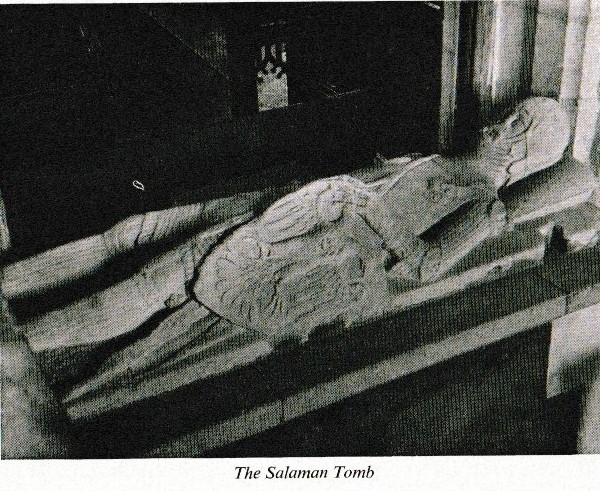
Horley has no such inscriptions. Nevertheless, it is certain that great additions were being made to the old church at this time, and that they were partly designed as the Salaman family chapel, where masses for the dead would be regularly said to assist them in the world to come.

The architecture of the present north aisle shows it to be distinctively early 14th century, the best period of Gothic building, and it probably dates from about 1315. The spire, with its huge timbers, a magnificent specimen of medieval carpentry, the porch and the arches into the nave, are all of the same date. The north windows still have the old design in their tracery, but this was, alas, renewed in the most unsuitable Bath stone in the late 19th century, though some of the beautiful ruby glass remains.

The connection with the Salaman family is proved by the old effigy of a knight in armour, of which a picture is given above. This lay originally on the floor, but now rests on what is doubtless the lid of the tomb. It is of Reigate stone, and the Victoria History describes it as “this remarkable effigy, undoubtedly the most interesting and finest, as a work of art, that remains in Surrey”. The knight bears a shield, on which are emblazoned the Salaman arms, a double headed eagle, charged on the breast with a leopard’s head, and in one of the quatre- foils of a nearby window this leopard’s head is repeated. The knight’s head rests on a cushion, a lion at his feet. His right hand must have held a drawn sword, but of this only the tip remains. The armour is chain mail, with sleeves to the elbow, and the knee pieces of plate.

[Page 15] Gauntlets, probably of leather, and roundels to protect shoulders and elbows are clearly to be seen.

It is the distinctive shape of the shield, “intermediate size between the small heater shape and the long one almost covering the body”, that makes it certain it was carved at almost exactly the same time that the north aisle was building—i.e. c. 1315—and it, in all probability, represents Ralph Salaman, father of the Roger who is known to have died some 28 years later, in 1343. It is curious to discover that the family, who owned land at Langshott, held it not from Chertsey Abbey but from Merton Priory, to whom they paid a rent of 5s. yearly.

The last decades of Ralph Salaman’s life were lived during the disastrous reign of the dissolute and irresponsible Edward Il, when the Scottish wars were draining England of both knights and wealth. Whether he ever went north with the Earl de Warenne, as did his neighbour William de Burstow will never be known. What seems certain is that he had a filial and godfearing son, and Horley owes much to this son’s care for his father’s soul in its journey through Purgatory.

No more is known of the family, except that Roger’s daughter married a certain Ralph Saunders, ancestor of Sir Thomas Saunders of Charlwood, and if, as is likely, she was an heiress, Langshott would in this way have passed out of Salaman ownership.

CHAPTER 3

Horley’s Churchwardens, their work and accounts

AFTER THE stress of building came years of quiet, but years filled with a faith that was seldom shaken—that “Mother Church” was the central point of all life. This was very largely true. Not only were the newly-born received into her membership, marriages blessed, and the soul speeded on its way at death, but almost all learning and teaching were in her hands; healing and the care of the sick were her concern, and architecture, drama, music and painting were largely dedicated to her use; while her festivals and holydays gave relief and change from secular work. Man’s passage through life was helped or hindered to an enormous degree by her care or neglect of this trust, as may be read in the great poem of Piers Plowman.

FURTHER GROWTH OF THE CHURCH

It is evident that, during the 15th century, the inhabitants were again at work. Perhaps the old church was in a state of decay. Whatever the reason, it is certain that about this time the decision was taken and the old church to the south of the Salaman Chapel was rebuilt. How curious it is that one of the smallest villages in the neighbourhood should have built the very large nave we know today, and how fortunate it is for modern Horley that their ideas were so spacious. Fortunate too that when the roof was raised the corbels, which originally supported the old roof, were left intact, jutting out above the arches which still connect the chapel with the new nave. They are practically the only visible remains of the early church.

At the same time a new inner doorway was made to the porch which is remarkable in many details, and a parclose screen added to give privacy to the sanctuary of the chapel, the lower parts of which were standing in 1881. The very beautiful brass, with the figure of a lady, now on the north wall of the sanctuary, also dates from this century, and is probably in memory of a Salaman, as its first resting place was the floor of the chapel. Here it was also seen in 1881, but “barbarously defaced by having the timbers of the organ resting on it”. The inscription to Joan Fenner, now placed on the wall below, does not belong to it.

It is noteworthy that a certain John Salmon was vicar from 1403 to 1410, but whether the spelling is a shortening of Salaman, or if he had any hand in the additions, one cannot say. It is however just possible that the scene in which Raymond de Cobham took the strong course of disclaiming his rights, or more probably his responsibilities, “before all the parishioners in church” on a Sunday in 1430, took place in the new building. Raymond de Cobham, whose home was at Gatwick Manor in the parish of Charlwood, owned Rowley Mill near Lowfield Heath. The Abbot of Chertsey was owner of Horley Mill further down the river Mole, and the quarrel arose as to who should repair the banks of the “watercourse” between the two. Three at least of Horley’s leading men witnessed the scene—John Burstow, here given his title of Esquire, William Jordan of Gatwick, and Henry Lechford.

These banks of the Mole are still making history, and at the time of writing are being surprisingly widened and altered. The river, though now no longer used to turn the wheels of the once essential mill, now has a more immediate use in carrying off the water from Gatwick Airport.

CHURCHWARDEN’S ACCOUNTS

By the early years of 1500 we become well acquainted with the affairs of the church, and this owing to a most extraordinary piece of good luck—the finding of the original Horley Churchwarden’s Accounts from 1505 to 1702 in the leather bound book in which they were written. In Manning & Bray’s History of Surrey, 1809, it is stated that these accounts, in a book “curiously embossed”, were bought by a Mr. Brand at a broker’s shop and given by him to the Editor, while in the book itself is written “Bt. of Mr Waight who told me he bought it at a sale by the Sheriff’s distress in the Borough” [Page 17] (Southwark), and below “A. E. Bray given by Rev. J. Brand 8th Nov. 1804”.

Where the book had been lying for the hundred years before it arrived at the distress sale will probably never be known, but its rescue has given to the local historian a remarkable insight into the history of the church through the days of the Tudors to the beginning of the reign of Queen Anne. It was later presented to the British Museum for safekeeping, and there it may still be seen. The experts are emphatic that the binding is original, and is very possibly the work of the same binder as that of a book now in Salisbury Cathedral.

Here we have the original writing of Horley’s clerks and churchwardens—including a few of their signatures—in all its endless and fascinating variety. Neat entries are followed by vast scrawls, educated writers by those who could only make their “mark”. Some of the entries are even upside down. Erasures are legion. The difficulty of deciphering is immense, especially in the earlier folios where the ink has become very faint, and it is not made the easier by the few who started boldly on a new page in the middle of the book, followed by others who more methodically filled in the blanks. None the less, it is the wonderful continuity that inspires admiration. Hardly a year passed, from 1518 to 1702, in which the names of the wardens were not entered and the amount of church money handed on to them by those who retired. Here is proof that even in the troublous days of the Reformation, and later in those of the Commonwealth, the life of the church went steadily on. From 1643 to 1660, for instance, Charringtons, Bristows, Woodmans, Heavers, Bonnicks and Shows, and many others, follow each other in steady succession, and not one single year passes without new wardens being elected to care for the upkeep and finances of the parish church. Sometimes it is noted that they are chosen “by the consent of the minister and parishioners”, sometimes “by the consent of the parish”, but chosen they were and they served their term.

CHURCHWARDENS

The ancient and honourable office of Churchwarden, originating at some unknown date in connection with the maintenance and repair of the church fabric, is definitely known to have existed in the 14th century, so that in all probability, Horley men had held this office since the days of John de Rutherwyk and the enlarging of the church.

By law the rector, who in Horley’s case was the Abbot of Chertsey, was always responsible for the chancel where Divine Service actually took place. This is expressly stated in an agreement in 1331 between the Abbot, John de Rutherwyk, and the vicar, Walter de Wavyndon— “the said Abbot and Convent wish to undertake the burden of the repair of the Chancel, the books and the ornaments which the Rector whether by law or custom has to bear”. The nave, however, where [Page 18] parishioners congregated, not only to attend services but also for many secular purposes, was considered their part of the building. Its upkeep fell on the whole village, each parishioner paying according to the amount of land he held and the number of animals he kept. The power to levy this rate, and the care and use of the money was in the hands of the wardens.

Two were elected each year at the Parish meeting—the word “vestry” was never used in medieval times—and a plan was followed which ensured continuity. Each served for two years, first with the previous warden, and then being himself joined by a new man. We read in the very first entries in 1518 that John Braye and Rychard Toode were together; in 1519 Rychard Toode was joined by Peter Bonwyk, and the next year Peter Bonwyk by John Barnyter. Though this arrangement naturally did not always hold good, it was the usual practice, and there is no suggestion whatever of a Rector’s Warden and a People’s Warden as is now the general custom.

A TUPPENY RATE

The first pages of the book are of absorbing interest, giving, as they do, a list of parishioners who each paid 2d., almost certainly a special rate levied towards the repair of the church. Here are the names of about fifty-one families, probably almost the entire number of freeholders. The first thing noticeable is that, unlike the earlier list of 1332 for tax assessment, these in 1500 all have regular surnames, names which recur continually through the following centuries. The heads of each branch of a family paid the rate. Thus “Owld Dewdeny” is followed by two Jhons, ( The name John coming from the Latin Johannes, the old writers were very casual as to where in the name they put the missing ‘h’. Jhon or John mattered not at all) a Thomas and a Rychard Dewdeny, while Kyllyck, Allingham, Addams, Showe (or Shove), Burstowe and Bonycke have each more than one representative. Even widows were not exempt, and four paid the twopence, including “Wacams” and “Allyns wyddowe”. Other family names, Wodman, Charynton, Heaver, Wynchester and Brooker are still well known in the neighbourhood.

This long list of eighty-nine names is the only one of its kind in the Accounts, and one wonders why especially it came to be written at this time. The answer may be found in the person of “Master William Burbanke, Bachelor of Law and Vicar here” from 1505 to 1521. Undoubtedly a forceful and businesslike person, we know that he was intent on bringing order into church finances, and keeping his churchwardens very much up to their work.

John Bristo and John Rugghey held this office in 1507 and, with them, the Rev. William Burbanke made the most detailed and careful agreement. They, as “guardians of the money of the parish church of the Immaculate Virgin Mary of Horley”, bind themselves that they will “actually present within the choir of the same church before the incumbant . . . and parishioners there 116 shillings of the goods of the same stock . . . and to place that sum openly, fully, and without diminution in the chest or treasury of the said church to be applied to the common use” and this under penalty of five marks (66s. 8d.). The document, in Latin, is dated “the feast of the Beheading of St. John the Baptist (August 29th) in the year of the Lord One thousand, five hundred and seven”, and is firmly signed “By me Wm. Burbanke”.

THE CHURCH BOX

The “chest or treasury” of this agreement recurs continually in the Accounts from 1518 to 1550, and the money handed over each year— varying from £2 1s. 3d. to £15 0s. 5½d., but being usually round about £8—is always noted as “Remayne in the Chyrche Booxe”. When the enormously greater value of money is taken into account, these must be reckoned as considerable sums to be held by such a small community.

Whether, in 1550, some violent dispute occurred, or the box was found to be unsafe one cannot tell, but the last entry of 1551 is erased in a most untidy fashion, and after that the money is always noted as ‘ ‘remayning in the handes off Henry Showe and John Bonwyck”, or whoever were the wardens for the next yearn

CHURCH EXPENSES

How was the money spent? Though in most cases the wardens were only careful to state the amount left in the church box, or handed over at the end of the year, they occasionally, to our great interest, wrote details of their actual expenditure. In the Latin agreement between William Burbanke and his wardens there is an account for the two years preceding, which must refer back to 1505, the year of his induction. This is to “all debts and repairs as well of the nave as of the books and other ornaments of the same church” or ‘ ‘ther accomptt for Reparations of bukes oder anowznments of the churche” as the wardens wrote it later in English. These cost £3 17s. 9d., including 5s. for “brasse for bellis” and 20d. for a gutter. During that time they had received 22s. 6d. for the “lncrease of the churche gudes and laundes”, 8s. 4d. for “Paschall pennes”, and 3s. 8d. for “Sancti Swithins farthynges”.

The very first entry in the accounts, which is undated, gives further details while John Woodman was churchwarden, and also mentions the price of books.

“Item layd owte for glasynge of the church                                                4s.

“Item to leves for washynge of the clothes of the church                       6d.

“Item for a charges at EWEL vecytacyon                                                  12d.

“Item to the plomars mendyng here the ledes                                          5s.

[Page 20]

“1tem for soder iij li at viijd a li & a halfe (3 lbs. at 8d. for I lb.

& a half)                                                                                                         1s. 4d.

 ‘Item expenses at the worke                                                                           4d.

“1tem for expenses at Kyngston vesytacyon at Myclemas                      12d.

“Item for syndynge of the great bel clepper                                               10d.

“Item to Cheseman for that yt was behind & for thonge lether                 2d.

 “ & for the bokes                                                                                               8d.

It is immediately followed by further ‘vecytacyons’ at Ewell and Kingston, which again cost 12d., and by “charges and coles for the plomar  6d”

The “leves for washyng” would be ‘lye’—a word still in use for water alkalised from vegetable ashes, used for this purpose.

‘ ‘Wesshyng of the chyrche gere” at the cost of 16d. is again entered in an account of 1542, with 9d. more for “coles”, 4d. for a “boke for the churche”, and another 4d. for “mendyng of yerns”. At the same time 9s. was paid for wax for altar candles—the usual price being about 6d. a lb.—while melting cost 4d. and striking 1d.  A further sum of 6s. 8d. for “makyng of wex and mett and drynke and wyer with othere thynges longing to the church” seems to show that the making of the candles was quite a social affair and that the meat and drink consumed were paid for out of church funds. Did it perhaps take place in the older building, now incorporated in the Six Bells?

BOKE OF THE STOKES

One way of making money, which was fairly usual in country districts, is noted in 1533. This proves that the church itself owned cows which were let out to local farmers. The entry is headed “This ys the boke of the Stokes (i.e. stock or possessions) belongying to the churche of Horieghe, in the yere of our lord gode MCCCCCXXXlll”. There follows a wonderful page of the most untidy writing, and if the scratchings of heads equalled the scratchings out in the accounts, it must have been a worrying afternoon that was spent by the wardens. It seems, however, to have been finally settled that William Venrse took the two best kine “eche price” twenty shillings. Rychard Kelyk has “1 kowe” worth ten shillings, and nine others take either “1 kowe” or, more simply in three cases, “1 cow”, presumably also worth 10s. each.

No explanation is given, but in a “sartyfycath of George Payne constable and Hary Shoe and Thomas Copar Wardens . . . . what they can say as consarnyng the Quens Maiesties artecles”, they find an “obat”, (money for prayers to be said on the anniversary of a death) “owt of a stoke of to kyne the which was geven by John Wechaster . . . of four shillings yerely”. The date of this is possibly 1561, and it is altogether likely that the earlier cows were also given to provide money for prayers for souls in purgatory, with a proportion [Page 21] to be used for the poor still living in this world. This is seen in the rest of the certificate, which is connected with a rent of 6d. a year “for the finding of a lamp… and “lyke wyes four shillings and eight shillings a yere owt of a sartayne lands called Soldgons and Stoke croft to be stowed in bred and drynke for the powar”.

THE CHAPELS

Some of those to whom the cows were farmed out certainly served the church in other capacities. William Veners, for instance, had been churchwarden for the two years previously. The same names are also found among those responsible for the lights burning in the side chapels. One of these, dedicated to St. Nicholas, standing slightly to the west of the site of the present vestry, was cared for by the men. The other, to St. Katherine—the old Salaman chapel—was in charge of the wives. It is noteworthy that these were as punctilious as the men in stating exactly how much they had in hand at the end of each year, and handed to their successors. This varied considerably, but was often about £3.

The entries, like those of the Church Box, start in 1518, but one may be sure that the chapels dated from much earlier days, and that the two men and the two women who served annually were in a long tradition of service. Ceremonial lights on the altar were among the earliest usages of the Christian Church, and it was for these that they were especially responsible. For these also men made provision in their wills, as in 1499 when Thomas Cowper left “To each of 4 lights 4d., and to the church to buy torches 13s. 4d.”. He directed that his body was to be buried in the Chapel of St. Katherine, and the torches would have been used at his funeral.

The most fascinating part of these early entries is the fact that the church, far in advance of the lay courts of the manor, was just beginning to substitute English for Latin, and here both tongues are used quite indiscriminately. The very first entry of 1518 reads “Summa totalis Sancte Katarina luminis in the handes of the wyf of Johne Schows wyff & Wyllyam Munger wyff in the yere of our lord Milesimo CCCCCXVIII—xlvijs (47s.).” There seems here a little confusion about the “wyff”. The next year the entry is entirely in Latin, “Summa totalis Sancte Katarina luminis remanett in manibus uxoris Henrici Schow & Uxoris Wyllelmi Munger anno domini Milesimo CCCCCXIX”. Here no sum is given. In 1522 English is used, and the mixture continues to vary from year to year.

The care of the chapels and their candles, which were always made of wax (though tallow was used for lighting), continued uninterrupted until the early days of the Reformation. The men gave up, or at anyrate ceased to enter their names, in 1539 when Edmund Hewett and John Lescheforth had 26s. 8d. in hand. The wives of Robert Stapylhurst and John Gatelond, both of whom had had church cows, had [Page 22] only 11s. 6d. in 1540, and the last entry is a memorandum that 20s. of St. Katherine’s money had been handed over to John Gatelond, presumably by his wife. So the zeal of the reformers spread even to the obscure little village of Horley, and the chapels of St. Nicholas and St. Katherine were left unlighted and dim. It would seem that much simple piety was lost to the church when the women handed in their last 20s. to John Gatelond.

DISSOLUTION OF CHERTSEY ABBEY

If Horley’s chapels were unused and bereft of candles, a far greater tragedy was overtaking the Abbey of Chertsey, to which they had looked in all matters, both lay and spiritual, for the last 600 years.

It was during the abbacy of John Cordrey that Henry VIll had begun to cast envious eyes at the riches of the monasteries. Commissioners were sent, accompanied by liveried servants, arriving in pomp at the Abbey gates. They carried out their inquisition in the most high-handed fashion, proclaiming Chertsey “the foulest set of monks in the kingdom”, with further accusations of gross immorality. This need not be altogether believed for, though the Abbey had undoubtedly become lax, and its use had largely disappeared, they are in direct contradiction to an earlier report by Bishop Fox.

Henry, however, already determined on the dissolution of the Abbey, was only too ready to accept the statements made, and on July 6th 1537, the monastery, with its annual revenue of £659 15s. 8¾d., was made over to the King. On December 18th John Cordrey and fourteen monks, all that were left of one of the greatest houses in England, set off on their journey to Bisham Abbey on the Thames. That they were given asylum was said to have been a mark of especial kindness, and here they were to pray for the good estate of the King and his consort Queen Jane.

One wonders if they thought of the days, nearly thirty-six years before, when Catharine of Aragon, a young and happy bride, had been lodged and feasted at the Abbey before her short-lived wedding with Prince Arthur of Wales, elder brother to Henry. Many changes and much suffering had been endured by the Church since that gay event. Worse was to follow. Henry had promised the monks an endowment, but a letter to Thomas Cromwell six months later shows them in utter poverty and distress. Six months later, on June 19th 1538, the Abbot again made surrender and, as Lucy Wheeler sadly writes in her history of Chertsey Abbey, “with this broken man ended the long line of Abbots of Chertsey”.

[Page 23]

CHAPTER 4

Horley and the Reformation 16th century

THE CHURCHWARDENS’ accounts show nothing of the effect of the Reformation on the parish, and one would imagine that farmers and their labourers, living in a small village largely cut off from the outside world by quagmire roads, would have little knowledge of or interest in the events which led up to it. Nevertheless, the impact was to be felt by even the smallest communities. Though certainly there was widespread discontent with Papal exactions, and with many abuses in the medieval church, and matters were hastened and intensified by the King’s passionate desire for a divorce, yet the Reformation itself sprang in great measure from the ferment of new ideas, and a new vision to which men were awakened by the translations of the Bible

“that most precious jewel and most holy relic that remaineth on earth”.

Probably Horley did not buy a copy of Matthews’ early translation, though Cranmer hoped that this might be read by every person, but on May 6th 1541, while John Heaver and John Gelott were churchwardens, came Henry Vlll’s famous proclamation that a Bible “Of the largest and greatest volume” should be set up in every parish church. This was a second edition of the Great Bible, with a preface by Archbishop Cranmer, and it may be taken as certain that sometime during John Heaver’s two years’ tenure of office Horley parishioners would, for the first time, have heard the words of the Bible in their mother tongue.

Few could probably read for themselves, but the proviso in the proclamation ‘”that it be not read aloud to the disturbance of divine service” or that any layman should make “any common disputation” of what he read shows that much interest and reading aloud to the illiterate was expected. The next year Convocation ordered that a chapter of the New Testament was to be read in English after the Te Deum.

A little bill in the Accounts at this time shows John Heaver receiving 9s. for wax for the altar candles. There was also clean linen, for 16d. was “payd for wesschyng of the churche gere”. A new bell rope cost 12d. and a watch was kept on the dead awaiting burial.

So far there had been no change in the services, though parsons had been enjoined to see that the young were taught the Lord’s Prayer, Creed and the Ten Commandments in English, but Cranmer was at work compiling a new Litany which the King directed to be used, in June 1544, in view of the miserable state of Christendom, “so plagued with most cruel wars”. Litanies were no new thing. Indeed they had been used in procession in the 5th century, but this was written in the [Page 24] beautiful English tongue, whose rhythms and cadences still delight the ear, and whose petitions, and not the least. “That it may please thee to give to all nacions unitie, peace and Concorde We beseche thee to heare us good lorde”, still find an echo in the hearts of millions today.

The old King died on January 28th 1547, and events moved faster under the young Edward VI and his uncle, the Duke of Somerset. The first was a Royal Injunction that the Epistle and Gospel were to be read in English at High Mass, but only two years later the use of the Book of Common Prayer was made obligatory. On this Cranmer and a group of divines had been working for many months, part of the time in the Abbey cloisters at Chertsey, by then no longer a monastery. On Whitsunday 1549 Latin ceased to be the language of the church. John Heaver was again churchwarden, with Thomas Cowper, to see through this most momentous change, as he had been at the introduction of the English Bible some eight years before.

But this great reformation of the services was not the end. Henry had despoiled the monasteries. His son, and his son’s uncle, despoiled the village churches, and that with the most complete thoroughness, with the double aim of removing of all that could be considered Romish, and the filling of the King’s coffers. A first inventory had been made, but this had been insufficient. “Nevertheless, the King is informed that such goods in some places are embezzled or removed.” A further Commission, among whom was Sir Thomas Saunders of Charlwood, was set up and given great powers.

One can imagine the scene and the anxiety while the new inventory was being prepared in September 1552 by the churchwardens, and how carefully they made sure that nothing should be omitted, even to the “pece of damaske that was on the pycture off our ladye”. It was taken on September 30th, the “goodes juelles belles vestymentes and other ornamentes” being in the.custody of “Johanis Braye and Henrye Schowe beyng nowe churche wardens”.

Imprimis towe chalyces off syllver.

Item three vestymentes one of them ys red velvett and the other towe off single satten,

Item towe coppys one off them ys off blewe vellvet and the other ys olde and butt meane.

Item a pax off copper and a pyx off lattyn. ( a metal rather like brass)

Item three corporaces with caces one of them blewe vellvett.

Item a cross cloth off sylke and a holywater stocke off latyn.

Item towe greate canstyckes and towe that stoode on the allter.

Item iiii belles in the steple and iiii lytyll hand belles.

Item xxv Iatyn booles and iiii latyn armes off a latyn branche.

Item a cross off lattyn and crucyfyx off copper.

Item iiii allter clothes.

[Page 25]

Item a pece of damaske that was on the pycture off our ladye.

Item three staynd banner clothes and a canapy clothe.

Item a brass pan.

Item an herssclothe with a Whyte cross off sattyn.

Item a payre off olde sensors off lattyn.

Item three iern beames that servyd for lyghtes.

Item a crysmatorye off pewter.

Item tow syrplyces and a ratchett.

The great day arrived in October. The inventory was presented, and the following replies given to the searching questions.

“goodes, plate juelles, vestments belles and other ornamentes” were in safe custody, and the old inventory “is annexed”.

“We saye that the goodes kept behind lost sold or stolen syns the first inventory made doth appere in the newe inventorye heare after writyn, whatt and howe moche to whom and for whatt price when and for whatt cawse by whom and whose appoyntment.

According to the “bokes regesters escryptes and writynges . . . ytt apyerethe that all charges alowances and reconynges accompted and alowed theere remayneth due unto the churchewardens . nichill”.

“goodes that were perloyned or recelygently forgotten appeyr in the newe inventory folowyng”

A note follows that Richard Heaver and John Bray in the 5th year of Edward VI “sold to a man off London XL Ii (40 lbs.) of old wax for the sum of XXs” (20s.).

The Commission had done its work. What were the feelings of Horley as they later looked at their church? The altar bereft of its “cross off lattyn and crucyfyx off copper”, and of its “towe great canstyckes” whose candles would have lighted it. The gay and colourful vestments were no more. All that remained was one chalice—the other had been stolen—a hearse cloth to make a cloth for the communion table, four bells in the steeple and four hand bells. All the rest had been “appropriated to the king’s use”, the copper and brass being duly weighed. The “ornaments” given by Horley people through the years were sold for 22s. 8d., and even the small sum of 11s. 4d. “redi money” was added to this total and also taken. Austerity could go no further.

Nevertheless, the services went on, and some music must have been used. It is known that Charlwood had a small organ at this time, so that there may have been one also at Horley, though they had no stalwart churchman of the calibre of Sir Thomas Saunders to take an interest in it. Possibly it was some time before John Merbecke’s “Boke of Common Praier noted” i.e. set to music, was brought into use.

The entries in the Accounts from 1552 are extremely untidy and [Page 26] full of erasures—a terrible folio—but I am far from suggesting that this has any connection with the return to the Roman services under Queen Mary. In 1561 a new hand takes over with the entry “Payde to Mr. Vyckeres wyll” one shilling: This is the only reference to the vicar, Richard Lucas, whose tenure of thirty-nine years would have seen in its entirety the change from the Roman to the Anglican rite, including the final restoration of the English service by Elizabeth I. Whether it was at this time that the old dedication of the Church, which had been to the ” Immaculate Virgin Mary”, was changed to that of “St. Bartholomew”, or on which side the vicar’s sympathies lay, and how he and his parishioners reacted to the many changes will never be known. Certainly there was no break in the succession of clergy or of churchwardens. It may be that the impact of events seemed more gradual, and so made less upheaval than would appear to us when reading the pages of history books.

CLERK’S HOUSE

Another responsibility of the churchwardens was the Clerk ‘s House. This is shown on the 1602 map as “The clerk of ye Church, sometime p’cell of ye common”. It was carved out at the corner of Vicarage Lane, clearly where Clerklands now stands. This was one of their more important preoccupations during the years of the first Elizabeth, and the collection of the rent (18s. 8d.) and the care of the securities always known as “evidences” are continually noted.

There must have been farming land attached, also belonging to the church, for in the first mention of 1562 “yt ys so agread bytwene the wardens (Harry Showe and James Ewhurst) that the sayd John Allyngham shalbe Farmer to the clarkes howse & the churche crowte to kepe the reparacion courrent lycke & payynge therefore ys by the yeare”—26s. 8d. However it seems that some complications occurred as this entry is erased, and the next year a new tenant, with the high sounding name of Phylippe Islyngeton, was accepted, but with much more stringent regulations. “1tem yt ys agreade bytwene the wardens that Phylippe Islyngeton shalbe Farmer to the clarkes howse and land unto yt & one crofte at Plottes Brydge fellyng there no woodes Wythe owt the consent of the churche wardens”. Not only that, but they demanded a “‘Mr. Whytton” as his surety for the same rent of 26s. 8d. Why did John Allyngham fail to get the tenancy? Was he considered unlikely to keep the reparations “courrent lycke”, and more likely to be rather free with the felling of church timber?

A curious entry reads “Item the warden George Payne hath payde all the lordes rent unto Jhon now lorde off Staffam for the clarks howse unto the xxvi day of March 1572”. So far this has not been elucidated, but certainly the evidences of the clerk’s house remained in the hands of the wardens. In 1613, forty-one years later, a last entry reads “The evidence of the clarkes house ar in the hands of

 [Page 27] Thomas Burgis”, who, with Henry Burstowe, was churchwarden for that year.

The church crowte, or croft, presumably near Plottes Bridge, is less often mentioned, but the rent paid in 1572 by Wyllyam Gylbard was 8s. a year.

BURIAL IN CHURCH

It would seem that, after death, it was a mark of superiority to be buried in the church itself “by accustomed use for breakyng off (of) the church”, as was written in 1561 when Rycheard Heaver paid the usual 6s. 8d. for burying his wife. This would ensure that the body, which was always buried without a coffin, would be left undisturbed, whereas it was necessary at intervals to re-dig the churchyard. Nevertheless, it was a constant problem for the wardens to collect the fee, and the recurring debts are passed from many churchwardens to their successors.

In 1567 there is a note “Remayning in the hand of Rychard Heavers wyddow For the breakyng of the churche for the buryale of her husband 6s. 8d.”. This is repeated the next year. Four years later she still has not paid, and by 1575 the wardens are noting that they still have to gather the 6s. 8d., but this time from Wyllyam Rughey. The widow seems to have dropped out of the picture. It is curious that in 1561 Richard Heaver should be burying his wife, and by 1567 his widow should be burying Richard Heaver, but this is the way it is shown and there is always the possibility that he married again in the interval.

John Adams also showed a marked unwillingness to pay for the burial of his wife, and the debt was finally taken over by John Heaver with that of his own wife. A welcome change must have been the receipt of 6s. 8d. from Thomas Lecheford “for the buryall of his son Edward”, the only entry other than that of a wife or husband in the Accounts.

THE REVEREND WILLIAM BROWN

The year 1561 in which Rycheard Heaver was burying his wife also saw the induction, as vicar, of the Rev. William Brown. This took place on June 26th, two years and five months after the Coronation of Queen Elizabeth I, Thomas Cowper and Harry Showe being his first churchwardens, and he remained vicar of Horley until ten years after her death. His name does not appear in the Churchwardens’ Accounts proper, but one may be pretty certain that he was the central figure at all parish meetings and kept a firm hand on church matters.

Many traces of his fifty-two years in the parish are still to be found. First and most important his neat handwriting in the Parish Registers. The first order for the keeping of a register of every “weddyng christnyng and buryeng” in England was made by Thomas Cromwell, for [Page 28] Henry VIII, in 1538. This, in the majestic English of the day, is well worth reading.

“I, Thomas, Lorde Cromwell, lorde privie seall, Viceregent within His realme, do for the avancement of the trewe honor of almighty God, encrease of vertu and discharge of the kynges majestie, give and exhibite unto you theise injunctions following to be kept and observed and fulfilled upon the paynes hereafter declared.

That you and every parson vicare or curate within this diocese shall for every churche kepe one boke or registere wherein ye shall write the day and yere of every weddyng christnyng and buryeng made within yor parishe for your tyme, and so every man suceedyng you lykewise. And shall there insert every persons name that shalbe so weddid christened or buried. And for the sauff kepyng of the same boke the parishe shalbe bonde to provide of their comen charges one sure coffer with twoo lockes and keys whereof the one to remayne with you and the other with the said wardens wherein the saide boke shalbe laide upp. Whiche boke ye shall every Sonday take furthe, and in the presence of the said wardens, or one of them write and recorde in the same all the weddinges christenynges and buryenges made the hole weke before. And that done to lay upp the boke in the said coffer as afore.” Fine for omission 3s. 4d.

They were, however, often written on loose sheets of paper, and sixty years later an order was approved by the Queen that parchment books should be used and the old registers copied into them.

It is evident that William Brown complied as far as he was able, for the names in the first register now in the vestry go back to 1578. Not only are they immensely interesting as giving a list of the parishioners of those days, whose names are followed in exact succession by those of the present, but, for those who have imagination, it is fascinating to compare all the different writings of vicars and clerks; to become also a little better acquainted with the people of Horley, their sorrows and joys, deaths, marriages and new births, as they are unfolded in these old pages. They start with the baptism of two little girls, Susana, daughter of Thomas Dudney, and Joan, daughter of Robert Cooper, both baptized on the 30th of November in the 22nd year of the reign of Queen Elizabeth l.

William Brown was certainly a man of standing and a considerable landowner, and, as such, was witness to a lease of land near Thunderfield for the imposing span of a thousand years, with the rent of 4d. a year to be paid in two halves of 2d. He would have lived with his wife Magdalen and his four children, Joseph, Benjamin, Phoebe and Sarah, at his vicarage in Vicarage Lane, but he also owned Russell’s Farm, from which Russell Crescent takes its name. This he left to Joseph, but it was again sold in 1613, a fortnight before the old man’s death. He himself was also left Rowles Farm and thirty acres by Richard Bonnycke.  [Page 29]

They must have been friends of long standing. Richard had been churchwarden no less than seven times between 1559 and his death in 1596.

He was not however churchwarden in 1577, when the vicar presumably received the most extraordinary letter from a certain John Pryce. Who this “Pryce the preacher”, who signs himself so unsuitably “By yours in Christe”, and writes in so highhanded a fashion of using the order of the church, can have been, has so far not been traced. Whoever he was, he was no admirer of the vicar of Horley, and the flourish of his ending is surely made the more superb by the spelling of “ypocrite”! How this letter found its way into the Loseley collection of manuscripts, from which it is quoted, is another mystery.

“Certeyne notes of a letter conteyning 15 Articles sent by Pryce the preacher unto the vycar of Horley.

Mr. Vycar your sermon moving yesterday to love of brotherly love secretly I tell you truth & do admonish you of your frailties at this time privately not such as I have by heare-say but such as I know by yow & am able to prove them.

  1. Yow did not understand your texte.
  2. Yow made a bragge of diffynition of love & brought forth the contrary.
  3. Yow did burthen the texte with a wrongful carriage.
  4. Yow recyted commin places which the text eannot agree withall.
  5. Yow used ragged & foolish retoneke toward the maiestrate.
  6. How that yow broughte the maiestrate, minister and sworne men in, and no doore to let them in.
  7. That yow spake agaynst them that did not obey the maiestrates and yow an open foolish contemptuous breaker of the law & a seducer of others thereunto.
  8. That yow are not able to expounde the Scriptures.
  9. That you shamed the clergy at that sermon & yourself also.
  10. That yow thunder & abuse God’s worde to none effecte.
  11. That yow are bombasted with common places & ignorant to apply them.
  12. That yow are an Apostate for your calling to the ministry is but counterfeycte.
  13. That yow have an arrogant spirite.
  14. That yow do not know your degre & standinge.
  15. That yow are a seducer of the fonde & frantycke people, & last of all an ypocrite.

I doe send this brother in the mynistery, and this token unto you wishing you to examyne youre selfe & your speyrite & when you will talke with me you may, & Yf this admonycione will not take place I will use the order of the church by degrees, Yf you be greved, seke your counsayle, yfyou wilbe healed come unto me, and I wilbe [Page 30] ready to mynister unto you, I wyll deale playnly as I doe, charytablie putting my owne hand to this my wryting, and wish you so to deale with me.

Wrytten this present Tuesday after the Visytacyon, the 24 Sept. 1577.

By yours in Christe,

JOHN PRYCE.”


In all probability a Horley man himself, William Brown was lucky in keeping both sons in the neighbourhood. Joseph, the elder, became rector of Rusper in 1590, and the younger, Benjamin, was vicar of Ifield from 1596 to 1638, and is buried there.

Perhaps the most fascinating of all the Brown relics is the memorial stone on the north side of the chancel in Horley church. Unlike most genealogical tables, this reads not from top to bottom but from left to right. It was evidently cut by an engraver who had little idea of spacing, and, by the time he got to the grandchildren, there was no room even to complete many of their names. This has been done for clearness in the following translation.

“William Brown, Minister of this church for the space of fifty years, died 14 November 1613.

Magdalen his wife predeceased him, seventh September 1604, and Margaret his “spouse” fell a victim (to Death’s arrow) 17th February 1611.
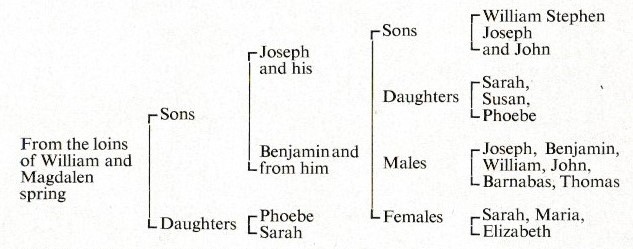
 

Doctrina Vitaque Greg(e)m (Qui Pasto)r Alebat. Christi Sereus Amans (Nun)c… Gloria Deo

The Latin should probably be translated:

“He who as a shepherd fed his flock with teaching and example, as a loving servant of Christ, has now once more sought his Master.”

In the Parish Register of 1613 occurs this notice: “Rev. William Browne clercke vicar of Horley having lived there the space of fifty years being of the age of four score years—four months departed this mortal life fourteenth of November and was buried the 16th of the same month.”

[Page 31]

CHAPTER 5

The Bristow Family

WILLIAM BROWN undoubtedly owed his position as vicar to the Bristows who, as lords of the manor of Horley, held the gift of the living though, at his induction in 1561, the head of the family was only a small boy often. They had always had the closest connection with the church, and, from the earliest list in the Accounts, when Wyllyam, Roberd and Jhon each paid their 2d., their names appear on almost every page. Benjamin, Richard, Walter, Henry, Robert, William, John and Thomas, either Burstow or Bristow, follow each other in all positions of responsibility in endless and bewildering succession.

Sir Edward Bysshe, Clarencieux King-at-Arms in the reign of Charles Il, and himself a descendant of the de Burstows, gives the key to their romantic ancestry, contained in one word on an old seal. It would seem that, in a deed giving the benefactors of the Abbey of Robertsbridge in the year 1190, there occurred the names of Stephen and Roger de Burstow, but on the seal attached they were expressly named as “Stephani” and “Rogerus filii Hamonis”. Now the FitzHamons were blood relations of the Conqueror and, like him, descended through the Dukes of Normandy from the Viking Rollo the Ganger, the scourge of English, Scottish and French coasts in the 9th century; but, unlike William, were not “Bastards”, the “Fitz” not bearing the stigma of later years.

Sir Robert FitzHamon, who died in 1107, bore the resounding titles of ‘Prince of Glamorgan, Earl of Corboile, Baron Therigny, Lord of Gloucester, Bristol, Tewkesbury, Cardiff, Conqueror of Wales, near kinsman to the King and general of his highness’ army in France”, and it was from his younger brother that Stephen FitzHamon, who had, it seems, acquired the manor of Burstow, was descended. As such the de Burstows were certainly the most important people in the two parishes. It was a curious freak of pronunciation which alternated the spelling of Burstow with Bristow for the family, while the village always retained the older form.

They were holding land in Horley by 1218, for sixty acres were released to Randolphe de Burstow in an agreement ratified at the Court of the Lord King at Bermondsey and dated “the 3rd year of Henry son of John”, The greatly coveted right to hold a weekly market and fair on “the even feast and morrow of St. Michael”, also granted by Henry Ill to John de Burstow on August 8th 1247, has already been described.

Only two years later come the echoes of a quarrel between this same John, now in the prime of life, and Peter of Savoy. It arose about [Page 32] hunting near Worth Forest, and became so acute that the suit reached the King’s court. Perhaps enough was told in “Early Days in Horley, Sidlow and Salfords” about this highly influential foreigner, uncle to the Queen, and his high handed depredations and cutting of trees, to show on which side the sympathies of the neighbourhood would lie. The first inquisition at Merton in 1249 states that ‘”the said John and his ancestors have always enjoyed the chace adjoining the forest of Worth up to the hedge of the said forest . . . nor were they ever impeded save by William de Wakehurst forester to Sir Peter de Sabaudia (or Savoy)”. A small point here is that William de Wakehurst probably lived at Rowley in Lowfield Heath, so that he was not far from the scene of dispute.

From Dover a writ was issued ordering that a jury “having no affinity with either side”, so that their findings would be strictly impartial, should enquire the date “when he was impeded in the enjoyment of that chace”. The final judgment must have given great pleasure to the de Burstows. In 1252 “‘The King accepts that John de Burstow and his predecessors always used the chace”, and further, ‘ ‘It is commanded to him Peter that he allows John to use the chace…. as they were accustomed to use it from ancient times and the time after the same”. “Accustomed use” gave a man a very strong position in medieval thought, and it is stressed again in the stipulation that he might not have any entrance into the chace other than he was “accustomed to have when the King committed the custody of those lands to him”.

At the end of the century John de Burstow was summoned to appear with horses and arms at a Military Council at Rochester, and the next year to perform military service in person against the Scots. Sir William, possibly a brother, must also have gone north, for he is described as “staying with the Earl of Warenne in the War of Scotland” Not only did they take their share of the fighting, but also a part in very early parliamentary government. John was returned as one of the two Knights of the Shire for Surrey in 1302 to one of the first regular parliaments of our constitution. Ten years later he was returned again, and he and John Hamme paid 4s. a day for attendance, plus journey charges—in all, the considerable sum of £19 4s. 0d.

By this time John de Rutherwyk had become Abbot of Chertsey, and was intent on making good his title to Abbey lands. William de Burstow certainly leased some of these, including land by the river “Emele” as has been written on page 13 and exchanges were made by which he received Mutteslond, Blackmores and Joyners “to be held of the Abbot”. The family also owned Hathersham and 120 acres in Smallfield, and the manor of Lodge (now Salfords). This seems always to have been let. It was held by Roger Salaman “by service of 36s. yearly and doing suit at John de Burstow’s Court every three weeks”, and later by John Bury. But by 1366 the de Burstows had sold the [Page 33] manor of Burstow, and only the Horley properties remained in their hands.

The first of the family, however, to become lord of the manor of Horley, with the gift of the living, was a certain Robert. It is very possible that he was born at Mutteslond (or Meath Green) in the house shown on the 1602 map, one of the places received in exchange from John de Rutherwyk and we read of him as churchwarden in 1525 and the following year. The family wealth was increased by trade. A Walter de Burstow had been a fishmonger as early as 1382, and Robert’s father and brother seem to have followed in the same profession, his father possibly being Warden of the Fishmonger’s Company.

Brother John the fishmonger finally settled at “his mansion house called Swaynes” in Leigh, and a tale about a later Henry, perhaps a grandson, makes superb reading. In an appeal in 1598 against Richard Lechford, lord of the manor of Shelwood, who, he declared, was “greedily thrusting after his lands”, Henry accuses him of having unlawfully assembled together a number of persons “armed and weaponed unlawfullie, some with long pikestaves, pitchforks and other unlawful weapons”, with which it seems they pulled down “one strong timber barn -and two oxhouses having in them 16 oxen”.

Worse was to come on July 19th when “Richard Lechford’s servants  . . . about one o’clock after midnight forcibly did enter a close . and put in about 40 great cattle and one hundred great beasts more and the rioters sometimes on foot and sometimes on horseback chased the said cattle up and down till they had spoiled the grass, and afterwards drove away the cattle”. No comment is needed except to add that Richard Lechford was a Justice of the Peace at the time! One supposes that the “one hundred great beasts more” must have been young stock.

Of Robert’s two other brothers, Richard was a tailor and George a draper, and it was probably the latter who furnished the following account to Queen Katherine Parr in 1546:

“red, 5 coats for 5 minstrels. . .scarlet for a petticoat some grey for a coat for. . .the Queen’s foole also red for 5 coats for Queen’s players and red for a petticoat for ye Queen’s foole”. The total was £12 5s. 0d.

His nephew Nicholas also rose to great responsibility at Court, becoming Clerk of the Wardrobe of Robes and Wardrobe of Beds, in which capacity he travelled to Oatlands for the purpose of furnishing the house there with beds and other necessities; was in charge of the repairs at Hampton Court, which cost £911 4s. 0d; and through him £2,000 was paid to labourers working on the banqueting house “at the coming of the Admiral of France”.

A story is told that, when he accompanied Henry at the surrender of Boulogne, the King was so overjoyed at his victory that he flung [Page 34] his hat of plum coloured silk, trimmed with a small green ostrich feather, into the air. It was deftly caught by Nicholas, who was told that he might present it again on their return to England, when his services would be rewarded. He was finally given the rectory of Kympton in Hertfordshire, but, whether this gift was the outcome of his dexterity, we cannot say.

But to bring this long digression back to church affairs, Nicholas Bristow, as Clerk of the Jewels, was one of those to whom the jewels, plate, church ornaments and vestments received on the dissolution of the religious houses were to be entrusted for the King.

The break up of the Monasteries, with all that this implied in the sudden change of ownership of church lands all over the country, had also brought upheaval to Horley, and when the last monks left Chertsey Abbey, an end had come to six hundred years of continuous and steady ownership. The manor was quickly appropriated by one of Henry’s courtiers, Sir Nicholas Carew, but his time was short. Losing the King’s favour, he also lost his own head, and the land reverted to the Crown. It was given to another land “speculator”, Sir Robert Southwell, who also held Charlwood. Finally, in 1543, Sir Robert sold to Robert Bristow, but it is sad to think that the first local lord of the manor only lived for two more years to enjoy his possession.

His will, which he had made less than three weeks before his death, was read by the vicar, Richard Lucas, on December 8th 1545, his son Robert, then aged eighteen, being present. His estate included the manors of Horley and Lodge, the advowson and rectory of Horley with the tithes and glebe, two houses, a watermill and 280 acres. Two years before he had also bought 500 acres of furze or heath, but these are not mentioned at the later date. He left “a third of his estate to the king, according to the statute”, a third to his son Robert, and another third to his wife Anne, with the express provision that she was to live at the rectory.

This mention of a rectory is intriguing. Probably Robert lived at Court Manor Farm and, as he was lay rector, this was then known as the rectory; while the vicarage where Richard Lucas must have lived, was the house taken two hundred years before from Michael de Waps, as has been written on page 13.

Robert’s son Robert married twice, but died as a young man of thirty-two, expressing a wish to be buried in the chancel of Horley church. But a further and greater tragedy was in store for Horley, as well as for the family, when his small son also died in 1563 aged only twelve. It was during his short minority that William Brown was chosen as vicar, and the next eleven years after his death were spent in a lengthy lawsuit between his stepmother Lucy (who later married Edward Whyston), and his four aunts, Joan, Margaret, Anne and Agnes. These ladies had all married local men, Robert Jordan, [Page 35] John Woodman, George Taylor and Thomas Twynor, and the curious thing is that, though Lucy had a son John by Robert Bristow, John’s share was only Horley Mill and the surrounding land, when the suit was settled in 1574, while the manor was divided between his four aunts. They seem to have cared little for its possession, and all finally sold their quarter share to Sir Mathew Carew, who already owned Kinnersley.

Though no longer lords of the manor, Bristows have lived on in Horley from that day to this. Through good days and bad the work of churchwardens, overseers of the poor and surveyors of the highways went on without a pause, and Bristows took a leading part. John was warden in the last year of the century when he “’gave up his Account which came to £9 0s. 0d.” They had houses in many parts of the parish —Edmonds, Benhams, Crichland (Crutchfield), Massat Land, Meath Green, Wolvers and Hookwood all belonged at different times to members of the family.

To come to more recent days, Canon Rhodes Bristow, one of the Canons of Southwark Cathedral, is still vividly remembered for his vigorous preaching and strong sense of humour. And closer at home, and even nearer in time, at Haroldslea Farm Mr C. Bristow is making his name famous in the fat stock world. Among his awards in the three years between 1956 and 1959 are Supreme Champion, Reserve Champion, Overall Champion and Breed Champion. Surely a noteworthy effort this, to bring Bristow history up to date after at least 769 years of continuous history in one corner of Surrey.

CHAPTER 6

Under the Ownership of Christ’s Hospital 17th century

MATHEW CAREW had bought Kinnersley in 1587, and, by the next year, all four portions of the manor of Horley had fallen into his hands. For these he held two “courts” in the old rectory. In the Court Rolls of 1591, we read: “View of Frank-pledge of the Lady Queen with the first Court Baron of Mathew Carew Esq”. Here the freeholders and tenants ‘”acknowledge Mathew Carew to be Lord” and “each pay one penny for return of Seisin and Service”. However, Carew’s ownership was shortlived, for by 1600 he had sold to a certain James Cromer, who quickly resold in 1602 to Christ’s Hospital.

The Churchwardens’ Accounts make no mention whatever of this transfer, which must have taken place while Henry Lechford and Anthony Morton were churchwardens. It is only noted that, this year, “there remayneth seven and fourpence more than they have layd out”. [Page 36]  The year before Nicholas Charrington and Richard Fenner had “made even with the church”.

If the Accounts are reticent, the Court Rolls give again a full account with the imposing heading “View of Frankpledge with the first Court of the Mayor Commonalty and Citizens of the City of London Governors of the Possessions and Revenues of the Hospitals of Edward King of England the Sixth of Christ’s, Bridewell and Saint Thomas the Apostle held there on the sixteenth day of May in the year of the Reign of our Lord, James . . . the first and of Scotland the thirty-sixth”.

There follows a very long list of landowners who have “defaulted”, by not attending the Court, and it is noticeable that Charles, Lord Howard, Earl of Nottingham and High Admiral of England has his fine, which in Mathew Carew’s time stood at 4d. raised to 6d., as do John Poyntz Esq., Henry Medler, Bartholomew Fromonds and Wm. Bond. It is also clear that a larger number than usual of tenants are “given a day” both to mend bridges and clappers, restore common boundaries and “rayles” and, as usual, to cleanse their ditches. In the matter of “spiced cakes”, Agnes Shoe and Bernard Humphrey are presented for breaking the assize. The new broom was attempting to sweep clean, but the court next year seems to show that success was not very great and, though the defaulters above had their fine raised further for this one year to 2s., Horley was still content with its broken down bridges and blocked ditches, and was still in trouble over the Common, and even “in mercy” for not “sufficiently repairing the stocks”.

To Horley, one of Christ’s Hospital’s most interesting possessions, is an old map probably drawn at about the time of purchase in 1602. This is now most beautifully restored and in safe keeping at the Surrey Record Office at Kingston-upon-Thames. Its value is enhanced by the fact that it shows not only farms and houses, but in many places gives the names of their owners at that time.

CHRIST’S HOSPITAL

The situation in London which lay behind the founding of Christ’s Hospital and the later purchase of Horley and other manors was truly appalling. The monasteries, to whom the poor and neglected had looked for succour and charity, and in which about one-fifth of the entire population is said to have been cloistered, had been dissolved. The streets of London were pitiful with the wrecks of humanity, those who were too young or too old to care for themselves, cripples, disabled soldiers, and beggars of every description.

Sir Robert Gresham, Mayor of the City, wrote in 1538 to Henry, his “most dradd beloved and naturall Soveraigne Lorde”, suggesting a remedy for the “ayde and comfort of the poor syke, blynde, aged and impotent persons beyng not able to help themselffes nor havyng no place certen where they may be refreshed or lodged at tyll theybe [Page 37] holpen and cured of their diseases and sickness”. He begged the King to give orders that the three Spytalls or Hospitals of St. Georges, St. Bartholomews and St. Thomas be given to the Mayor and Aldermen. This, after some delay, Henry agreed to, not only for the “greate paine and sorrow” of the poor and sick, but also because of ‘ ‘the greate infeccion, hurte and noyance of his Grace’s lovinge subjects, which of necessitie must dailie goe and passe by”. To these was added the church and site of the late Grey Friars, which, with other land adjoining, was to be used under the new name of Christ Church.

Henry died soon after signing the indenture, but the young Edward, having his heart touched by the pleading of Ridley, Bishop of London, and the prayers of his Court Preachers for those who “lye and creep, begging in the miry streets of London and Westminster”, took up the work “knowyng it to be the expresse commaundement of Almightie God to have compassion of his poore and nedie members” The Bishop, two Aldermen and six Commoners met the young King, details were drawn up, and the Charter bestowed only a very short time before his death. The proposals were that Christ’s Hospital was to become a home for “fatherless and other poore mens children” who could find there meat, drink, clothes, lodging and learning; that, considering the “corrupt nature of the children whoe being taken from the dounghill mighte one infecte another”, a sanatorium was to be opened at Finsbury, and infants kept in the country. For the lame and aged shelter should be provided at St. Thomas’ Hospital in Southwark, while the “ydell and lustie roges” should be consigned to a workhouse. Finally “Lazars” must be kept off the streets on a weekly pension.

So the streets were gradually cleared, the first tentative experiment towards the Welfare State came into being, and social work was being attempted apart from the Church. By 1552 Christ’s Hospital was opened to three hundred and eighty children, and, though it was admitted that the great problem of the first beadles was the running away of the inmates, and even that a number of them “being taken from the dunghill, when they came to the swete and cleane keping and to a pure dyett, dyed downe righte”, the great work went steadily forward. These early troubles over, education became the major preoccupation, the Foundling Hospital took its place as a Free Grammar School, and in 1566 the first “Blue” matriculated at Cambridge.

DAME MARY RAMSEY

Finance was naturally an abiding problem, the money received from the “poor boxes” in the various wards of the City being totally insufficient. To the credit of the first Governors “They fyrste thoughte good to begynne with themselves”, and each gave £10 or £20, according to their ability. Many other donations and legacies were received, and chief among these, towards the end of the century, the most munificent gifts came from Dame Mary Ramsey, widow of the Lord Mayor.
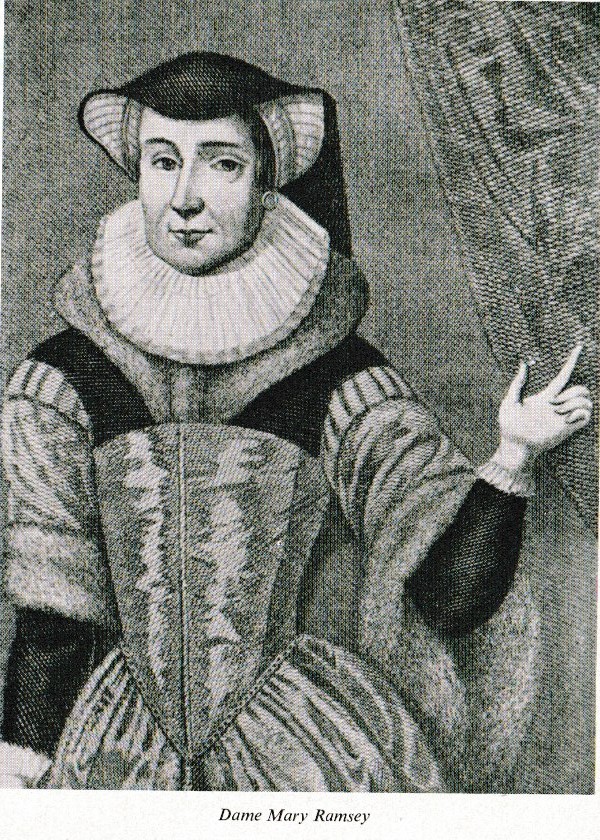
[Page 39]

Her good deeds are delightfully set forth in a tablet in the Christ’s Hospital church, and give not only a wonderful picture of the lady’s liberality but also of the bitter needs of the day.

“Behold the Workes of God done by his Servant Dame Mary Ramsey.

She hath given a yeerly maintenance for two Fellowes and four Schollers in Cambridge.

More, two Livinges of good value when they shall be come fit to supply them.

More, towards certaine Sermons to be preached in this Church yeerly.

More, in Christ’s Hospitall a free Writing-Schoole for poore men’s children.

More, in the Country a free Grammar Schoole for the poorer sort. The rest of the godly Workes done by this good Lady. She hath given a worthy maintenance to the poore of Christ’s Hospitall.

More, a bountiful gift for the healing of poore wounded Souldiers.

More, a liberall maintenance for ten poore maimed Souldiers.

More, a liberall maintenance for ten poore aged Widows.

More, a bountifull gift to release poore men out of prison.

More, a bountifull gift to relieve poore men in prison.

More, a yeerly Stipend to poore Maides Marriages.

More, to the reliefe of the Poore of foure severall Parishes. All of which severall gifts are for ever, (dated) 1596.

The “ten poore maimed Souldiers” each received a coat, cap and pair of shoes in addition to a pension of £2, but it is with the “bountifull gift to release poore men out of prison” that Horley comes into the picture. One gift of £500 was to be spent on buying lands in London, Middlesex and Surrey, the income from which was to be used “for the relief of such prisoners as should lie in execution or otherwise in the prisons of London or Southwark, who are detained in the said prisons for the sum of 40s. or under”, with discretion to pay more than 40s. ‘”for prisoners of good repute and behaviour”, but such toleration to be used as sparingly as might be, her object being to “encourage them that lie miserably imprisoned for trifling sums”.

With the capital the Governors purchased land at Horley, comprising the manor and advowson, and rather later Westlands Farm at Hookwood, Duxhurst and Collendean.

The prisons would have included Ludgate, Newgate, Marshalsea, White Cross, Southwark, King’s Bench and the Compters of Wood Street, but, alas, there is no means of knowing how many poor wretches were saved by money from Horley rents. By 1849 debt for less than £20 was no longer punishable by imprisonment, and after the Bankruptcy Act of 1861 no more claims were received and the [Page 40] money was finally transferred to the Hospital’s General Fund for education. However the pensions, £12 per annum to three maimed soldiers, and another £12 per annum to three widows, are still continued.

SMITH’S CHARITY

Dame Mary Ramsey’s benefactions were rivalled by those of Henry Smith, silversmith, and “Smith’s Charity” is still to be seen posted up year by year at Christmas time. The following account is taken from The Free Men of Charlwood.

“Many romantic legends surround this name. One calling him Dog Smith, tells how he went, disguised as a beggarman, from village to village accompanied by his faithful dog, for whom he never failed to beg a bone. Another legend tells how, having begged in every village in Surrey, he allocated his charity accordance with his reception. How in Newdigate a woman taking pity on the poor, cold beggar-man, stripped off her red petticoat to wrap around his shoulders, and so to Newdigate he left his money to distribute red petticoats among the poor women of the parish. To Rusper, where he was whipped out of the parish, he left horsewhips for the carters, and in Charlwood, where he was received more kindly, with a good meal of bread and meat, he bequeathed money to buy bread and meat for the poor.

“These legends have gone the way of much that is picturesque, for it is now known that Henry Smith was a silversmith of Silver Street, Cheapside. He was born, of humble parentage, in 1548 at Wandsworth, and amassed great wealth in his trade, which at that time, included that of banking and money lending, both of which were exceedingly profitable. He rose to be an Alderman of London, but his personal needs remained simple and, though married, he had no children. He invested his money in land, and in 1620 appointed trustees to devote the revenue to benevolent purposes, reserving only £500 a year for his own use. Many and various were the causes to which he devoted his munificence, The poor, the aged, the infirm, the apprentices and the workless all profited. He founded a scholarship at Cambridge, and left money ‘to redeeme poore captives and prisoners from the Turkish tyranie’.” Here indeed is the same cause to which Horley subscribed fifty-four years after his death. “He gave £1000 to each of the market towns of Surrey, and every parish in the county, except three, eventually benefited by his generosity. Varying sums were allocated to the villages.”

Horley’s share originally came from land in Worth which, in 1786, produced £5 12s. 6d. This was later sold, and the money now comes through the Charity Commissioners. About a hundred years ago Robert Blundell of Benhams was distributing the gift in church just before Christmas. It then took the form of warm clothing and material. [Page 41] Today Mr. Blundell’s granddaughter, Mrs Hughes, is Secretary to the four trustees who still administer the gift locally, and last Christmas £85 was divided between elderly people and widows with families to maintain. The scrutinizing of Smith’s Charity accounts and report is always the Parish Councils’ first duty at its Annual Meeting.

APPRENTICES

How did Horley care for its own poor in the 17th century? There is no mention either in the Accounts or in the Court Rolls of any workhouse in the village, though one seems to have existed, but, in accordance with the great act of Queen Elizabeth, Overseers of the Poor were regularly elected from 1604 onwards to carry on the work begun by the churchwardens, and every person had by law to contribute towards this end. Their duty was not only to maintain the poor, but to set them to work, and, in the case of children, to apprentice them nominally to a trade, but more often, one fears, as boy or girl of all work to some local master who had no choice but to receive the child.

There are seven apprenticeship orders in the Accounts, clearly written in great detail and often signed. In the case of Ann Williams, who was taken by John Chelsham, “he muste keepe the said Ann sufficient and untyll she come to xxjti (21) yeres of age”, and for this he received a mare and a colt from the girl’s father “in full sattysfaction”, and duly made his mark, being unable to write.

An Chamley’s father was dead when she was apprenticed to Jeremy Shooe, who received her with some household stuff to the value of 6s. 8d. He was also to be “eased in not paying to the poore for four years to come”. It is evident that the poor rate was a very real burden on all householders. This is on January 13th 1604, and is the first mention of overseers, of which there are three—Robert Woodman, Thomas Leacheford and Robert Burstow, though after this there are never more than two.

Susan Washforde was bound to Bernard Humphrey who had a place in the second seat in church, until she was twenty-four, “he to keepe her and finde her sufficient meate, drinke and apparell’ and for this he received a cow from the widowed mother. Her brother went to Ifield to be taught the trade of a tailor by Edward Woodman, and whose signature in the old book is exceptionally neat. Perhaps the boy was likely to be of more use than his sister, as Woodman only received 2s. from the overseers.

The only other definite trade mentioned is that of a shoemaker. This agreement bears not only the “marks” of the churchwardens but the signature of the famous vicar William Brown.

 OVERSEERS OF THE POOR

Of their manifold other day to day duties, setting to work the able, relieving the sick, maintaining the poor and aged, either in work houses and by out relief, in money and clothes, etc. etc., there is no mention, probably because they were all in the day’s work, but overseers’ accounts were always kept separately from those of the wardens. During the Commonwealth they note 1s. 4d., 13s. 3d. and £4 17s. 3d. in hand in three consecutive years, but much more interesting is the mention, in 1667, that Richard Allingham and John Holmes “disbursed this last year £37 15s. 2d.”. Three years later only £22 13s. 0d. was spent, but after this expenses mounted steadily, and by the last year of the century had reached £82 0s. 5d.

It was this rapidly rising poor rate which led to the disastrous Act of Settlement and Removal which empowered the Justices to order the removal to his place of birth of any person renting a dwelling of less than £10, unless he brought with him a certificate from his own parish that they would take him back should he or his family become chargeable on the rates of the parish where he wished to settle. So the ratepayers sought to cover themselves, but it was partly this policy, together with the rapid rise in population, which led to the wave of pauperism which engulfed the whole country in the following century.

SEATING IN CHURCH

In one great particular land owners had a distinct advantage over their poorer brethren from the fact that a seat in church belonged by right to the occupiers of certain farms or land, as was stressed in “Early Days in Horley, Sidlow and Salfords”. There are two lists in the Accounts. The first in 1604, while William Brown was vicar, is very clear and neatly written and well spaced. It has sixteen names, and of these six used their own pews.

Richard Killick dwelling upon Wyes

Richard Todd usinge Lodge Mill

Nicholas Tulley for landes called Stiveildes

William Brooker for landes called Neweman’sfeild

William Weathered for landes called Hostlers

William Nye for landes called Christmas

Margret and Joane, the wives of Nicholas Tulley and William Brooker sit together with Anyse Dawlinge in the last seat. Seven others had also seats to dispose of “to whom he shall assigne it”.

It must be remembered that, in pre-Reformation days, the churches were bare of pews. Sometimes in the larger buildings a stone seat round the wall supported the old and infirm, and gave rise to the saying ‘ ‘the weakest to the wall”, but pews became more of a necessity with the vogue of sermons, when gradually “the exaltation of the pulpit accompanied the neglect of the altar”. Seats were allocated by the wardens in return for pew rents, and in Horley there was definitely “the formoste Seate” for Richard Killick, Thomas Saunder, Richard Todd and Robert Jordan, and the “nexte Seates” for the others.

[Page 43]   Thirty years later a second list augments the first, the seats being for different holdings. The occasion was important, a new page was started well on in the book, and is firmly headed:

“The 5th of November 1634.

Memorandum the day and yere above written it was consented and agreed upon by the Minister and churchwardens parissoners of Horley that certaine seates within the North side of the Church of Horley should be disposed to these Inhabitantes of Horley as followeth videlicet.”

The minister was William Waller and there are about thirty-four names, including one woman, Widdow Rowlye. Many places still well known in Horley are mentioned, Benhams, Landons, Bures, Edgeworth and Cottinghams among them. The list ends conclusively “These setes were winescoted and planked and repared and paide for them above written”. There can have been no further argument as to the seating in the old north aisle of Horley Church !

One year before the great repairing and wainscoting of the seats took place a little entry throws light on church manners in Horley at that time. “John Ansteye is chosen by the consent of the minister and parishioners to see if ye younge men and boys behave themselves decently in ye church in time of Divine Service and sermon, and he to have for his panes 2d.”.

THE COMMONWEALTH

During the upheavals of the Commonwealth the south eastern countries were solidly behind Parliament and against both the King and the high church tenets of Archbishop Laud. Many among the congregations of the village churches were only too pleased to have an excuse to turn out their ministers as “malignant persons”. In Charlwood Thomas Mulcaster, the rector, was proceeded against— as it was written later—by “five or six of the very scum of the parish”, driven out and forced to earn a living as a schoolmaster at Merstham. Even there he was “Harassed and Perplexed by the Soldiers and on many a time in Danger of His Life”.

Much the same seems to have happened in Horley, (and it well be that the fine glass mentioned by Manning and Bray as existing in 1619, was destroyed at this time.) for we read that in 1647 Henry Prince was put in by the Parliamentary Commissioners but that in 1649 Mr. Aims (or Aymes) who was then vicar was summoned to the Court at Christ’s Hospital “to answere a complaint made against him for absenting himselfe from his cure for six weeks together, in all wch tyme he hath not preached to his parishioners there, but left them destitute”. The reply they received from the poor man shows his predicament. “It was” he said “in regard of some [Page 44] troubles that Mr. Jourdaine and 3 or 4 more of ye Parish which hee saith are Annabaptists had brought upon him by accusing him to ye Parliament for being a Malignant. Whereupon he was summoned upp to London to see what they would charge him withall and feed Counsell to pleade for him, and afterwards they used means to imprisson him and so deprived him of his libertie, and is at this present as he alleadgeth by their means sequestered from his living, soe that he could not performe his dutie and office as otherwise hee would had done.” Money must also have been very short, since for the past year he had “but £4 for his labour and paines bestowed among them, where off hee saith hee hath paid about £3 10s. 0d. to ye Parliament”, and it seems that he intended to “make his peace if hee may” or else resign.

In the Parliamentary Surveys of Church Lands, which took place between 1649 and 1658, it is stated that “Horley P’ishe hath a parsonage and a Vicarage under Christ’s Hospital the Vicarage and Glebe worth £50”, but, what is a little ominous for Mr. Aymes, it continues that it is “Unprovided with a preaching Minister by reason of late Sequestration”. However a curious little entry in the Churchwardens’ Accounts in that same year 1649, in very neat new handwriting, gives grounds for hope that he returned. The churchwardens are chosen only “by consent of the parish”, but this is followed by the entry “John Aymes for Overseers for ye poore, Henry Bonnicke, Robert Mansell” and the next year the churchwardens are chosen, and the accounts accepted, by “the minister and parishioners”.

The Parish Registers of these years make interesting reading. Though baptisms continue uninterrupted, and the writing is most neat and orderly, there is a complete gap of about six years in both marriages and burials from 1646, after the final defeat of Charles, to 1652, three years after his execution. In 1653 the custody of the registers was taken out of the hands of the ministers, and the following year it was ordained that the marriage ceremony should no longer be solemnized in church, but entrusted to a secular justice. Horley certainly complied. In a note in the register dated April 22nd 1654 is written “the parish register for marriages as well as burials was by Thomas Moore Esq., one of the Justices of Peace for County of Surrey the day and year above….”, and his signature occurs for two years. There are a lot of burials in 1654, and even more marriages “by John Coocke” minister of Burstow in 1658. Either it was that more were entered in the register, or that Horley was making up for lost time; and that two years before the Restoration.

Whatever the position of the minister, the churchwardens, overseers and surveyors from exactly the same families Woodman, Round, Bristow, Charrington and many others continue to be “chosen”, and served their year without a break. Though the “king’s” highway was a thing of the past, and John Sanders of Colingdean [Page 45]  and Robert Palmer are elected only as “surveighers of ye highwayes” otherwise the work connected with the church, the poor and the roads continued uninterrupted, and in this last connection modern surveyors may look with some envy at the price of stone and carting in the following bill of round about 1700.

    Paid Richard Cuddington for fetching of 20 load of stone          £2 16s. 0d  

    Paid him for 6 loade of ston                                                                     6s. 0d

    Paid Nicholas Whitmore for spreding of stone                                     2s. 0d

    Paid William Perken for 2 load of ston                                                   2s. 0d 

     My own team fetched 4 load of ston                                                   12s. 0d

    Paid Nicholas Whitmore for spreding of ston                                             9d     

ARTHUR FENNER

The year 1646, in which the gap occurs in the Parish Registers, is also remembered in America! The link between the Old World and the New being in this case the Fenner family, long connected with Horley Church. In 1601, for instance, as churchwarden with Nicholas Charrington, Richard Fenner “made his accompt uppon the 27th day of December and made even with the church”. They were large landowners, and that same year Thomas the Elder of Horne died, leaving Tanners and Little Harrowsley to his youngest son and Lakeland to his eldest son Arthur.

Here is the interest. Arthur Fenner, who married Sarah Brown in 1613, the year her father the Rev. William Brown died, had, five sons. Of these, three, Thomas, Arthur and John, all left England in 1646 for the New World, and have descendants living, one of whom made the return pilgrimage to Horley this year.

As a young man Arthur had been an Ensign in “a troop of Horse under Lord Cromwell”. In Rhode Island he certainly made his mark. He bought his first six acres of upland in 1650 and, after a roving life and many changes, found himself, when trouble arose with the Indians, commissioned as “Chief Commander of the King’s Garrison in Providence”, and later as Governor’s Assistant and then Deputy. One wonders if the following little notice throws any light on his successes. “Everybody agreed that Capt. Arthur Fenner brewed the best beer in Providence Plantations. It commanded the high price of three shillings a keg. When the good Captain died his formula was publicly released. Among the ingredients such as malt, molasses, sweet balm and sage, the Fenner beer contained 1b. of finely ground iron.”!

Fenners lived on at Little Harrowsley until 1774, and longer in the neighbourhood, for in 1822 another entry in the Churchwardens’ Accounts shows – a William Fenner in charge of Smith’s Charity, and also giving out the bread each Christmas, at the cost of about £15 a year. [Page 46]

ENGLISH CAPTIVES our OF TURKEY

While no reference is made to the Restoration, the first and indeed the only, notice in the old accounts of Horley giving money to an outside object is found in 1671, when’ Charles Il had been back on the throne for about eleven years. The heading is as follows: “The names of such persons in our parish of Horley who did contribute toward the Redemption of our English Captives out of Turkey with the perticular summe what each individuale parissioner gave”.

This was no local collection, but the response to a national appeal for the relief of our own people whose misery stirred the hearts of church people throughout the country. A forerunner of the wider sympathy for the refugees of many lands and the immense effort being made on their behalf in the present year.

The list was headed by Mr. Mansom with 5s., and this was equalled by John Shoue (evidently a rich man for he gwve a bell to the church), and Thomas Perkins the vicar, but no sum was too small to be noted. John Weller and Francis Woodman gave 2d. each, and through gifts of 4d., 6d., 1s. and 2s. 6d., the fifty-one donors reached the grand total of £2 15s. 11d. The money was taken to St. Saviours, now the Cathedral at Southwark, and presented with many other such offerings at the Biship’s Visitation. The receipt “Rec. of Mr. Perkins Vicar of Horley £2 15s. 11d. Towards the Redemption of Slaves is stuck in the 2nd volume of the registers. Horley must have felt that, for such a small community, it had not responded unworthily to such an appeal, and it is sad to think that piracy in the Mediterranean went on as a very real danger up to the time of Nelson, some 140 years later.

This chapter may well end with a bill found among Sir John Charrington’s papers, which, if it shows a considerable amount spent on eating and drinking, yet does not stint on the sermon. Who “my Father” was is unknown, but probably a Horley man. 

“The burial of my Father who died this twenty-fourth day of June, buried 27th, 1677.

 For three bushels of wheat                                                    12s. 0d

for shrub (a cordial made from fruit juice and spirit)       10s. 7d

for butter for a barrel of beers                                                 5s. 0d

for a coffin                                                                                 10s. 0d

for the Clerk                                                                                  2s. 0d

for a sermon                                                                                10s. 0d

                                                                                                   £3  3s. 7d

CHAPTER 7

Sidelights on the 18th and 19th centuries

AFTER THE violent changes of the Reformation and no less violent interlude of the Commonwealth, the Church of England as a whole settled down in the first three-quarters of the 18th century to a peace that bordered on stagnation. It was even perhaps a little difficult to find the way to Horley Church. Manning, writing as late as 1809, says “The church stands half a mile from Turnpike, Reigate to Crawley, but no road passes it and whoever goes to it must return by the way he went.  The road passes Gatwick. You cross the Mole here, a stream of no great size, by a wooden bridge, and by a circuitous lane find your way to the church, having gone a good way beyond it”

Inside, the family pews, already a hundred years or so old, still gave a place for a quiet nap during the tediously long sermons. “The old seats disguised by the addition of a top gallant bulwark to keep out the draughts and curiosity and facilitate a quiet snooze.”, as they were described by Major Heales in 1877 in his article in the Surrey Archaeological Collection.

Nevertheless the whole structure of life was about to change. In the Midlands and the north the industrial revolution was getting under way, and by the end of the century every coach from the south must have brought news of the upheavals of the French Revolution. There were many reasons to cause the Church to turn in her sleep, and far sighted men to preach reform and, among others, endless praise must be given to the vision and work of two brothers, John and Charles Wesley, and their friends in the great Methodist movement. This they definitely started within the Anglican Church, of which the Wesleys remained priests for the whole of their lives, and in which Charles’ wonderful hymns of faith are still sung by countless congregations up and down the country.

Some old Horley bills from the beginning of the century show that minor repairs to the church were being carried out. In the first “beer at the ringing, mending the bell wheels and wine and bread for the sacrament” came to 17s. 8d. Bell ropes cost £l 5s. 4d., and further work on the bells and bell brasses £3 16s. 7d.

Probably John Thorpe was a first rate carpenter, but his spelling is somewhat imaginative. This is dated March 19th 1721.

“Then received of James Rosel the som of 15 shillings in foll for mending the gotaes (gates??). At Horley Church. I say received by mee John Thorpe.”

And the next year [Page 48]

The plommers bill for work don at horley Church the 20 of September 1722.

          for new casting of 10. 3. 12 poundes of ould lead    £2. 14s. 4d.

          for 9-3-3 poundes of new lead at 18shillings pr lb.   £8. 16s. 0d.

          for 48 poundes of sothar                                             £1. 16s.  0d.

          for 5 days work for 3 of us                                              £2. 0s. 0d.

          for half a days work for 2 of us                                              2s. 9d.

                                                                                                    £15   9s.  1d.


In a glazier’s bill for ‘ ‘worck done at horiey church” in 1723, 78 quares cost 6s. 6d., and a further “I foots and 8 inches new leaded and 9 foots repaired”  1s. 6d.

These repairs were all carried out while Samuel Billingsley was vicar, and the church was again “repaired and beautified” in 1790 during the incumbancy of Peter Whalley. One year later, he was followed by William Sparrow, perhaps a delicate man, who seems after thirteen years to have found the damp of Horley insupportable. Here, at any rate, is a licence from his Bishop giving him leave to be absent.

“We Brownlow, Bishop of Winchester, hereby licence you William Sparrow, Clerk Vicar of Horley in the County of Surrey within our Diocese and Jurisdiction, to be absent from your said Benefice for two years from the date hereof, on account of the actual Infirmity of Body of yourself and your wife, it being medically certified that you labour under a Pulmonic Complaint and further on account of your serving as a Stipendiary Curate at Walthamstow in the County of Essex. Given under our hand this first day of January in the year of our Lord 1804.”

It was lucky for Horley that he left a most energetic curate whose name appears in a wonderful “Plan or Map of the Church-yard of the Parish of Horley… showing Burying ground of every Several Family Seating in Church etc. etc. Taken in the year 1806 by the Reverend Samuel Steele and Martin Bray Jun.—Ambrose Mansell, Richard Flint, Churchwardens”.

So runs the inscription, and the plan has many points of interest. It shows that the box pews, in which the congregation sat, were each still definitely allotted to a particular dwelling house, as in the 1604 and 1634 lists, the difference being that in the early lists it seems that only one seat for the occupier was specified, while in 1806 he had the whole pew and so apparently would have had room for the family. In fact, across several of the pews in the nave is written “Womens seats”. For these pews the occupants would have paid pew rent and very possibly kept the key. Petridge Wood, Horse Hills, Horley Mill, Newnhams and Wyatts are shown both in the early lists and the 1806 plan, otherwise the names have changed.

[Page 49]


Not only the nave and north aisle are full of these seats but they also stretch up into the chancel where the Vicarage, Lodge, Court Lodge and Kenersley all have pews. Here, too, on the north side, steps led up to the pulpit, below which was the reading pew, and next that another for that most essential person, the parish clerk. In the old chapel of St. Nicholas, which had been modernised and went by the name of the Bastwick Chapel, (perhaps a corruption of the word “Gatwick”?) and which opened into the chancel from the south under a flat timber beam, were more pews. These belonged to Horley Land and Lady Land, with a large pew for Gatwick and two more for “Gatwick Servants”. This is the only house except the Vicarage whose servants had special seats. “Doctor Borer on the Common” sat in the north aisle.

The first pew in the nave belonged to “Blundells, Horley Mill”, and behind this are eight others filling the whole space to the west door. Above this was one of the Minstrels’ Galleries where the singers and musicians sat. By great good fortune four bound books of metrical psalms and anthems, sung at this time in Horley Church, have been preserved, handed down for over a century from father to son. The paper has a watermark of about 1825, and the music, copied from many sources, is beautifully written by hand. Each book contains a separate part—treble, alto, tenor and bass—and Mr. Blundell Edwards who has them in safe keeping writes: “The reason for a [Page 50] single line in a big book is that it could be propped up, or held up, in front of the instrumentalist and over his shoulders the singers could read their part”. This picture of the old choir is made the more delightful by the knowledge that two brothers King, from Dean Farm, Salfords, always came in their smock frocks. These early musicians, who thus led the singers with either flute, clarinet, violin, cello, or bassoon, would all have owned their own instruments, but sometime later the first organ was installed and this was most curiously placed in another gallery over the north door as may be seen in the picture on the previous page.

To return to the plan of 1806. Here, most curiously, the Salaman monument is briefly described as “Hermit”. Why a figure in full armour should be taken for a hermit is something of a mystery. Only one free seat is shown in the nave, but other benches which ran along the chancel walls on each side of the altar and a timber seat almost in front of it, are also “common seats”.

A most meticulous plan of the surrounding churchyard shows to which family each group of graves belonged; who had head rails and who the more permanent tombs. Halliday, Constable, Woodman and many other well known names are shown with their exact place of burial. Not only did Samuel Steele have a major part in making this careful plan, he was also responsible for buying the old chest in the vestry for £4, and he was still in charge when the great decision was taken to scrap all the old bells and hang an entirely new peal.

THE NEW BELLS

A most detailed description is given in a later volume of the Churchwardens’ Accounts of the buying of these new bells in 1812, when James Brazier and John Newnham were churchwardens, and of the considerable amount spent by parishioners.

The first entry is of a notice given out in church, on November 17th 1811, that “the peal of bells being very much out of repair . . . one cracked . . . That the churchwardens desire the inhabitants of this parish to meet them at John Millers the Six Bells on Friday next at 4 0’clock to consult concerning the repair of the Bells”. At this meeting, on November 22nd, attended by Mr. Mears, the bill for liquor amount to 17s. 6d., but the important meeting at the Six Bells took place nearly a month later. Here three estimates from Thomas Mears, who also on examination had found “the timber work going into decay”, were “distinctly” read by the vestry clerk, William Ede. The first, of £498. 13s. 8d., with an allowance of £300 for the old bells, leaving £198 13s. 8d. to be found by the parish, was accepted. This was “To cast a peal of 6 good and musical church bells in tone and tune” and to include six new clappers at £7 7s. 0d., six stocks and six wheels        £62 0s. 0d., and six new setts of ironwork etc. etc.

The names of those who signed the book, and to whom all honour [Page 51]

is due for having chosen the best bells, and so the most expensive estimate, are S. Steele, minister, John Newnham, James Brazier, churchwardens, James Halliday (his mark), Nich. Sanders, Ambrose Brooker, James Packham, Edward Tullett, Rich. Blundell, John Miller, Martin Bray, James Peters, Edward Banks and Thomas Humphrie, inhabitants. (The population of Horley in 1811 was 942 persons.)

The question of transport came up the following March, and it was decided “that Edward Tullett of Horley should take up the old bells to the foundry and bring back the new bells . . . he to have Eleven Pounds for the journey”. It must however be remembered that the main road to Redhill was not yet made, and when the great day arrived and the six bells were loaded on to Edward Tullett’s waggon, it was found necessary to harness three more horses, belonging to Mr. James Packham, to drag the waggon to the ‘”Turnpike Road leading from Horley Common to Reigate”. However, it seems that the whole journey, taking the old bells to Whitechapel, and bringing back the new, only took five days from Saturday, 20th June, to Wednesday 24th, and on July 1st they were triumphantly rung.

The Rev. Samuel Steele, curate, and James Bray had been up to check the weights, which will be of interest to bellringers, the new bells being 2 cwt lighter.

                      6 Old Bells                                                 6 New bells

            Treble 5 cwt 3 qtr 14 lbs                                 5 cwt 2 qtr 0 lbs

                 2     6 cwt 0 qtr  15 lbs                                 5 cwt 3 qtr 5 lbs    

                 3     7 cwt 3 qtr   5 lbs                                  6 cwt 3 qtr 5lbs

                4     7 cwt 1 qtr   8 lbs                                  7 cwt 3 qtr 11 lbs

                5     9 cwt 1 qtr  7 lbs                                   9 cwt 2 qtr 7 lbs

           Tenor 13 cwt 3 qtr 25 lbs                                12 cwt 3 qtr 8lbs

             Total  50 cwt 1 qtr 18 lbs                                 48 cwt 1 qtr 8 lbs

Apart from the cost of the bells themselves and transport, there was a certain amount of incidental expense. Mr. Newnham of Ardingly had £l Is. 0d. “for his trouble in examining the bells with regard to their being in tune”. New bell ropes cost £3 14s. 0d., and the great dinner for twenty-nine inhabitants, £3 19s. 9d. which included the ringers’ fee to open the new peal. Again in 1813 : “To John Miller for new and sound Holes and Timber to strengthen the Tower £23 14s. 3d.” On the new 3 bell an inscription was made that “Henry and John Shoue gave the original in 1673”.

The two additional small bells of 3 cwt each, “making the peal complete of the Eight”, were hung in 1839, and a long list of subscribers entered in the Accounts.

[Page 52]

THE BELLRINGERS

No list of the bellringers on that great occasion in 1813 has been found, but that they have been worthily followed is shown in the Attendance Books of the Horley Church Bell Ringers Society. These go back to 1891 when ringers seem to have spent, not made, money. Not only did they each pay 1s. to join and a monthly contribution of 3d., and fine themselves regularly a further 3d. for non-attendance at services or practices, but they each subscribed 6d. a month towards their excursion. The last book ends suddenly on May 19th 1940 with the names of A. Bull, C. Razzell, W. Slaughter, W. Taylor, R. Beale, F. Sadler, G. Illman, F. Lucas and G. Woodman. War had made bellringing a call to danger from invasion, and not to the worship of God.

Not only had bells been rung Sunday by Sunday, but many “changes” rung by Horley men and their friends are shown in the books of the Surrey Association of Change Ringers, and on boards and cards still in church. The earliest to be found is in 1892, a Grandsire Triple rung by A. Songhurst, J. Kenward, G. Staplehurst, F. Dewey, W. Edwards, S. Kenward, F. Wickens and G. Rothwell. Since then many peals are noted from 1900 onwards, and among them, perhaps the most interesting because unique in this part of the world, Worcester Treble Bob Major (5,120 changes rung on February 20th 1921 in 3 hours 6 minutes), London Surprise Major (5,024 changes) in 1932, the first peal in this method, and, the same year, Londonthorpe Surprise Major (5,152 changes in 2 hours 58 minutes). Oliver Sippett and Alfred Bull were the leading bellringers.

In 1927 death watch beetle was discovered in the steeple. Though repairs were carried out to the uprights while the bells were being recast, the same trouble is found today. No one is waiting more anxiously than the bellringers for the joyful day when it will be safe to ring again.

SOME BILLS AND A LETTER

A few items from the accounts of the early nineteenth century throw a little light on prices at that time and the letter that follows seems to show that the effort to “improve” Horley is not an altogether modern phenomenon.

                          1812  Edward Tullett straw for thatching of clerk’s Cottage. £2. 12s. 6d

                          1814   New brooms.                                                                                Is. 6d

                          1814   Clearing Church yard.                                                                 3s. 0d 

                           1816   By cash for a letter.                                                                          6d 

                          1826      Mrs Jordan 2 day’s cleaning church.                                     2s. 0d

                          1826  Horse cart and man ½ day.                                                         2s. 6d

                          1826   Dec. Paid Dod. 3 doz. Sparrows.                                               1s. 0d

                          1826        “    “       “     Cleaning churchwalk.                                         4s. 0d

[Page 53]         1826   March Thomas Harding 4 doz. Sparrows                                  Is. 4d.

                          1826   Sparrow Bill.                                                                                  1s. 8d.

At this time the annual salaries of the Parish Clerk and Sexton were £2 2s. 0d. each and that of the “Singing Choir” £1  1s. 0d.

The letter is as follows:

“To the Churchwardens and Overseers of the Parish of Horley Surrey. Gentlemen it is time thare was a stop Put to the goeing on att George Monk’s all day long of a Sunday and severall Night in a week the house is full of Men drinking of Sider while thare wifes and Children is starven at home and it is a harbour for lazy girls which brings trouble to the Parish and the ruing and destructsion of many a family which Monks dont do it for want now he as got money houses and land and a house furnished as well as any farmer in the Parish and is as well of it is you Churchwardens and Overseers duty to put a Stop to it and you should have done it Long agoe ifyou had done your duty. April 25, 1835.”


CHAPTER 8

The Last Hundred Years 1860—1960

IF THE first breath of new life was blowing in the 18th century, it had become a great wind by the mid 19th, stirring the Church further from her lethargy. From the Oxford of Keble, Pusey and Newman, as from many other quarters, a new vision of urgent needs and responsibilities, both to missions abroad and to church people at home, was spreading over the country.

In Horley it was realised that new churches and chapels were essential for the growing and scattered communities, and it is curious that it should be almost exactly a hundred years later, while this book is being written, that this need has again become so urgent and demanding. If, then, this last chapter is largely concerned with bricks and mortar, with building, enlarging and restoring, it is because this is both the effect and proof of the church’s vitality. Readers must fill in for themselves the picture of the work that goes on—Within the new walls, the day to day and week to week services of worship, and, most significantly of all, the greatly increased attendance at the central service of Holy Communion; and outside the ceaseless work that continues among the ever increasing population.

To write adequately of these things in a small book is impossible, but in the pages that follow no one can fail to notice the large number of parishioners, who all through the century and right up to the present day, share in this vision of a growing and expanding church, and who had, and still have, generosity to carry it into effect. Their names are far too many to mention individually, but it seems right [Page 54] that the greater benefactors, to whom present and future generations owe so great a debt, should not be entirely forgotten.

SIDLOW

The north of the parish which borders on Reigate takes its name from the Saxon woman who owned the mill, Sidilufu. Here the River Mole takes a sudden sweep to the west, the small manor of Kinnersley lying further upstream on its right bank and Bures Manor lower down on its left. Originally in the manor of Banstead, it has always been quite distinct from Horley proper, and still remains a quiet country hamlet, though now cut by the London to Brighton road.

Being over three miles from Horley Church, it was obvious, especially in the days before cars, that another church to serve the needs of the rural population of about 900 was badly needed. It was therefore at Sidlow that the first church building in the parish for about 450 years took place. Mr. Sherrard of Kinnersley Manor gave the land, and the older part of the rectory, believed to be Tudor though since added to, and also a generous subscription to the church itself. Among other subscriptions £500 was received from Mr. Clutton of Hartswood, who was the architect.

The first services were held in 1861, and plans are now in progress, under the rector the Rev. A. H. Shergold, for a great centenary celebration of its dedication. In 1865 the district was formally constituted a parish, and the living a rectory, with the “glebe”, which paid £75 towards the stipend of the rector, as far away as Anerley in Kent.

RESTORATION OF THE CHURCH

A restoration of the Parish church itself, on a very large scale, was carried out by parishioners in 1880, while Mr. Peckover was vicar. The architect was Mr. Blomfield. The whole work cost £3,161 and this included lowering the level of the floor, making good the nave roof, moving the organ from its position in the gallery over the north door to the Bastwick Chapel, re-hanging the bells, and £83 for the purchase of a cottage. The most generous contributors were the Governors of Christ’s Hospital, who gave £500, and Canon Bridges of Langshott who not only gave £600 but, in addition, furnishings for the altar, while the reredos (now removed) was given by Mr. E. W. Shooe in memory of his ancestors who had long lived in Horley.

That the galleries and the old box pews attached to various houses and farms were done away with for ever, and the seating almost doubled with the present pews, was all to the good, but the most unfortunate, indeed tragic, part of this restoration was that the fourteenth century windows in the north aisle were removed and entirely renewed in Bath stone, though it would seem that some of the old ruby glass was replaced. However greatly this vandalism, may be deplored yet, it must be admitted that the restoration as a whole [Page 55] brought a new sense of space and order. The boast was indeed largely justified that “the ancient church is now unsurpassed by any in the Rural Deanery, and the present parishioners must be largely satisfied in handing it down to their successors in so fit and proper a condition to the Glory of God and to the honour of His Name.”

SALFORDS

Not only was the Parish church being so largely restored, but at exactly the same time money was raised for a Chapel of Ease near the old Tollgate at Salfords to meet the needs of that side of the parish. The cost of building was £500, the land being given by Mr. Russell Miller, and the parsonage built by the Maple family of Petridgewood, and, be it noted, these had also given generously to their Parish church. Another benefactor is one whose name is still well known in the district  – Mr. Joseph Hall. The little church was dedicated in 1881 by Bishop Thorold, famous as creator of the new diocese of Southwark and builder of the new nave to its Cathedral. It was served for many years by curates from Horley and it was in one of the first Privy Councils of her reign that Queen Elizabeth ll provided for the new Parish of Salfords and Lower Earlswood.

In spite of a later enlargement, this small church has for many years been quite inadequate for the growing population. Again the demand for a better church is being met. A sense of continuity was provided when, in September 1958, Mrs Kate Peters, a witness of the dedication in 1881 and a former vergeress, laid the doorstep of the old church as the foundation of the new. This stone marks the beginning of a tremendous venture by the Rev. Peter Lewis, the parish priest, for Salfords has decided that as far as possible their church shall be built by the voluntary labour and skill of their own people, something surely almost unique in the Surrey of 1960, and wholly admirable.

SOUTH AISLE

In 1889, only nine years after the great restoration, a young man, with a brilliant record as Scholar of Sidney Sussex College, Cambridge, came to Horley from Hurstpierpoint, where he had been Chaplain and Mathematics Master, and became curate to Mr. Peckover. The next year Mr. Peckover resigned and Henry Thomas Lewis was instituted vicar on April 2nd. Many in Horley still remember how greatly he was loved during his long ministry of forty-four years.

When he arrived, Horley was hardly more than a large village. Albert Road was finished but houses were still being built in Lumley Road, and Massetts Road was a green lane. The main road, too, was still cut by the level crossing, near the present subway, with the old railway station on its right.

The church itself consisted only of the nave and north aisle, but [Page 56] congregations were growing, and ten years after his arrival Mr. Lewis was presiding at a meeting in the new church room in Albert Road to discuss additional accommodation. The discussions bore fruit, and by December 12th 1900 the new south aisle being finished and the organ moved to its present position, the dedication service took place. This was followed the next day by a Confirmation Service for 110 candidates. The cost of £3,014, to which the Constable family gave the most generous subscription of £750, almost equalled that of the restoration twenty years before, so that in two decades over £6,000 was spent by parishioners on their church. This was very far from being the end.

BOMBING OF THE CHURCH

Mr. Laker had been vicar for three years when, on Thursday March 20th 1941, at 8.58 p.m. two land mines were dropped by parachute. One fell in the field to the west of the church. The other scored a direct hit on the houses exactly opposite the Lych Gate, which were totally destroyed. Miraculously only one man was killed, but great damage was done to the roof of the church, especially on the south side, from which all tiles were stripped, and to the windows, where almost all the glass was shattered. Many turned up the next morning to help with the clearing up, and these give a woeful account of the scene, and of the mess and piles of rubble which completely buried the Sanctuary carpet. Nevertheless, the great wonder was that the spire, organ and clock escaped destruction, and, even more surprising, the electric light continued to function.

That was Thursday. On the following Sunday services were “as usual”. Ninety-three attended Holy Communion at 8 0’clock, the church was completely full at 11.00, and another 400 were there for Evensong at 3 0’clock. And this in spite of the “bitter cold” of a church, the roof covered only with a tarpaulin, windows empty of glass, and with a March wind blowing.

The work of restoration was delayed by the war, but first aid repairs were carried out by Mr. E. F. Anderson. At his suggestion, tiles from the bombed houses opposite, being right both in size and colour, were used to re-roof the Church, thus saving parishioners at least £100. The final work was carried out by Messrs Hoad & Taylor, and by Mr. Mitchell.

During this time the 14th century arches, found to be displaced by the bombing, were also partially taken down, and they and the corbels above were replaced in exactly their old position. Practically all the glass had to be renewed. The east window which had been in memory of Rev. H. Hughes who died in 1871 has an entirely new design on the old theme. The west windows, also entirely new, was given by Mrs Milbanke of New York in memory of her ancestors, the Constables of Mill House.
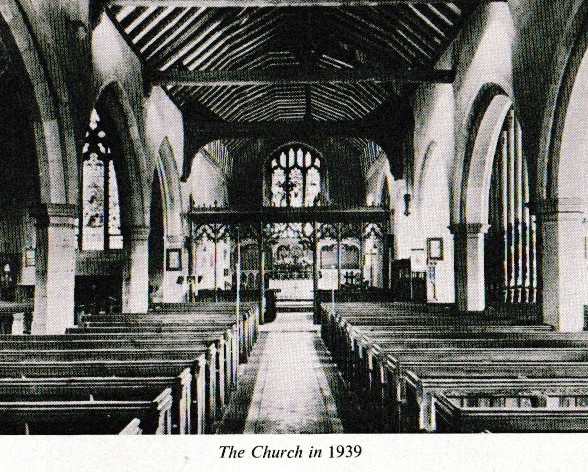
A marvellous bit of restoration was carried [Page 57] out on the east window of the north aisle, of which about half remained. It is now almost impossible to distinguish between old and new. The ruby glass in the small windows was mercifully intact. Even this year, 1960, the work is not complete, and more trouble has been found in the inside of the roof, which is being attended to, to the sound of much hammering.

The parish owes a great debt to the Rev. John Torrens, who was instituted vicar in 1950, and to his churchwardens Mr. Bennett, Mr. Cramp and Mr. Rowe for the care with which all the troublesome problems have been met, and the repairs carried through. Among other changes the old reredos, not a thing of beauty, has been removed, and the screen, also modern, taken down and placed at the west end. There is now an uninterrupted view of the altar, and this is, as most think, a great improvement.

THE BAPTIST CHURCH

Baptists have worshipped in Horley for over 200 years. They may well look back with pride to their founders, the men who met in the first little meeting house in Newgate Street in London in 1612, and from whom, as one biographer puts it, “there flashed out first in England the absolute doctrine of Religious Liberty”. Pride too in those who, together with many others, suffered grievous persecution under the Stuarts for a faith they would not renounce, “holding forth this faith even in the midst of all trials and afflictions, not accounting [Page 58] our goods, lands, wives, children, fathers, mothers, brethren, sisters, yea our own lives dear unto us, so that we may finish our course with joy; remembering always that we ought to obey God rather than men”. This faith had led them to dissent from many usages of the Anglican Church, one of their chief tenets being that baptism should only be administered to the proved believer, and not to the untried babe.

The first meeting house in Horley was built in 1760. This was replaced early in the 19th century by a chapel, whose little graveyard is still to be seen in Lee Street. It was in this chapel that its builder, Edward Miller, was minister for twenty-seven years.

In 1879 the building of the present church was begun. Both the church itself, which is said to have cost £l,100, and the land on which it stood were the gift to Horley of Mr., afterwards Sir, Samuel Barrow. Here his great faith in the future was certainly shown in good measure, for, at the time of building, there were only eleven members of the Baptist community, including his own family. It was fully justified. Eighty years later, under its present minister, the Rev. J. T. Willmin, the church is filled with congregations of round about a hundred twice every Sunday. Plans are already in hand for a new schoolroom, the present one being far too small for the youth activities and the growing sisterhood—a sisterhood whose wonderful loyalty to their church is a shining witness to their faith.

The Baptists also have a chapel at Norwood Hill which, in 1959, was entirely rebuilt in brick to replace the older wooden building.

THE PLYMOUTH BRETHREN

The Plymouth Brethren are also moving forward with new work, especially among the young, centred on their little Chapel in Lee Street. This was built in 1930 and it is hoped soon to replace it with a larger building.

THE METHODIST CHURCH

John Wesley has been referred to in an earlier chapter on the 18th century. One of England’s greatest preachers, with his message of the Saving Power of Christ, and the necessity of individual turning to God, he seemed to speak directly to the soul of each hearer. The response was enormous. Much of his life was spent in the saddle, and it has been reckoned that he must have ridden some 5,000 miles a year preaching to his countrymen from Cornwall to the Moray Firth.

He visited Surrey in 1771 and preached at Reigate. According to his Journal, about twenty to thirty attended in the morning and a hundred in the evening, but it was not a good meeting, and his comment was “Dull indeed as stones, but cannot God ‘out of these stones raise up children unto Abraham?”

At the beginning of the hundred years under review a Primitive [Page 59] Methodist Chapel stood on the site now occupied by Woolworth, but in 1910 a Wesleyan Methodist church schoolroom was built in Victoria Road at the cost of £800.  Again, vision was needed, and was forthcoming, to buy the whole strip down to the road, and it is on this land that the new church, opened on June 11th 1960, was built. It is a fine spacious building, with the interior brickwork used to carry out the architectural design, but the first thing that will catch the eye is the great cross hung before a deep blue curtain. A cross, not portraying the humiliation of the Crucifixion, but made radiant by faith in the power of the Resurrection.

The cost of the church was £20,OOO, a large proportion of which was borne by the members themselves. Their enthusiasm is surely indicative of their continuing faith in the future, and the great sense of fellowship that prevails among them under the leadership of the minister, Rev. Bertram Woods.

In Wesley’s own words, “There is no such thing as a solitary Christian”, and to attend the Methodist church and mix with its people is to know just how true that statement is.

THE ROMAN CATHOLIC CHURCH OF THE ENGLISH MARTYRS

For very little short of a thousand years the Catholic Church alone passed on the Christian faith in England, from generation to generation, and without its ceaseless witness there could have been no knowledge from which the reformers could begin. Many however refused to accept this reformed faith and suffered persecution and in some cases martyrdom for their belief.

In 1537 the Benedictine Abbey of Chertsey ceased to exist. Almost exactly 400 years later, the right to public worship having been restored to them in 1778, the Benedictines came back to Worth. At Horley in 1929 the stable at “The Chestnuts” in Ladbroke Road was converted into a chapel. Then in 1935 a small asbestos church was put up on the same site, the first in Horley since the Reformation, and was dedicated to these martyrs for their faith. This church is however quite inadequate, both architecturally and in size, for the congregation of about 500 now living in Horley.

A new site was acquired in 1952 and, most curiously, this is “Clerklands”, the bit of land shown on the 1602 map as belonging to “the clerk of ye Church sometime p’cell of ye common”, and about which more was written on page 26. In this way again the Roman Church is linked with the past and, local historians will hope that this link may be noted and remembered though the name is to be changed to “Marylands”. The reason for this is clear, the first dedication of the Parish Church being to the “Immaculate Virgin Mary” and the Church which will be started this year will be of great interest. The aim is that no pillars shall interrupt the view of the altar from any position in the church. It will therefore be octagonal, with eighteen [Page 60] windows, designed on a new principle, thick slab glass in concrete— not lead—a process also being used by the monks at Buckfast Abbey. Another innovation unusual in this country, the little belfry will be entirely separate from the main building. The cost will be high, about £30,000 but of this £10,000 is already in hand, and about £3,500 is coming in steadily each year—all, or nearly all, from a basic 1s. a week from the faithful, under the enthusiastic leadership of Father Woolmer.

CHURCH FELLOWSHIPS

No history of the church would be complete without mention of a movement, perhaps springing from the friendships made in the stress of two World Wars, that is bringing its influence into the homes and everyday lives of the people. It is not confined to any one outlook or age. Fellowships for children, youth, young wives, mothers, even for grannies and grandfathers are springing up, all making for friendship among themselves and loyalty towards the church, where they worship—a movement of the greatest value to the future.

And to the future one looks at the end of this history, and so especially to the new churches of St. Wilfrid and St. Francis.

ST WILFRID’S

It was in an old “row” in the parish, which still bears the name of Horley Row and which originally faced on to the vast common, that the first Horley school was built in 1834. We are lucky in having a photograph of the first schoolmaster, Mr. Wingood.

Here, in 1937, the Education Authority having vacated the old and dilapidated building, evening mission services were started by the Church of England Men’s Society, “C.E.M.S.”, under that wonderful old man of Horley, Mr. George Edwards, whose wheelwright’s shop was so near at hand. These were to have far-reaching consequences, and continued, with one break during the war, until June 1959. Then came the challenge and the opportunity. It was taken, and in three months of “hard” but enthusiastic voluntary labour a place of worship was created, very lovely with its soft grey and pink walls, its curiously shaped arches, and creamy gold curtain behind the altar. This at the cost of only £175. It was ready for the first services by September 21st of the same year, and continues to serve some 5,000 of Horley’s inhabitants, mostly living in new estates. Needless to add that plans are already on foot for a larger building in the not too distant future. A pleasant footnote is that the first baby to be baptised was Michael, son of the Rev. Norman Alexander, curate-in-charge.

ST FRANCIS

St. Wilfrid’s has taken over and wonderfully adapted an old building, but St. Francis is a completely new church. A new church with a [Page 61] new look, designed by a Horley architect Mr. Tapner, and, as daughters are always doing, transforming the old traditions into new shapes.

The land near the Balcombe Road, worth £3,000, was given by Mr. F. D. Edwards. This was large enough for the church, the parsonage and—a modern essential—a large car park. Speed is also a modern attribute, and the following dates are very suggestive. The first sod was cut in September 1957. The house, built first, was ready by May 1958, but a month before this, in April, the foundation stone of the church was laid and in October of the very same year, in under six months, it was dedicated by the Bishop of Kingston. The cost of building was approximately £13,000, raised by voluntary subscriptions and loans. All the furniture has been by gift, one donor giving everything needed for the worship of the Sanctuary, including surplices for some twenty boys and three men. Music, indeed, plays a very important part in the services and this choir is singing a new setting for the Communion Service, with the air sung by the men and congregation, and the boys weaving a descant—again a new interpretation of an old tradition by the curate, the Rev. John Presswell.

Large congregations and intense vitality are the hall marks of this new church. The fine hall, which, in the tradition of the mediaeval nave, can be used either for services or for secular purposes, is in constant demand, and a new addition is already being planned.

EPILOGUE

To go back through the centuries. There can be little doubt that the first Saxon missionaries planted a wooden cross where they held their first service, and later built their first church. A procession from the Parish church, carrying a large wooden cross and setting it up by the Balcombe Road, near the old Saxon track, preceded the cutting of the first sod of the new church.

The circle of the past is complete. The parish churches have, in spite of their many vicissitudes, setbacks and failures, passed the faith of Christ, the Way, the Truth and the Life, through the generations to bear new fruit in many branches.

This book is dedicated to the Church of the Future.

[Page 62]

Incumbents

NOTE. This list of vicars has been made on Manning and Bray’s foundation and other names added as found.


1218                            WALTER. “parson” a witness.

1234                            WILLIAM DE DAGGLYNWORTH. Willelmi Dagelynworth

                                     vicarii ecclesie de Chabelam Chertsey Cart. 1230.

1283 Jan. 31st              WALTER DE STOTEFORD admitted to Rectory of Honey. Register of John de Pontissara. Sy. Rec. Soc. note,  William                                 de Stoteford   vicar of Banstead 1326.

1324 Oct. 24th             JOHN DE CROMPLEHORN vicar Charlton Adams Somerset 1323. Weevers Somerset Incumbents

1328 May 10th            THOMAS DE ROSELYNGTHORP.

1331 May 8th               WALTER DE WAVYNDON see pages 12, 13.

Registers lost 1345—1366

1377 March 10th         JOHN ALEYN OR Alwyn exchanged with vicar of Epsom.

1377                            GEORGE or ROGER DE APERDELE exchanged with John Alwyn vicar of Leatherhead.

1384                            HENRY DE MERSTON vicar mentioned in deed re Gatwick.

WILLIAM WEST resigned 1399 in exchange for Epsom.

1409 Feb. 20th             JOHN SALMAN. was vicar in 1427.

Registers lost 1415—1446

 JOHN THURTHULLE resigned 1447

1447/8 5th Feb.          NICHOLAS SHORTEHEESELL resigned 1450

1450 11th April           JOHN MORTON resigned 1457.

1457 2nd April            GODFREY BROMLEY resigned 1461.

1461 17th Nov.            HENRY OKERE, died 1474.

1474 14th July            JOHN PLUMPTON.

Registers lost 1492—1500

1505                            WILLIAM BURBANK A.M. Vicar Stanwell Mx. 1521-2. Hennessey’s Novum Repartorium. See also Churchwardens accounts and pages 18, 19.

No date                       WILLIAM BISHOP of Darien (?S. America) Resigned in 1522 on pension £8 per annum.

1522 16th April           RICHARD LUCAS, died 1561. see pages 26, 34.

1561 26th June           WILLIAM BROWN. See Memorial tablet, Horley church and pages 27—30, 42. No degree or other benefice died 1613.

1613 1st Dec.              GEORGE NEEDHAM

1616                            ANTHONY HUGGETT.

Registers lost 1616—1626 and 1643—1664

1626                            WILLIAM WALLER see page 43.

1647 Nov. 26th             HENRY PRINCE, put in by Parl. Comm. S.A,C. XXVII.

1649                            JOSHUA AYMES,

Note in Parish Registers. “Mr. Thomas Moore one of the ‘Jesteses of the pece’ married a couple in 1654 and continued to officiate till Jan. 1655/6. In 1657 entry of a marriage by John Bonnicke minister of Leye and then by John Coocke Minister of Burstowe. see pages 43, 44”.

1657                            ROBERT HACKINGES

1666                            SAMUEL WELLS.

[Page 63]

1669 May 25th           THOMAS PERKINS B.A. Resigned 1672. see page 46 1672

 May 3rd                      THOMAS NORTON M.A.

1690 Oct. 10th            BENJAMIN LONG also had living of Walton.

1701 July 29th             SAMUEL BILLINGSLEY. Prebend of Chichester. Archdeacon of Surrey, also living of Newdigate. See page 48.

1725 July 16th             THOMAS TRIGG, died 1767.

1768 Feb. 19th            PETER WHALLEY. Upper Grammar Master Christ’s Hosp. 1760-1776. also living of St. Margaret Pattens, London.

1791 July 22nd            WILLIAM SPARROW. See page 48. Curate Samuel Steele.

1817 19th Feb.            FREDERICK WILLIAM FRANKLIN.

1828 8th Aug.             EDWARD RICE D.D. Upper Master Christ’s Hospital. Trinity College Cambridge. Established two school rooms, one for boys, one for girls, and house for master and mistress. Built the long drive in the Vicarage garden and made up the road thence to the Thorns, because Vicarage Lane was impassable in winter.

1853                            WILLIAM HUGHES, died 1871. Old East Window was in his memory.

1871                            EDMUND GEORGE PECKOVER see page 54.

1890 2nd April            HENRY THOMAS LEWIS M.A. Cantab. Scholar Sidney Sussex College, Cambridge. Assistant Mathematics Master Hurstpierpoint College. See page 55.

1934 19th July             WILLIAM CHARLES REEDER M.A.

1938 28th Nov.            JOHN CHARLES LAKER see page 56.

1947 24th sept.           JOHN RODBOROUGH PAGET A.K.C.

1950 15th Feb.            JOHN HERBERT TORRENS M.A. st, Edmunds Hall, oxford and Christ’s Hospital. See page 57.


Reference has been made to the following:

HISTORIES OF SURREY. Victoria County and Manning and Bray.

SURREY ARCHAEOLOGICAL COLLECTIONS.

CHERTSEY CARTULARIES. Trans. Surrey Record Society.

CHERTSEY ABBEY. Wheeler. “RELIGIOUS ORDERS IN ENGLAND” Knowles.

“CANTERBURY CATHEDRAL PRIORY” Smith.

“ST. DUNSTAN OF CANTERBURY” and “WANDERING SAINTS” Eleanor Duckett.

“HISTORY OF CHRIST’S HOSPITAL” Trollope.

‘ ‘ANNALS OF CHRIST’S HOSPITAL” Pearce.

“PARISH CHEST” Tate,

“CHIPS FROM THE OLD CHURCH CHEST” Lewis.

“HORLEY ITS CHURCH AND RECORDS” Alfred Jonas.

“FREE MEN OF CHARLWOOD” Sewill and Lane.

“EARLY DAYS IN HORLEY, SIDLOW AND SAL-FORDS” Lane.

MANUSCRIPTS: Horley Churchwardens Accounts. British Museum. Add. Charter 61 73; Court Rolls of the Manor of Horley; “History of the Bristows” Jenkins; Notes by the late Mr. C. D. Hawley F.R.I.B.A.; Loseley MSS. No. 767; Also Original map of Horley, c. 1602 from Christ’s Hospital on loan to Surrey Record.

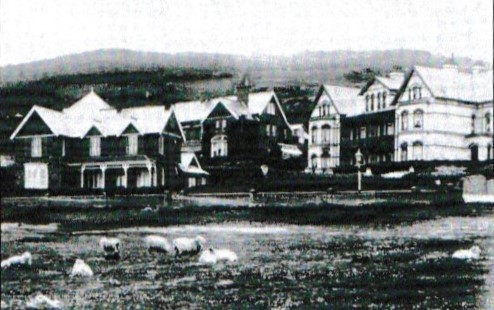


High Trees School -Recollections by Rosemary Mumford.

These recollections of life at High Trees School formed the basis for an address given by Miss Mumford to pupils at High Trees during the 1970’s.

This text is taken from her type written notes and was uploaded to the HLHS website in July 2024 by Doug Cox.


The Emergent Years

being a personal account by Miss Rosemary C. Mumford. CMC

Headmistress of St. Ives School, Haslemere.

Her father was Capt. Walter Clarkson Mumford (MC & Bar)  –  Irish Guards

The three young Mumfords arrived at the first High Trees just before the 1930′ s.

The eldest of the three was a very serious young boy of 4 years of age: he was profoundly serious because he had brought along with him twins, a boy and a girl of 2½  years of age — a great responsibility you will agree, and one which he recognised as a weighty matter right from the start; for on the day of the Mumford’s arrival the twins were quickly dispatched to the nursery but Master Deryk, aged four, insisted upon standing on the front door step — tense but brave, waving our farewells for the three of us and demanding stoutly to know where ‘his’ twins had been put. In those days small boys did not demand information — no matter how great the urgency might seem to the child concerned. Children were told those things, and only those things, that it was considered necessary for them to know.  However, this small boy was apparently greatly comforted to find the twins, surveying the new scene from high—chair level; the boy banging his tray vigorously with a spoon, obviously indicative of the fact that he had high hopes of nourishment arriving shortly; the little girl smiling demurely at anyone who ventured near her.

But I should perhaps start my saga from the beginning for you may well be wondering why It should be that High Trees School, with its vigorous founders, Miss Tucker and Miss Young, should have catered for such very young children. It was necessary, mainly, because of the appalling losses and injuries inflicted upon the young men serving in the trenches during the First World War; practically a whole generation was lost on the battlefields of Europe and many young men were so seriously wounded that they were never to live a normal active life again.

My father, a Captain in one of the famous regiments, had been awarded the M.C. and Bar and was acting Colonel of the regiment at the age of 23 years. As each senior officer fell, the next in order of rank, assumed command: sone regiments had to promote mere boys, young Lieutenants to positions of Command, the losses were so stupendous.

Well now, in those days pensions were pitifully small, and the Welfare State did not exist, so when the wounded returned from the front they were naturally transported to hospitals, and remember, no free medical attention at that time.  However, my father was particularly fortunate as Lady Astor, at Claremont in Esher, befriended the wounded officers who were in my father’s regiment and she opened Claremont, her very lovely and spacious house in its beautiful setting, and used it for the seriously wounded, keeping one wing for herself and her family; but she did not remain isolated in her own private wing but donned a Red Cross uniform and put all her friends, whom she invited down for weekends, into uniforms and having secured qualified medical staff she directed this Sanitorium of hers.

Mother however, realised that she must now become the supporter of the family, if the boys were to go to Wellington and Sandhurst as their father wished them to do, for their father was certainly not ever again going to be able to provide for his family. So very reluctantly our family home had to be given up — there were to be no more rides in a smart,  well-turned-out gig, our light two-wheeled one horsed carriage; no more calling for Polly Dora, the resident maid, who was nicknamed Polly Dora by Master D because she was called Polly and answered the ‘door’ . To end were the days when brother D, aged 3 years, was to insist upon taking a jug of milk down to the herds in the field because he associated milk with cows and was troubled because no-one appeared to be providing them with this very necessary liquid.  To end also were the antics of brother D and the female twin, who was found one day up on a high ledge of the dresser clinging to one of the shelves above her upon which sat a tempting bowl overflowing with a delicious variety of fresh fruits. Brother D, at that time aged 3 years, was standing down at floor—level, saying to his small sister “Just a little further darling” and darling was inching her way ever nearer to the forbidden fruit — and remember ‘darling’ must have been all of two years of age.

So perhaps all things considered it was not so surprising that it was considered the best thing for the children to go to High Trees, where kindly trained people would look after the children; for Miss Tucker had formerly been Matron in charge of a Children’s Hospital and Miss Young had a History degree from Liverpool University and they had gathered to them an army of young nurses, all of whom looked right for the part they had to play, for they wore voluminous white starched caps and uniform nurses overalls, black stockings and shoes and they had the capacity to work from morning, noon and night if requested to do so, for which they may have been paid about 5/- (25p)  a week and of course their keep: all this for the privilege of having a training which included contact with real nursery school children.

The decision having been made and Mother having been appointed to an executive position at one of the large London stores, and Mother having also hand-knitted, with the help of her friends, six sets of every garment for each child, we, the children, were duly dispatched to High Trees.

Being so young, at the time of our arrival, it is hardly surprising that only a smattering of memories remain of those very early years, but some memories are still quite clear. Soon after our arrival, I remember being taken out in an outsize pram, which seated eight children, four facing the nurses who did the pushing, and four children facing the opposite direction; but we didn’t just clamber aboard this magnificent vehicle: oh dear me no, we had to be suitably clothed. I can distinctly remember sitting on a table while leather – buttoned leggings were put on, each button fastened with a button-hook, a task which took at least ten minutes for some wretched young nurse to accomplish. Then we were seated four in a row, back to back, and a rug was wrapped round our amply gaitered knees, gloves on hands, scarves round necks, coats of course, and presumably some sort of suitable covering for our heads — then off we went for what was always described as a walk; those who were old enough to actually be permitted to walk trotted along on either side looking rather wistful, for the pleasure of being taken on such an outing never varied in any degree — if you were a walker you walked, if not you sat and from such an elevated position surveyed the surrounding countryside in grand style. The only advantage to the nurses must have been the fact that there were eight pairs of walking shoes less to be cleaned at the end of their full and very arduous day. Another memory which I have of these early days is of contented days spent in the nursery riding upon a rocking horse, a horse who had a bridle, a mane and tail made of real horse hair, a red saddle, stirrup too, I believe; and my feet, I remember, didn’t reach down to the wooden bar upon which you alighted to perch yourself astride the beast. I used to be slightly alarmed as the creature always seemed to go a great distance forward before he reverted to his upright position.

I also remember we used to play for hours with a very lovely doll ‘s house which Gordon Selfridge himself sent down for Miss Murray t s (my Mother’s business name) little girl.      At this time my Mother used to fly over to Paris by Imperial Airways to do business for Selfridges, and it might be of interest to you to know that she flew in the days when she sat on a wicker basket chair, of course in a biplane.       The doll’s house brings back fond memories of early High Trees days, for remember we were still very young. But young as we were, we had a very ordered programme to our day and good habits of tidiness and obedience were constantly being fostered.

 The next memory is rather a traumatic one and not very vivid. I have heard so much in detail about the fire at the first High Trees that it is difficult for ne to know how much is actually a remembered experience and how much is fact which was related to me after the event. At all events I do remember being carried down a ladder by a very kindly fireman who said, “Don’t be frightened, you’ll be all right”. I am told that it was actually brother D who was being sick in the night that first alerted Miss Tucker to the disaster. Mr. Norsworthy has cuttings of the papers issued at the time; the only information that made a lasting impression upon me was the fact that Miss Young was honoured as one of the bravest women of the year, in recognition of her valiant attempts to save the children.

We, the majority who were saved, were taken to a single storied house called t Brownslade’,  although I seem to have a distinct memory of the house having green painted woodwork.      At Brownslade we were put two in a bed and I remember being very distressed because when the fireman put me down on the road so that he could race back to the house for the next child, I stood on a surface which had been newly tarred and I thought I would get into serious trouble for putting tar on the blanket — little did I realise that everyone was far too busy to worry about a matter as trivial as that .

The following day I can remember being driven up to London in a coach with a brown blanket wrapped round me and I was only wearing my underclothes, — (not one garment of the hand—knitted woollens was left). We as a family were particularly fortunate as the whole of Selfridges stopped still while we were clothed from head to foot with the compliments of Gordon Selfridge, who came down to Mother ‘s department with his grey top—hat on and tails, and shook hands with us. I don’t think I really understood very much apart from the delightful fact of being presented with an almost life—sized teddy bear which I insisted upon taking with me everywhere. Mother, through her connections with Selfridges, was able to get Miss Tucker and Miss Young the basic pieces of furniture which they needed — for remember they were left without a thing. Selfridges also sent them down some very smart woollen skirts and jackets, two—piece sets, which Miss Tucker and Miss Young wore for many, many years.

Many of us who had been the original family group at the first High Trees moved to Duxhurst to join Miss Tucker and Miss Young again once they had re-established themselves. We went back to Miss Young, who had been acclaimed one of the bravest women in the country, and to Miss Tucker, who had already proved herself to be an extremely vigorous administrator on behalf of the well-being of children. Miss Tucker worked constantly to see that the children’s health was good; she had almost a fetish in her opposition to germs and saw to it that we were surrounded by cleanliness and high principles of hygiene; good wholesome, sensible food was provided and lots of fresh air and mighty ‘carbolic’ scrubbings in the bath, soap in eyes, with no nonsense. I particularly remember the garden at Duxhurst which was very lovely and to us it seemed very large indeed. There was a large lawn and massive Rhododendron bushes in clumps so large that you could chase your friends and not find them for half an hour or so. There were huge Wellingtonias, around which we developed all manner of make—believe games; there was a vast pond and beautifully kept hedges. Every summer seems to have been idyllically fine — or that is my impression. We had lessons in the garden at green folding desks and chairs and we seemed to spend a good deal of time moving from one patch of shade to the next.  We always wore beige felt hats to protect our eyes from the sun and to prevent us getting sun-stroke. During playtime we wore vest and overalls and a felt hat; boys wore overalls over their normal clothes — I suppose they were not supposed to feel the extreme heat.

In the winter on Sundays, the girls wore very thick white jerseys with large collars, with very tight necks, which were almost impossible to pull over your head, white kilts and white socks — considering the fact that we lived up in the branches of trees or filled our days in the playroom with paint pots and paints or boisterous games,  I can’t imagine how this uniform can have been in the least bit serviceable; I can only imagine that we were less boisterous on a Sunday.

The next highlight in our lives was the move to the present High Trees which took place in the year 1930.

Every child who had a bicycle or tricycle or scooter or pram to push got under way and the whole school took to the road. There were very few cars in those days and just as well, as I remember we were three or four abreast and certainly too excited to heed any appeals for caution.

When we arrived at High Trees we left our two or three—wheelers and we all sat down  on the lawn where the swimming pool is now sited. In the flower bed in front of us, for we were all facing the main lawn, were very lovely standard rose trees and after a while we amused ourselves by rolling, lying sideways, down the bank.

Here, at last, we had arrived: it really felt like home especially to those of us who also spent their holidays at High Trees. We were most pleased with the lane, for we could ride our fairy cycles from the top of the back lane, outside the Junior House which at that time did not exist, down to the bottom of the lane, turning right at the bottom of the lane along as far as the haystack and then trudge back never deigning to put a foot to the ground. The haystack was a familiar landmark for us, for before breakfast we had to run down to the haystack and back, a good half mile each way. How we enjoyed our playtime. We had splendid camps in the jungle and in the spinney. We spent a great deal of tine up the cherry tree which was in the lower field. In the old swing field, we had three swings, a knotted rope and a plain rope and a long slender tree trunk supported at each end and in the middle, as it lay in a horizontal position about five foot above the ground; on this we used to do some very exotic acrobatics. And of course there were always the animals. We had a white pony called Lightning and a donkey and trap in which we used to load up a churn of milk and tin of ginger nut biscuits and set off during the blackberrying season. The donkey had to be urged out of its stable and enticed all the way to Norwood Hill and beyond with a carrot, but on its homeward journey it took at least four of us to keep it under any sort of control and when it entered the stable-yard outside the gymnasium, it never slackened pace but bolted straight through the gates, into the yard and back into the stable. We of course were hysterical with glee, and a little fearful.

Another pastime was goat carting.   We were not over fond of the goats because we had to drink goats’ milk which always spoilt tea, cocoa, cereal or porridge; for everything seemed tainted with the smell of goats, once goats’ milk had been added to it.  But riding. in the goat carts — now that was different.      The carts were painted yellow with a black canework woven in and out to form a pattern and the goats wore leather harness and pulled us sedately round the ground, the goats looking thoroughly alarmed and even the passengers a little uncertain of the wisdom of the proceedings. We had rabbits and guinea pigs and there were chickens and ducks too and they were very attractive when the young ones were hatched by a mother who had sat for many days patiently upon her 6 or 8 eggs. In your present swing field we had a wide range of vegetables, for all were grown on the premises, and fruit, redcurrants, blackcurrants, gooseberries, etc. But I mostly remember the delicate coloured Sweet-peas — all a riot of colour end growing in great profusion with the most glorious scent, always attracting a great variety of butterflies.

Goodness no, I almost forgot the dogs; we had Jumbo, the old fashioned long – haired sheep dog and Tinker, the Sealyan. Jumbo could be useful; for he was very good at eating all unwanted scraps and as everything on your plate had to be eaten, fat, gristle, the lot, he could be a very welcome visitor at lunch time.    Tinker, however, seemed to us to be very spoilt and rather snappy. Every year, December 14th I believe it was, Jumbo had his birthday party; we had biscuits baked into the shape of bones and Jumbo arrived, sporting massive blue ribbon, barking in rather an alarming and over—excited way, but with his coat shining after his annual bath. He certainly knew that he was the centre of attraction.

I have concentrated upon the animals, as they too seemed to play a part in our lives. The children thrived in what can best be described as an ‘ordered freedom’. I think that perhaps at the sea at Selsey, where we spent our summer holiday tine, it could even be more truthfully described as ordered chaos; and how we enjoyed ourselves bathing, playing shinty on the beach — but never having a bath.

But at the present High Trees, the new High Trees to us, we learnt how to be resilient; how to be brave, for we never informed an adult about minor cuts, bruises or sprains, and only as a last resort would the Spartan youngster of yesteryear seek for sympathy or approbation.  We relied upon one another for comfort and understanding.     We did not even expect adults to react to what at that time would be considered childish moods of homesickness. No child with any self-respect would indulge in any form of self-pity — this would not have been tolerated by the children, let alone by the adults of those days.    A highly developed sense of fair play was being created, the children themselves setting themselves a high code of honour.    It was not done to report a child’s mis-conduct to an adult ” I’ll tell of you” would have been a shocking breach of the code of etiquette which was understood instinctively by each and every child. As children, we were actually pleased for those to whom material things came freely.   I am thinking particularly of pocket money, sweets, extras of any kind,  sent from home.

If a child went out frequently at weekends and came back laden with goodies, we were not envious or jealous of this particular child if he or she had lavish boxes of toffees, chocolates, etc. and that was what one came to expect that child to have; but those of us who were the original core of the foundation of children at High Trees never received lavish goodies of any sort ;        it never occurred to us to hanker after these things.       We had our 2d pocket money on Saturday and if your account only ran to Id a week, a penny a week it was — no hard feelings — this was life — one did not expect life to be ‘fair’; life, we were learning rapidly, was full of variations but because you had only Id or 2d to spend at the tuck shop, this in no way embittered your attitude towards life, this was the way life treated you.

Another example of accepting graciously what came to one, occurs to me.       We were given, after tea each day, one sweet each out of huge tin; as each child filed out of the dining room, the hand of the sweet distributor dipped into the tin and brought out one sweet per child.   One evening it might be an enormous pear-drop, almost too large to place in the mouth; the next evening it might be a jelly—baby. It was the luck of the draw. Three nights in succession it night be a very small jelly fruit that was just your luck; but if the child in front of you had a large lump of butterscotch, you were delighted for him or for her and pleased with his good t windfall’ (“Gosh, lucky you: How super. — or whatever the current word was at the time, would be uttered as we skipped merrily down the corridor). We learnt too at High Trees to be very tolerant but exacting too — pushers never got away with much, the spiteful were soon cold shouldered, the bullies found themselves matched by spirited retaliatory measures. Few got away with meanness, without it being made abundantly clear to them that beastliness didn’t pay; we seemed to teach each other these things in much the same way that you perhaps do today. Those in authority interfered surprisingly little and gave us freedom to develop a sense of great loyalty to ones another and to the school.

We had an inbuilt sense of loyalty to High Trees — not one forced upon us but an eagerness of our own to show anyone from outside how proud and splendid place we knew our school to be. When we went for daily walks we wore polished shoes, blazers much cherished and free from any speck of dust — we fairly pranced along the road; delighted by every violet or milkmaid growing in the hedgerow — chattering merrily to our partner, for we walked in tidy ‘croc’  two by two and smiled eagerly upon anyone whom we encountered; but once  home again, we were into our overalls in a flash, out of our walking shoes and into wellington boots — up trees, swinging from the top-most branches or hurtling at the rate of knots on trike or bike down the lane. Make no mistake about it, we were real children — but children with a sense of occasion, children who knew that it was good to be alive, and very lively we were too!

There were also two main highlights in our life, one of these being our annual visit to the Mansion House party in London as guests of Sir Malcolm Campbell, the breaker of the land speed-record in his famous car, Bluebird. Jean (Gina) Campbell, Sir Malcolm’s daughter, was a day girl at High Trees, — the only day—girl at that time I believe. Jean and I were close friends, being of the same age, and I used to sit in the front seat with Jean when her father drove us in one of his fleet of pale blue cars from their home at Povey Cross to the Mansion House. Along the London to Brighton road we urged our host to drive “faster” “faster” and I remember the tremendous thrill of excitement as we watched the needle of the speedometer rise slowly 50, 60, 70, 80, 90 mph. shrieks of glee from the appreciative young passengers, an amused smile on the face of the expert at the wheel. On one occasion, I remember we left Povey Cross rather Iater than scheduled because Donald, who was home from his Prep. school and was to travel with us, had been delayed. So, Sir Malcolm set off none too pleased, at really tremendous speed; as we approached the ‘Angel’ at the foot of Reigate Hill, the tall very upright RAC patrol man who was always on duty at that particular junction of the road slowed us to a halt. There were no traffic lights in those days. Sir Malcolm sat reasonably patiently and then snapped on his radio, the first radio, we were told, to be installed in any car. Sir Malcolm was anxious for a time check but all that we could hear was a commentary being given of racing at Goodwood; minutes ticked by and Sir Malcolm put his head out of the car and spoke to the patrol man who stood almost at the side of the car. ”Officer” he said,  “I wonder if you would let us through, I’m in rather a hurry to get these children up to London to a rather special party”, and the man stooped down and said to Sir Malcolm, “Of course Sir, I’m so sorry Sir, I was just listening to the results of the racing,” With that Sir Malcolm burst into guffaws of laughter and we fairly sped on our way. The only thing that I can remember very clearly about the Mansion House party, was the vastness of the room in which the party was held and the moment when I, 000 balloons were released from the ceiling and we all scrambled to get one, balloons bursting all about us and so causing intense excitement.

Jean was at High Trees at the time when her father broke the land-speed record in Seattle, I believe it was.   The next day newsmen from all over the country swarmed up the drive taking photos of Jean with her friends, Jean without her friends, Jean on the back of the pony, Jean sitting on her bicycle — what excitement: All the main newspapers gave us massive coverage with large pictures of Record-breaker’s daughter at her school in Surrey; World Record – breaker’s daughter sitting on the school donkey with her little friends. We had hit the headlines and the name of High Trees School blazed round the world; at least round Britain and America for news value was very scarce in those days and reporters were bent on filling their pages.      The news that Sir Malcolm had driven at 300 mph was world shattering in the intensity of the impact which it made upon the English-speaking countries of the world, for there were no televisions in private homes in those days.

Our visits to Povey Cross by kind invitation of Sir Malcolm and Lady Campbell were always eventful ones.

We, that is about six of us, were taken down by a Mademoiselle C .      Of course we walked: Miss Young would not have dreamed of getting her Rover out to transport us; and Mademoiselle duly delivered us where we were greeted by Lady Campbell and by their green parrot who was perched in the hall behind the front door and who greeted us with “Welcome, boys and girls”.        We then sat down to an enormous tea and Donald, if he happened to be at home, enlightened us by telling us an        astonishing lively list of swear words which he had taught the parrot; of course, we had to test this out to see if this astounding bird could reveal all. He could – much to Lady Campbell’s consternation.      Then she discovered how we were being enlightened by the colourful language  of her parrot she was rightly horrified.      We also spent some magical hours watching Donald’s electric train run all round the garden. – Alas, all too soon came the time for Mademoiselle to collect us; but Donald had plans of his own and quickly sprang into action. Around the house were four Alsatian dogs each attached by a chain lead to another chain which ran a quarter of the distance round the house. When poor, wretched Mademoiselle C. was spotted advancing purposefully down the drive, Donald would whistle to the dog nearest to the front door and he would immediately place himself ‘on guard’ and if the poor woman so much as moved one pace forward the dog would curl back its lips and snarl threateningly.  We sat hidden behind the rockery appalled at the apparent evidence of real danger.  If Mademoiselle backed and moved to the side door, the next dog took up his position and so on.      We remained spell—bound for what seemed to us an eternity and although none of us would admit it, we were thankful beyond words when this charade came to its final close, with Lady Campbell taking control, quite unaware of the drama that had just been enacted outside her own front door. We clambered into our coats and said our farewells and shook hands and departed full of rich food and rich entertainment, the parrot sang out “Hat, coat, umbrella” , and we all departed in high spirits ready to skip on our way back to school again, a walk of 1½ miles, all chattering and treading on one another’s toes with just one small flash torch to guide us, immensely happy and utterly contented with life.

Another event which raised the pulse of excitement at High Trees quite considerably was our trip to the Savoy Hotel in London’s West End to see a private viewing of Walt Disney’s latest films. This was the annual birthday treat for Master Sony Kelly, who was the son of the director of Walt Disney’s Mickey Mouse films, and we were to be lucky enough to see these films before they were sent out on general release; for Sony Kelly and his friends had to be given the “Red Carpet’ treatment — nothing less than the best was meted out to Sony. He had so many toys sent over from the United States that he used to hand them out to anyone who happened to be around, in much the same way that you or I might hand round a tin of toffees. So, a list had to be compiled of the children who were chosen to accompany Sony. This deliberation entailed such weighty decision making that it sent dear Miss Tucker into a fervour of activity: which children should go? had they all had their hair washed that week, had their toe nails been cut recently? Should they all be given a good dose of Gregory Powder or Senna Tea? No, that was considered not to be a good idea after all. These children must, however, certainly sniff raw salt and gargle night and morning and place a piece of camphor, suspended on a cord round their necks — all these remedies to ward off any impending infection or imperfection were swiftly acted upon, and the list of those who were to go had already been compiled. Certainly, the Norsworthy’s should go, for they were utterly reliable and obviously sufficiently intelligent in outlook to set a good example to the rest of the party. We, the Mumfords, were also lucky enough to be amongst those chosen to go, for I think Miss Tucker in her level-headed way felt that she was re-dressing the balance a little for those who were not constantly out at the weekends. We were so full of suppressed excitement that it took a good deal of self-restraint to refrain from defaulting in even some quite minor way — one false move and our names, we knew all too well, would be deleted from the list of those to partake in this exciting outing, for the Walt Disney Mickey Mouse films were for all children at that time the highlight of film entertainment for youngsters.

We did actually have silent film shows, once a week at High Trees; but to see a Disney film, before its general release to the Country at large, we knew was a very special treat indeed, and a treat which we most thoroughly enjoyed.

  The weekly film shows were pretty special occasions too — we all had to be bathed and be in our pyjamas, dressing gowns and slippers and sitting in rows on the kindergarten room floor (Assembly Room to you) and then the lights would be switched out, the film projector switched on, and, as if by magic, a constant whirl and rattle, caused by the reel rotating, would gyrate us into a mood of intense excitement        The amazingly comical antics of Charlie Chaplin were flashed in black and white cine film onto the screen, and week after week Charlie Chaplin with his small black moustache bowler hatted and wearing his inevitable baggy trousers, tripped over buckets of paint, fell down ladders, walked almost under Morris Cowley motor cars, dashed up and over 20 ft. walls with 5,10, 15, 20 policemen brandishing truncheons, all following one another in quick succession up and over the wall, whilst we of course knew, but not the officers of the law, that we had just seen the little man twirl his walking stick and walk breezily and calmly in at the rear entrance of the restaurant where he apparently worked as a waiter, the Manager, completely outraged, remonstrating with him for being two whole minutes late:          To us at that time in the days before entertainment became sophisticated, this was all hilariously funny most of us laughed so much that the tears coursed down our cheeks and left us weak and helpless with mirth.

Laurel and Hardy were superbly entertaining too.        We couldn’t have believed it possible that the entertainment world would produce anything which would be an improvement upon material such as this — it matched up completely to our highest expectations, and at the end of the film, without a murmur of protest, we all returned to our bedrooms ready for sleep, thoroughly delighted with every moment of a wonderful evening’s entertainment.       None of us would have dreamed of requesting to stay up a moment later after the completion of the show: this would have seemed to us an unnatural and outrageously greedy request, for we were overwhelmed and contented fully with the immensely happy evening which kind adults had prepared and arranged especially for us. Weren’t we the lucky ones? How we hummed with pleasure and instinctively we knew that that night we would cause not one ounce of trouble. In this small way perhaps, we could show something of our gratitude to Miss Young who operated the film and to Miss Tucker who probably initiated this splendid happening.

We didn’t rely upon adults to provide any other form of entertainment for us; this we devised ourselves. I remember being invited to join a group of Acrobatic Artists who labelled themselves by the appropriate name of “The Lena Lastics” – (Lean Elastics).  I was chosen because a friend called Audrey Felgate and I were smaller than the rest of the troupe so we were told to stand on the backs of two girls who were on hands and knees. I managed to pirouette reasonably efficiently but it was Audrey who brought the house down, for she was rather a plump little girl and her support kept caving in under her not inconsiderable weight. The Lena Lastics had invited Miss Tucker and Miss Young to be their guests of honour so the troupe were rather embarrassed by this short-fall in prowess on the part of one of their performers, but Miss Tucker and Miss Young, ever ready to rise to the occasion, considered that it was all part of the rehearsed programme and they laughed and applauded with genuine enthusiasm, so with spirits revived the Lena Lastics went on to perform remarkable feats of daring — surpassing even their own expectations. The school, of course, put on performances of plays produced for the parents’ pleasure and delight but these occasions were of course always enjoyed to the full by the performers themselves. I particularly remember the production of Toad of Toad Hall when June Marie Sylvaine, the daughter of the famous playwright, played Toad so outstandingly well, and in the same production I believe Margaret Wolfit, the daughter of Donald Wolfit the actor, took a leading part. I was Phoebe, the washerwoman’s daughter and I had to do a dance so that the scenery could be shifted and all the noises off stage coincided with my landings so the audience got a good laugh. Miss Cooper, a much-respected member of staff, was a wonderful person, she gave everyone the confidence to play his or her part well.

So many memories come flooding back to me, and yet I find it a little difficult to know which aspects of our daily living will be of interest to you boys and girls at High Trees today, so much water has passed under the bridge of time.       Perhaps you have heard of the House tea parties in the garden, with special trays provided all laden with heaps of fresh strawberries and jugs of real cream; so many strawberries that each helping sat upon each plate forming an unimaginably generous portion — for in those days strawberries were available at a very reasonable price, so Saxon, Norman and Dane were well and truly fortified with the fruits grown upon rich English soil.

Is it fair to make your mouths water by telling you that the car used to arrive down at Selsey laden with gorgeous juicy peaches and large bunches of black and green grapes — all this lavish produce gleaned from the High Trees hot houses? But also transported for our delight were cream cheeses — these we did not like, and surreptitiously we placed mounds of soft white cheese under large white pebbles upon which we were conveniently seated for our picnic, for it would not have been possible to say “no thank you”. Such an observation would have resulted in the instant banishment of all those luscious peaches, grapes — and goodness me I was forgetting to mention the ripe red delicious flavoured cherries; so we    did our best to dispose of the goats’ milk cream cheeses — ugh — smiling wryly all the while it lasted; then at last the moment came when we feasted upon the fruits which tasted as nature intended them to

taste. and what a feast it was for the palate.

What memories I have of holidays spent at Selsey. On late  afternoon as the tide came in Mr. Norsworthy’s courageous and adventurous sister could be seen swimming out to sea holding yards of weighted line all baited ready for the expected catch of some large flat plaice; and sure enough the catch was nearly always a good one; so into buckets went the fish, then into skilled Miss Duncan’s frying pan they could flop all floured and sizzling ready to be devoured for a late tea. One or two families of French children always joined us at Selsey during the summer and we could never accustom ourselves to accepting the fact that mussels eaten raw straight from the beach could be considered a delicacy. We stood round astounded while they feasted upon the molluscs. We busied ourselves with prising off the winkles which had extraordinary powers of adhesive tenacity and which were later boiled and eaten by us with much relish. We bathed morning and afternoon and then the tide went out leaving a large area of lovely flat play space for us. Our favourite game was Shinty, which was played with thin Ash sticks which had a curved end similar to the shape of hockey stick; but unlike hockey you were not restricted to any specific territory. I believe we played with a flat puck, not a ball. We found this game wonderfully exhilarating especially when there were about fifteen or more players on either side — it was a very fast-moving game and always seemed to be played in a wonderfully good—natured spirit.

After a very active day we would all congregate in one of the bungalows and eat our supper and then all gather round the piano and sing sea-shanties and many other songs arranged for community singing, such as Polly Wolly Doodle, Oh Poor Orderly, and can you guess who played for us? Yes, J.M.N, (Norsworthy) aged about 14 years, playing and skilfully harmonizing as he went along. We had an incredible repertoire of songs and we never tired of singing — sometimes arranged as part songs, sometimes with descants. There was never any formality attached to these evenings, they were times when we were all just in harmony one with another and all this self—entertainment done by the light of an oil lamp. Then off to our bunk beds after a mug of steaming hot cocoa and biscuits of the squashed-fly variety or ginger nuts. During the evenings Miss Tucker and Miss Young retired to the veranda of their bungalow, Miss Young making endless rug wool mats or sticking in stamps, for she was building up a valuable collection which she sorted into albums, kept company all the while by her amiable companion, Miss Tucker. Incidentally as so many of the children had parents abroad directing the affairs of the countries of the British Empire, Miss Young had stamps sent to her on letters which she received from all corners of the world. If the parents of a child were in Malaya or Fiji or some other far-flung region of the globe that child might not have seen his or her parents for two or three years at a stretch, for leave was usually a tri-annual affair and travel was mainly by boat in those days. Companies did not offer free or subsidised transport arrangements for the children of the personnel working for them, so the children of tea-planters in India or Ceylon or the Governor of Sarawak or Bermuda all formed part of this large family group, a group which was infinitely compatible and adept at arranging its own programme of entertainment. No one suggested the course of arrangements for each day. As long as we appeared at meal times (and being hungry and healthy we certainly did that), no-one questioned our movements — perhaps we had walked across the dykes with a few friends in search of eels or perhaps sandwiches were provided to enable us to walk to Bognor Regis and back, a goodly hike when one was perhaps only 11 or 12 years of age, especially as we had to make a detour of course round Pagham Harbour which made it a very circuitous route. We really did more or less what we wanted to do and this did not seem to conflict in any way with the expectations of the adults who were at Selsey supervising the holiday for us: We had breakfast and lunch in a large marquee and often gathered after a meal in one of the larger tents where we sat  on camp beds chatting away together about anything and everything.

We found the French children fascinating, for they spoke very little English, yet we communicated with them remarkably successfully.        For several holidays prior to the war there was an older boy and girl from Germany, this at a time when the youth of Germany were being conscripted into Youth Organisations directed by the Nazi leaders of the Reich.    Some of the stories they relayed to us of the hold which the Nazis in power had over the youth of Germany left us pulverised, for this was 1936, 1937, 1938 and ugly rumours were abroad of strange and sinister happenings in Europe. We were, we began to realise, living in strange and menacing times.

My brother Deryk now aged 15 had, while on holiday from his Senior School during the previous summer, sailed to the Baltic on a 100-ton yacht with other cadets, mainly from the Swedish Sailing School, and he had taken pictures of the German pocket battle ships which he had seen massed in the Mediterranean. On the return trip they called in at Gdynia, the Polish port on the Baltic, and at Gdansk they heard the Polish Army being briefed, prior to the German invasion. These stories electrified Miss Tucker and Miss Young who immediately after their return to High Trees ordered a quantity of stout brushes and brooms from the Army and Navy Stores proclaiming in stern tones that we would certainly have some high standards of cleanliness to show the Germans if they dared so much as to set foot upon our shores. So it came about, unknown to us at the time, that this was to be our last holiday together at Selsey — the three bungalows which had been our refuge from the storms during many happy summers no longer stand today for the sea has eroded the coast line. Along the top of the cliff overlooking the sea, Mother had driven her 1930 style car when she had come down to visit us when we were small — now we were to leave Selsey, its windmill and unspoilt dyke lands behind us for ever.

During my last term at High Trees we were visited by A.R.P. Wardens and presented with gas masks which we had to wear for 5 to 10 minutes at a time on Thursdays of each week. We must have looked very comical but this was not a time for laughing. We who were House Captains and Prefects suddenly felt the full burden of our responsibilities. We were, however, greatly comforted, I remember, by one air raid warden who told us that sirens would wail to alert us if enemy bombers were approaching but that we at High Trees need not worry unduly because animals had super—sensitive hearing and they would pick up any alert minutes before even those at H.Q. were alerted. So hastily to ourselves, we made a careful countdown of the animals whom we could count upon to forewarn us in time of need, and having accounted for every cock, hen, goat and donkey on the premises we satisfied ourselves that all would be well at High Trees at least, for were we not very well provided for with all the ‘keenly alert’ live stock which were scattered about the grounds. We did not stop to ask ourselves how a goose hissing or a duck quacking could differentiate between the approach of enemy aircraft or one from our own squadrons: it certainly did not disturb our equilibrium in the least.

Some of us spent our early formative years at High Trees as a direct result of the First World War, others because their parents were abroad, and that particular era lasted until the outbreak of World War 2 when High Trees evacuated down to Woolacombe in Devon, the school meanwhile having been commandeered by the Army. To you, the children of the late 60’s and 1970’s, I would say — savour all that is best in these early years of your growing time, add something of value to the sun total of good that over these years has been accumulating term by term; for you have a rich heritage of selflessness, happiness, courage, tolerance and kindliness. see to it that you pass this on, for many generations yet to come will need to draw upon this unique ethos, the characteristic spirit of this place; for you belong to a school whose beginnings stretch back into the past and whose hopes are set firmly towards the future.  To each one of you at High Trees, Saxon, Norman, Celt or Dane I would say: continue to be people who really care about the needs of others and you will be passing on one of the unique characteristics of High Trees.


High Trees School – WW2 Evacuation to Woolacombe

High Trees School – WW2 Evacuation

The account reproduced here is taken from a short leaflet published in 2021 by Sue Hill and distributed in Woolacombe.

It was uploaded to the HLHS website in July 2024 by Doug Cox.

Reflections by Joy ? – of the War Years

High Trees School at Woolacombe

The first year was fine, 1939 to September 1940, as we rented a house in Clevedon, Somerset, where my grandparents lived and we stayed down there for a while and nothing much seemed to be happening in London, so we returned (my mother, sister Gill and myself). My father just visited us as he worked for the War Ministry. My brother was at school in Buckinghamshire (Stowe) as he is nine years older than me.

But, oh dear, along came 1940 and in September the bombing started to get really bad. We had been sleeping every night in an air raid shelter under our house in Wimbledon and we could hear all the gunfire and barrage balloons in the sky and in the morning, we looked for shrapnel in the garden and collected it. (I think my brother must have put me up to that.)

Well, it was destined that we were to go to a school which was in the throes of uprooting itself from Horley in Surrey to a safe place called Woolacombe in North Devon. My sister and I were taken to Woolacombe by car, I think by my mother and father, but he had to get back to London so he didn’t stay for long.

We were taken to an hotel called Chatsworth and introduced to the two headmistresses, Miss Tucker and Miss Young.

We were each clutching a soft toy, I had a dog and Gill a cat, you could Wind them up and they played a tune, but that was soon to be broken and the dog and cat lost in the turmoil of everyone moving.

We were taken to the Hotel next door called the Westcliff (seen in the photo below, the next house up Rockfield Road)

and given tea; all I can remember of this meal was some awful jam, it turned out to be marrow and ginger. There were not enough beds to go round our first night, so we had to double up, Gill and I slept top to toe. She started to cry and a big girt who we were sharing the room with told us she didn’t want any blubbing so I had to quickly dry her tears up in case we got into trouble. Anyway, her brother was sleeping with us and he never seemed to stop talking and was very excited with the situation he found himself in, so that helped a lot.

I’m not at all sure what happened the next day but t rushed to see my mother in her car waiting by the letter box and sat and talked to her. I’m sure Gill wasn’t with me, but then she was only a baby and I was all of Six and a half. I did this for about three days and then one day she wasn’t there; it took me some time to realise she was not going to come, I wasn’t to see her for a long time, as London was so unsafe.

I was put in the little ones’ house, Bentley, to start with so that I could be with Gill; there were a lot of cots there (I had a bed) as children slept in cots a lot longer in those days. I expect they took up less space, and space was needed with those children. Boys and girls and little babies, there was one called Sheila Anderson and she wasn’t even a year old. She stayed at High Trees until she was thirteen. Bentley was run by Sister Rymer, she was extremely strict, she used to read out a list after lunch of the children who had misbehaved and you then had a good whacking with a wooden spoon! You just hoped your name wasn’t on her list. My poor little sister was teased by one of the day boys called Digby Jennings, who told her in the middle of her lunch that he had seen her name on Sister Rymer’s list, poor Gill couldn’t eat another thing. She was so relieved when she wasn’t!

I can remember being sick a lot at Bentley because they gave us hot milk at bedtime with honey in it and you had to drink it, so I was sick. (Better than having the wooden spoon.)

One day I went off to dancing Class at the Rathleigh.  I wasn’t allowed to return to Bentley as I was too old for that house and had only been keeping Gill company. I hadn’t even said goodbye to her. (That was the second time I had been denied saying goodbye.)

The juniors, of whom I was one, slept on the top floor of the Rathleigh.  I was put in with two sisters, the younger one, poor thing, had this awful bad luck of being a bed wetter. There was no sympathy shown to her at all, in fact she had her nose rubbed in it, but that didn’t seem to cure her either!

The Rathleigh Hotel, on the corner of Beach Road (then known as Station Road) and West Road. It is now The Tides Inn with Bar Electric along West Road.

Life sort of went in a routine, up at 7 a.m., breakfast at 8.00, why we needed an hour to put on our clothes I don’t know, although in the winter we did wear liberty bodices with of rubber buttons to be done up. After breakfast someone would shout out on the landings what we had to put on to walk to school. Usually coats, berets and walking shoes. When everyone was ready, we would walk in a crocodile to school. If you misbehaved you walked in the gutter. Miss Young would walk on the left-hand path and us on the right to Westcliff, whatever the weather. The clothes in those days were not very warm like they are today and in winter we froze. There was no heat when we got to Westcliff either, a lot of us were covered in chilblains. I only got them on toes and how they itched, but the poor ones with them their fingers, they had to wear bandages as they broke open.

We did lessons all morning except for a half-hour break when we played on the grass by the sea and did a lot of skipping. I don’t know what the boys did as I kept out of their way. I didn’t like boys as they were always rolling about and fighting each other. We then had lessons until lunchtime, we walked back to Rathleigh for lunch and then walked back to Westcliff for afternoon lessons. We had green wooden desks and chairs and had to stack them up to make it easy for the cleaner, whoever that may have been.  I think it was a man called Trinder.

Saturdays – letters home, all written much the same, and in the afternoon, tuck from the shops in Woolacombe. Broken biscuits, Fry’s chocolate bar, and an apple, and a few sweets. We could wear shorts in the summer. That was my favourite day. We could play on the beach too.

Sometimes Pung (Miss Young) would read us a story in her study. I remember her reading us “Ballet Shoes” by Noel Streatfield. Also, sometimes we would sing hymns, which we chose.

Sunday – Church, lunch, walk.

St Sabinus’ Church in Woolacombe.

In the evenings except in high summer, Pung would let us have jigsaw puzzles, draughts, Ludo, snakes and ladders, and we chose all these things from her study where she had shelves full of things. She always kept us busy in the evenings. We also played fivestones and Jax (Jacks), we all got very skilful at these games. Jax was really good, I think I could give anyone a good game still!

In the summer evenings we would play any amount of hopscotch games on big Beach. Ball games and catching bean bags, and we would have races. We went to bed when the sun was still full in the sky. It was very difficult to go to sleep, when we could read really well it was fun to read our books, but if you were caught you had to sit on the mat outside Pung’s bedroom door. You would sit there hoping she wouldn’t come to her room and find you there because you got into more trouble, anyway I think Matron only made you sit there for ten minutes but it seemed a long time when Pung could catch you. You went back to bed thankful she didn’t.

We had a half holiday on Wednesdays when we could play on Big Beach and chase the Orphanage children who were evacuated to Woolacombe too. In fact, they chased us as much, and we were very frightened at times hiding from each other!

Bartrum Gables was the big school down at the Watersmeet Hotel and we rather looked up to them and called them ‘The Posh School’ because they had umbrellas!

We often had to stay at school for the holidays, but it was much nicer then, as everything was relaxed and we could play a lot on the beaches. Shell Beach was great fun and we created lots of games of make believe on the rocks. Pung used to take us swimming in the summer, she never went in herself, in fact I never saw a grown up in the water, come to think of it.

At Easter time we used to go to Kiniver Valley and pick wild daffodils, there were hundreds of them, and then came the bluebells and wild iris. Primroses grew everywhere, and later on the thrift. We were always walking up the Donkey Path to Twitchen. I loved it when we got to the wood, but often a time we had to turn round before we got there, so disappointment, but it meant a shorter walk.

As the War progressed there were times when there was a brief lull in the bombing and we got home for the holidays. We were woken up early when we were going home as we had to catch the 8 a.m. train from Mortehoe Station.

Having put our things in a tiny case, the trunk went ahead of us by P.L.A. (Passengers’ Luggage in Advance) and having had breakfast, I was so excited, I hadn’t slept all night long.  still think in the whole of my life that was the most exciting and magic time for me. The taxi arrived to take us to the station, it probably was the only one and made several journeys as we were piled in, too many to fit it (which they did). Our cases went on an open-back lorry. I expect someone’s fell off, but never mind. It was always done in the dark, this exercise, which made it even more fun. I expect we did go in the light too, but I can’t remember that. It took six hours to get to Waterloo, so we had to have lunch on the train, we were dished out with some sandwiches but never any drink. I don’t know why, perhaps they thought we would be sick.

When we got to Waterloo Mummy would be there to meet us, it was just like heaven, so wonderful four whole weeks before us of warm rooms and beds and hot toast by the fire, but of course air-raid warnings which I dreaded, that warning sound struck fear in my heart and mg teeth would begin to chatter as soon as I heard the planes coming over. I so badly didn’t want to get killed as I was enjoying everything so much at home. We would have to go and sit in the cellar until the all-clear.

It all went so quickly and it was time to return to Woolacombe. How I thought I hated that place and must we go back again? The day dawned when the car would arrive to take us to Waterloo Station, I hoped all the traffic lights would be red and we would miss the train and one day all the buttons had come off my blouse and as Mummy sewed them on I thought “Good, we’ll miss the train!” –  but we never did.

Armed with our turkey sandwiches and little suitcases containing our night clothes, rations book, some sweets and a soft toy, we would gather at the station and find all the children going to Mortehoe. There were always a lot of troops at the station going off to the War. Everyone looking and feeling miserable, and trying to be so brave, One or two did play up: a boy called Nunkiville kicked the porter well before he was forced into the train. We would pool our sandwiches for the journey and have lots to drink (we weren’t sick!). We would ride in the luggage racks; we were in trouble if we were caught. I used to look out of the window and cry a bit, hoping no-one would notice me. I just said I had a cold, we all tried very hard not to cry as it looked weak and babyish, considering we were only about eight or nine it took some doing to be brave,

When we got to Mortehoe at 4 0’clock (we had left London at 10 a.m.) we were met with the taxi to get to our houses. Us two to Rathleigh. Pung was always there to greet us in, she wouldn’t have any fuss, straight upstairs to our rooms to get ready for high tea, it was always baked beans. They are quite sticky things as the best of times, so you can imagine how difficult they were to eat when you had a huge lump in your throat, they just wouldn’t go past. After tea we unpacked our belongings and took our ration cards to the kitchen and pocket money to Pung who put it in little bags with our names on. We used to buy National Savings stamps to help the War Effort.

We were lying in our beds and the wind was whistling and making the windows bang, when someone said it was leap year. I can remember feeling very pleased because I thought it meant the year would leap by, not give us an extra day!

I can also remember lying in my bed at Woolacombe hearing one solitary plane overhead, and as it droned on I thought it might be a German one. I got myself so frightened I was sick all over the blue Iino. I had to spend next day in bed as they thought I was ill. I didn’t dare tell them it was fright. To this day if I hear a plane at night I think back to that night and remember it all so clearly and the fright. I was frightened a lot in the war. I always thought What if Mummy and Daddy were bombed in London and I would never see them again, it was an awful fear which always hung over me. I thought when it’s over I will never be frightened in my life again.

The school went through the normal childhood diseases: Chicken Pox — we were all kept in bed and had bread and milk every morning — that’s lumps of bread dropped in milk — ugh, we used to drop it on the floor by the bed next to the wall. Mumps — only two of us didn’t get it, me and my friend Ann Picket. (Her father was a prisoner of war under the Japs. I never did hear if he came home.) The only dangerous disease was Scarlet Fever, which one girl got, she had come from the Middle East and been torpedoed twice! Everyone was sent home who could go, but I stayed at Woolacombe. Pung made us spend as much time as we could out of doors and on long walks. There wasn’t another case and Ann Jordan recovered, so all was well.

Pung kept us fully informed about the way the War was going. I can remember her telling us that the Germans had got a really lethal ship called the Tirpitz, that frightened me all day long. I thought that will be our end now… It was wonderful news when I heard it had been sunk.

Also we were always brought down to hear Mr. Churchill on the wireless at 9.00 p.m. Half asleep, we would gather on the stairs to hear “This is London speaking”.. Mr Churchill. I can’t remember what he said from that time, as I was too tired to take it in, the only thing that affected me was that it all sounded quite stirring. (Of course, I know what it was all about now and I had got the “stirring theme” right.)

I always thought if the Germans come in by sea I shall gather a few things up and run for the station, to take me home. There was a of of gunfire and shooting at targets on Big Beach. There were also a lot of posts on Big Beach so planes couldn’t land, I was told.

When my parents did come, which wasn’t often, they always stayed at The Mount Hotel in Ilfracombe. It was wonderful to stay over there with them and go to the Scala Cinema but then The Mount was taken over by the Wrens, and they didn’t come any more.

My brother came down to see us, he was in the Army by this time, he was about 18 or 19. I can remember sitting with him in Combe Martin on Hangman’s Hill, he told me he was going out to India or Burma, anyway somewhere he didn’t want to go, we sat discussing the War and I was really frightened again, for him and myself.  I thought I may never see him again and he was such fun and such moral support for me, he always helped me over the awful homesickness of Woolacombe. (He died of cancer four years ago.) To me he was a hero and in the end he never had to go anywhere, because the War finished in May 1945.

Mg Father had a £100 bet that the war in Japan or VJ Day would end on his birthday. August 15th 1945, and it did, so we had double celebrations.

We had left Woolacombe in July and were returning to High Trees in Surrey in October. What a lovely long holiday we had that year — 1945.

Postscript: Some extra memories:        

I remember a girl called Valerie Taubman falling out of the taxi on the way to the station, there were too many of us in it and she fell out as the doors in those days were not very secure. We told the man but he didn’t believe us at first, until he saw her running up the road after us, she hadn’t hurt herself at all! That same morning one of the boys’ suitcases fell open, on the crossing on the line, that was alright as the train was still chugging up from llfracombe so everything was put back in the case before the train got slowly into the platform.

The other thing I can remember in August every year the C.S.S.M. (Children’s Special Service Mission) arrived and we all built an enormous pulpit on the beach, Mr. and Mrs. Bath ran it, there was a text put up on the front in flowers and a small contraption was brought onto the beach which Mrs. Bath played and we sang choruses, e.g. “Wide wide is the ocean”. In the afternoon we did tide fighting and played all sorts of games. I don’t know how long they were there for — but it was great fun.

Oh, Pung always cut the toes out of our sandals so we could wear them for another year!

Joys notes end here but the same booklet contained this note from Greville Watts who added his memories to Joy’s.

High Trees at Woolacombe

I recently stayed in Woolacombe for the first time since 1945 when. at the age of ten, I left High Trees for a prep school (Belmont) in Sussex. Unfortunately, in my otherwise voluminous family archive there are no papers relating to my time at High Trees which I joined at Horley, Surrey, aged five, a few months before the evacuation.

I was therefore very pleased with the help given by Woolacombe Tourist Office and Mortehoe Museum, which included the booklet on Joy’s story. That certainly revived a few of my fragmentary memories. I found her recollections delightful and I wish I had the same recall.

I was, of course, with the boys in Chatsworth, a few of whom went a bit wild and broke into some nearby houses for adventure. I acquired a black eye in a fight with one of them and had to try to explain it away during my mother’s visit as the result of “a collision with a lamp post”. The adults present gave knowing nods and winks! My other principle memory of life in Chatsworth is of the endless milk puddings (rice, sago, tapioca etc) which I detested and have seldom eaten since.

However, I did well at school subsequently, so the education must have been reasonably sound and we were

probably more healthily nourished than many of today’s children.

As to the military activities in Woolacombe, I well remember the American soldiers on the streets of the village handing out gum, sweets and biscuits to passing children. But I have no memory of actually witnessing their practice landings (for D Day) in the bay. I can only imagine that the Misses Young and Tucker had forewarning of such events and kept us well away from any viewpoint. Walks on the Donkey Path and Morte Point, treks to Black Rock and playing on Shell Beach are my main recollections. I find the military history is well covered in publications by Richard T Bass (“Spirits of the Sand”) and “Devon at War” by Gerald Wasley, both published in the 1990s.

High Trees School, founded in 1922 and closed in 1984, was the subject of a short history by Brian Buss and Richard Cooper of Horley Local History Society. This is now out of print but I found a pdf version on the internet. This is well worth reading since the school had more than its share of drama and tragedy and the Misses Young and Tucker were remarkable and determined women. Unfortunately, the history book has little to say about the Woolacombe years.


The History of High Trees School

Introductory Note

The history of High Trees School reproduced here was researched and written by Brian Buss and Richard Cooper in about 2000 and published by HLHS in 2002 as one of a series of ‘History Notes,’ copies of which are available for reference in Horley Library. 

This well researched paper is another example of the work of Richard Cooper and one of the rare examples where his name actually appears as a co-author.

Richard was a major contributor to many of the HLHS publications at this time but was always reluctant to see his name in print or to take credit for the work. Richard died in 2022.

This history note was uploaded to the HLHS website in July 2024 by Doug Cox.

HIGH TREES SCHOOL

The History of a School near Horley,

Surrey from 1922 to 1984

By

Richard Cooper & Brian Buss

© Horley Local History Society

2002


HIGH TREES SCHOOL

The History of a School near Horley,

Surrey from 1922 to 1984


CONTENTS

MAP OF THE AREA                                                            1

1      INTRODUCTION                                                        2

2      THE FOUNDING OF HIGH TREES SCHOOL           2

3      THE EARLY YEARS AT NEWHOUSE LANE              6

4      A TERRIBLE DISASTER                                              9

5      THE AFTERMATH OF THE FIRE                              12

6      THE TEMPORARY SCHOOL AT DUXHURST         17

7      LIFE AT HIGH TREES FROM 1930 TO 1939          21

8      WORLD WAR TWO AND EVACUATION                25

9      THE RETURN TO HORSE HILL                               27

10    TOWARDS ITS ZENITH                                           30

11    THECLOSURE OF HIGH TREES SCHOOL             35

         REFERENCES                                                           40


1

2

1 INTRODUCTION

For over half a century in the locality of Horley in Surrey, the name “High Trees” was immediately associated with a private school that stood at the top of Horse Hill, alongside the old main road between Sidlow Bridge and Hookwood. Sadly, it was forced to close its doors in 1984 when many young children could no longer enjoy the lovely old house set in spacious grounds, or the friendships which early schooldays so often engender

Today. many in the district, and probably in several other parts of the country as well as in various regions throughout the world, were once pupils at the School and have treasured memories of the time they spent there. It was founded in 1922 by a very determined lady who rented a large house close to Salfords village, situated between Redhill and Horley. The house sat high on a hill with a southern aspect in delightful country surroundings for some 6 years when a most tragic fire broke out and 5 young children were lost, despite the heroic efforts of staff to save them. Temporary accommodation had to be found quickly until eventually the school settled locally at Horse Hill some 4 miles away After forced evacuation to Devon when the site was requisitioned during World War Il, the pupils returned and the school grew under new leadership into a large and well-respected centre of education where in excess of 200 pupils were in attendance for many years. It soon became an integral part of the community in Horley, participating in all local events and organisations.

Recently, the Horley Local History Society was presented with many of the School’s records and other detailed information. These, along with the considerable number of existing photographs of the School taken throughout its life, collectively offered a unique opportunity to compile a brief history of High Trees throughout its 62 years of existence.

What follows does not claim to be an exhaustive record of the School’s life as there must be many past pupils and staff who could provide additional memories of events and more descriptive detail of the items covered here. However, because High Trees was part of the history of Horley, the Society considered it important to record the part played by the School, in a manner that, perhaps later, others may wish to refer to or expand on.

Special thanks must be given to Mrs Pat Spokes and Mrs Christine Cooper for all their help in providing many of the records, for recalling first-hand, details from their many years of service to the School and for their invaluable comments during the preparation of the text. Also to Judith Marshall who, with the help of others, stored the School diaries for many years after the School had closed The authors also gained much pleasure in receiving approval of the text from Mr John Norsworthy, the principal of High Trees for the final 30 years of its life. This made it all so worthwhile.

2       THE FOUNDING OF HIGH TREES SCHOOL

The staff

Miss Edith Marie Tucker was previously a matron at a children’s hospital in Leasowe, Liverpool, when in 1922 at the age of 46 years, she moved to the village of Salfords, situated between Redhill and Horley in the County of Surrey. The purpose of the move was to set up a new school to be known as “High Trees” where she became its Principal.

The reason why she came is not known. Whether she alone had the desire, initiative and resources to set up such a school, or if she answered an advertisement, is not recorded. There does not appear to be any evidence that a number of interested people had formed say, a Board to finance, run and manage a new school, but at that time rules and regulations to do so were very lax compared with today’s requirements. It is therefore likely to have been a purely speculative venture by Miss Tucker.

3

The School occupied a three-storied house in Newhouse Lane then called “Chatel Guyon” that was built in 1901 for Mr Auguste Robert Reynard. The owner in 1922 was his wife, Mrs Susannah Reynard who presumably was seeking a tenant to rent the property. It stood high on a ridge looking south, along a driveway to the west of the Lane, where it does today. It was a handsome three-storied house, with tall brick chimneys set in extensive grounds with a nearby cottage, stables and greenhouse, surrounded by open fields.

“Chatel Guyon”, Newhouse Lane, Salfords, renamed “High Trees” by Miss Tucker in 1922.

“The Cottage” is on the right.


About a year after Miss Tucker arrived, she was joined by Miss Ethel May Young, who was then 35 years old and was a BA (Hons) in history from Liverpool University. She had taught at the local Reigate County School for Girls since 1918. Previously, up to December 1914, she had taught history at a Secondary School for girls in Halifax and after that, for two years at Rotherham High school. Ms C Greenwood, the Head mistress of the school in Halifax which had some 240 girls,. is reported to have said of Miss Young, ” In all her work she has been highly successful. She is fluent of language and has an enviable power of attracting and keeping the attention of the girls. Her lessons are always carefully prepared and are most interesting. The solid groundwork of history is thoroughly safe in her hands. She is an excellent hockey player and has entered heartily into the social life of the school. She has been most generous of time and effort for the pleasure and profit of the girls”

As there is a gap of some two years between Miss Young leaving Rotherham and starting to teach at Reigate, perhaps she and Miss Tucker, might have been engaged in some form of war-work during World War I and that is where they met? Miss Young lived at High Trees, but continued to teach at Reigate until 1926 and made the journey each day by motorcycle, a means of transport that must have surprised many people at the time. Records show that she did not purchase the motorcycle until 1923, presumably the year she arrived, in order to journey back and forth to Reigate. Perhaps motorcycling was something she acquired during WWI? When she left the County School she became responsible for the educational standard at High Trees. The two ladies obviously became very attached to one another throughout the rest of their working lives which they devoted to the School. Miss Young was always known to Miss Tucker by her initials as EMY and Miss Tucker as EMT.

Miss Edith Marie Tucker, the founder of High Trees, followed by Miss Ethel May Young.

They soon acquired the assistance of others. One trained nurse was engaged and several others known as governesses. Some were said to be very young indeed, being only 16 years of age, but as many must have been searching for jobs in the post-war years, applicants may not have been difficult to find, or costly to pay. It is said they all looked the part in voluminous white starched caps and uniform overalls, black stockings and shoes. They worked extremely long and arduous hours for about 5/0s  (25p) per week with food and board included and a half day off.  All this as it was said, “for the privilege of having a training which included direct contact with nursery school children”. Most were taken on for a year and were given a certificate of a kind, when they left .

4

The School’s Purpose

The school was first described as a “Children’s Convalescent Home”, or “For Children in Need of Country Air” and the latter was thought to be its main purpose when it first opened with about five children, three of whom it is said were the nephews of Miss Tucker. A Miss Mumford, who was one of the early pupils in the 1920s, referred to it many years later as a “Nursery School” as she and her twin were 2½ years of age and her brother only 4, when they arrived. They were placed at the School not to convalesce, but because their father had returned from WWI so badly wounded he could no longer support his family. It was therefore necessary for his wife to work and High Trees was selected to look after and educate their three children.

For this and similar reasons, like parents having to work and live abroad in India and other places, appears to be why High Trees was set up to meet a very real need during the 1920s and 1930s. Presumably, it was Miss Tucker who either foresaw this need, or knew she could meet it.

How was it Financed?

From correspondence in 1926 between Miss Tucker and Mrs Reynard’s son, it appears that the former rented the house, cottage, grounds, etc from Mrs Reynard for £130 per annum, plus 7-I0/-s for a nearby field. Whilst a charge was made for boarding children whose parents were overseas, etc, perhaps local authorities paid for children who were boarded primarily to convalesce. These were thought to be the main sources of income. However, a certain amount of capital would have been required to equip the School initially, even if the house was let furnished. Perhaps Miss Tucker had money, or inherited sufficient capital to float such a venture, or was there a silent benefactor? Records do not suggest there was one and in any case, the amount of equipment expected by parents and the local authorities at that time was minimal and salaries were very low. Also, Miss Tucker was judged by many who knew her to have been a shrewd business person.

In the first two years many young children came and went over short periods, not it is believed due to any inadequacy of the School. Perhaps the period of convalescence was complete or parents were again able to bring them up themselves. Often, visiting parents stopped for a day or two, but of course were charged for accommodation. Records show that most, if not all who stayed had to pay.

Life at “High Trees” in the mid 1920’s.

Although Miss Tucker did a great deal herself like painting bedsteads, lockers, etc, presumably to save money, she was not averse to attending house content sales in the area. For example, in May 1923 she spent £8 18s at a house called “Hillbrow’ and in August of the same year £10 at one in Burstow and another at Blindley Heath. Does this indicate that she was not short of funds as they were considerable outlays at that time, and were the purchases all for the School?

5

6

3     THE EARLY YEARS AT NEWHOUSE LANE

Accommodation

For the six years that High Trees School was at Newhouse Lane, it took boarders of both sexes. The dormitories were in the large house, and the cottage alongside was used to accommodate the staff. From the diaries kept by Miss Tucker, it appears that she made frequent visits to large houses in the district and on 8 June 1926 she made an offer for “Dunley Hill” near Ranmore Common, Dorking. She and other members of High Trees visited it on several occasions, but no further mention was made about its purchase. In October of that year, preparations were under way to occupy “Brownslade” on the opposite side of Newhouse Lane. It became part of the school on 24 November 1926 for use as dormitories and classrooms. Presumably, this met the immediate needs, although Miss Tucker was still viewing large houses after this date. It is thought that Brownslade was also rented.

On the 9 July 1926, a diary entry reads: “Took ‘The Chalet’ Selsey” that presumably meant it was then purchased as initially it was rented for the purpose of using it for the August School holidays from 1923 onwards. It was also to serve another very useful purpose in contributing in no small measure, to the School’s income. At this time, School terms were not defined, children came and went as their parents, or perhaps the authorities wished. Other paying boarders were also taken in to stay at Selsey. This move to the seaside each summer allowed High Trees to be regularly cleaned and maintained while virtually empty, yet income continued, but from another property.

As the numbers staying at Selsey grew each year, Miss Tucker decided to buy a bungalow with a large area of land alongside. It was named “Gyft”, but she soon changed it to “Ramparts” as she said “it was no gift”. Perhaps this suggests that it was a costly purchase, and the question must be asked again, where did the capital come from, as the diaries do not indicate that a mortgage or bank loan was secured. Later, another bungalow was erected alongside, called “Ramparts Il”. This still allowed sufficient room for several bell tents and a small marquee to be pitched and Miss Tucker had a disused railway carriage placed on site and converted for her and Miss Young’s use. There was no electricity and meals were cooked using stacking steamers heated over primus stoves. Tilley and Aladdin lamps provided lighting. It was said that it was a good job no health inspector ever called to view the sewage system, which suggests that it was extremely primitive!

The holiday bungalow at Selsey, originally called “Gyft”, renamed by Miss Tucker as the “Ramparts”. Perhaps its shape suggested it.

The School entered the new age of communications when on 4 December 1926, Miss Tucker signed the necessary papers to have the telephone installed at High Trees. She also liked to keep abreast of all the latest domestic devices, furniture, etc, as she and sometimes with Miss Young, regularly attended the Ideal Home Exhibition each year. While such events handled all that was new, she also continued to spend much time at house content sales as previously mentioned.

7

Staffing

One feature of the early years of the School was the high turnover of staff. Perhaps the standard required of them by Miss Tucker was too high, or she was somewhat difficult to work for. Cryptic entries appeared in the diaries about notice being given to this or that person and some inferred that either she could not tolerate them, or they left as a result of some disagreement. She made an inordinate number of visits to local towns, as well as to places like Croydon and London, to interview prospective members of staff. While she may have been a martinet with her staff, she loved the young children in her care and she also loved her many animals.

While many of the younger members of staff lived in, several married ladies appeared to work part time, presumably to cook and clean. Again, while some names stayed over several years others were dismissed quite quickly.

As already mentioned, Miss Tucker and Miss Young had become very close friends as the concern for Emy (Miss E M Young) comes through strongly in the diaries over the years, as does the fact that Miss Young was frequently very depressed. During these early years, Miss Tucker also suffered from ill health as she had to take to her bed on many occasions. Whilst the School had a trained nurse, it did not have a resident Doctor. Whenever one was required, the School always used the services of Dr Powell from Redhill, who became a very close friend of High Trees throughout his life.

Other members of staff at the latter end of this period, included: Miss Parry and Miss Mim both governesses, Miss Lampard, Miss Edeson, Miss Jordan, Mrs Sillum a lady housekeeper and her husband a poultryman.

School Life In The Early Years

Life in the School during its first year is not recorded in any detail. However, from 1923 onwards, much can be gleaned from the diaries. Little is mentioned about the educational side, but as Miss Tucker was not directly in charge of this, perhaps this is the reason why she concentrated on recording who visited, started and left the School and what happened outside teaching periods.

The children were exposed to most aspects of country life. Within the first year, Miss Tucker was busy buying chickens and bantams. The diary entry for 10 January 1923, states, “Chicken house came 27 13s 5d” and on 25th “Made bantam house”. On the 3rd of the next month, “Moved fowl house”, and on the 8th, Bantam cock and 8 leghorns arrived E2 16s”. She also kept and bred goats which obviously caused some form of trouble because in September 1924 the Police called  about them. The poultry and animals provided eggs, milk, etc for the School, and were said to be a useful source of income.

During the summer months picnics were frequently taken on Outwood Common. They must have walked there and back as Miss Tucker did not take her first driving lesson until 2 July 1925. A car was bought on 24 November 1923 and Miss Young took lessons in that year, so perhaps she drove them. There were also frequent visits made into town which is thought to have been Redhill or Horley. Sometimes Miss Tucker cycled in, but at other times she pushed the children into Horley in a pram, some 1½ miles away. Once one of them fell out, but there was no mention of any injury.

Setting out for a walk down Newhouse Lane, towards Horley.

8

One of the very young boarders recalled many years later, being wheeled out in an out-size pram which seated eight children, four abreast, back to back. Dress was important for all outings, especially in the winter months. Each child was placed on a table while leather-buttoned leggings were put on. Each button was fastened with a button-hook, a task which took at least ten minutes per child for a young governess to accomplish, assuming of course the child was lying still. They were then sat in the huge pram, a rug placed over gaitered knees, gloves or mittens pulled on to small hands and scarves wound round tiny necks. Finally, a variety of coloured head-gear completed their outfits Off they would set with those old enough to walk or trot alongside.

Other memories of past pupils are of the nursery itself with a large rocking horse complete with bridle, red saddle, stirrups, with a mane and tail made of real horse hair, There was also a doll’s house. It was however a very orderly place where tidiness, cleanliness and obedience were always fostered and expected.

Events such as dancing exhibitions, swimming and sports competitions, sales of work, open days and prize giving, soon became regular dates in the School calendar. Often, well in excess of a dozen children were taken to church on a Sunday, either to Salfords or Outwood. There is no mention of how the local congregation reacted to this, or what form of transport was used.

Holidays

During normal holidays, several of the children went home to join their parents or close relations. However, during August, the School usually closed and those who remained went with members of staff to Selsey, as mentioned above. In August 1926, Ms Tucker, Young, Jordan and Mrs Sillum watched over 18 children enjoying themselves at “The Chalet”, which they occupied for a number of weeks.

Numbers At The School

The numbers started to increase as the educational curriculum was introduced by Miss Young and a prospectus was circulated via an agency. In August 1924 there were 14 children, but by March 1927 the school had 40 children and 10 members of staff. Most of the children were probably under the age of 6. They came from families of many different backgrounds. Some parents lived and worked in India either as civil servants or in the armed forces. One single parent worked for a major shipping line and spent much time at sea and other children at the School were known to be in a similar situation.

As with members of staff, there was also a constant turnover of boarders, but as previously mentioned, perhaps the reason for the latter was due to the arrangements of their parents, rather than any reflection on the School. There were one or two cases of children running away from High Trees, but often this was a natural reaction of children when far away from their parents for the first time and most returned after a day or so.

9

During 1926 two young children arrived to stay for a month. Their names were Pat and John Norsworthy. Little did they, or the staff know then what impact they would have on the life and direction of the School in their adult careers. Little did they know either, that their stay would be measured later in years rather than just a month.

Negotiations To Purchase

In June of 1926, Miss Tucker wrote to Mrs Reynard’s son with a request to purchase the house and cottage. Up to this point in time, Mrs Reynard had not considered selling the property, but Miss Tucker was asked if she would make an offer. Correspondence took place during the remainder of that year, concerning Miss Tucker’s offer of £2000 and an asking price of £3000. Eventually, Miss Tucker raised her offer to £2600 on condition that an adjoining field was included. It appears that these negotiations were not concluded and perhaps the occupation of Brownslade as already mentioned, was the outcome of this situation.

4     A TERRIBLE DISASTER

The Outbreak Of The Fire

On Saturday 17 March 1928, there were 37 children sleeping in High Trees house and 17 sleeping in Brownslade with five members of staff. Seven members of staff slept in the Cottage. Both Miss Tucker and Miss Young slept on the top floor of High Trees, with a dormitory alongside where 8 children were asleep. At 9.45pm, Miss Edeson a governess, reported that all the children were alright except for one in the top floor dormitory, so Miss Lampard was sent for to attend the child. At around 10.15pm the nurse reported that she had seen to a sick child in another dormitory, who was thought to have been young Master Deryk Mumford. Miss Tucker went to see the child before retiring for the night to find that he had been sick again. After making certain the child was cleaned up and settled, she left the room and was joined by Mrs Sillum on the stairs and a little while later Miss Mim and Miss Young joined them. After Miss Mim had said goodnight and left, Mrs Sillum said that she thought she could hear someone out of bed and went to investigate. When she opened the door of the top floor dormitory she shouted, “The room is on fire!”

Although the true cause of the fire is unknown, it is thought that an oil lamp used in the Principal’s room next door to the dormitory had smoked, flared and caused the fire.

The Rescue

Miss Tucker, followed closely by Miss Young, rushed to the doorway to be met by a room full of thick black suffocating smoke. Thinking that it was just smoke, Miss Tucker tried to open a window to let it out, but was forced back. She tried a second time and managed to open another window by which time she was almost completely overcome by the smoke and had to retire to the landing gasping for breath. Miss Young and Mrs Sillum, who was close behind then made two or three attempts to enter the room. On one attempt, Miss Young got to the head of the bed of 5 year old Derek Ridgeway and managed to pull him by his pyjamas, to safety. Mr Sillum, who was taking a bath in Brownslade when he heard shouting coming from High Trees, and Miss Mim had arrived on the scene. Both tried repeatedly to enter the smoke-laden room where the heat from the adjoining Principal’s room was becoming intense, yet there was still no fire in the dormitory. Miss Young who had regained her breath, re-entered the room yet again used her powerful hand torch, which in the intense smoke was of no use whatsoever. She did find 8 year old Rosemary Vincent standing by her bed and she quickly handed her to the rescuers on the staircase. Mr Sillum then entered the room and reached a bed that was empty, it being that of Rosemary Vincent. Not giving up, he groped his way to the next bed that he also thought was empty. At this point he then received Jimmy Reed from Miss Young who was in the room searching yet again, and he carried the 4 year old to safety.

Miss Mim then placed a jersey over her head and tried to penetrate the smoke-filled room, along with Mrs Sillum, but on each attempt they were driven back, Miss Young had at this stage become almost completely asphyxiated and all hopes of saving the other five children sleeping in the room was receding fast.

10

After Miss Tucker’s abortive attempt to enter the room when the fire was first spotted, and knowing that others were right behind her, she rushed down stairs to shout out of the back window to others in the Cottage, etc, that a fire had broken out. Following which she called immediately for the Fire Brigade and the Doctor. Miss Lampard and Miss Parry who were in the Cottage rushed with others, to help remove all the remaining children in the house quickly and safely, some not knowing what it was all about. Miss Tucker returned to the top of the stairs with further fire extinguishers where the attempts by staff were still underway to save the others in the dormitory, but they failed. The stairs were by this time also filling with smoke and the staff could do no more than retire for their own safety. The extinguishers could not presumably be used as the seat of the fire was still not visible to the rescuers.

As no further attempt to save lives could be made, Mr Sillum went to the Night Nursery and threw the children’s bedding out of the window. Following this he removed items of furniture from the dining room and then went to the cellar with police who had arrived, to collect food. At this time, they were told that the roof was about to collapse, so they all had to retire.

The Outcome

By the time the Fire Brigades from both Horley and Reigate arrived, the top storey of the house was well alight and there was no chance that a further rescue attempt could be made. Some 1800 feet of hose was laid to the nearest hydrant in the Lane and with the aid of a motorised pump, the crews fought the fire throughout the night, working until 8am Sunday morning. The entire house was gutted and only the main walls and chimneys remained standing

Later that morning the remains of five small children were recovered from the ashes. They were:

Surname  Christian name Aqe Yrs Home Address
French Pamela 5 21 Rosslyn Hill NW3
Lowdon Desmond 4 61 Warrington Crescent W9
Smith Francis 4 70 Oakford Rd Tufnell Park
 Waters Dickie 4 12 Collingham Place SW6
Trevethan Graham 5 53 Egerton Crescent SW3 (Grandmother)

The Rest Of The Night

The three children rescued from the top floor dormitory and all who entered the smoke laden room, were treated for acute signs of asphyxiation, particularly Miss Young who suffered bad effects from her actions. Luckily they all recovered. The remaining children from the house suffered no effects whatever, other than from a disturbed night’s rest. They were taken to either the Cottage or to Brownslade where they slept in beds where available, or on mattresses on the floor.

11

12

One Small Memory

One small child recalls being carried down a ladder by a friendly fireman who said “Don’t be frightened, you’ll be alright”. When she was carried over the road to Brownslade where they were put two in a bed, she remembered becoming most distressed because the fireman had stood her down on the road so that he could race back to the fire. The road had been recently tarred and she thought that she would get into serious trouble for allowing the blanket that was wrapped around her to become soiled.

Whilst this tale sounds plausible, it is known that by the time the Fire Brigades had arrived, most of the children that could be saved, were safely out of the house. Also, tarring is usually carried out in the warmer months of the year and she most probably was stood down on a wet patch of the driveway rather than carried across the road to Brownslade.

Whatever the memory may have been, it no doubt remained a frightening experience to live through, especially for those three children in the top floor dormitory who were saved through the brave efforts of the staff at High Trees.

The End Of High Trees?

It looked as if in the space of a few hours High Trees School was no more. In a physical sense it was correct, but few who knew of the tenacity of Miss Tucker doubted that it would remain so for very long.

5     THE AFTERMATH OF THE FIRE

Accommodation

Miss Tucker, Miss Young and all of the children who had previously slept in High Trees and survived the fire, had only the clothes they stood up in next morning. Most of the children had to stay in bed until some form of clothing was found. “St Georges”, another house almost opposite High Trees across the Lane was empty at the time and so was used as temporary accommodation. So for a while, that house, the Cottage and Brownslade, literally housed what was left of the School.

Miss Tucker being the vigorous administrator that she was, quickly found that she was able to rent the Manor House at the Lady Henry Somerset Homes at Duxhurst, just over 2 miles away to the west. Plans were put in hand and the move to Duxhurst Manor House, took place on 2 April 1928.

In the intervening period, several of the children went to stay with parents or relatives, which relieved Miss Tucker of some of her responsibilities during this trying time.

Parent’s Reactions

The parents of the children who were saved, were of course most thankful for the heroism of Miss Tucker and Miss Young as well as all their staff. However in scanning some of the correspondence received immediately after the fire, it is interesting, as well as surprising, to note what some considered to be of importance

One parent who must have realised the extent of the damage from the newspaper reports, wrote the following day after expressing his sympathy, “I take it, of course that you are attending to Bunty’s clothing”. Later on he sent a further letter, “Living in an hotel I naturally do not have a fire insurance policy and I therefore look to you to replace all of Bunty’s clothes”. Perhaps the parent had very limited means and in the circumstances, this was important after the safety of the child was assured.

13

Several parents who were stationed or working overseas were extremely concerned and sympathetic as the following two letters clearly illustrate. The address of the first one is particularly significant in the light of current affairs.


14

The last sentence in this letter sums up how one parent realises and appreciates the influence Miss Tucker has over her children, his in particular.

15

Several however were only too quick to offer to come and remove their children to relieve Miss Tucker, or to make arrangements to do so if abroad.

One young child received almost royal treatment. Next day she was placed on a coach to London wrapped in a blanket over the nightclothes in which she was taken from her bed. She was met by her mother who worked in Selfridges store in Oxford Street. There she was re-clothed from head to foot with the compliments of Gordon Selfridge who attended her in person dressed in his usual grey top hat and tails. Finally, she was presented with a huge teddy bear, that was said to be far larger than herself

Outside Reaction

About 120 letters and cards offering sympathy and condolences were received by the School after the fire. Not only did they come from different parts of this country, but also from many lands overseas. Several were from schools who were personally moved because they could readily relate to what High Trees must be feeling at the time.

Like most tragic events, there are often some surprising reactions from the most unexpected quarters. Probably the first like this came the very next day from the Monotype Corporation in Honeycrock Lane, Salfords, about a mile away. It was a letter which read:

 “Dear Miss Tucker.

First let me express, on behalf of my Board and myself, sincerest sympathy in your bereavement and calamity, then beg that you will allow us to assist you in any way possible. If it meets with your approval, we will be very glad to provide meals in our Canteen for the children and assistants. we could serve dinner at I o’c and the room would be at your disposal until 5.30. Breakfast could be served at any time between 8 and 9 0’c.

 If this arrangement is of the least help to you, I eamestly hope that you will accept this small assistance.

In the event of stormy weather, we could probably provide all the vehicles necessary to get them to and from the Canteen. With sincere sympathy, Believe me,

Very truly yours

 F H Pierpont Manager”

It is said that this kind and immediate offer was readily accepted for a few days

There were several others who offered help with donations and items like household linen as well as temporary homes for children. Schools well away from the area sent children’s clothes when they heard of the news and the school’s urgent needs. The Rev H T Lewis from St Bartholomew’s Church at Horley was quick to offer his sympathy. His wife, Nora Hudson Lewis, Captain of the Horley District Girl Guides, promised to provide a party of Rangers and Guides to help the school move, presumably to Duxhurst.

Memorial Service

On Sunday 25 March 1928, a Memorial Service for the five children who lost their lives in the fire, was held at Outwood Parish Church. It is supposed that this church was selected rather than the nearby church of Salfords, because the children frequently attended services there and had many picnics on the nearby common. However, it was a considerable distance to walk from Newhouse Lane, even if the more direct route across the fields was taken, it was still all of two miles.

16

17

Settlement of Insurance Claims

In the remarkably short space of some seven weeks after the fire, the Alliance Assurance Co paid the claims made to cover damage to the structure and contents of the house. Morris, Hewitt & Harris, solicitors of Redhill, wrote to Miss Tucker on 17 April 1928 informing her that a cheque for £l700 had been received. She was asked to call at their offices to endorse it.

The letter also stated that Mrs Reynard had already endorsed the cheque. This confirms that at the time of the fire the sale of High Trees to Miss Tucker had not taken place. The same letter also referred to a proposal to settle the agreed charges made by a Mr H G Mayhew of Chiddingfold, who it is thought was engaged to assess the fire damage. They were for 1% of the amount recovered for the structure and 5% for the contents, totalling £42. This inferred that Miss Tucker received part of £625 for the contents, possibly consisting of her and the children’s property, and the remainder went to Mrs Reynard for the structure and perhaps those furnishings that were hers. It is also of interest to note that in 1928, Miss Tucker placed on deposit £550, but this was on 14 April, three days before the date of the solicitor’s letter. Also, the diary shows that she did not endorse the Insurance Company’s cheque until 21 April. So did she transfer some of her own capital in order to help maintain the School over this difficult time?

Miss Tucker received a letter from Mr Mayhew dated 12 May 1928 stating that he had received the extinguishing bill from the Horley Fire Brigade and questioning when a similar bill from the Reigate Brigade may be expected. He also thought that the services of the Horley Brigade should not be charged, since High Trees was in that Parish. It is not known how this situation was resolved.

In retrospect, the insurance cover was grossly inadequate to allow the School to be set up elsewhere with the type of facilities it required. Furthermore, the School’s financial situation following the fire probably never recovered from this tragic event and it could well have contributed in some way to the position the School was to find itself in, over 50 years later. Of course, no one could have foreseen this at that time and all credit must be given to Miss Tucker for the steadfastness and resolve with which she clung to the one thought; “The School MUST carry on”.

Recognition For Bravery

The story of Miss Young’s bravery in rescuing three of the young children was carried in many newspapers throughout the country. As one young member of the school put it, “She had been acclaimed one of the bravest women in the country”. On 17 July 1928, certificates were issued to Miss Tucker, Miss Young and Miss Parry, by The Society for the Protection of Life from Fire, at 26 New Bridge Street London EC, in testimony of prompt and efficient aid rendered by them at a fire on 17 March 1928 at Horley, Surrey. These three certificates are held today by the Surrey History Centre at Woking.

6    THE TEMPORARY SCHOOL AT DUXHURST

Duxhurst Colony

In 1894, Lady Henry Somerset founded an “Industrial Farm Colony” on a 180 acre farm half way between Reigate and Horley, to the west of the A217. A model village was constructed close to Duxhurst Manor House, consisting of 10 thatched roofed cottages grouped around a large grassed area, with a school, dining hall, recreation hall, laundry, hospital and church. The object was to accommodate some 30 inebriate women, some with their children. They were introduced to outdoor work in the gardens and the farm and taught various craft and domestic subjects.

In July 1915 it was taken over by the War Office as a Red Cross Hospital for nursing wounded soldiers, although the orphanage part of the village remained under the care of Lady Henry. Many of the children were thought to be illegitimate. After WWI only a few ex-patients remained to help run the estate and following the death of Lady Henry the finances of the Colony deteriorated.

18

A Prayer Answered

Miss Tucker saw in the Manor House, an ideal place in which temporary accommodation could be rented and this along with two smaller houses nearby; St Agnes and St Christophers, were to be the new setting for High Trees School until 1930. A few nuns were still occupying parts of the Manor House when the School arrived, but the owners were only too pleased to let this accommodation. Perhaps someone was trying to make up for that terrible night!

In its second year at Duxhurst, the school was expanding quite rapidly and two of the village cottages were also used. By this time the school numbered about 48 children with some 8-10 babies. Day scholars are believed to have attended the School for the first time when the new term started in January 1930.

Normality Restored

Miss Tucker quickly organised the School’s affairs. A telephone was installed so that calls could be made to Norwood Hill 67. Sports and prize days were arranged to take place at Reigate County School and events like celebrating Mayday with maypole dancing, firework nights, pageants for Empire Day when faces were blacked using cocoa, still took place.

All dressed up for Empire Day at Duxhurst

The School however did not forget what had happened. Flowers were laid at Outwood in May 1928, on the anniversary of the birthday of Graham who was one who lost his life in the fire. Later in the year, a stone was erected in the churchyard in memory of all five.

What Duxhurst Meant To The Children

It is fair to say that although the school was not all housed under one roof, it was in idyllic surroundings for young children. Some remembered those two years very fondly. The garden was said to be so large and magnificent. There was a huge lawn and massive rhododendron bushes in clumps that you could chase your friends around and not find them. There was a vast pond and beautifully kept hedges everywhere. Before breakfast on most mornings the children walked four times round the large lawn that was said to equal one mile. In the summer lessons were held in the garden sitting at green folding chairs and desks that were always having to be moved to shadier spots.

19

Children enjoying glorious summer weather on the lawns at “Duxhurst Manor”.

A uniform was introduced for the first time while at Duxhurst. Fawn jumper and brown skirt for girls, brown corduroy short trousers, fawn shirt with a brown tie and fawn pull-over for boys. In summer, the girls wore brown check dresses while the boys left off their ties and pullovers. On Sundays, the girls wore white kilts and jumpers or cream check dresses in summer. The boys obviously did not have an equivalent optional uniform. On Sundays, it is believed the children attended the Colony Church close by in the Duxhurst Village, that has long since gone. The girls’ jumpers were thick with large collars and tight necks and many had extreme difficulty pulling them over their heads. On returning from church in their winter white kilts and white socks, several of the girls would want to play. As one said, “Considering the fact that we lived up in the branches of trees or filled our days in the playroom with paint pots, or played boisterous games, I can’t image how this uniform could have been the least bit serviceable”. No mention was made of the poor governesses who presumably had to kept these clothes clean.

During long hot summers, the girls often played in their vest, knickers, plimsolls and wore a beige felt hat. However, the boys sometimes wore overalls over their normal clothes and during the hot weather they striped off to their shorts.

Many of the same countryside aspects of life were encouraged at Duxhurst as they were when High Trees was at Salfords. Goats, cats, dogs and chickens were to be seen and special living quarters for them were soon found, or acquired by Miss Tucker.

Health Problems

Living in the countryside as they did, the children were not expected to suffer from any major ailments. However, where a number of children were in close proximity in schools, contagious diseases that existed in the 1930s, spread quickly. In February 1930, an outbreak of diphtheria occurred and several children were taken to the isolation hospital at White Bushes, close to the present-day site of the East Surrey Hospital at Earlswood, near Redhill. This was followed in March of that year by an outbreak of whooping cough and in May by measles. All who suffered are believed to have recovered from these dangerous outbreaks despite there being no immunisation at that time.

It was during this time that a “Sick Room” book was instigated, probably at the suggestion of Dr Powell, following the visit of the Health Inspector. Every person who attended the Sick Room was recorded, as was their treatment.

Plans For Another Move

Probably the whole time while at Duxhurst, Miss Tucker was striving to find a more permanent location for High Trees School. It is known that she viewed several houses including one at South Nutfield, and another near the village of Mickleham, between Dorking and Leatherhead, called “Juniper Hall”. She even made an offer for a house called “Clarence Lodge”

Within a few months of moving to Duxhurst, the diary mentions for the first time, a large house on Horse Hill, not far away. The date was the 6 July 1928. It was built by Mr Bernard W Parsons in 1901 for his invalid wife, supposedly as a holiday home. He was a master butcher who then lived in “Wrays” in Crutchfield Lane. It is said that the new house was never liked by his wife and remained under-utilised.

20

Miss Tucker presumably knew oft or attended the sale by auction on 12 June 1928, of the freehold estate known as “Horse Hills”. The majority of the 23 lots in which the estate was divided were not sold that day including lot I, the large house. A document dated 13 June 1928 listing the unsold lots, includes lot 1, £7500, presumably the reserved price of the house. It is believed the house remained empty from that time until purchased by Miss Tucker two years later.

The economic climate during that period was far from buoyant and Miss Tucker being the type of woman that she was, probably bided her time hoping the house price would fall still further. The next diary entry concerning this property was on 27 January 1930 when she heard there was either a lowering of the price, or perhaps she made a lower bid that was accepted.

A Move To A Permanent Home

Things happened swiftly after that date. Visits to the Bank Manager and to her Solicitor followed in February and she announced on 15 April 1930 that she had “Bought it”. The property included the main house, a cottage and stables. Several alterations were made, including the removal of the lift and conversion of the stable block into rooms. On-site electrical generation was also installed, as well as a new cess-pit.

The cost of acquiring this property and carrying out all these alterations is known to have required using all the insurance money from the fire, plus a short-term Bank Loan. Other monies would have been received from boarders staying at Selsey for the three Augusts while at Duxhurst. However, it still appears doubtful whether the total was sufficient to cover all the outlay, unless of course, the price for it was extremely low, or the Bank Loan quite large.

The School had moved out of Duxhurst to Horse Hill by the end of July 1930 when most children and some staff went off to Selsey. The move appears to have been undertaken in stages. The house known as “St Agnes” was vacated on 30 June that year, and the School was re-established at the top of Horse Hill on the old road section between Sidlow and Hookwood. In September 1930 it opened its doors there for the first time as a school.

One child recalled the move as follows: “Every child who had a bicycle or tricycle or scooter or pram to push, got under way and the whole School took to the road. There were very few cars in those days and just as well, as I remember we were three or four abreast and certainly too excited to heed any appeals for caution.” It is assumed this party like others, went from Duxhurst Manor, over Crutchfield Lane and then along it into the rear of the main house. In this way, they would have avoided most normal road traffic.

This truly magnificent house sits today as it did then, on the top of the hill, 280 feet above sea level about a mile away from Duxhurst. It is close to where before 1813, a toll gate for the turnpike road once stood, outside of an inn called the “Black Horse”, whose modern-day counter-part now stands at the bottom of Horse Hill in Hookwood. Part of the old inn can still be seen on the opposite side of the road to High Trees, attached to the rear of a Georgian style house. The road was in fact the first new road in Surrey since Roman times when it was turnpiked in 1696 and ran between Crawley and Reigate, initially for the use of packhorses, riders and foot travellers.

The house acquired by Miss Tucker was approached via a driveway and was larger than any the School had resided in before. It sat in its own huge grounds with a delightful south facing aspect It had a stately appearance with a turreted feature at one corner. It also had several smaller outbuildings and land with much potential for development.

21

“High Trees” School and grounds on the top of Horse Hill.

7 LIFE AT HIGH TREES FROM 1930 TO 1939

A New And Better High Trees

There was never any question about retaining the name of the School and so the property immediately became known as High Trees.

For most children who had been at the School in the years before, this move proved to be memorable and impressive. While Duxhurst offered an air of openness and freedom, the house and grounds at Horse Hill gave one a feeling of grandeur and orderliness. To sit on the colossal front lawn (where the swimming pool was later) and survey the grounds which swept down the hill, along with the magnificent view to the south, made up for all that had happened in the past. This really was the “Right” location for High Trees and long may it stay there, which for over half a century it did.

Its Love Of the Countryside Grows

As in its previous settings, the School continued to enjoy every aspect of the countryside. At Horse Hill, this attitude could be expressed to the full. It had a market garden that supplied most of its produce and in the summer the children helped with hay making, besides going on numerous picnics to Norwood Hill and elsewhere. Not only could the extensive gardens and grounds with many paths, bushes and tall trees be used for all manner of games, exercise and fun, but also many more animals could be kept.

Dogs, cats, chickens, etc, are believed to have made the move with the children. In October of 1931, 4 nanny-goats and a billy arrived so that the line of goats could continue and Miss Tucker could breed them as she had done before. Primrose, one of the nannies, gave birth to two kids in March 1933, but unfortunately, between the two parents they killed them both. Early in February 1933 a diary entry says that 8 Leghorns were killed. It didn’t say whether this was on purpose, or what happened to the dead chickens, as it was rather late for Christmas fayre.

The goats however served several purposes. They supplied the milk which the School used, much to the consternation of the children who did not like its taste or smell, which tainted everything it was used in or on. The goats were also used to pull a small cart which the children rode in. The cart was painted yellow with black canework woven to form a pattern on its sides and the goats had leather harnesses specially made for the purpose. Rides were taken around the grounds, but often it was difficult to tell who was the more concerned about it, the goats or the children?

22

All aboard the goat-cart for a ride around the garden with one of the pet dogs.

Two well-known dogs of that period were Jumbo, a long-haired old-fashioned Sheep Dog and a small snappy little Sealyham called Tinker. No scraps were ever to be seen laying around with these two and Jumbo’s birthday on 14 December was always marked in some manner. Rabbits, guinea-pigs and ducks were also to be seen and in January 1933, some geese arrived.

Not only was the market garden and many of the animals kept to help balance the finances of the School, but they also brought in badly needed outside income. At its height, about eight gardeners were employed full-time.

Illnesses

The normal outbreaks of child ailments occurred such as Mumps, Whooping Cough and Chicken-pox. Many of the children as well as members of Staff must have been annoyed at so many being struck down with Mumps in August 1933 as they were on holiday at Selsey. More serious illnesses were however experienced. In February 1931, Eric Shilleto was rushed off to Great Ormond Street Hospital and operated on for Osteomyelitis. He died 7 days later. Also in March 1933, Kathleen Horton, a close friend of Pat Norsworthy, had measles, followed by pneumonia and died 5 days later. It must have been a severe shock for her parents who were in India at the time. Pat herself, contracted septicaemia while at Selsey in 1930 which resulted in a three months stay in Chichester Hospital.

Growth Of The School

As the School became well established during the 1930s, the number of boarders increased quite rapidly. Word circulated among the growing number of parents working abroad, or in the services overseas, about the School and what it could offer throughout the year, rather than only during school term. Initially, nearby “Wray’s Cottage” and “Hookwood Lodge” were rented and used to handle the growing number of children, but in 1936/7, “Junior House” was built to the north of the stable block called “Wrays House”, and this became the Nursery Section. More classrooms and a gym were added later and the School was connected to mains electricity. All these additions required a further bank loan.

“Junior/Little House” used initially as the nursery.

23

When the School moved to Horse Hill, it numbered about 48 children and some 8/10 babies. By 1939 these increased to around 65 children, plus 10 babies.

Day scholars were attending the School by March 1931 and the number gradually increased with time. One of the first was Jean Campbell, the daughter of Malcolm Campbell later to be knighted after he became holder of the World’s racing car speed record in 1933 and 1935. They lived at nearby Povey Cross where today Malcolm Gardens is named after him.

During this period, both Miss Tucker and Miss Young handled all the correspondence and accounts in long-hand. One day, Sony Kelly, one of the boarders referred to below, came back to school with a typewriter which in no way was allowed to be placed in the boy’s playroom. As one member of staff could type, it was held for safe-keeping in the office and the School’s letters appeared from then on neatly typed

Treats

Treats came to the children in many different forms from the simple selection of sweets each night from ‘the’ tin, to films and days out in London. The tin would contain sweets of all shapes and sizes. Each child was allowed just two before retiring. It was pure luck of the draw as to what size and type you picked, as you were not allowed to choose.

Often, children were able to benefit from the profession and generosity of the parents of their friends and colleagues at the School. For example, Sony Kelly was the son of a Director of Walt Disney’s Mickey Mouse films. On occasions, a group of children was selected to see a private viewing of the latest films at the Savoy Hotel in London. This was far superior to watching the silent film show each week at School, when you had to have been bathed and attired in your night clothes to see it. Friends of Jean Campbell were also invited to the Mansion House in London as guests of her father. Frequent invitations were extended to the children to have tea with the Campbells at Povey Cross when Malcolm Campbell would take them for a ride in his pale blue car, sometimes at great speed.

Miss Tucker had to select who would go on these trips several weeks before. Hair had to be washed, nails had to be cut and if thought necessary, a good dose of Gregory Powder or Senna Tea was given. If there was the slightest trace of a cold emerging, a salt gargle night and morning was specified and a block of camphor suspended around the neck on a chord to lie against a child’s chest. Everyone attending had to be in tip-top condition so as not to let the School down.

Sundays were special days for some children who were lucky enough to have parents or relations visit High Trees. There were often more than a dozen adults taking tea on the lawn during the summer months. In the morning, before they arrived, many of the children attended church. Exactly where and how they got there is not recorded. Sundays for those children who never had visitors, must at times have been rather sad, but knowing Miss Tucker she no doubt saw that they were otherwise engaged.

Lessons

By the 1930s the teaching curriculum had been designed to achieve a high standard. Much of the credit for this must be given to the dedicated teachers of the day, some of whom are still remembered. Mrs Laird who lived in Hookwood, along the Brighton Road is one and Mrs Wren who served the School in the late 1930s and again for many years after the war, is another. No doubt there are many others whose names do not appear in any existing record, but pupils at the time will remember them.

Many of the lessons were held out in the open during the summer months, as they were when at Duxhurst. No doubt good use was made of the extensive grounds, as several classes could easily be taught outside without interfering with one another.

24

Lessons on the lawn at “High Trees” with Tinker in the foreground.

Brownies And Cubs

Brownie and Cub packs were formed at High Trees in 1931. The first Cub meeting was held on 18 May and enrolment in both packs took place on 22 July that year. The Cub pack was distinguished by being the nearest place at which Lord Baden Powell introduced the scheme of cubs to the Scout movement, ie, at Little Mynthurst Farm.

The grounds at High Trees offered such a magnificent venue to hold their meetings and to carry out pursuits like tracking and camping, Outside packs were also known to have been invited to camp at High Trees.

Enrolment of Guides on the tennis courts in the 1930’s while the Scouts look on.

Holidays

As previously mentioned, several children could not join their parents during School holidays and so they remained in the charge of the School’s staff. During the long summer break, those who remained were transported to Selsey to stay in the adjacent bungalows close to the beach. For example, on 2 August 1933, a Southdown bus transported 38 children and 8 adults to the coast, while a car with 2 adults and 5 children followed on. Needless to say, in those days there was no check on the number of passengers carried in cars and of course, no seat belts. Others who did not attend High Trees also joined the party at the coast to increase the School income.

Everyone appeared to have fond memories of those holidays. There were no rules like those in force back at High Trees. Eleven and twelve year olds could wander off for the day to investigate Bognor Regis or Pagham Harbour. As long as they reappeared for meals that were taken in the marquee, all was well. There were endless periods of swimming, playing beach games or helping others to catch fish that were later fried and eaten. There were hilarious sing-songs in the evening, all quite spontaneous. Always a mug of steaming hot cocoa before bedtime with a ginger nut biscuit or perhaps one of the ‘dead fly’ variety. Miss Young would continue making rug wool mats or attend to her growing stamp collection, gathered from the letters of parents from around the world. All was fun, all was bliss, it was all a real holiday.

25

1939

By this year, the routine at High Trees was well established and ran smoothly over each 12 month period. All the major days in the year were recognised and sometimes practised beforehand, like Empire Day, sports day, open day, prize-giving day. All were held annually as were the swimming competitions, bonfire night, etc.

Most of the children had little idea what was happening in Europe during the mid to late 1930s. However, in the years before 1939, two older German children were at Selsey and as children are always influenced more by their peers, High Trees pupils became frightened about what they heard was happening in Nazi Germany. Miss Tucker and Miss Young had been taken aback by reports made by Deryk Mumford who whilst on a sailing holiday in 1938 had put into two Polish ports. He heard how the Polish Army was being briefed about a German invasion. On returning to High Trees, Miss Tucker immediately ordered a quantity of stout brooms and brushes so that she could show the Germans the high standard of cleanliness maintained, if ever they were to set foot on English soil. Perhaps she also had a different purpose for the broomsticks, if they were to arrive unexpectedly.

1938 was the last School holiday at Selsey and in the following months, gas respirators, or gas-masks as they were usually called, were issued to all. Air Raid Precaution (ARP) Wardens made regular visits to instruct the children on the use and care of the masks. Every Thursday they had to be worn for 5 or 10 minutes to familiarise everyone with the drill and to gain experience in wearing them. Their obnoxious smell and the claustrophobic feeling when the head was encased in a mask, remains familiar today to all who ever wore one.

The House Captains and Prefects were put in charge of the smaller children for the various ARP drills that were instigated, which placed quite a burden and responsibility on young shoulders. As August 1939 drew to a close it was obvious that war was inevitable and at 11 o’clock on Sunday 3 September it was declared. High Trees then had to decide how it was going to cope with schooling and looking after many children and babies, when the country was at war.


8       WORLD WAR TWO AND EVACUATION

The First Year Of War

Until June of 1940, life at High Trees went along very much as before. Except for the Black Out and the carrying of gas mask cases, particularly if any one left the grounds, it would have been difficult to tell there was a war on. The Black Out was more of a nuisance, for with a house as large as High Trees, it was quite a task to ensure that no chink of light was showing. Also, as the house stood high on Horse Hill, the authorities would have been particularly concerned if any light was showing after dark.

Regular gas mask drills were undertaken and no doubt local Air Raid Wardens continued to visit the school to inspect the masks and inform the children as to there use. All babies were issued with respirators large enough for the baby to be housed completely within it. However, an attendant had to operate a bellows device to ensure the baby was constantly supplied with filtered air. The respirator was very heavy and cumbersome and it meant that every baby had to have a full-time attendant when the mask was in use. This would, it is thought, have placed quite a strain on the School staff. Luckily, they never had to be used in earnest.

26

No purpose-built air raid shelters were known to have been constructed, though the cellars could have been used for that purpose. The boy’s playroom was however reinforced to act as a Warden’s room.

The Battle Of Britain

Historians have maintained that this battle commenced on 10 July 1940 and ended on 30 October that year. Although the air raid sirens were heard at High Trees before that period sounding the alert very little enemy aircraft activity was seen in the area. A shadow Royal Army Ordnance Corps Depot was built in Hookwood prior to the war, almost within sight of the School and nearby Gatwick aerodrome, as it was then called, that became an RAF airfield in August 1940.

Just before midnight on Sunday 28 July, a high explosive bomb was dropped at Wolver’s Farm about a mile to the north, but no damage was done. It is doubtful whether any of the children heard this, unless of course they were all woken and perhaps taken to the cellars. Then in the early evening of Thursday 15 August some 125 bombs were dropped between Salfords and South Park in Reigate and after the air raid warning had sounded around 11pm on Friday 24 August two salvoes of bombs were dropped close to Gatwick airfield. From that time onwards, very many alerts were sounded and much aerial activity took place high in the skies overhead. While nothing is reported to have fallen on or around High Trees during the aerial fighting, all in the School must have witnessed what was going on, as the weather throughout the battle was exceptionally good. The sky was constantly full of aircraft and condensation trails crisscrossing at high altitude as the air battles raged in clear blue skies overhead.

Some of the children may have witnessed what was thought to be the only premeditated daylight attack in the area. At around 11.30am on Saturday 21 September, the all-clear had just sounded when a German Ju 88 bomber came out of an overcast sky and circled Horley. It lined up on the Royal Army Ordnance Depot situated at the foot of Horse Hill and dropped 4 bombs. Its line of flight was no doubt clearly visible from the School. Three of the bombs hit the Depot killing one soldier and injuring 14 military personnel. The raid caused much damage and a large fire.

Evacuation

In October 1940, the RAF requisitioned the School premises for its use and Miss Tucker and her staff put into action plans to move the School away from the area. She had 4 days notice in which to pack everything up and leave. Even all the animals had to be quickly disposed of. War had come to High Trees very swiftly, but not in the manner expected.

The house was quickly cleared of furniture and taken to various rooms where it was to be stored for the duration. Each room was either locked or padlocked. Much of the crockery was placed in locked cupboards in the basement. Because of insufficient room within the house to store everything, including that from the other smaller buildings, much had to placed in the loft space over the stable and adjoining harness room. Trunks, tea-chests, play-toys, bicycles, tricycles and boarder’s property were placed there and securely locked.

When the School left to go to Woolacombe in Devon in great haste, there was no time to make and leave an inventory, something that Miss Tucker came to regret later on.

Woolacombe

Woolacombe was selected because Miss Tucker and Miss Young had previously spent short holidays there together, but. it is not known how many children and babies actually went with them. It must have been a tremendously chaotic time as no doubt several of the staff at High Trees who resided locally decided not to go.

27

The School rented 3 Hotels in the town, ‘The Bentley” where infants were housed, the boys went to “Chatsworth” and the girls to “The Rathleigh”. where they spent the rest of the war. “The Rathleigh” (now renamed) was owned by the Kelly family and was sited at the end of the main shopping street next to the Methodist Church. Residents of Woolacombe at the time recall seeing a crocodile line of children returning to “The Rathleigh” for lunch after morning lessons presumably from “The Chatsworth Hotel” as it is understood the infants were catered for in their own accommodation The numbers at the School are believed to have fluctuated quite markedly and other boarders were taken in while it resided in the town. Two pupils evacuated with the School were known to be the children of Sir Donald Wolfit the actor and Jean Campbell mentioned previously was also there.

Local teaching staff and carers were taken on, one was Mrs R Bidgood who joined the teaching staff in January 1943, while several young school leavers from the district became young nurses. Grace Sprague, Zoe Blamey and Iris Samson were three who did. All later returned with the School to Horse Hill after the war, married and settled in Surrey, to become Mrs Hollands, Mrs Woodman and Mrs Faulkner respectively.

In January 1943, Miss Tucker had reason to visit High Trees at Horse Hill and to her dismay she found items of School crockery in use by the RAF that had been locked away when the School left in 1940. She was so angered at this that she insisted on making a formal complaint that was signed and witnessed, but the outcome of this action is not known.

In 1944 Miss Tucker suffered a heart attack and left for a while to be nursed by her sisters in Wales.

It is known that Mrs Bidgood left the School while it was at Woolacombe in July 1945. This could suggest the School moved back to Horley by the start of the new term in September of that year if the RAF had by that time vacated the premises at Horse Hill.

9     THE RETURN TO HORSE HILL

A Time Of Change

Within what must have been a few months after the return of the School from Woolacombe, Miss Tucker died and was buried in Horley cemetry. Her headstone reads: “In Loving Memory of Edith Marie Tucker, December 14 1875 – 12 January 1946, Founder of High Trees School, Horley”. Her heart attack and all the upset of wartime conditions no doubt contributed to her demise. She was the guiding light of the School and were it not for her insight, ability and tenacity in overcoming problems, High Trees would not have existed though,  of course, Miss Young was her right hand and Deputy throughout her time at the School.

Miss Tucker and Miss Young initially had reciprocal wills to allow the surviving partner to use the other half share of the School. However, while staying in Wales, Miss Tucker changed her will in favour of her sisters, although Miss Young could retain the School in full during her own lifetime. It is said that Miss Tucker took this action during an air raid, but this was not known until after her death. Whilst the implications of her decision were not obvious at the time, they were to add yet further to the financial burden of the School and contribute in part to its eventual closure many years later.

Therefore, Miss Young had then to lead the School back to peace-time conditions at Horse Hill with, it is thought, little help from Miss Tucker. This meant she then had to manage the housekeeping, control the administration and maintain the educational standards of High Trees. This she had to do single handed, as Miss Tucker’s strong leadership was no longer there. New staff had to be taken on and the buildings and grounds had also to be restored after four years of neglect. While the military authorities had paid a nominal rent for the period it occupied the buildings during the war, it in no way covered the expenditure required to replace the classrooms that had been dismantled, or the cost of redecorating, etc. Miss Young was never acknowledged to be an excellent administrator or business woman and this was thrust upon her when vast changes were taking place in post-war Britain. No longer could cheap boarded labour be found and prices had risen enormously. Austere conditions, food rationing and shortages also continued to prevail for several years which only complicated still more, the task of running the School.

28

It was said that Miss Young found it extremely difficult to cope with all this and probably one of the final straws was the tragic crash in 1952 of two of her former pupils. They came over in an aircraft from the Royal Naval Air Station at Ford in Sussex and it is believed demonstrated their flying ability over the School, during which the plane hit some trees and crashed below High Trees, killing both young men. It is said that she found pieces of them scattered in the grounds. Shortly after this she died quite suddenly. She was buried in Sidlow Churchyard and her headstone reads: “Ethel May Young, Born 31 July 1888, Died 2 November 1952, Founder Of High Trees School, Horsehill. She Loved to Teach and Taught to Love. “

Another feature of post-war changes had also become evident. The number of parents who lived or worked abroad was small compared with pre-war days and the demand for this type of schooling showed signs of waning. Many children started at a later age and no longer was there a requirement for a Nursery Department. It was a time of great change as the School found itself having to adjust to conditions it had not been used to when it was last at Horse Hill.

An advertisement for the School when Miss Young was Principal.

29

A New Principal

Mr John M Norsworthy (JMN), who came to High Trees in 1926 for a month and then became a boarder, later joined the teaching profession and in 1952 had recently accepted a senior post at Greenford County School. The High Trees Solicitor and its Doctor approached JMN and asked if he would take over the School. It is likely that Miss Young had bequeathed her share of the School to JMN, but this has not been confirmed. Hence this was one reason why the approach was made. However, he was already under contract to the Educational Authority at Greenford and so was not free to do so.

The request obviously struck him deeply as he admitted later that he owed a childhood indebtedness to High Trees and he finally agreed to become the Headmaster/PrincipaI. For two years he worked at both Greenford and Horse Hill and by the end of that period he could see some prospects of High Trees flourishing, so he resigned his post at Greenford and came to live at the School.

Mr John M Norsworthy on the steps of High Trees School at Horse Hill.

He was only able to do so, once he had found sufficient funds to buy out the other parties and take over the School completely. This necessitated taking out a mortgage on Wrays House and exhausting all the capital resources at his command. So High Trees was extremely lucky to find a new owner who matched the tenacity and ability of its originator, Miss Tucker.

A Turning Point

For the previous 30 years, the School had been run and controlled by two very dedicated ladies. They had moulded it along the lines they considered appropriate to meet the needs of a certain type of family at the time. Now both its stalwart leaders were no longer there, the environment in which the School now found itself had changed dramatically and a new Principal was about to take control, whose only previous background experience of how the School had been run, was from a pupil’s viewpoint many years before.

High Trees School was therefore at a turning point in its history. While that history provided a sound base to work from, there had to be radical changes if it was to survive. With the rapid increase in car and air travel, the need to board children during the holiday periods declined markedly, which as earlier implied, was a necessary source of income pre-war. However, the demand for places at day school started to increase and children stayed on longer than before to take the Common Entrance examination to a Grammar or County School. Also, the National educational standards which all schools had to meet became far more stringent in the years after the war and visits by School Inspectors more frequent.

Therefore, greater emphasis had to be placed on widening and increasing the standard of the educational subjects taught. This called for more classrooms, equipment and high calibre staff. These were but some of the problems that faced JMN when he took up his post late in 1952.

30

10 TOWARDS ITS ZENITH

The Challenge

The challenge faced by JMN was tremendous. The School had the capacity to accept more pupils, but maintenance and repairs were required in many areas following its wartime use by the RAF.  Shortages still existed in the supply of materials, etc, beside which, qualified staff had to be found and engaged if the School was to be expanded. As already mentioned, the National standard of education was also undergoing some radical changes. If a private school like High Trees was to continue, it not only had to recognise these, but it also had to set its curriculum and in-house teaching standards at a level that would be acceptable to HM Education Inspectors, besides provide adequate equipment and class rooms to achieve such standards. All had to be met while the lack of capital remained an ever-present problem.

Growth Of The School In Its Early Years After The War

JMN was ably assisted in overcoming many of these problem areas by Mr and Mrs Gosney who joined the Staff in 1953 and later by Mrs Pat Spokes (JMN’s sister) who became the housekeeper, and her husband, the caretaker. By around 1960, the School had about 80 boarders, some 60 day scholars and about 25 members of Staff. Several of these remained with the School for many years, including Mrs Buzzoni, Miss Down, Miss Maclean, Miss Rumsey, Miss Smith, Mrs Tucker and Mrs Walker, to mention just a few. Several of the members of staff who joined the School at Woolacombe decided to stay and moved to Horley and district, including Grace Sprague who later married Alf Hollands. Many a young person will recall their first impression of the School through the welcoming attention and love of Mrs Greenhill in her Reception form. The domestic and maintenance staff from Horley and Woodhatch, headed by Margaret and Fred Simmonds also provided a loyal and dedicated service over many years as did Margaret Bagshaw the cook for some 22 yrs.

Discipline was immediately tightened up compared to that accepted in pre-war days. A new uniform and badge was adopted for all and several aspects of the school were dropped. The tradition of keeping animals was no longer part of School life, although it did become a sanctuary for a number of cats and a venerable and highly original goat named Seamus who lived at High Trees for some seventeen years.

A list of events or fixtures became available at the start of each term, namely, Lent, Summer and Michaelmas, so that every pupil and parent was aware of the programme. Many optional extras were available to pupils including dancing, piano and violin tuition, riding, swimming, etc. The common entrance examination, referred to as 11 plus, could be taken in order that a pupil could pass on to a school of their choice. It was called 13 Plus for entry to Public Schools.

Pupils were also encouraged to participate in the growing activities offered outside of the classroom. Besides the normal sports like cricket, football, badminton and hockey, the Cub and Brownie Packs and 3rd Horley Guide Company became part of the relevant movements in Horley. Boys who were old enough for Scouts joined the 2nd Horley Troop which usually met at Balcombe Road close to the gas works. Other sports like archery, were taken up later with the help of Mr Greenhill. Great emphasis was placed on integrating with local organisations, while they in turn frequently used the facilities offered at High Trees, in particular its grounds.

31

Mixed Hockey Practice.

Well before 1960, the School was running smoothly and gaining a respected reputation. JMN had already laid a firm basis from which the School could grow and develop in a stable atmosphere, in a manner that both Miss Tucker and Miss Young would have approved most strongly. Not all children came from parents who could afford to send their offspring to a private school. One day JMN saw a London Transport bus inspector walking up the driveway and wondered what on earth he wanted, so he walked out and asked if he could help. The Inspector said that he had a small grandson who he thought had no chance of ever receiving a good education. He went on to say that he passed by the entrance of High Trees on numerous occasions whilst on duty and he thought the School may be able to help him. It did, as JMN took the boy in, but the way he had lived was soon revealed as for some time, the only place he would sleep was under a table. The School on another occasion took in a 9 year old gipsy boy and other under-privileged children.

A Steady Growth

The number of pupils continued to grow steadily year on year with the number of boarders roughly equalling the day-time scholars. By the beginning of the 1980s, the total number had risen to around 230 with some-35 Staff and this was close to the largest number the School aspired to.

In the main, the number of girl boarders tended to exceed the boys who lived in. The girl’s dormitories were on the top floor of the Main House and in the Cottage, while the boy’s dormitory was in the Main House only. A small number of girls were also in the Junior House.

This growth called for the development of specialised classrooms, including a science laboratory, an art studio, a gymnasium, a library, a common room, etc, so that all the subjects necessary for Common Entrance examinations could be taught. Even the old gas cleansing centre built by the military during the war, known as the Decontam, was used for storage and later as a boys’ changing room. More money had to be found to equip these. At times, JMN found that he was paying his senior staff more than himself in order to control costs and maintain these facilities.

Administrative Duties Of A Busy School

Several of the parents of boarders at High Trees worked overseas, but whereas pre-war few children could join their parents for holidays because transportation was slow and expensive, cheap post-war air travel reversed this situation. Therefore, the School was expected to ensure that every child travelling abroad to holiday with parents was safely placed on the relevant flight. This not only entailed transport to and from the airport, but also all the necessary arrangements beforehand. These included, the booking of flights, vaccinations, passport photographs, applying for passports, visas, etc. Also, several different airports were used. At first the one resident secretary did all this, including driving the minibus, but others had to be taken on, all travelling daily to the School from within the local area.

32

Because High Trees was located some two miles from Horley, transportation had to be arranged for children to attend different churches, sports and other activities, such as excursions to the theatre and outside visits by Cubs; Brownies and Guides. During each term there were two or three visiting days for parents or friends, where prior arrangements had to be made. Besides which, there was always the prospect of an uncle or aunt wishing to take one of the boarders out for a day.

In addition to the normal ordering of food, cleaning materials, etc, other regular admin duties included arranging for medical and dental inspections, fire practice, hair cutting, educational form filling and staff engagements.

Mr Woods had frequently to be called in to tune the piano and the chimney sweep requested to call. The diary also called for the “Rat Operator”. Later this gentlemen’s company was called Disinfestation Ltd. On one or two occasions Rentokil called at High Trees no doubt to treat an infested timber or two

In 1965, the School was asked if the gymnasium could be used as a polling station for the local election. It agreed to this and it was used many times for this purpose in the years that followed.

Wherever possible the School looked to local traders in Horley to supply most of its needs. It remained a good customer for as long as it could, or until several businesses had to close. For example, Coutts the radio engineers, Elbornes the outfitters, Bunkells the fishmonger, Stapleys the grocer and Batchelor the furniture shop, to name but a few.

Summer Holidays

Until the early 1960s, not all boarders could take a holiday with parents or relations, so the School arranged summer holidays as it did before the war. It could no longer return to the Ramparts at Selsey as that coastline had been used for naval gunnery practice and both bungalows had been destroyed. The School received, a meagre £200 in compensation, so another of its capital assets no longer existed.

After the war the School made at least seven away trips for these holidays. They included visits to St Osyths in Suffolk, to Jaywick near Clacton, to Herne Bay, to Selsey and one to Westcliffe in Kent. Following a decrease in the demand for these holidays due to the growth in cheap overseas airfares, it was decided to close High Trees during the summer vacation. It did however offer the use of the School and grounds during this period to various charitable groups such as the handicapped who were overseen by the Red Cross.

The grounds of the School were frequently used for camping- by various Cub Packs and Scout Troops from elsewhere. In September 1981, the Horley District Scout Jamboree was held there.

Sports

As already mentioned, sports occupied much of the pupils time at the School and It was all taken very seriously. Inter-House cricket, football, hockey and badminton matches were played, as well as inter-Cub Pack football. Even the parents and staff were given the opportunity to play. A high jump competition was held every year, as were swimming races at the Reigate pool.

Horse riding was another sport encouraged and it is believed that some of the senior riders were on occasions, allowed to join in a meet of the local Fox-Hunt.

Awards and cups were given for many of these sporting events.

33

Other Activities

Several other activities were organised throughout the year. For example, a shopping spree took place at the start of December so that some of the children could purchase their Christmas presents. In early January a trip was organised to attend a pantomime or a children’s theatre in London. In May or June, they sometimes participated in the Horley Carnival, which was always great fun, as for many years the weather was extremely kind for this event. While only a few children could and did participate in the above activities, almost all could indulge in the delight of the swimming pool during the summer months. This was erected in the grounds and proved to be a great asset to children and staff alike.

The taking of the annual School photo was another regular activity A difficulty was the increasing length of the end result as the number of pupils grew year by year.

Young Ladies relaxing

In 1958, Her Majesty Queen Elizabeth Il came to open Gatwick Airport and arrangements were made to take a group of children from the School to see this historic event. Concern was expressed that being small they would not be able to see all that took place, but despite the School’s pleas it was too late to change where they were to sit. When they arrived at Gatwick there appeared to be some confusion over the seating plan and they all finished up right in front of every one with a perfect view of the Queen and the event.

In 1968, several pupils took part in the Brighton to Horley walk organised by Oxfam. It is not known however, how much money they raised

Sometimes visits were made to places of interest. In 1972 a group was taken to the Ford Motor plant, while the following year one visit was to see the Folk Dance Festival and another to see HMS Victory. In 1974 a party went abroad to ski while some of the boys went to view the RAF Museum at Hendon.

The Great Flood of 1968

During the weekend of 15/16 September 1968, the country experienced many inches of rain, the like of which most living in the area had never witnessed before. The River Mole close to the bottom of Horse Hill broke its banks and the population of Horley and nearby awoke on the Sunday morning to find themselves in a most serious situation. The School had been spring-cleaned and was prepared for the new term the following week when the local authorities urgently requested it take in those who were stranded, or had been forced to evacuate their homes

34

The Horley Advertiser for Friday 20 September 1968 included in its widespread coverage of the floods a feature under ‘Disaster centres’ which read:-

“Stranded drivers forced to spend the night in the town talked the following day of the kindness of a man who found beds for them on Sunday night. He stood in the pouring rain dressed only in a pair of shorts directing them to High Trees School in Horsehill Road where more than 300 found temporary accommodation. “

Following the call for help, the seven staff on site rallied immediately and by nightfall the 300 people had been taken in. Classrooms, dormitories, etc, were used for their overnight stay. People slept wherever they could find room, while others played cards in the dining room all night long. The School’s food store was soon depleted and the Army brought in supplies of bread and milk.

Horley Guides were holding their annual camping competition in the School grounds that weekend and although by Sunday morning they were somewhat wet, they had no idea how grave the situation was becoming by the minute at a lower level in the surrounding countryside. The husband of a Ranger-Guider from Smallfield arrived and informed them. Frantic phone calls enabled many of the girls to be swiftly whisked home by parents. However, by the time the Guiders and helpers had staked everything down and left by car, they found they could not get through because of the flooding stream below Horse Hill. They returned to leave their cars at High Trees and walked/waded home. The Smallfield couple eventually made it all the way home, only to find their house completely flooded!

By 9.30am next morning most who had taken refuge in the School had left and the staff had then to clear up the mess in readiness for the arrival of the children. Many of those who sheltered there that day showed their appreciation as letters continued to pour in from all over the country for days to come. The position of the School high up on the hill and the willingness of the staff to play their part when the call went out, helped once again to cement the name of High Trees firmly in the minds of local people, some to this day.

JMN’s Activities

As his time at High Trees lengthened, so JMN became more involved not only in the activities of the School, but also in those associated with the locality. He was an active Governor of Sidlow School, regularly attended Reigate Church Society Meetings as well as others to do with the diocese and was involved with the Norwood Hill Drama Society. His time out of school hours appeared to be always fully booked and he must have been a most busy and active man.

By the number of times that his various cars visited either Fairman’s or the Sidlow garages, he either must have travelled a great number of miles, or he drove his cars extremely hard, as they always appeared to be in for servicing.

He, like Miss Tucker, appeared to have a similar interest in house content sales, because he is reported to have attended many. Perhaps this was a way of ensuring that the furniture for the School was acquired at a reasonable price and that it could be replaced quite readily.

By 1980, the School functioned each and every year in a smooth and similar manner. Everyone knew what was expected of them, including the older pupils. JMN was responsible for this and he along with his staff, had established the School as a well respected part of the local community, as most residents in Horley knew of its whereabouts and where the children in their brown-coloured blazers came from.

However, changes were in the air and JMN had, by 1982, served and run High Trees School for 30 years, which is a very long time in anyone’s career.

35

11      THE CLOSURE OF HIGH TREES SCHOOL

JMN’s Letter

In July 1983, JMN wrote to all parents of pupils attending the School. In the letter he raised many points and because they help to bring into focus the type of man that he was, the letter is given below in its entirety

“I write to let you know that at the end of the Summer Term of 1984 High Trees School will be closing.

There are many reasons for my having to make this hard decision For the main part, they stem from the fact that I have now reached the age when I must retire, because the very demanding and exhausting role I have to undertake cannot be maintained, and I would not wish to continue beyond my capacity to meet it.

This reason, would of course, explain the necessity for my leaving the school, but not for its closure. The reasons for this are as follows:

  • Though I have sought to find a suitable successor by personal contact as by other means, this has not proved successful, and such an outcome has been confirmed as expected by professional advisers. On the one hand, the kind of successor who would be a concerned educationalist would not be in a position to finance the take-over and the future running of the school; on the other, any type of business man or organisation would not see in the school any expectations of a financial return for the outlay, even if emphasis were to remain on achievement measured in terms other than those of profit.
  • Since its inception, the school has run itself on so straight a financial course, with little, often no, profit, that it has been impossible to build up any funds from which I, or any of the staff simultaneously retiring, would be able to live in the future. It is thus necessary to sell the property to raise such funds for providing for those who have been serving it.
  • To bring the school adequately into the next decade of educational advance, by providing the resources and more complex plant required, would demand expenditure far beyond that which the school is likely to command. It is necessary to take stock of our present position and to try to read the future as it would apply to the school of our age-range and style.
  • The possibility of transferring the school to some sort of trust has been discussed, but not seen as a workable possibility. Such schemes may well be set up for schools of a secondary stage in an urban situation; they do not well apply to a junior school in a rural area with no local community.
  • The development of Gatwick Airport poses great problems, not merely in the recruitment of domestic and similar staff, since it seems a matter of a short time before the school site and amenities will be considerably altered or restricted.

For these, amongst other reasons have come reluctantly to the conclusion that it is better for our doors to be closed with honour than in shame. Against the recent standard practice of the closing of schools with the giving of the minimum possible notice, I have decided that an announcement a year in advance is the more honourable way. I realise that many parents will have problems to solve, and I hope to be able to offer advice for the placing of children elsewhere-but a year’s notice should prevent the worst panic action. Naturally, however, parents will at once wish to make the best alternative arrangements for their children.

At the same time, I realise that my course of procedure will give to the school a year of great uncertainty, particularly financially. With both children and staff having to withdraw, there will be financial obligations that can be met only by heavy borrowing, since it is my intention to maintain the school during its last year as closely as possible to what it is now, particularly in staffing. This last year then, will be a difficult one, and I hope the parents of those children who will be remaining with us during its course will understand. Yet I do not wish it to appear anxious or unhappy for the children who remain.

I am sure that you will understand the feeling I have in making this announcement in the 62nd year of the school’s life, and the 32nd of my headmastership here, particularly as I have enjoyed such excellent support – and, may I say, even affection – from the present generation of parents as from those who were so before.

Yours sincerely

John M Norsworthy”

36

From the life of the School described in previous Chapters, perhaps the financial position under JMN’s item (2) in his letter, can be appreciated .

In 1928, the sixth year of the School’s existence, it suffered a devastating fire, from which it has been shown, the insurance cover was inadequate to meet the cost of a fresh start. Most probably, the rent at Duxhurst was quite nominal, but within two years, Miss Tucker purchased the large property at Horse Hill. No details of her personal financial position at that time are available, or what she contributed herself towards the purchase, but with knowledge of the payment made by the insurance company after the fire, it would barely have been sufficient to secure a mortgage, or bank loan for a property of that size.

Also, the house, cottage and stabling had to be adapted and equipped for school use which required a considerable outlay. By 1936, a bungalow had been purchased at Selsey and another built alongside, the Junior House had been built at High Trees and various animals purchased

Income during this period was not only from school fees but also from accommodating other children at the seaside bungalows, as well as from garden produce and the animals.

When the School was forced to evacuate itself to North Devon it had to rent accommodation in four hotels and its expenses at the end of the war were known to have exceeded its income. Despite a payment by the Military Authorities for the wartime use of High Trees and the destruction of the seaside bungalows, the School’s bank balance in 1945 was said to be far from satisfactory. Another financial set-back was the deaths of Miss Tucker and Miss Young when unexpected part-owners suddenly came on to the scene.

 It is a great wonder how JMN kept the School afloat for so long and enlarged it so well. Again, with hindsight and the rapidly changing educational future, there obviously was little if any prospect of the School continuing and JMN’s action at the time appears now to be correct and commendable. Also, the possibility of this day arriving was probably in JMN’s mind several years before, as one of the options he was pursuing was to amalgamate with another school. It is understood that discussions did take place with Kingsley School at Elm Court in Horley Row, which obviously were not taken further.

The Parent’s Reaction

Most parents received JMNs letter with great shock and disappointment and many wanted to take immediate action to establish whether it was possible to consider ways in which the School could continue. One of the parents, Mr R G L Sharman, an accountant, sent a letter to parents on 29 July 1983 suggesting that he consider the present financial position of the School and to explore alternative arrangements and structures to maintain and extend the high standard and facilities offered at High Trees.

37

JMN agreed to this and Mr Sharman asked for the help of other parents who had the necessary skills and resources to assist him in this task. If a scheme could be found to place the School on a sound financial footing, then a meeting was to be called later in the year.

However, in another letter from Mr Sharman to all parents, dated 5 September 1983, he reported with regret that it had not been possible to develop a suitable scheme to overcome the closure of the School. He said that he had held numerous meetings with JMN, the School’s financial advisors, the Charities Commission, the Inland Revenue, Kenneth Baker, the MP for Dorking, the local education authority and the finance department at County Hall, Kingston.

Much work had been done to incorporate the School into a Charitable Trust and agreement to do so was reached with all the necessary authorities. Unfortunately, there were considerable outstanding liabilities and commitments relating to the School which would have placed a financial burden upon the new administration of such a magnitude as to render the Trust arrangements financially impractical. It was said that this liability was almost £I00,000 and the running costs alone in the coming year was estimated to be around £400,000.

It Closed Down Smiling

The School published its annual collection of tales, poems, etc, in its “Leaves from the Trees, while in July of each year it put on the annual play. In 1982 it was “On Galleon’s Lap” and in 1983 it was “Pepys Before the Scene”. 1984 had of course to be something special and was entitled “What Next?” It was a satirical play about a travel agency.  JMN wrote a forward to the programme.  It read: –

“We all know that one certain feature of our lives is uncertainty. Empires rise and fall, fashions change, people are unaccountably in, or out, of favour. Neither the time of the beginning nor the end can be assuredly declared.

Therefore, no human institution can be vouchsafed everlasting existence. Nor can the changes in direction that an institution may be forced to take be easily foreseen, even by those involved in it.

ff this applies to the more ancient forms of human enterprise, such as schools, it applies equally to more recent phenomena, of which the Travel Agency is by no means an insignificant example.

We have attempted to put before you a drama without any deep significance – for we are determined to close smiling. But if a moral be demanded, we might offer the parable of the house built upon sand – even that golden, sunbaked variety so frequently exhibited in the brochures of Travel Agencies. “

And so High Trees closed its doors on that note, after 62 years of existence. The ex-pupils are now grown up and many are parents themselves. Several who are known to the authors still speak of their fond memories and happy times spent at the school at the top of the hill.

The School’s Achievements

The achievement of any school is measured by the academic standards attained by its pupils, along with their accomplishments in later life. Unfortunately, no detail record of either appears to have survived the closure of the School and so it is not possible to include any statistics, or to highlight some of the more notable achievements. Suffice it to say that many pupils passed their common entrance examination and later gained a university degree to become a qualified professional in the career of their choice. If these are considered to be of average ability and typical of the standard pupil taught by the School, then it did achieve what it intended.

One of its finest achievements speaks for itself… Mr John M Norsworthy. From High Trees JMN went to Christchurch, Oxford before moving to take late retirement during which he died in 1998.

38


39

Some Odd Closing Remarks

The final day of the School was on 7 July 1984 and it was open day with sports. On that very day a group of German Scouts came to camp in the grounds. If Miss Tucker was still alive, would she have shown them how clean High Trees was kept, or use the broom handles for another purpose?

The fire at Salfords has been described in some detail already, but long after the School left Duxhurst, St Agnes one of the cottages taken over by the School burned down at a time when it was called St Albans. After JMN had announced the closure, Wray House burned down and he lost all his possessions!

Will The Name Live on?

After the School closed, the property was sold. The contents were auctioned by T Bannister & Co on 16 August 1984, but it is believed the buildings remained empty before they were sold separately much later. It is not known whether the sales covered all the outstanding liabilities or if payments were made to all the staff remaining at the time of the closure.

Wray House was later rebuilt, while the stables were converted and extended into private dwellings. The main house was eventually bought and opened as a nursing home in June 1986, which retained the name HIGH TREES. So, what was started and named by Miss Tucker back in 1922 as a school that looked after the very young, retained its name throughout its life in three different nearby locations. Ironic that the last property became a resting place for the elderly, as if the name High Trees had a defined life of its own. Perhaps it has as in 2002 the owner submitted an application to part demolish and change the use of the nursing home into residential apartments. If this does eventually occur then hopefully the name will still live on. Whatever may be its future, it will be remembered fondly, not only by its past pupils, but also by those living in and around Horley as the site of the School on the Hill. Long may its name live on.


40

REFERENCES

Letter dated 18 December 1914 from the County Borough of Halifax concerning a reference for Miss E.M Young. Mr R Cooper’s collection.

The Emergent Years, A paper read to the Owls’ Society on 8 May 1972 by Miss R C Mumford. Mr R Cooper’s collection.

Correspondence from Mr A C Reynard to Miss Tucker along with her notes from July to December 1926, on the prospective purchase of High Trees in Newhouse Lane, Salfords. Mr R Cooper’s collection.

High Trees School diaries written by Miss Tucker and others, from 1923 to 1983, including some sick books and secretaries’ diaries. Surrey History Centre Reference 4453.

Personal hand-written reports on the fire at High Trees School on 17 March 1928, by the members of staff, along with the answers to a list of questions. Mr R Cooper’s collection.

Certificates issued to High Trees School staff by the Society for the Protection of Life from Fire. Surrey History Centre Reference 4471 Times Newspaper, 19 March 1928.

Daily Sketch Newspaper, 19 March 1928.

Some 120 Letters and cards received by High Trees School after the fire. Mr R Cooper’s collection.

Order of Memorial Service held at Outwood Church on 25 March 1928. Mr R Cooper’s collection.

Beauty to the Ashes, An Introductory Description of the Lady Henry Somerset Homes, Duxhurst, Reigate, by J Norsworthy, 1981. Horley Local History Society.

Sale Documents for Horse Hills, Surrey. Issued by Messrs Blunt, Torr & Co., Solicitors and Messrs Simmons & Sons Auctioneers, for sale by auction on Tuesday 12 June 1928 at the Lakers Hotel, Redhill. Honey Local History Society.

Horley Advertiser Friday 20 September 1968

Letter sent to all parents of children attending High Trees School, from John M Norsworthy, July 1983. Mr R Cooper’s collection.

High Trees School: A Background Story, by J M Norsworthy, 1983. Mr R Cooper’s collection.

Tape recording of a talk given at Charlwood in 1983, by Mrs P Spokes. Horley Local History Society.

Personal communications with Mrs P Spokes during 1995 and 1996.

Personal communications with Mrs C Cooper during 1995.

Personal communication with Miss V Ballard re Guide camping at High Trees.

Letter to Mrs C Cooper from Mr J Norsworthy, August 1996. Mr R Cooper’s collection.

Photographs from the collection of Mr R Cooper.


Early Days at Gatwick Airport

Early Days of Gatwick Airport.

Another short leaflet has been discovered in our archives and is reproduced here.

The original document is an extract from a 1996 publication entitled ‘ARCHIVE – The quarterly Journal for British Industrial and Transport History.’ This particular article was called ‘Gatwick Airport and its Beehive Terminal’ and was compiled by John King.  We have attempted to seek authority to reproduce this material but have not been able to contact the original publishers. By its publication this material is already in the public domain.

Horley Local History Society have consequently placed the material on our website in June 2024 and will willingly take it down or pay an agreed fee if the copyright owners get in touch.

Also included at the end of the main article are some photographs of The Beehive taken in March 2025 by Doug Cox.


GATWICK AIRPORT and its ‘BEEHIVE’ TERMINAL

1930 to 1945 by John King

(Photographs from the collections of BAA, Alan Timbrell, British Rail, Eve Brothers & the Desoutter family and some as indicated)

The name Gatwick first came to the nation’s attention when the race course was opened in 1891, following the closure of the one at Woodside near Croydon. This circa 1910 view shows the band stand, centre left, dwarfed by the elegant wooden main grandstand behind.

When the race course first opened, it was very much in the country and it was thus fortunate that the London Brighton and South Coast Railway decided to open a special station to serve it, although trains we’re only to stop on race days. A Brighton Express, hauled by one of R.J.Billington’s B2 4-4-0  locomotives, thunders through the station in this circa 1910 view.

How many of those who flew out of Gatwick last summer on holiday realised that on the southern edge of the airport stands a building almost trapped in its sixty-plus year history? Commonly known since the war as the ‘Beehive’, the building was the passenger terminal from 1936 to 1958. More than that, it was the world’ s first circular airport passenger terminal.

Indeed, how many Gatwick travellers realise the airport’s history goes back to 1936? In fact the Gatwick story begins in 1930, when two young men, Ronald Waters of Reigate and his younger friend John Mockford, had just learnt to fly, They decided to go into the aviation business and sought a suitable airfield. Commencing in the spring of 1930 from Penshurst, an Emergency Landing Ground on the route from Croydon to the Continent, they soon found a field next to Gatwick Racecourse which more suited their requirements.

Obtaining an Air Ministry licence effective from 1st August 1930, Waters and Mockford moved their small collection of light aircraft to   Gatwick. During the ensuing two years, they embarked on a programme of pilot instruction and joy riding, with the odd charter operated in the name of their company, Home Counties Aircraft Services Limited. They also formed the Surrey Aero Club for the social side, utilising a centuries old farmhouse as the clubhouse, where much merriment took place. There was not enough serious business however, and in May 1932 the airfield was acquired by the Essex-based Redwing Aircraft Company, the manufacturer of an attractive side-byside two-seater. The new owner gave Gatwick more stability and a School of Flying & Aeronautical Engineering was established, although the Surrey Aero Club continued in the old farmhouse.

Redwing’s owner, a rich American expatriate, tired of aviation after a while and, on 30th September 1933, sold the airfield for £13,500 to Morris Jackaman, an accomplished young pilot from Slough. It was at this stage that Gatwick first appeared to have a future, as Jackaman had a vision of developing it into an airport for scheduled services. He quickly formed a company, Airports Limited, to manage the airfield and initiated various improvements.  One thing that particularly worried Morris was the design for a terminal. He was still living with his parents near Slough, to the west of London and one night, probably in 1934, Morris was working late in his study when his father came into the room. ‘Go to bed Morris’, his father admonished, “or you will be thinking in circles’.

‘That’s it’, thought Morris, ‘a circular terminal’. This story sounds corny but it is true and thus was born the world’s first circular airport terminal. Morris subsequently obtained a patent on the building, seemingly because of the design of some moving parts – the passageways which were to telescope out on rails from the terminal to the aircraft. The development of Gatwick was not to prove an easy matter, however. Contact was soon made with the architects Alan Marlow, Frank Hoar and Bill Lovett, and drawings were completed by the spring of 1935. The problems came not with the building itself but the drainage of the airport. The work became difficult due to the proximity of the River Mole and its tributary streams, which meant the site tended to become extremely muddy when it rained.


Morris soon realised that the challenge of Gatwick was too much financially for one man and Airports Limited was made into a public company in 1935. Later, he was joined by Marcel Desoutter of artificial leg fame. Desoutter had broken a leg in a pre-WWI aviation accident and had had to have it amputated after gangrene set in. Refusing to accept that a wooden leg was his only option, with his brother he had designed and constructed an artificial leg for himself, made out of duraluminium. Subsequently, the Ministry showed an interest in his invention during the war and he set up a company to manufacture artificial limbs for other injured pilots and servicemen.

The main London / Brighton railway line ran alongside the airport’s eastern boundary and Jackaman always regarded it as the key to Gatwick’s success. He did not find the Southern Railway very responsive at first but eventually the powers at Waterloo decided to co-operate by building an airport station, which would be linked to the terminal by a tunnel. There was also the airline problem. At first, no one wanted to move to Gatwick. Croydon, then London’s principal airport, may not have been ideal but it was near the capital and was the focal point of the international airlines serving it. Eventually, Hillman’s Airways, which operated some domestic and Continental services from Abridge in Essex, decided that Gatwick could be the airport of the future. The new terminal was completed in the spring of 1936 but, in the meantime, Hillman’s Airways had merged with three others to form British Airways Limited. Fortunately for Airports Limited, the new airline decided to move all of its London services to Gatwick, which by this time included such destinations as the Isle of Wight, Paris, North Germany and Scandinavia.

Plan of the Beehive building.

The first scheduled service from the new Gatwick was on Sunday 17th May 1936, to Paris. This was followed on the Monday by the service to Germany and Scandinavia, the Isle of Wight service starting later in the month. The official opening of the new facilities was on Saturday 6th June 1936. It was a grand occasion with many and varied aircraft at a well-attended air display. An attempt at human flight by a young American, Clem Sohn, nearly came horribly unstuck when his parachute became entangled with his wings but he was not seriously injured although suffering a bumpy landing.

Gatwick’s future with its novel circular terminal was now surely secure but such was not the case. Not only were there a number of accidents by British Airways but there was also above average rainfall in the first winter, the airport subsequently becoming waterlogged. How could it have happened? To begin with, it must be remembered that before the war few international airports in Europe had concrete runways. In Gatwick’s case, the problem was still the drainage – some of the pipe drains had collapsed, inter alia. British Airways pulled out in disgust in February 1937, moving temporarily to Croydon.

There had to be a scapegoat of course for the airport company’s troubles. Thus Morris Jackaman, the man with a vision who had bought Gatwick in 1933, withdrew from the scene, eventually going overseas as the Air Ministry’s Civil Aviation representative, leaving Marcel Desoutter to become the sole Managing Director of the company. After the war, Morris Jackaman settled in Australia where he took up farming. He died in 1980, some weeks after Gatwick celebrated its fiftieth anniversary as a licensed aerodrome.

This aerial photograph of Gatwick race course, showing it’s proximity to the railway station which ensured its success. When the race course disappeared under a new runway in 1958, the bandstand, near the centre of this picture, was rescued and stands today in the gardens of Crawley  town centre. The present Gatwick station is on the site of the Racecourse station.

In the beginning  –  a line up of aeroplanes belonging to Home Counties Aircraft Services Limited in the late autumn of 1930. From left to right they are a Bulté (00-ALD), an Avro 504 (G-AACW), a Blackburn Bluebird (G-AAVG) and a de Havolland DH 60X Moth (G-EBWX). Sealandair Ltd (on the fuselage of the nearest aircraft) was the UK agent for the Belgian manufacturere Bulté. The aircraft was not a good aquisition by Waters and it never entered the UK air register. Consequently it was not supposed to leave terra firma, although occasionally it was flown around the aerodrome for the hell of it until it began to fall apart. Waters never paid for it (he may have paid a deposit) and it was eventually repossessed for this reason.

One of the last activities organised at the aerodrome by Ronald Waters, Gatwick’s founder, was this aeroplane and motor cycle racing meet on Easter Monday 1932. It was not a success due to heavy rainfall and subsequent water logging.

Above is an aerial view of the aerodrome taken in 1933 around the time it was changing hands yet again, this time to Morris Jackaman. Clearly shown is the area developed by the Surrey Aero Club; future development of Gatwick by Jackaman occupied the fields directly behind the clubhouse, leading up to the railway line running across the rear of the picture.

This clearly ‘arranged’ but nevertheless charming period study was taken at a tea party at Gatwick, organised by the airports second owner, the Redwing Aircraft company. The photograph shows Frank Payne, chief flying instructor of the Surrey Aero Club, standing with his wife-to-be Peggy in front of a Redwing machine.

Using a simple rope and pulley system, three workmen haul a sheet of corrugated roofing asbestos up to two colleagues perched rather precariously in the upper girders of the British Airways twin hanger. This picture would make an ideal “How many dangerous working practices can you spot?” question. Health and safety officials today would undoubtably have a fit! Note particularly the narrow planks on which the two men are kneeling perched between the trusses. This early 1936 photograph also shows progress on the new railway station in the distance which has gained a footbridge and nameboards.


There were several other prominent airlines with major activities at Gatwick including Dan Air, British Midland, Britannia and Laker but not all stayed the course.Throughout the 1960s and 70s the airport’s terminal facilities were constantly being enlarged although the original plan to build a second runway was abandoned. In the meantime the Beehive had continued in use as offices for various Airlines, companies and the British Airports Authority. In 1986, on 11th of June, members of the Croydon Airport Society and Sussex Industrial Archaeology Society gathered with Morris Jackaman’s widow and daughter to hear BAA Gatwick director Guy Bell, recall the events of 1936 and the struggles of the various pioneers. Since that meeting, BAA has been privatised but the new owners of Gatwick and it’s major users will never forget those visionaries of the 1930s, without whose perseverance we would not have the Airport today. They have a constant reminder, should they need it, as the Beehive still stands proudly, between the Railway and the A23, in the shadow of offices of the Civil Aviation Authority.

The Beehive is not listed however, for reasons that have never been clear, although the building has been altered little over the years. BAA however, regards the building as almost a temple to the 1930 pioneers and it’s property department has plans to enhance it’s appearance in a way that is sympathetic to its original construction. With the support of the BAA, British Airways and voluntary groups such as SIAS and CAS it is hoped English Heritage will be able to persuade the department of national Heritage to pay honour to the words of the Secretary of State for air, Viscount Swinton, when, in 1936 upon re-opening Gatwick, he referred to the ‘genius of Morris Jackaman’.

In March 2025 HLHS was asked by the BBC Sounds department to provide information about the Beehive for a programme in the Secret Surrey  series and Doug Cox attended.  These are some of the photographs taken of The Beehive 90 years after its construction.

It is now used as rented office space by a variety of businesses and kept in a magnificent condition with the exception of the Tunnel which is still plagued with water ingress as it was when first built.

Rails for Aircraft access ramps.

This photo shows the rails on  which the aircraft passenger access gantries were moved.  Ther were 5 of these spread around the terminal.

The Tunnel which linked the Beehive terminal to Gatwick Airport Station

  This photo shows the Tunnel which joined the Beehive to the Railway Station 130 yards away.  Constant water ingress is a problem today as it was in 1936.  The Tunnel is not accessible beyond the gate shown.  Origionally it had display cabinets along its length which displayed wares from Horley’s shops.

The staircase which went from the Tunnel exit to the main concourse.

When passengers exited the Tunnel they walked up this staircase to the main concourse area.  The handrails are the original fittings.

View of main entrance from concourse.

This view shows the main entrance at ground level from the main concourse area.

View north along the ground floor from the main concourse.

This photo shows the view north along the main concourse. The upper floor can be seen and in the 1930s this upper floor led round to the restaurant area overlooking the airfield itself.

View south from main concourse.

A similar view in the opposite direction.

Wing shaped lights

The whole Concourse area is now illuminated by ‘Wing’ shaped lighting.

Control Tower Access stairway.

Access to the former Control Tower is by a very steep staircase.

View North from Control tower.

This is the present view from the Control Tower.  In 1936 the airfield would have been visible through these windows.

This photograph is on the wall of the present Beehive Reception Area.


A Tribute to Os Brown

This Tribute to Os Brown was mainly composed by Brian Buss and the late Richard Cooper in the year following Os Brown’s death in 2016.

It was uploaded to the website of HLHS by

 Doug Cox in May 2024.


1 Introduction

Arthur Osmond Brown was always known as Os, because he never liked his Christian names. He was born on 31 January 1915 and died on the 7 May 2016. Yes, he lived for a very long time, exactly 101 years, 3 months and 8 days. No one in today’s Horley Local History Society are old enough to recall exactly when he joined, possibly during the 1960s. Several of us do however recall the tremendous help he gave to each and every one who wished to know almost any-thing about the history of our locality. Even if he didn’t know it, he certainly knew how to find it out. Someone once described him as, ‘the walking encyclopaedia of Horley’ that was very apt, but unfortunately his knowledge has not been widely recognised in the Town.

Os was quite reserved but always approachable and did not seek to produce publications under his own name. You will find his name in many of the Society’s books, as someone who is acknowledged as a contributor and this tends to hide the size of the tremendous contribution he invariably made. Perhaps this can be summed up under the old idiom of ‘hiding one’s light under a bushel’, said here with no dis-respect to Os whatsoever.

It is because of his obvious modesty that several members of the Society consider it essential to record for posterity the real part he has played in raising the knowledge of the history of the town and locality and that is the objective of this tribute. In this way we also recognise all his tireless efforts in doing so, be it in teaching others how to undertake their research, in undertaking it himself for so many at home and overseas or just to satisfy his own curiosity. This was the kind of person that he was.

2 His early Life, Work and Interests.

Os was the elder of two boys, born and raised in Horley. They both attended the Grammar School in Reigate and it is said, they walked the 5 miles there and back every day. A task few would accept as normal today. He was a bright lad and never stopped leaming about topics that interested him. This aspect remained with him throughout his life. His chosen career was architecture.

He spoke about some of his early working days in the 1930s. One of his first jobs was on the design of the doors for the very first hangar in 1930 at Gatwick Aerodrome. Another was when he worked for John Crewdson on the building of the 1935 Regent Cinema. He had to do something after hours which necessitated climbing the internal scaffolding in the semi-darkness and he lost his footing, almost falling to the auditorium floor below. He imagined that if he had done so he wouldn’t have been found until next morning.

When he joined the Army in the early days of WW2 he was stationed in Hastings where his main job was spotting lights shining in the strictly enforced black-out at night and triangulating their positions for investigation to see if they were spies. One incident of a varying light position turned out to be an elderly man who had dropped his house keys and could not locate them in his garden. Later he was sent to Burma, but on his way, he was pulled out of his unit and sent to Iran (then called Persia) as architects were wanted there. Some of his recollections were of Arabs who could not write but could record in great detail what was required of them from their own memories and found it to be very accurate. Others who considered themselves superior because they could make a cross to confirm their receipt of pay compared to those who could only do so by a thumb print.

After the end of WW2 Os completed his training and became a qualified architect. He was soon working on the near-by New Post-War Town at Crawley, designing many different houses, etc. He recalled being told about the garages he had designed, were something like three times too many for the projection of that time and were also too large. Later he was to be proved quite correct as the number of cars increased and they gradually became somewhat larger. Then he worked on a very large contract in London building the National Provincial tower before the bank became the NatWest.

Os married Audrey in 1949 and he designed and had built his own house in Limes Avenue, besides designing two more near-by houses for others. When his two sons, Anthony 10 and John 6 were but young boys, his wife sadly died and he then had far greater responsibilities to take on. This he did without quibbling and remained as a widower for the rest of his life in the same house.

He took up several manly past-times, building/maintaining items indoors, like taking engines to pieces on the kitchen table, constructing a small dinghy, etc. as no one was around to see or object. This allowed him to bond readily with his sons who obviously enjoyed these activities and probably learned a thing or two

He was also a member of several local organisations including the tennis club.

He took to wood carving beautiful objects such as large birds with wings outspread, one measuring more than 10 inches wing span, to African warriors and other objects that interested him. These were usually as a result of studying them intensely beforehand. They were also of a very high standard, beautifully finished and highly polished. Whatever he undertook was always to an extremely high standard as a result of his intense interest.

This interest and study became a large part of his character throughout his life. For example, although he learned Latin at school, he became very proficient at it when he wanted to read historical documents written in this language. Many in the Society also sought his knowledge of Latin when undertaking their research as so few of us had even a grasp of it.

Another passing attribute was book binding and in that he again became most proficient. Examples of his work can still be seen on Horley library shelves today, resplendent with their gold lettering, but more about this later on.

Very late in life he did not wish to miss out when the digital age arrived. With the help of his daughter-in-law he quickly picked it up including the ability to email. This was a way he could readily keep in touch with all his family, particularly his grandchildren. He became very irritable if anyone else altered anything on his computer because it was used to record much of his research in the detail that he knew he could bring up at the touch of a key.

One of his passions when late on into his nineties, was playing Sudoku. He even attempted to speed up the time taken to complete a game by deducing a mathematical approach.

3  Os the Local Historian

We do not have any true record as to exactly when he first became a member of Horley Local History Society so we can only conject from those who were early members. We know, for example, that Col MacLeod and Elisabeth Lane searched national records for Horley data, so when Os joined, he too presumably decided to gain information of a similar type. He concentrated first and foremost on local information particularly memorial inscriptions. It was as if he decided to start looking at information  about Horley that no one else has ever recorded.

But Os being Os, he had to do it to his standards. He not only went round our and other churchyards and recorded every inscription in long-hand, but also laid out every grave as shown typically in the drawing below for St Bart’s (as he did for others), write them all out, copy each page and then bind each book and attach their titles in gold lettering. It was as if he could not stop once he had started as he did the same for at least the following churches.

Horley Baptists

Chartwood, St Michaels

Outwood, St John’s

Horne, St Mary’s

Nutfield, St Peter

Bletchingley, St Mary

Crawley Baptists

Ockley, St Margarets

All the above and others were covered in the same detailed manner. His dedication and the time that he must have expended in this work is remarkable which is another side of his character that must be admired. One of his sons recalled when he was quite young, that sometimes he went with him to assist.

He therefore laid down the irrefutable information about all known persons that had been laid to rest in the earliest Churchyard in Horley. Such basic data is still in constant use today.

Os’s extremely detailed diagram of burial sites in St Bartholomew’s Churchyard, typical of what he did for all of the above churches.

By 1982, although small in member numbers, the Society decided to produce a series of “Great-Grandfather’s Horley” booklets featuring photographs of past scenes. This, we know, came about through Os’s efforts, by his writing the captions and securing the funding for its first publication, although his name does not appear in it. One would have imagined this would have provided him with the confidence and initiative to write and publish other titles, but this was not so.

He always preferred to help others and this was another aspect of his character.


When the Society increased its membership in the early 1990s several decided they wished to expand the series and Os was always on hand to assist. It became quite obvious that this was what he really enjoyed. Some of us would regularly visit various history centres in other counties to seek new information with OS always included and as the party were all retirees and all enthusiasts, it became a very happy pastime besides contributing directly to new publications.

In 1995 his knowledge and talents were called into use urgently because a developer had started to remove the burial ground alongside the Bethel Chapel in Lee Street which dated back to 1848. Unfortunately, most of the burial stones had been unearthed, but Os produced a diagram of where they were thought to lie originally as shown below. This helped immensely to ensure that this site will be protected for posterity and HLHS was further involved with this site in 2016.

The diagram Os drew to assist in the replacement of tombstones in the Lee Street cemetery.

During all these activities, Os would continue to undertake his own personal research, be it family or local and to answer personal enquiries that he often received.  In answering the latter, we often wondered how (1) he could write in such small size script and (2) how the person receiving it could read it. A typical example is given below. As always, his writing was extremely neat and the details given precise and covering a long period.

He did however undertake a considerable number of these, particularly in respect to the history of houses, for people who were interested to discover who had lived in them, or those enquiring from overseas.

He was however persuaded to write a brief history under his name about the Albert Brewery as his Father and Grandfather were so directly involved with brewing and public houses. It was published in “Brewery History” in 1996.

It is said that he could trace his history in the Burstow and Horley area back to 1660. That is some 10 generations from Os’s grandchildren today.  This, perhaps, explains why he became a local historian with such extensive knowledge.

A very poor copy of a copy of a part summary Os had prepared from his research into the occupants of a house in answer to an enquiry.

When the Society formed the Horley Local History Centre in association with the Surrey County Council Library Services in 1995, Os always attended the two hours two days a week when it was opened in the Library. This was the first Centre to be set up in Surrey and the local history knowledge that he had acquired by that time really came to the fore. Not only did the enquirer who came to seek information readily learn what he/she came for, but so did we as volunteers as we listened. This was another aspect that obviously Os thoroughly enjoyed, not only did it bring him into contact with the public in general, but also with us the volunteers and members of the Society socially. He was then 80 years of age, so it also gave him another reason to regularly come into the town. This he did as long as he could manage to do so, well into his nineties, even when he had to discard his walking stick and he took to a mobility scooter he would whiz into the library to do his stint, sometimes quite dangerously.

He obviously really loved the subject of local history and we think this can be amply seen in the photo of him below taken in 1996. Several of us, including Os, had been involved in a difficult search for the deeds of a certain building in Horley.

One of our members – Bernard Davis, now deceased – came up with an idea for a Christmas present for Os. Bernard had a certain skill in writing ancient script, so he produced a spoof sales document in Os’s name. Bernard wrote it on rather dirty, dog-eared parchment-type paper in his lovely script, rolled and tied it in pink ribbon and presented it to Os. As the photograph shows, Os was so delighted with it and accepted it in the manner we had hoped.

Os enjoying his spoof Christmas present at 81 years of age.

Possibly the last known photo of Os at Horley library celebrating the Queen’s Diamond Jubilee on 28th May 2012 with Brian Buss on the right.

How the History Society will always Remember Os

He was a quiet modest man with a very strong character, not given to saying a lot of words when a few would do. Sometimes he’d convey what he wanted to say without uttering a word. He had the ability to use his eyes, a smile or chuckle (lots of them), or shrug his shoulders and you knew. He never wanted to thrust himself forward, but was always willing to help anyone in any way.

He was extremely intelligent and if he did not know he would quickly find out and tell you later, although what he did know became legendary. He had an incessant thirst for knowledge along with such an inquisitive nature. He really should have been a candidate for the TV show, “Mastermind”. He was also a gifted craftsman, had very high standards in all he tackled, but never boasted about his achievements.

He would always dress smartly, always appeared in a tie and someone who was so pleasant to call a friend –  a very good friend.

We will miss him terribly, but we will not forget him particularly for making such an impression on the Horley Local History Society, without having his name on enough books.

New members please note the above. This is why we hold this man in such high esteem. He is a very, very, hard act to follow, but someone well worth emulating.

Acknowledgments

The writers of this tribute have briefly included what they have recorded from working closely with Os for some 25 years, on so many different aspects of local history. They have also been kindly assisted by Anthony, John and their families, for which we say “Thank you”.


The Chequers – Early Days

EARLY DAYS AT THE CHEQUERS (Now the HALT & PULL)
Printed in The INDEPENDENT 17th January 1985 by Leslie Oppitz

                                                    Watercolour image of The Chequers as it was in about 1780.

Breakfast, dinner tea and supper all for 30 pence a day
EARLY last century, the Old London to Brighton road ran north from Horley over Reigate Hill.
This was not an easy route for horses and their coaches since the original road was much steeper than at present so it was small wonder that Horley, being half way on this coastal route became a popular and much-needed resting place.
At the Old Chequers travellers could take wine, brandy or ale with their meals, and horses could be changed. With as many as 20 coaches passing through Horley each day. business was brisk.
The Chequers is said to date back to 1537, when Henry Vlll dissolved a monastery at Chertsey which had helped many Surrey travellers in its time.
It was then that Horley Row came in to being and ‘Bolters’ — as the Chequers was then called — started life as a beer house to serve the village.
It is not certain when Bolters became the Chequers but the name Chequers is derived from the coat of arms of the Earls de Warrene, which bore a chequered board. The de Warrene family licensed ale houses in Surrey.
At first the road from Salfords to Horley and beyond was a mere lane but as this improved the inn became firmly established as a well-known place for mail and staging coaches.
Excellent service
Service became excellent. Horses and travellers received first class attention and on special journeys only one minute was allowed to change horses.
For those who stayed longer, breakfast, dinner. tea and supper was charged at 6s. (30p) a day. Once a guest complained when he was charged an additional 7s. 6d. (37½ p) to stay the night, pointing out it was not usually put on the bill!
In winter, guests were given wax candles to help them get to bed — at an extra cost. Such candles became a status symbol for, should a brave guest refuse one. he was regarded as either mean or poor and the service he received dropped accordingly.
When the railway came to Horley in 1841 the old Brighton mail coaches were withdrawn. Mail was carried by train for about 40 years but local folk then began to argue that there was time overnight that could be used to speed up the service, so a two-horse night mail was introduced.
Steam van
The mail coaches changed at the Chequers every night. The down mail from London Bridge met the up mail from Brighton each morning at 12.55 am. A steam van was tried in 1896 but this lasted only a few weeks.
By 1905 the last journey of the horse mail had taken place. Daimler petrol vans took over the run, taking just over the hour to reach Horley from London or Brighton.
What a colourful sight it must have been, however, in earlier days, when a blast from the horn announced the arrival of a heavily laden coach outside the Chequers.
Perhaps on a wet wintry night it may still be possible to see ghosts of men wearing curly brimmed hats and many-tiered driving capes, shrouded in Surrey mud.
They would be perched high on the driving seats of their coaches urging horses to plunge wildly on down the road to Salfords and into the night.

No 35 Munition Store, Horley, WW1

No 35 Munitions Store
Horley, Surrey
In World War One

By Brian Buss

©Horley Local History Society
1st Edition 2002
2nd Edition 2007
3rd Edition 2012

Contents
Introduction 3
Background History up to 1939 3
The Estate during WW2 3
Where was the WW1 Munitions Site? 4
What Happened at the Munitions Site & When 5
Photographic Evidence 5
Local Concern 7
Other Aspects 8
In Conclusion 8
References 9
Fig 1 Horley Gardens Estate in 1943 10
Fig 2 Aerial View of Proposed Site for
Horley Garden Estate c1935 11
Fig 3 Composite Plan of Houses in Estate within
WW1 Munitions Site with Footpaths, Hedges, etc 12
Fig 4 18 Pound Shrapnel Shell Assembly 13
Fig 5 Group in Costumes at Munitions Site 14
Fig 6 Gas Shell Dump in Surrey 15
Fig 7 Women Workers who Filled Shells 16
Fig 8 Inspection Department at Munitions Site 17
Fig 9 Civilian “On War Service” Badges 18
Fig 10 The Painting Department 19
Fig 11 The Box Factory Department 20

Introduction
I came to live in Horley in 1966 and bought a new house to the SW of Horley railway station on what was known as Horley Gardens Estate, or Hall’s Estate. As retirement loomed ever closer, I became interested in the history of the area and the Estate. Why Hall’s Estate and what were these rumours of a World War One munitions site in the locality? On joining the Horley Local History Society it was easy to establish that I was living not far from the edge of what was once a huge open common, named of course, Horley Common. Some sites of existing farm buildings could still be identified as those at the same locations on the 1602 map prepared when Christ Hospital in London bought much of the land in Horley (Ref 1). For example, the last remaining building of Spears Farm (variously spelt Spires, Spiers, Speirs and Speeres) could still be seen from my bedroom window and some of Fisher’s Farm buildings still survived on the eastern side of the railway off Limes Avenue. Both once stood on the SW edge of the common and this was my starting point to carry out further research.
The findings of the initial research were first produced as a note in 2002 for placement in Horley Library within the Horley Local History Centre (with copies to HLHS archives, SHC Woking and the Imperial War Museum). However, during the following five years several additional aspects of the munitions site came to light. These were incorporated in the 2007 edition. Similarly in late 2011 further information about other work undertaken at the site has been made known and this is given in this 3rd edition.
Background History up to 1939
It seems most probable that the land around my house had been part of Spears Farm from at least 1602, and perhaps before that, up to the time railway construction commenced through Horley around 1840. By the shape of hedge lines on the 1870 1/2500 scale Ordnance Survey maps, the railway appears to have cut through part of this farmland. Also, the exact boundary between Spears land and that of Russells land, once a farm to the NW of Horley railway station, appears uncertain. Perhaps the back garden fence line of houses to the south of today’s Russells Crescent defines it, as the area north of this line was developed around the end of the 19th Century.
Spears farmland is thought to have remained unchanged from around 1840 until 1935 when Mr J W Hall, a developer from south London, bought 100 acres to the south of Russells Crescent, up to what is now known as the Gatwick Stream. He laid out a series of concrete roads whose names he then chose that still remain to this day. The remaining area of land he divided into 350 residential plots. On each, he offered to erect a house from a range of architect designs. The price of a plot with a 3-bedroom semi-detached house was £725 and for a 4-bedroom detached house from £1195 to £1495, prices that are considered expensive for the late 1930s in this part of Surrey. Buyers could if they wished, employ a builder of their choice. Up to the start of World War 2 only around 50 houses had been erected, some only part completed, of which just over half were built by J W Hall, mostly along the start of The Drive (Ref 2). Mr Hall’s sales brochure at the time was entitled “The Horley Gardens Estate” which has remained as a general description of the residential area to the SW of Horley station (Ref 3). However, many senior residents in 2002 still referred to it as Hall’s Estate for the obvious reason.
The Estate during World War 2
Considerable research was undertaken in the early 1990s to determine what happened in Horley during World War 2 (Ref 2). This covered the Horley Gardens Estate in some detail to find the extent of a Royal Canadian Engineers open store as well as RAF and WAAF billets for ground personnel working on nearby Gatwick Airfield. The open store consisted of Nissen hut parts, camouflage materials, wire netting, etc, with living accommodation and associated buildings for all military personnel. Except for St Hilary’s School buildings in Fairfield Avenue opened in 1939, all other habitable houses remained occupied by their owners or tenants throughout the war.
The Canadian military vacated their billets in 1943 to take part in the invasion of Sicily. Shortly after, Italian prisoners of war were moved from their camp on Norwood Hill to occupy these billets, as many of them worked in and around Horley. Following the end of the European war, RAF and WAAF personnel along with the POWs, quickly left their temporary wartime accommodation on the estate. Civilian squatters hurriedly occupied them, some on the very day they were vacated. Most billets and huts were used as living accommodation for several years because members of the forces returning to civilian life found there to be a severe shortage of houses and materials to build them. Although the [Page 4] authorities at first attempted to remove the squatters, they eventually regularised their occupation as tenants until new housing became available in the locality. Eventually all the huts, etc, were demolished and almost the whole of the Estate was finally developed for residential purposes.
The siting of all the buildings erected for these wartime activities were accurately established, including a loop railway siding, and were detailed in Ref 2 (see Fig I). Except for the building erected as a squash court in Michael’s Crescent that was used later by the Scouts, all other major traces of World War 2 occupation were removed completely. However, some items like railway sleepers and live ammunition dated around 1942, were found as new residents first laid out their gardens.
During this early research about WW2, several elderly citizens that were interviewed spoke of a World War I munitions site on land where the Estate is today, that employed many women. As this was not the subject of the research in hand it was noted but not taken further at the time.
Where was the World War 1 Munitions Site?
Confirmation that a munitions site existed in Horley came from Parish magazines. One dated October 1918 (Ref 4) reported the death of a women worker from the ‘munition factory’. It was not as a result of her work or conditions, but from pneumonia following an attack of influenza that was widely prevalent in the country at the time. Also, in a 1919 issue (Ref 5) a ‘peace procession’ was reported commencing in ‘Munitions Road’. The location of this road can only be surmised as no local maps of the time, or later Town Guides, etc, identified it.
Several of my neighbours on the Estate came to know of my search for the location of the munitions site and asked if I could identify various concrete and brick foundations in their gardens that had proved too difficult to remove. My first concern was why hadn’t these been located during the WW2 research? The answer was obvious as we had only looked where we knew World War 2 buildings once stood and so these foundations must belong to another period. As no farm buildings stood well away from Spears Farm itself, they most likely could have been associated with the munitions site. Examination of the foundations proved most interesting, especially in their relation to one another, but taken together they neither defined the shape or extent of separate buildings or the extent and exact location of the site. The last two features mentioned were however found from a most unexpected source.
In the late 1990s, a new neighbour took possession of one of the 1930s houses just a few doors away and commenced redecorating some of the rooms. In a cupboard he found hidden one of J W Hall’s late 1930’s brochures mentioned above that he gave to the History Society (Ref 3). It included an aerial photograph showing the extent of the planned estate on mostly undisturbed farmland except for a swathe where some form of development had taken place. As can be seen from Fig 2, it occupied a sizeable proportion of the proposed estate and remnants of buildings could be discerned within the boundary of the disturbed land. Also, what appeared to be a central track ran the length of this site as if it was a railway siding from the main Brighton line that had once entered at the site’s southern end.
As no known development had taken place in this location between 1918 and 1935, the extent of the disturbed land was assumed to be the boundary of the World War 1 munitions site in Horley. From the 1913 1/2500 scale Ordnance map the eastern and northern boundaries followed existing hedge lines while the western boundary bisected almost centrally, a large 30½ acre field that necessitated a realignment of one of several footpaths that crossed the farm land. Hence the area of the munitions site was estimated to be about 15 acres.
When the concrete and brick foundations that had been examined were superimposed on a reproduced plan of the site shown in Fig 3, all were found to be either parallel to, or at right angles, to the assumed central railway siding. This confirmed that they were parts of buildings on the munitions site. One set of foundations was not found until around 2004 when the Grosvenor Close development took place off the southern part of Upfield. However, an insufficient number of foundations have been identified to date that would permit a detailed layout of the site to be constructed. Also, the photo of the site lacked sufficient definition to construct such a layout. An extensive search was made to identify whether an original copy or, negative of this aerial photo existed that with present technology might assist in this task, but again without success.
[Page 5]
What Happened at the Munitions Site and When?
In July 1915 a conference was held by the Ministry of Munitions to consider how the increase in shell production could be set up to meet the growing demands of the army (Ref 6). It decided to establish some 15 National Filling Factories and Horley became a depot controlled by one. This is assumed to be the Royal Arsenal, Woolwich, see Fig 8. Ref 6 as it describes Horley as a ‘Depot for completing foreign ammunition in 1915 and 1916′. From Appendix Ill of the same Ref, production figures for Horley are given for the years 1916 and 1917. Also, a letter from the site dated October 6th 1916, (Ref 7) gave its address as: ’35 Munitions Store, Ministry of Munitions, Telephone Horley 94, Telegrams, Munidepot Horley’. But for the above reason, it could not have been operating other than for a simple storage site as its name implies, before late 1915 or early 1916. By January 1918, the telegraphic address had changed to “Cockles, Horley’. Perhaps this was for security reasons while selecting a word with a play on shells?
The first correspondence found is dated 18th September 1916 (Ref 8) from Major General Shaw, General HQ, Home Forces, Horse Guards, London SW, to Horley Parish Council, stating “that the munition works have not as yet been scheduled for special protection against possible raids by hostile aircraft”. This was obviously in answer to an earlier letter from the Council that has not been found. This suggests the site was up and running well before this date and the Parish Council were no doubt overly concerned that the site could become a target for enemy attack. The production statistics given in Ref 6, App Ill supports this conclusion as Horley achieved its maximum output in 1916.
From Ref 6 the main activity during 1916 and 1917 was filling 18 pound shell cases with shrapnel bullets. This type of shell case was approximately 3¼ inches diameter and 9 inches long, made from forged steel supplied from either or both American and Canadian companies. The process of filling is thought to have consisted of placing in the base, a shaped charge in its own container, and then a lining, perhaps made of paper, inside the shell case. This was followed by a base packing into which was screwed a tube the length of the shell case that would carry the explosion triggered by the fuse installed at the opposite end and so ignite the charge. (The type of fuse was selected and fitted on the battlefield.) Around the tube several hundred small spherical lead or steel balls, called bullets, were poured and the whole held in place with resin topped by a felt washer. An upper packing, possibly made of wood, shaped to fit the internal dimensions of a nose fairing, was then fitted over the central tube. This packing was recessed to accept a brass insert that was itself screwed to the upper end of the tube. The nose fairing was then fitted over this packing to fit tightly around the upper part of the shell and rigidly attached to the shell case. This insert had an internal thread that would accept the selected fuse. (See Fig 4) It is not known whether the component parts were manufactured on-site or supplied by outside sources. Furthermore, no evidence was found concerning the handling of explosive materials, therefore it is assumed that the shaped charges arrived on site within their own containers.
In 1916, 3,158,500 such shells were filled and in 1917, 1,578,600, making a total of 4,737,100. No other records have been identified to suggest the munitions site undertook other related activity other than for the production of wooden cases in which to transport shells. However, Ref 4 suggests that the site was still functioning in July 1918, but to date no other production records have been located.
Photographic Evidence
Besides the aerial photo of the extent of the munitions site given in Fig 2, several other photos were given or loaned to the History Society.
One consisted of a group of people in various costumes situated outside of fencing by the munitions site who were purported to have worked at the site (Fig 5). The background in the photo reveals several interesting features. The wall of the windowed shed at the top left is of wooden clapboard suggesting a structure easily erected for temporary purposes. At the foot of the building can be seen two railway tracks to confirm that a siding existed. Between the two persons standing and on the right-hand side behind the fence there is a large stack of shells. These appear to be far larger than the 18-pound type described above. Perhaps they were merely stored at Horley rather than worked on although it is surprising to see explosive munitions so close to works buildings. Also, the fence does not appear to offer a great deal of security for a military installation unless it was an internal fence and the [Page 6] photo was taken within the site itself? However, the only place the external fence is as close to the railway siding is at the northwestern extremity of the latter, hence the group might have been outside of the site. Finally, were all in the group engaged as employees at the site, as they appear to be in fancy dress? The sailor’s hatband reads HMS Victory but he could not have been a legitimate matelot as sailors were not permitted to grow just a moustache. Also, the army uniform appears to be worn by a woman and looks devoid of certain paraphernalia normally worn by soldiers such as regimental badges, etc. Perhaps the costumes were in aid of some form of celebration like the end of the war and was the top hatted lady really smoking so close to a munitions store? The elderly part-sighted owner of the photo who was related to one of the women, could not unfortunately provide answers to the above questions.
Another undated photograph was found miles away from Horley, loose in an unrelated second-hand book. It appeared in a newspaper that must have been published after WWI. It depicts many hundreds of shells with the caption “GAS SHELL DUMP IN SURREY” – Workman removing the mustard-gas shells from a dump near Gatwick Racecourse which has been causing annoyance to the villagers of Horley” (See Fig 6). From the steam-driven vehicles seen in the photo, it suggests a date in the 1 920s. As the southern end of the site was only some 500 yards from the edge of the racecourse property, it is thought these shells might have been within the munitions site boundary, but they could not have been filled on the site for two important reasons. One, the plant required to manufacture mustard gas and fill shells at that time was extremely complex, akin to a major chemical plant. Two, the British were not able to manufacture mustard gas shells before the middle of 1918 (Ref 9). It is therefore virtually impossible that such a small site as Horley could have possessed the necessary capability. However, different types of shell could have been stored at Horley as suggested above as it was alongside a direct line to Newhaven, a port used extensively to transport military equipment to France during World War I. If these shells really contained mustard gas and were just left after the end of WW1 as the photo implies, then the potential hazard they represented is beyond one’s imagination.
Fig 7 was initially thought to show the majority of the female staff who worked at the site, but information received in 2011 revealed that another department existed consisting of many more female workers. These were employed on making wooden cases in which to transport the filled shells. (See Fig 11) As all the female workers in the Fig 7 photo are wearing light coloured overalls it is assumed they are from the same department and most probably were those employed on the actual filling of the 18-pound shells. Two interesting features of this photo are; only one male is included, presumably the foreman, and the background. By a study of the brickwork the group appear to be positioned in front of the inner curve of the arches under Victoria Road leading to today’s railway station. The arch is the present auditorium of the Archway Theatre before the stage extension was added after World War 2. The question must be asked, why was it taken there when the Munitions Site was well beyond the other side of the arch and what was the reason for taking it and the date? Perhaps it was taken immediately after the end of WW1 as most of the overalls appear exceptionally clean.
Despite a copy of this photo being on display in Horley Library for well over 12 months, only 3 persons have been identified, one whose son kindly loaned the photo to the History Society. Part reason for so few identifications is of course the more than 90-year time interval and because the majority was thought to be workers from south London. Horley’s population in WW1 was relatively small at less than 6000 and many were in reserved agricultural occupations.
The indistinct caption on the original photo in Fig 8 reads; “Inspection Dept. Royal Arsenal Woolwich. Horley 7.5.18. This photo is significant for several reasons. The caption confirmed that Horley was most probably a depot of Royal Arsenal Woolwich as this information was not given in Ref 6. The number of males to females at that time suggests that the demand for a high standard of accuracy from such a department was necessary to overcome so many known shell failures in the field. Also, does the date of 7 May 1918 perhaps suggest that this Department had finished its work at Horley and a photo was considered desirable for archival or personal reasons? The above production figures in Ref 6 do not go beyond 1917 so unless there was production of another type of shell that is not listed it would not necessarily be required to retain so large a department to inspect munitions just being stored? Another point of interest is the type and colour of the female overalls that are entirely different to those shown in Fig 7. Finally, the photo was probably taken by a Horley studio photographer working at Doré in Station Road, now the High Street, rather than the staff visiting the studio in their working clothes. Perhaps this suggests it was taken for administration purposes rather [Page 7] than for personal reasons? The photo was loaned to the History Society by the daughter of one of the men in it.
Fig 10 is a photo of the Painting Department taken a week after the date of the armistice. As mentioned previously, one of the female workers in this Department died in July 1918. Even so there are 30 females and 2 males shown. This appears to be quite a large Department for a comparatively medium sized site whose title is a “Store” and begs the question was certain munitions brought to Horley just to be painted? Also was it still working after the end of WW1? – judging by the state of some of their overalls it suggests that it was. Most of the women in the darker overalls appear to be wearing the “On War Service” badge shown in Fig 9 and their overalls do not appear soiled. Perhaps they were office staff rather than hands-on painters? Only one is known, she is on the extreme left-hand side named Louisa Flint from Albert Road.
Fig 11 shows that another large Department existed on the site as already mentioned, called the “Box Factory”. It is not known whether this Department produced shell cases just for the 18 pounder shells filled on site or whether it constructed cases for other shells made elsewhere. From the number of cases seen behind the workers in the Department that appear to be of the same size, there is estimated from just the front face alone to be around 700. If the stack was built in a pyramid fashion, the minimum could be around 1500 and there is obviously another stack alongside. The end and side view of the cases certainly appear to be of a size to hold at least 4 shells shown in Fig 4 so the site would have had to produce almost one and a quarter million cases to transport its 1916 and 1917 production of filled shells unless some were returned. Therefore, it is no wonder that the “Box Factory” would have required the 130 female workers shown in Fig 11. The board in the middle of the photo reads, “M & M (standing for Ministry of Munitions) Horley, Box Factory, Our Motto, The Greatest Output with the Greatest Efficiency.
The carpenters’ tools are shown by the number of hammers and brace and bits held by many of the workers. The obvious number of different coloured overalls also show up but few if any of the “On War Service” badges can be easily seen. Presumably the different overalls indicated the various duties undertaken by the workers. The two large circular saw discs each side clearly indicate the size of different machines that they operated.
The only thing missing with this Fig 11 is the date when it was taken. Perhaps if the filling of the shells in Fig 4 came to a halt by 1918, then there would be no longer any requirement for further shell cases and the photo could have been taken then. However, the board with the motto suggests that production might have been still underway.
Local Concern
From copies of other correspondence during the war, several aspects that concerned Horley Parish Council, and presumably local residents, can be appreciated. For example, Ref 10 from the Senior Stores Officer on 23 November 1916, states that a ‘compensation allowance of £1.0s.0d (One Pound) (has been decided) for each occasion six members of your (Horley Fire) Brigade have to stand-by after a Zeppelin alarm has called them out’. This most probably represented almost the entire strength of the Brigade at that time. Hence it was not available to attend other fires during those periods.
Local residents must also have complained about the noise and fumes emitted by the site as in a letter to Horley Parish Council dated 11th January 1917 (Ref 11) from the Superintending Munitions Stores Officer, it stated; ‘I….have already given instructions for alterations to be carried out, so that the noise of exhaust from gas engine will be abated’. From its wording, it is not clear whether there was more than one gas engine or the word ‘the’ was omitted. Horley did not have its own electricity supply until 1927 so perhaps the site generated its own supply that was required for 24/7.
From Ref 12, the ‘Not in My Back Yard’ attitude prevailed even in those days. The following was a resolution passed by Horley Parish Council on 12th March 1917 and sent to the Ministry of Munitions of War at Whitehall on the 14th of that month:- [Page 8]
‘There is a rumour that land adjacent to this Parish is to be taken for the purpose of building further Munition Works of a very dangerous character and this Council views with very grave concern any further commandeering of land in the direction of inhabited houses in this Parish.
This Council trusts that the Ministry of Munitions will be able to assure them that any further extensions of the present works will be in the direction of Three Bridges (where there is plenty of available land) and which is in less proximity to the inhabited part of the Parish’.
The Council’s suggestion to extend southwards appears odd as this would encroach on racecourse property towards both the stand and the railway station beyond. Also, the Grand National race meeting was held at Gatwick in 1916, 1917 and later in 1918 that would no doubt have been extremely unpopular with the general public if the last two meetings could not be held. Why not suggest extending westward where there was adequate space unless the purpose of the extension was as the letter implied, “of a very dangerous character”? It could, of course, have been quite separate from 35 Munitions Store as the resolution did say “land adjacent to this Parish”, but the reply appears to refute this.
It did appear to be only a rumour as the Ministry was quick to reply just five days later (Ref 13) stating, ‘…..the Ministry are not at present considering the extension of the Horley Munition Stores, and in the event of any extension being found necessary at a future date, due consideration will be given to the locality of the houses in the vicinity’. Typical of official correspondence it did leave the door open, but no further reference to the extension of the site has been found and from the site photo (Fig 2) it does not appear to have taken place.
Other aspects
As well as describing in some detail the funeral of the young girl in July 1918, Ref 4 also provides an insight into other aspects of the site. She was employed as a painter and some 60 women attended in their munitions dress and were referred to as ‘munitionetts’. (There are 64 in Fig 7, 15 in Fig 8, 30 in Fig 10 and 130 in Fig 11) The girls from her department wore blue overalls while those from other departments wore grey. Eight women from the site, all named, acted as coffin bearers, possibly a most unusual sight at that time. Only three men from the site attended and this may have indicated the small proportion of men to women who worked there.
An idea of the working hours and payment of the women employed on the filling of the shells can be gained from an undated copy of the church magazine published after WW1. It stated that during the week, the industrial hands worked a twelve hour shift, one week by day and one week by night for six days. On Sundays volunteers came in, working from 9.30am to 7pm with one hour break for lunch and half an hour for tea, for which they were paid 4d an hour and in that eight hours they were set a target such as completing (filling?) 88 shells. At least one church nearby held a short service starting at five past one to enable these relief workers to have their ‘little bit of Sunday’. Presumably the volunteers were known persons who received some form of training before working on Sundays.
There were many people during World War I who were unable to join the forces through ill health or were in reserved occupations but still undertook work of importance to the war effort. Because it was not obvious they were doing so through their outward appearance and because they often received jeers by passers-by, the government issued a small triangular shaped badge for both males and females who were so engaged as already mentioned. The two sizes of badge are shown in Fig 9 and carry the plain words around a crown, “On War Service”. The smaller one was for use with dress wear. The full size one shown in Fig 9 was, in fact, found in a garden in Horley some way from the site. Many of the females shown in Fig 7, two in Fig 8 and eight in Fig 10 are wearing such a badge.
In Conclusion
The location and extent of No 35 Munitions Store at Horley from 1916 to 1918 have been established, but the exact layout of the site including the railway siding, has not. Some concrete and brick foundations have been found that appear to support that a railway siding ran the length of the site, but no shell cases or shrapnel bullets have been found or reported found in the vicinity of the site. Its main activity was most probably the filling of almost 5 million 18 pound shrapnel shells during 1916 and 1917 [Page 9] when the Horley site became a Depot of one of the main National Filling Factories believed to be the Royal Arsenal Woolwich. Other munitions activity during those years and up to the end of WWI might have taken place, but no details have been found although details of a “Box Factory” has been established. Photographs do, however, suggest that other shells were stored at Horley as its name implies. Also, the site probably employed in excess of 250 workers.
The site remained derelict from 1918 until around 1935 when a developer bought the land that included the site. By the start of World War 2 about 16 of the houses then built, or partly built, were within the boundary of the munitions site. Most were occupied as were those outside of the boundary. The remainder of the site and the surrounding undeveloped estate became an Army open store and Air Force billets. Many of the wartime hutments were taken over by squatters after the war, following which the entire estate was eventually developed almost as originally intended in 1935.
All that remains today to mark where the munitions site buildings once stood are a few concrete and brick foundations within about ten gardens. However, in 2004 Grosvenor Close was developed and in clearing the site, foundations of a large building were unexpectedly exposed. They measured approximately 60 ft by 20 ft with the long dimension lying almost parallel with the assumed railway siding as shown in the revised Fig 3. Although they necessitated removal this find could suggest that perhaps other foundations still exist below the surface in the gardens of houses that sit within the boundary of the old site.
References
1. Christ’s Hospital map of Horley c 1602, Guildhall Library, London, (reduced copy held in Horley Library.)
2. Horley in Wartime, Brian Buss & Bernard Davis, 1994, Horley Library.
3. The Horley Gardens Estate: A sales brochure published by Builders: J W Hall & Son Ltd, 148 Addiscombe Road, Croydon, C late 1930s.
4. St. Batholomew’s Parish Magazine, October 1918.
5. St. Batholomew’s Parish Magazine, August 1919.
6. History of the Ministry of Munitions, 1922, Vol XIII pp148 to 155 & App lll pp 242 & 243 Imperial War Museum, London.
7. Letter from No 35 Munitions Store, Horley to F J Nightingale, Horley Parish Council, October 6th 1916, SHC 6296 Box 87.
8. Letter from GHQ Home Forces to F J Nightingale, Horley Parish Council, 18th September 1916, SHC 6296 Box 87.
9. The Poisonous Cloud, L F Haber, Oxford University Press, 1986.
10. Letter from No 35 Munitions Store, Horley to F J Nightingale, Horley Parish Council, 23 November 1916, SHC 6296 Box 87.
11. Letter from No 35 Munitions Store, Horley to Mr F J Nightingale, Horley Parish Council, 11 January 1917, SHC 6296 Box 87.
12. Resolution passed by Horley Parish Council on Monday 12th March 1917, SHC 6296 Box 87.
13. Letter from Ministry of Munitions at War to Horley Parish Council, 19 March 1917, SHC 6296 Box 87.

Horley Gardens Estate 1943


Figure 1: Horley gardens Estate in 1943.


Aerial View of proposed site for Horley Gardens Estate 1935


Plan of houses within munitions site.

Figure 3 : Composite plan of present day housing.


Group in costumes at Munition SiteGas Shell Dump in SurreyWomen workers who fillws shells.Inspection Department at Munition SiteCivilian 'On War Service Badges'.The Painting DepartmentThe Box Factory Department.

Early Days in Horley, Sidlow and Salfords

Explanatory Note


The booklet from which this text is taken was written by Elisabeth Lane in 1958, just six years after the formation of Horley Local History Society of which Elisabeth was a founding member. The Society had existed, for some years previously, as the Horley Local History Association.

Elisabeth Lane, although a resident of Charlwood, developed a passion for Horley history which was matched by her great friend and colleague, Os Brown.  These two people, together with Jean Shelley, more than any others, are responsible for the bulk of the early research into Horley’s local history and we owe them a huge debt of thanks.

The text is reproduced exactly as it was written so it is possible that some names or locational descriptions may now be outdated, nevertheless I am sure that whilst being read by anyone familiar with Horley this will not cause any difficulties.  Because of the difficulties of reproducing precise pagination the page numbers of the original booklet are shown in the online text at the commencement of each page thus {25}.

A few years after this booklet was published, Elisabeth wrote another booklet entitled ‘Horley, It’s Church and it’s People’ and we hope to bring this to our online archive very soon.

The gentleman who wrote the Introduction to this booklet, Col. D Macleod, was Chairman of HLHS at that time.

This document was uploaded to our website in May 2024 and copyright is held by HLHS.

Doug Cox

May 2024

EARLY DAYS

IN HORLEY, SIDLOW AND

SALFORDS

ELISABETH LANE

1958

{2} THESE NOTES make no pretension to being a formal treatise on Horley. They aim only at giving a little of the early history of the roads, houses and other places of interest in the parish, including Salfords and Sidlow. As, however, much new information has lately come to light in the Court Rolls of the manor of Horley and the Church Wardens’ Accounts, which is not to be found in the older histories, I think they may be of interest to many in the neighbourhood.

The history of the Church is not included. This will follow as a separate part, and it is hoped that others will write of Horley in the later days of coaches, the railway, motor cars and aeroplanes.

I should like to thank the Monotype Corporation for most generous financial help, Mrs. Murray for her typing, and the Horley Local History Association for their support and encouragement.

ELISABETH LANE

June1958                                                                                                                           

 The design on the cover is a reproduction of the arms of the Salaman family. a double-headed eagle charged on the breast with a leopard’s head. It is taken from the shield of the effigy of a knight who lies in Horley Church. The Salaman’s held land at Langshott in the fourteenth century.

Introduction

{3} THE GROWTH of Horley resembles that of many a parish eventually invaded by main roads and the railway. Beginning as forest, and a wet forest at that, with all the headwaters of the Mole to keep it moist, a few clearings were made here and there by the Britons. When the Saxons came more land was cleared, and it may be that the Saxon settlements laid the foundations of Horley as we know it today, perhaps along Lodge Lane, about Sidlow, Bonehurst Street, Vicarage Lane, Lee Street, Horley Row and Horley Street, and in the Haroldslea—Thunderfield area, where the Saxon place of heathen worship is thought to have been. The name Thunderfield seems to be older than Horley, and it may be worthwhile remembering that, if the first grant of Horley land to the Abbey of Chertsey was made under the name of Thunderfield, the Saxon place of worship may have been on the site of the parish church itself.

The pages which follow this introduction will have much to tell of the manors with which the parish was concerned. As regards the manor of Horley itself there can be few manors in England which have experienced so rarely a change in their lords, for the land of Horley was granted many generations before the Norman Conquest to the Abbot and Convent of Chertsey, who held it as a manor until the Dissolution of the great monasteries in 1539. It then passed into the hands of the Crown and, after King Henry VIll had granted it to a new lord, it passed through a few private hands before being bought in 1602 by that great charitable institution founded in the City of London by King Edward VI, Christ’s Hospital. Most of the Hospital’s Horley lands have now been sold, but the manorial rights were retained.

The coming of the Normans can have made little difference to the people of Horley, except perhaps in more strict manorial control, and in the building or rebuilding of the parish church. Part of the existing fabric appears to have been connected with an earlier church, and though nothing is known of a church in Horley before Norman times, that goes no way to prove that there was not a wooden church of Saxon date long before a Norman had set foot in the parish.

As the centuries passed by the parish no doubt shared in the slow increase in the population of the country. Gradually roads were improved, bridges were built and rebuilt, farming methods changed, more land was enclosed here and there, until, by Tudor times, the parish would have been recognisable in its main features to a parishioner of fifty years ago. Except in one particular: the Common.

Known at various times as Horne Common, Thunderfield Common, Horley Common and Horley Heath, it stretched from the Chequers almost to Edgeworth, from Vicarage Lane to near Wilgers {4} Farm, a waste of thorns, bracken, rough pasture and wet places unbroken in its extent except for a few enclosures such as Inholms, Clerk’s Land, and a pair of cottages near the Empire Hall.

Turnpike roads and the arrival of the coaching era can hardly have influenced the manner of life in Horley to any great extent. No doubt an extra hostler or two were taken on at the King’s Head or the Chequers, more horses were kept for posting purposes, there was more trade for the blacksmith and the saddler, and the wheelwright may have found it worth his while to stock a few spare wheels; but the traffic passing through the parish was making for the more important centres and can have had little local effect.

The railway made more changes, but few enough at first. A sprinkling of Victorian villas appeared and are still with us, but there were not enough to change the character of the parish. Much more drastic changes were brought about by the enclosure of the commons. Heaverswood Common had already disappeared when the turn of Horley Common came to be divided into fields, and so like many others it vanished. Uncontrolled overstocking with cattle had rendered it a waste of trampled clay, undrained, waterlogged in winter, with little enough of the poorest grazing in summer. Its enclosure brought much more land under cultivation and eventually gave the speculative builder his opportunity, and this developed into a harvest when it was realized that improving railway services made it possible to live in Horley and work elsewhere. With the houses, mainly concentrated about the station, came the shops and offices to serve them, and the time was gone when the village store by the Chequers was the only post office in the parish.

Since then and until about 1925 Horley may be said to have had a growing suburban centre, a fringe of light industries, and a much larger but slowly contracting outer fringe of agricultural land. More lately, as we all know, its suburban character has developed greatly, with steadily expanding light industries, and rapidly dwindling farm lands, until it seems that Horley is no longer content to be a mere parish but aspires to call itself a town. Whether it was prudent to devastate so many hundred acres of valuable farming land in order to erect hundreds of dwelling-houses, thus displacing producers of bread, corn and beef in order to house some 13,000 consumers is for the historian of the future to determine.

For the present this first instalment of Mrs. Lane’s copious notes on the history of a simpler and quieter Horley will infallibly interest many. Indeed, as the story unfolds, it is surely inevitable that those who read it will be infected by the author’s obvious enthusiasm and love for her subject, for the fields and the homes and the people or Horley of the past.

D MACLEOD

 June 1958


The Mole at Gatwick 1955


The River and its Mills

{5} IN ANY ACCOUNT Of Horley the river should surely have first place, if only from the fact that it has been flowing in the same direction for round about sixty million years, cutting its way continually through the chalk, as may be seen today at the Dorking Gap. In Horley it has now found a bed on the ancient clay of the Weald, bringing down with it a conglomeration of gravel and iron, known locally as “chevick”, which it has laid in various thicknesses in many parts of the parish.

Other rivers may claim as long a life, but only a few have such a curious twist to the history of their names. Known to the Britons as the Emel, Emene or Emlyn (the latter a Christian name still in use by the

Welsh), it survived and was so written as ‘Emling Streame” on the Christ’s Hospital map of c.1602. Why then the “Mole”? Both Spenser, who writes “the nousling Mole” which “cloth make his way still underground till Thames he overtake”, and Milton’s “Sullen Mole that runneth underneath”, obviously refer to the river’s curious sinking into the ground

at the “Swallows” near Mickleham. It would nevertheless seem likely that the real derivation of the name is as the “river of Molesey”, from the place where it joins the Thames. Harrison, in 1577, is the first writer to use it, and as it became generally accepted by Stuart times, the charming old name of “Emlyn” is now completely forgotten.

The mills on its banks were of the utmost value to our forefathers, water was, until windmills came into use, the only available power {6} stronger than man or ox, and the ownership of a mill to grind corn was a valuable asset in the hands of the lord of the manor, So much was this so that it was made illegal for the peasant to grind with a hand mill at home, while every tenant of the manor had the right to take his corn to be ground at the lord’s mill.

                                              SIDLOW MILL

The Saxons had water mills, and the one at Sidlow takes its name from a Saxon woman Sidilufu, though at what date is not known. This, with continual slurring through Sidalawemelle (1279) and Sydeloue Mulle in 1332, when Roberto paid the large tax of 2s.8½ d., has gradually been condensed to the present name. A deed at the time of Richard I shows a connection with Reigate, This translated reads “Grant from Hamlyn de Warenne to Robert de Comba of land and a mill called Sideluna Melna, at an annual rept of 22s. 0d. Witnesses William de Warenne, Adam Punirges, Ralph de Plaiz”, and a later one by his widow Isabel, Countess de Warenne, confirms the grant. But, though Sidlow has always been, and still is, in Horley parish, it was part of the manor of Banstead from early times, and the mill in that manor, quoted in the Domesday Survey as worth 20s„ may have been at Sidlow, since Banstead, situated on the downs, had no water power to grind its corn. In 1412 John Grenyng of Sidlow Mill was fined 2d. as “a Common Butcher taking excessive gain” at Banstead Manorial Court, and in 1432 the mill was paying “Borgh silver” as a borough or tithing to Richard Arundel, lord of that manor. Again in 1533 we read “Side le Mill Bridge. Leading over the said Great River from Reigate towards Crawley is in decay of timber work. Borough Sydemill in the lordship of Banstead ought to repair other half.”

                                            HORLEY MILL

This, at the end of Lee Street, is first referred to in a Latin deed of the early thirteenth century, which reads translated “Grant from Robert son of Walter de Horleia to Alfred son of Robert of a mill at Horleia at a rent of a silver mark (13s. 4d) and a meadow and ploughland by the mill at a rent of 16d, Witness Gilbert de Heafia, Simon his son, John de Heafia and others.” Robert and Walter also held land at Langshott, as may be read on page 12,

Another grant by Gilbert de Dunthon leaves the mill to Alice, daughter of the above-mentioned Alfred, the fourth generation to hold it succession. This is the only time Gilbert’s name appears, but the next owner, William de Newdigate, lord of the manor of the neighbouring village, is well known. He had acquired it by the beginning of the fourteenth century, for a grant from him to Thomas, son of Thomas of Horley Mill, gives the latter land, a house and a garden croft to be held for two hundred years at a rent of 12d.

This was in 1309, but by 1317 that great administrator John de Rutherwyck had been Abbot of {7} Chertsey for ten years and was busy improving the Abbey’s estates in Horley. Amongst other transactions the Abbot bought Horley Mill from William de Newdigate, with the 12d, rent due from Thomas especially noted. Thomas seems to have stayed on under the Abbey for he, or a son of the same name, paid a tax of 8d. in 1332. It is interesting to compare this with the 2s. 8½ d- paid for Sidlow.

The witnesses to these early deeds are most interesting to the local historian. Gilbert, Simon and John de Heafia, and later Nicholas de Hevere, are all ancestors of the Hever family who owned land for so many centuries in Horley, Roger de Loge owned Lodge Manor, 382 acres, partly in Burstow and partly in the district of Salfords, later sold to Roger Salaman in 1329, and Walter and James de Haddiesham (or Hadresham) came from Hathersham Farm near Smallfields. The old house of Edgeworth, on the Balcombe Road, stands on the site of an earlier house owned by another witness, Richard de Egisworth, while two more came from Charlwood parish, Richard de Wakehurst from Rowley and Walter de la Hoke from Hookwood.

Considerable trouble arose over the millstream in 1429, between the Abbot of Chertsey and Reginald, or Raymond, de Cobham of Gatwick. The dispute concerned the banks of the water course from Rowley mill to Horley mill. Raymond took the strong course of disclaiming his responsibility openly in the Parish Church of Horley on Sunday before all the parishioners. The witnesses to this declaration, John Burstow, William Jordan and Henry Lechford, were all local men, who would have known the rights and wrongs of the case.

A century later the Abbey was dissolved and the mill passed, with the rest of Horley Manor, to the king, and from Henry Vlll to Sir Robert Southwell, who sold it in 1544 to Robert Burstow, or BristowThe spelling is quite interchangeable. In a later inquisition of 1574, it was stated that this land be ‘held of the Queen at one fortieth of a Knight’s fee.” His name should be remembered as the first local lord of the manor. His son inherited, but his eldest grandson died as a small boy of twelve and, after a long lawsuit with three aunts, the half brother John received only “Nudigates alias Horley Mill” as his share of the inheritance. How curious it is that the name of Newdigate should have stuck to the mill for over two hundred and fifty years after such a short ownership. It did not remain long in Burstow hands. In 1586 John sold it with “its appurtenances, which included land called Mill Eye, the mill house and all watercourses, ponds, ways and passages belonging to the mill and all its profits and commodities” to John Kerrell and his son Nicholas.

The mill was not bought by Christ’s Hospital until 1862, and the last miller left within living memory, as the owners did not find it possible to instal modern machinery. No mill now exists. A sad end, this, to one of the earliest and most important centres of life in the village.


LODGE MILL

{8} The manor of Lodge, of which the name Lodge Lane is now the sole reminder was a large district in medieval times. It covered much of Salfords, and other land in Horley Row was included in the manor. Lodge Mill – called Todde’s Mill in 1602 and shown on Mason’s Brook, almost opposite Horley Lodge — was working in Henry Ill’s reign in 1263, when it was granted by Roger de Lodge to Mary, daughter of William de Dammartine. She was even offered a choice of rents, either an annual gift of a “pair of golden spurs” or “6d. and foreign service”. The Dammartine family also held land at Ockley, Buckland and Godstone, and had another interesting connection with mills, for Odo de Dammartine gave one of the very first windmills ever to be built (about 1190) to Tandridge Priory.

“Richard Todd usinge Lodge Mill” was of sufficient importance to be al lotted a place in the “formostygate” in Horley Church, together with Richard Killick, Thomas Saunder and Robert Jordan, but, curiously enough, Lodge Mill was not mentioned in a new list made thirty years later. There is no trace to be found of it on the old site, but Salfords Mill, a little further up the stream, undoubtedly took its place. Here the old mill house still stands, though now used as an hotel, and the mill itself was working at the end of the nineteenth century.

Apart from the river the old roads are Horley’s earliest landmarks, and it is along these that the following notes will lead.

The Balcombe Road

Horley’s roots are to be found in the forests of the ancient Weald, and it is generally accepted that a prehistoric track was made through these forests and marshes by Neolithic man, from his dwellings on the drier chalk of the downs to north and south. The line of this track, which possibly led to Shoreham, is in all probability closely followed by the present Balcombe Road, so famous as one of the great coaching roads to Brighton. It was certainly used by the Saxons, for they have left their names to clearings on either side, and not far off an open space was given over to the worship of Thor.

 THUNDERFIELD

The name dates back to the time when the Saxons were worshipping had brought with them from northern Europe. Among these was Donor or Thor, God of Thunder, whose name is still remembered in the fifth day of the week, and which is derived from the ancient root of “tan”, to sound. The northern sagas give many glimpses of this great and splendid god, “Defender of the World”, who vies with Odin for the chief place in Norse mythology. A strong man, in the prime of life, with a ruddy beard, he rides the thunderstorm in a car drawn by {9} two he-goats, called in the Scandinavian Tanngniortr and Tanngrisny. He grasps his hammer, Mjollnir, with gauntlets of iron, or flings the red hot thunderbolts. He wears a miraculous girdle, which increases his strength when his wrath is aroused. His sons are Magni (power) and Mooi (courage), His daughter is Druor (strength), and his mother Faro (the earth).

In the saga of Olaf the saint, whose figure may be seen above the High Altar at Southwark Cathedral, there is a description of a statue of Thor, virtuously destroyed by the Christians, showing him as a huge man, all adorned with gold and silver. Thor was also the God of fecundity, and his blessing was sought on the rite of marriage. He is always considered—and how strange this is unless as a bringer of rain for the crops—as a friend of man, succouring him in his conflict with demonic powers, who are shown as giants.

A very delightful legend coming from Thursley, or Thors-ley, near Guildford, whose name also derives from the god, seems to bear this out, Here three strange conical hills have always been known as the Devil’s Jumps, and the legend, in which paganism and medieval lore are curiously intermingled, tells of the Devil, horns, tail and all, skipping nimbly from hill to hill while Thor rumbles heavily after him, casting immense stones, and eventually knocking him over, It is pleasant to think that here at least the god was definitely on the side of right, but alas that the blow was not fatal!

That the devil is still at large, and the stone still to be seen at Thursley, would almost persuade one to believe the story true!

 Of the actual worship at Thunderfield it is impossible to write with certainty. The sagas describe temples with altars for blood sacrifices and great statues of Thor, Odin and Freya. Such temples are known to have existed in pagan England, but holy places, hills, pools and groves of evergreen trees or oaks were also used. The latter certainly abounded on the edge of the Weald. It is said that the sacrifices were generally of oxen, but may occasionally have been human.

Thunderfield was a royal demesne. It was owned by King Alfred in the ninth century. He died in 901 and left it, by name, among many other places, to his nephew Athelme. It is called in his will a “vill”, not a “burg” or fortified place. Alfred’s grandson Athelstan, King of the English raised to the throne of Britain by the right hand of the Almighty”, as he is styled in his charters—held one of his witans or councils at Thunderfield, an assembly in which many great magnates, lay and ecclesiastical, earldormen, thegns and bishops took part. The details—where exactly they met, and where and how so many lodged and were fed—would be of great interest, but alas are not known.

It was also Athelstan who, ten days before Christmas A.D. 933, granted the manor of Sutton “cum Dunthresfelde silvatica” (with Thunderfield in the forest) to Chertsey Abbey. It seems likely that, though the present site of Thunderfield is just outside Horley parish, in {10} Horne, the name may have been applied to much of Horley. It now only survives in Thunderfield Castle. The name Horley is probably later and means the woodland or clearing of Horn—and was often written Hornley.

The pool at Thunderfield is mentioned as a boundary of land in Merstham granted by King Aedred, a younger brother of Athelstan, to the thegn Oswi in 947. Twenty years later the grant to the Abbey was confirmed by King Edgar, “cum cubilibus porcorum quae illuc pertinent scilicet in Dunresfelde”. The point of this appears to be that the Abbey was granted “lying up places” for pigs where they could remain at night and not only graze by day.

 It is probable that in the Domesday Survey a place in Sutton Manor, which is not named and in which the Abbey held two hides of land – i.e. about 240 acres — refers to Thunderfield. It was worth 20s. in the time of Edward the Confessor, and one bordar and one serf are mentioned. The connection with Sutton remained for at least 600 years, for both Benhams and Admonds were still within that manor in 1567.

Though the rest of Horley remained quietly in the possession of Chertsey Abbey, the marsh of Thunderfield was destined for a more turbulent fate. It was claimed by the de Clares of Bletchingley as part of the parish of Horne, and was held by them, with Herewoldsley, in the days of anarchy under King Stephen. It is known that they took an active part in the confused fighting of the times, waging almost continuous war on their local enemies, the de Warennes of Reigate, and the three strongholds which they held some few miles apart at Bletchingley, Ockley and Thunderfield, all commanding roads running south to the coast, would have been of great value in this connection.

Thunderfield was. in all probability, fortified by the famous Gilbert de Clare, who made most skilful use of a little tributary of the Mole, not only to surround the central island, on which a timber stronghold would have been built, but also to strengthen this by further outworks also surrounded by water. Mr. H. E. Maldon gives a full description of this quite elaborate use of water as fortification, and notes that on a very small scale it resembles the great waterworks round the magnificent castle of the de Clares at Caerphilly in South Wales. Gilbert fought on both sides in the struggle, offering his sword alternately to King Stephen and the Empress Matilda.

Both strife and castles were put down with a strong hand by Matilda’s son, Henry Il, although Herewoldsey, which still included Thunderfield, was part of the estate of a later Gilbert de Clare, who was killed during the English defeat at Bannockburn in 1314,

The discovery was made in 1936 of an iron smelting bloomery site, with fragments of pottery of the fourteenth and fifteenth centuries, though with not many hearths or great depth of cinder, on the central is land. It is the only one known in Horley, although the name Cinderfield preserves the memory of another whose site has not been found.

{11} In Rocque’s map of Surrey Thunderfield is shown in the strange guise of a conical tree-topped mound, but is called Horn Castle,

Nevertheless, though the worship of Thor has been forgotten for well over a thousand years, the name Thunderfield remains into the Atomic Age, whose vast man-made explosions rival the thunder of the god.

HAROLDSLEA

This, nearby, was also a Saxon dwelling, being cleared by a certain Hereweald. Held at one time, as has been said, by the de Clares with Thunderfield ; later by the Countess de Warenne who “held one fourth of a Knight’s fee in Herewoldesle”; it was afterwards owned by Reginald de Cobham of Gatwick—by which time it had become his “manor of Herewardsle”. Later, in 1675, “Little Harworsley, with all stables, barns, outhouses, buildings, yards, orchards, backsides, gardens etc., eight fields (twenty-four acres), was sold to Thomas and William Tooth for £280. Thomas’ will, made in 1692, is interesting as showing both the possessions and their value of one of Horley’s landowners at that date.

EDGEWORTH

This, originally probably a clearing made by the Saxon Ecgi, was owned by Richard de Egisworth who paid 12d. tax for it in 1332 and was of sufficient importance to witness a grant of Horley mill by William de Newdigate to Thomas the Miller. It certainly remained a valuable farm for a place in the third “seate in that compas against the alley towards the pulpit in Horley Church” was allotted to John Saunder for Edgeworth in 1634, and these seats were only given to the well-to-do.

HOLYLAND AND HORLEYLAND

These appear to be quite distinct farms, one to the east and the other to the west of the Balcolmbe road, but the names are so much alike that some confusion is possible. Holyland would be the house for which Robarto ate Helilond paid 16d. tax in 1332, and of which John Atte Holieland was the owner sixty years later. The Drewe family lived there in Tudor times. By 1593 it seems to have belonged to the Needlers, people of some importance, and Henry Needler was assessed the large sum of £6 on which he paid 24s. tax in that year. Another who also owned Coppingham , Parkers and Fishes (now Fishers Farm) died in 1613 leaving 40s. to the poor of Horley. His widow Ann had considerable trouble and a long lawsuit over the vicarage, which “had become voyde 3 years last paste”, and it was said that she “did and still doth plott and secretly combine” with her son-in-law against George Needham of Horley, Clerke, who, it seems, had been promised the living. The result of the feud is not known. According to Manning and Bray another of the family was a Colonel in Cromwell’s army. Two more Henrys followed more peaceful pursuits. One was a gifted violinist, of whom Handel wrote ” I met Mr. Needler, he played two or three solos sweetly upon his violin; it soothed some of my melancholy thoughts and I was sorry when he had done.” Another, a poet, philosopher and musician, was born in Horley in 1690 but died at the age of twenty-eight after losing his reason, as may be read in the Surrey Archeological Coll. vol. XXV.

Horleyland House was, up to the 1914 war, the kennels of the Surrey staghounds and was always known as the Kennels.

LANGSHOTT

Langshott, which lies a little to the east of Balcombe road, is known to a great number of Horley people through the generosity with which the late owner, Major Jennings, lent his house and garden for countless good causes. Many of us retain a picture of the summer sun shining on the timbered house, and on the gay flower beds and brilliant green of mown lawns.

{13} The land belonged from very early days to Merton Priory, but its long history is closely interwoven with that of Horley. This early connection is shown in a deed of c. 1225 when Robert and Walter de Horle were granted a house and f, our acres at Langshott, at an annual rent of 2s. and three acres at Lepesheth, by the Priory. Here a little piece in the puzzle of local history falls into place for it is also known that they owned Horley mill at about this time. Evidently they were people of growing wealth. In March 1319 Richard de Langshote alienated a house to Chertsey Abbey in mortmain, but with apparently no land attached, while the mill was alienated at the same time by William de Newdigate.

The Salamans were a family who held land from Merton Priory at Langshott, and the effigy, carved in Reigate stone, which lies in the north aisle of the church, dated about 1315 is believed to represent Ralph Salaman, father of Roger. The shield displays the Salaman arms, a double-headed eagle charged on the breast with a leopard’s head, and this monument is said to be one of the finest in Surrey. The family was evidently of importance, and Roger was a considerable landowner. Salamans held the manor of Imworth and lands in Gatton, in addition to Lodge Manor in Horley, with 382 acres in Horley, Burstow and Nutfield, acquired from Roger de Loge in 1329. There is also mention of eighty acres at Aldagh in Salfords.

The tax assessments of 1332 are immensely interesting, giving not only the names of the various families, but the relative value of their land, and are given as an appendix to these notes. John de Landestote (another variation of Langshott) was only assessed at 8d., while Roger Salaman paid 2s. 11d. in Burstow and Salaman “le marler” 3s. 2d. This name is also found in 1303 when Robert le Marlere releases a field called Buffislande to his sister-in-law Eadilda.

A Salaman was Vicar of Horley from 1403 to 1410, and about 1415 a brass with the figure of a woman was laid in the Salaman chapel. Here this was seen in 1877, “barbarously defaced by having sleepers for support of the organ loft resting upon it”. It was later placed in the north wall of the chancel, and is generally believed to be a Salaman. The inscription of Johan Ffenner does not belong to it. Roger Salaman’s granddaughter, and his heiress, married Thomas Codyngton, whose family were Lords of the Manor of Lodge in Burstow, which included land in Horley in 1471.

To return to Langshott. The confirmation of the rights of the Priory of Merton, in the manors of Shelwode, Legh, Horlegh, Cherlewode, Newdigate and Langeshot in 1468 give a curious sidelight on the law at that time. It shows that, by a charter of Richard I, the Priory had enjoyed “among other liberties, all deodands, treasure trove, chattels of their men and tenants being felons, fugitives, condemned, convicted, hanged, outlawed or waived, and chattels called ‘wayf and stray’ within their manors; also free pannage in the king’s forests for their pigs and free pasture for their mares and for those of {14} their men or tenants ….. also assay and assize of measures and weights and victuals”.

Seventy years later the Priory was dispossessed, and Richard Gylmyn held Langshott on a thirty years’ lease from King Henry VIII. A buttress in the south aisle of Horley church bore the inscription “Here lyeth Alice the eldest daughter of — Gilmyn gent”, with the date 1615, but Langshott had already passed to other owners.

The Bridges connection with Horley began in 1671 when Langshott was bought by William Baines, who married Sarah Bridges, and later left it to his wife’s nephew. I am told that the present house was constructed out of two cottages, of which the photograph still exists, by Sir Henry Bridges who left it to his son the Rev. Alexander. It remained in the family until 1923, when it was bought by Major Jennings, who sold it again in 1957.

Before leaving the Balcombe road, a disqovery which was made when the Christ’s Hospital map of 1604 was examined should be mentioned. On that map the track of the Balcombe road is roughly sketched in, and close to the road, on the east side of it, apparently not far from the King’s Head, there is drawn a cross, named Horley Cross. Opposite to it and on the west of the road is the drawing of a tree, named Repier’s Oak. Local memory and tradition of the existence of the cross and the oak have disappeared. All that can be said with certainty is that in the Middle Ages wayside crosses were not uncommon. Why it was that the cross and the oak confronted each other in this way must be left to conjecture. But it is perhaps significant that Crossoak Lane leads off from Bonehurst Lane, and the field at the junction of these two roads is also called Crossoak.

HORLEY ROW

This name was given to a row of ancient houses between Benhams on the east and Hutchins on the west. Some of these show traces of late fifteenth century work, others have been partly rebuilt, and one or two pulled down. Whether they were in existence before the fifteenth century we do not know, but whenever they were originally built their doors came to the very edge of the north side of the Common. All the way from Hareland Corner to the Chequers was a narrow strip of common land belonging to the waste of the manor of Lodge, lying between the present highway and the houses of Horley Row, This strip was enclosed during the latter end of the last century, and this enclosure left the old public footpath, which ran along the north side of the Common, paved with flagstones, inside the enlarged gardens of the houses. The path can still be seen here and there, but the flagstones were removed from the last few feet of the old path in 1956, in the garden of Monks Cottage. The name Horley Row properly belongs to the houses and is not the correct name of the street now so labelled, which should be Horley Mill Road.


   Benhams before restoration.

{15} Benhams is interesting because that house and Admonds, or Edmondsbury, in Meath Green were the last holdings to be left in the manor of Sutton, to which Thunderfield and a great part of Horley belonged in the tenth century. In 1592 it was said that Admonds “was not long ago attached to the manor of Horley . . . formerly parcelled out of the manor of Sutton”, and a few years later Benhams is described as “a tenament with seven acres . . . within the fee of Sutton and the Lordship of Horley”.  Henry Shove, who had a seat in church in 1634 for Benhams, also owned Hitchhurst.

At the other end of Horley Row lies Hutchins, otherwise Hareland, It is an ancient house with some oak panelling of the time of Henry VIll in its original position. Unfortunately, some generations ago this house, which must have been a fine specimen of the smaller mansion house or farm house, was severely dealt with when improvements were attempted. In the seventeenth century it was the property of the prominent family of Turner, one of whose tombs lies on the left of the path as one enters the parish church by the north door. From the middle of the eighteenth century it has been in the possession of the Blundells, and their descendants, and so remains. It was apparently Richard Blundell, second son of Thomas Blundell of Cinderford, who left his initials and date on the pump in the kitchen.

Horley Cricket Club ground occupies the greater part of Hareland Meadow, at the junction of Meath Green Lane, Vicarage Lane, Horley Mill Road and Lee Street. Opposite this, on the other side of {16} Meath Green Lane, there was a field named Leymer, now covered with houses with a frontage also to Lee Street or Ley Street.

MEATH GREEN

Hutchins was at the very corner of Meath Green, which, on the Christ’s Hospital map of 1602, is written as “Moy Grene”. The name came originally from an old English word meaning a junction of two streams, and it is certainly not far from here that Mason’s Brook joins the Mole.

The Green is shown as a considerable open space, growing wider towards the north, and finally branching into two lanes, with a house in the centre. It was known as Muttesland when it was received from the Abbot of Chertsey by John de Burstow in 1339. Some two centuries later Burstows still owned land to the west of the Green, which Thomas Burstowes later sold to John Kerrell. A sad little tale in which these families were involved in some illicit hunting is found in the Court Rolls. Here it was stated that “Geo. Paine, John Kerrell and John Burstowe, all of Myegrene, each fined 6s. 8d. for hunting hares on the previous day in the demesne and chasing one with dogs, and killing it contrary to the statute”. This was in 1569, when 6s. 8d. was a large sum. It cost no more for special permission to bury your father inside Horley church. Here it will be noticed it was called Myegrene, but It was also written both as Methgrene and Methborrowe at the end of the same century.

It was one or the four tithings of the manor of Horley—see page 26 —and its tithing man, who was responsible for its affairs, was elected at each Court. The year 1603 saw the first of these to be held by the Governors of Christ’s Hospital, who, it appears, were determined to put things on a more businesslike basis. Fines for non-attendance of landowners were in many cases increased, and great numbers of tenants were “given a day” to repair bridges or cleanse ditches. Among others “the inhabitants of Methgrene” have not repaired “le Clappers” at Sinderford Bridge or Platt Bridge, fined 6s. 8d. for each and given a day in which to complete repairs, and “John Huntley has allowed his ditch from Plottbridge to Heavers Wood to fill up, which want of amendment is common knowledge to all the King’s Lieges there”

The tithing man for Methgrene was Roger Show who brought the “common fine by ancient usage” of 12d. The following defaulted and were fined 4d.—Thos. Spencer, Ric. Fenner, Bernard Humfrey, Ruben Hollinwood and John Boothall, who was nevertheless elected constable for the next year.

Ric. Braye, John Dudney, Rob. Hewett, Thos. Martin and Abraham Baker were fined 2d. each, Rob, Wells was excused. It was at this court that Bernard Humfrey and Agnes Shoe were fined a further 6d, each for “breaking assize in the baking of spiced cakes”.

Meath Green remained a tithing or borough of Horley manor as {17} long as courts were held and was represented at every one of the twenty-three of these between 1562 and 1627. It was still officially known as the “boro” of Meath Green in the nineteenth century for a plaque on the present Cinderford Bridge, over Mason’s Brook reads: “Built 1863 at the joint expense of the boro of Meath Green and the parish of Horley.” And in a map of 1858 the “manor stone”, marking the boundary, was shown at the corner of Meath Green Lane and Lodge Lane. The boundaries of the tithings are now lost. Several times in the sixteenth and seventeenth centuries the inhabitants are “given a day in which to repair the boundaries which are broken down”, but these most probably refer to the boundaries of the common which was both fenced and gated.

Chiswick Farm, properly Cheesewick as it is still pronounced, is an old house which, however, is probably newer than the name. Local tradition says that this cheese farm was long ago one of the farms in this locality owned by “the monks”. If tradition is correct, it may have belonged to Reigate Priory, which is also believed to have owned Priestland in Vicarage Lane, as well as lands lying to the east of Erbridge Street. But nothing is known with any certainty of its earlier history.

LADYLANDS

Ladylands is one of the least spoilt of Horley farms, with its charming timber and brick front and massive central chimney. It stands in its own fields, a little to the east of Meath Green Lane, facing south to catch the midday sun. The name is possibly connected in some way with the Virgin “Our Lady”. It was common custom to devote money from certain farms to the upkeep of the church, which in Horley was formerly dedicated to the “Blessed Mary”.

In the first mention found of the farm, in 1556, it belonged with “Kenersley” to Henry Lechford, in right of his wife Clemency Huchar, and it was sold with the manor to John Moore of Worth in 1566. John Kerrell, who bought it in 1619, was perhaps the son of the John fined 6s, 8d. for poaching in Myegrene, mentioned earlier. Before this, Ladylands, with Landons—here called Londons—had belonged to Henry Drake whose son Richard paid as heriot on his father’s death “a bull dark coloured with white face value 33s. 0d.” A seat in church was allocated to Ralph Parker for “Londons” in 1634, next to Robert Burstow for Benhams and Nicholas Charrington for Beers.

MILL LANE and REIGATE ROAD

{18} MILL LANE, with its danger of flooding, its twists and its two narrow bridges, must still be something of a headache to the authorities. This is nothing new. The Court Rolls of the manor of Horley in the seventeenth century are full of complaints and orders for the mending of Mill Bridge and “le halfe bridge”. This was the duty of the inhabitants of “Lestrete” tithing (now Lee Street) and one which they were most reluctant to perform. They were not alone in this distaste. The Tudors had made great efforts towards the improvement of communications, and in 1533 a Presentment of Bridges was held at Quarter Sessions at Croydon. Many Horley bridges were declared to be in a state of decay and lacking planks. The report on the mill bridge is particularly detailed. It states “A bridge over Emlyn Stream by Horley mill leading from Horley and Charlwood, which bridge lacketh plats, and the ways at the end of the same bridge by the space of 300 foot is not sufficiently repaired to a Comon Noysance”. The west end was the responsibility of the inhabitants of Charlwood. This they were to “new plank” and for it the “tenants have, of a common custom, used to have Timber for the same bridge in the Lord’s Common”. They were also to repair the “clappers”, Half of the east part of the bridge was to be amended by the inhabitants of Lystreet and the other half to be “hawnsed and amended by Will Rowe Jones of Horley Mill”. Also the “Little Bridge and way thereto ought to be reared by the miller eighteen inches and new made” and the miller “ought to clapper half the way”.

It is suggested that these clappers were large stepping stones laid at each end in the mud, but as they were in constant need of repair, it would seem more likely that they were wooden planks. The history of the mill itself will be found on page 5.

After crossing the river, the road enters Charlwood parish and at Hookwood joins the very old highway to the south through Crawley, and to the north via Reigate and London, but such is the curious shape of Horley that the stretch from Hookwood to Sidlow is again largely in the parish.

Near Sidlow, however, the road passes over land that used to belong to the manor of Banstead, and that it was a highway in 1371 is proved by the story of John Neel and his friend John Wacche, who had bought two hundred cartloads of soil from John Wrotyng, the King’s bailiff, for 50s. and at Neel’s own cost dug and removed them “as he was entitled to do”. Trouble started when he was charged with digging up the highway and creating a nuisance, Neel’s plea that it was no highway, only a path over “a certain waste parcel of the manor of Banstede, in which waste was a mine of iron”, was not accepted, and Neel and Wacche were each fined 2s., and were summarily ordered to repair the highway “completely at their own coste”. John de Shardelowe prosecuted, and five men who were hired to dig—Walter {19} Pickard, Walter Wyss, Gilbert Scorlayn, Richard Dilton and John Gavelere—were also indicted but, proving that they were merely obeying orders, were fined only Is. each.

It would seem most likely that the little hamlet still known as “Irons Bottom”, near Sidlow, was the scene of the dispute, as Cinderford, which has also been suggested, is not in the manor of Banstead. It is interesting that this is both one of the very earliest records of iron working in Surrey, and also the first mention of the highway which later, in the coaching age, was to

become so famous. The names of the surveyors responsible for the highways, who were elected at the annual church vestry after the year 1632, are to be found in the Church Wardens’ accounts. Nicholas Charrington of Bures was elected “Surveyor of the King’s highway” in 1647. Charles I was then still alive, though a prisoner, but more violent changes were to take place, and for eleven years there was no king in England to give his title to the highways. It is noticeable that in 1651 no “King’s” highway is mentioned, only surveyors for the “hie waies” and after that only the one word surveyors was written, though the spelling at times caused some trouble “survaieres” and “surveighers” are two good attempts. Though by 1666, when Nicholas was once more elected, Charles Il had been back on the throne for some six years, Horley was not sufficiently up to date to return to the old title, and it is not until 1673 that we again read “chosen surveirs for the Kings highwais William Bains and Thomas Show”, Whether royal or republican, the highway passed Nicholas’ own gate on its way to Crawley and the south. A later John Charrington followed him as surveyor, at the end of the century, but it would almost seem as if the vestry had given up the unequal struggle with road making. Only five times between 1678 and 1702 are surveyors even elected.

The trouble was forcibly pointed out in an Act of Parliament in 1697, in the time of William and Mary, when it was said that “the lanes leading from Woodhatch Borough to Sidlow Mill and Salmans Cross and the lanes called Horsehill and Bonehurst and Petteridge are very ruinous and almost impassable for above three miles to Reigate”.

The road was then authorized as the first turnpike in Surrey but, though Trustees were appointed, the Act was never implemented and only a stone bridle way, said to be the first stone road making in Surrey since the Romans, was laid. This bridleway, being intended for packhorses only, was to be protected by posts to prevent it being cut and rutted by wheeled traffic.

It was widened in 1755, and being later made passable for coaches became part of the famous route “The Appian Way of the High Nobility” to Brighton. A tollgate, placed at the top of Horse Hills was combined with an inn, the old Black Horse. This was later removed to a new building at the bottom of the road, and the house, with its {22} original serving hatch, remains as a farm. Cobbett may throw some light on the name of the inn, for he calls these the “Black Horse Hills”, though that name, if it ever existed, is now lost.

CRUTCHFIELD

A farm lying to the north of Horse Hills without doubt bears one of the oldest names in Horley. The Celtic root of “cruc”, which is also to be found in Cherchefelle (the original name of Reigate Hundred), has the meaning of an open space by a barrow or grave.

Crutchfield was in the manor of “Cherlewode” in 1332 when Johanne de Cruchesfeld, the first owner of whom we have knowledge, paid a 2s. tax, and it continued as part of Erbridge, a sub-manor of Charlwood, until the nineteenth century, see page 32. In 1334 a Henry de Cruchefeld is mentioned when a licence is given for his chaplain, John de Malton, to grant a house, mill, and 172 acres to Alan de Warrewyk and Emma his wife. After their death the land is to revert to the prior and convent of Reigate so that two canons may celebrate divine service daily for their souls. It is noticeable that it is the Chaplain who had the duty of ensuring that the land passed eventually to the church.

In 1525 Richard Brystow of Cherchefeld was jointly responsible for the care of the money used for the candles in one of the chapels in Horley church, as may be read in a wonderful mixture of Latin and English in the Church Wardens’ accounts. “Summa totalis Sancti Nicolae luminis Reste in the handes of Richard Brystow of Cherchefeld and Wyllian Mongere xxxs. iiijd. (thirty shillings and fourpence) the yer of our lord god anno MCCCCCXXV”.

Shortly after this in 1552 comes a reminder of the great value of wool in Tudor days, when Robert Burstowe of Crouchfielde was fined 2s. at the Charlwood court “for that he surcharged the common with his sheep against the custom of the manor”. The farm was a very large one, stretching right down to the river, and gave “Mr. Bristow” (note the ‘Mr. ‘—a title given to very few) “for Crichland” the right to a place in the “hinemost seate” in Horley church, which was “wainscoted, and planked and repared and paide for” in 1634, Truly the well-to-do farmers sat more warmly than their poorer neighbours when they attended church, In 1759 the connection still existed for in that year a heriot of a gelding was still due to the lord of the manor of Charlwood on the death of Benjamin Flint.

                                                                                                 DUXHURST
Duxhurst, nearby, had already belonged to Chertsey Abbey for a long time when, early in the fourteenth century, the Abbot, John de Rutherwyck, who was confirming his hold on all Abbey lands, granted it to Peter de Duxhurst to be “held of the Abbey”. It was considered a manor in the seventeenth century, when it was bought in 1602 {23} from William Mulcaster and George Ede or Charlwood by Christ’s Hospital. Very much later, it was acquiredby Lady Henry Somerset, and enlarged by her into a village settlement for inebriate women.


                                                                                                                          Bures Manor

BURES MANOR

To the west of the road lies Bures Manor, and it is pleasant, in these changing, shifting times, to know that one house in the parish has belonged to the same family from the lifetime of Queen Elizabeth 1 to that of Queen Elizabeth Il, and that the family is still in possession after 377 years. The house of dull red brick, added to and altered by many generations, remains quite unspoilt.

Nicholas Charrington was fifty years old when he first rented Bures from Richard Bray in 1580. It is not certain where he lived before he moved, but it was in Horley parish for he was a Churchwarden there in 1566. Another earlier Nicholas was among a great number of parishioners who gave 2d. each towards church expenses, quite (a lot) at the beginning of 1500. John, a kinsman, was Churchwarden of Charlwood in 1552. It fell to him to check the inventory of church goods when, in the violently Protestant days of the boy king Edward VI, everything beautiful was being removed from the churches as savouring of Romish superstition.

{24} Nicholas’ second son, also Nicholas, bought “the Manor and that capital messuage and farm called Bures, all of which premises are, or lately were, in the venue of Nicholas Charrington” from Sir William Garway in 1622. There had been several changes of ownership since that of the Brays, but the acreage probably remained the same as when it was bought by them for £200. There were then seventy acres of land, ten of meadow, sixty of pasture and twenty of wood, together with 46s. 5d. rent. Nicholas married twice, both times into well-known Horley families, of Woodman and Shove.

Nicholas Charrington, both father and son, were constantly elected Churchwardens, and a little note at the end of one of these terms stated “In the year of our lord god 1601, Nicholas Charrington mad eccon (account) of his Reconynge, nothynge in his hands—nothyng owynge”. He was re-elected with Richard Fenner, who “made his account uppon the xxviith (27th) day of December and made even with the church”, Perhaps one may be allowed to add that this was seldom the case, much more often money was owing either to or from the Churchwardens. In 1634 he was noted as having a seat in church. ”Imprimis the seate next unto Mrs. Roffyes belongs unto these men from . of right for ther houses or tenements Henry Shoue (Shove) for Benhams, Thomas Flint for Collats, Ralph Parker for Londons (Landons), Robert Brystow for Benhams, Nicholas Charrington for Beers”.

In 1766 the Charrington family became connected with the brewing industry. About twenty years later another John Charrington, son of Thomas and Anne (daughter of Richard Humphrey of Court Manor Farm), left Horley to start in London as a coal merchant. A very large share in both these great industries still remains in Charrington hands.

Wealth from brewing enabled Richard Charrington to build a much larger house almost adjoining, called Burys Court, in 1887. This has since been sold in its turn, and Bures Manor is again the family home.

The history of Bures Manor stretches far back, however, before the Charrington occupation, and the old deeds are extremely interesting as

giving a glimpse of conditions on a Surrey farm in the days of Edward lll. Even before this, in the reign of Henry lll, a John “de Bures” held a Knight’s fee in Bergh, near Banstead, and from early days Bures, as well as Sidlow, were part of Banstead manor. What is curious is that seven Johns, who were certainly important people in Bergh, should all have retained the suffix of “de Bures”, obviously the place from which they originally came, and which they continued to own with the neighbouring farm of Stumbelhole—but where apparently, they did not live.

The duties of a “customary tenant” at Stumbelhole, one who did not pay a money rent, were stated in 1333. He was to pay a cock and hen at

Christmas worth 2½d., to harrow the lord’s Lent corn, and to find three loads of wood and carry them—presumably by packhorse— {25}  to Bergh. In the autumn he was also to carry four bushels of salt from Brembre, near Steyning, to Bergh for the “use of the lords kitchen”, and both these services were valued at 3d. One is glad to find that, in each case, it was noted “the lord finding provisions”.

The Holgrave family held Bures during early Tudor times, but three years before the death of Henry VIII it was bought by Richard Bray, a member of the oldest family still living in Surrey, from whom it was leased in 1580 by Nicholas Charrington.

The early history of Sidlow mill may be found on page 5 and it is here that the old highway leaves Horley parish. The straight road from Sidlow to Hookwood was only cut through about 1820 further to shorten the distance from London to Brighton for the coaches.

KINNERSLEY MANOR

From this new road the restored front of Kinnersley Manor may just be seen, standing on a little hill overlooking the Mole, above Sidlow Bridge. It is a wonderful site which Cyneweard, the Saxon, first found and cleared, and there built himself a dwelling. His name, like that of Peda of Petridge Wood, was remembered through the turmoil of the Norman Conquest, and Kinewardeslee (or Cyneweard’s clearing) was owned by a Norman, Fulk de Archek, late in the thirteenth century. He paid 13d. rent for the house and forty acres. Thereafter the spelling takes many delightful twists and variations, as Kinewardesle and Kynworsley, and becomes Kynwardsley (alias Kinnersley) in 1601. Johanne de Kenwardesl was taxed the considerable sum of 4s.7¾d. in 1332—as may be seen in Appendix A.

During the fifteenth century the house was owned by the Cooper family. Evidently, they were well-to-do people. On 29th August, 1489, Thomas Cooper made his last will, ordering that his body be buried in the parish church of the Blessed Mary at Horley, of which he was a benefactor. He also bequeathed two torches to the church, which might well have been used at his funeral, each valued at 13s. 4d. We are glad to read that he also “provided handsomely” for his children —John, William, Agnes, Margery and Joan.

It is interesting that this early dedication of the church was to the “Blessed Mary”.  It was later changed to that of St. Bartholomew, possibly at the Reformation, though there is no mention of this in the Church Wardens’ accounts.

By 1556 there were eighty acres, including Ladyland, attached to the house, which was let by Henry Lechford and his wife Clemency, the owners, to a very well-known Horley man, Richard Hever, for £12 per annum. Here was a considerable increase from Fulk de Archek’s 13d, with only forty acres of land added.

Matthew Carew, Master in Chancery, already owned Kinnersley when he bought up the manor of Horley in the latter part of the reign of Queen Elizabeth, but the house never passed, as did the rest of {26}  Horley, to Christ’s Hospital. It became instead the property of a famous man. Sir William Monson, “Admiral of the Downs and Narrow Seas”. It was at Kinnersley that Sir William, in his old age, wrote of his adventures. His career was picturesque in the extreme, and in the short notes that follow only the very faintest light can be thrown on the vicissitudes of a naval officer’s life in the great days of Elizabeth I during the struggle with Spain, as described in his book.

Running away to sea at the age of sixteen, he was at the capture of the first Spanish prize ship to be brought to England. In 1588 he fought as a Lieutenant in the Charles against the Spanish Armada. Three years later he was captured by the Spaniards, and spent the next two partly in a galley and partly in a fortress on shore, but had the extreme pleasure of himself capturing the very galley in which he had been held prisoner at a later date. Released in 1593, he joined the Golden Lion, and in this ship captured a fleet of Spanish ships laden with powder. By a twist of fortune, he was again attacked and, his ship being boarded, was in great danger or being made prisoner again and only saved himself by jumping into a small boat. He sailed with Drake, and later commanded the Repulse in the expedition against Cadiz, where he was knighted for his bravery. From 1604 to 1615 he held command as Admiral of the Downs and Narrow Seas, and only retired to Kinnersley in 1635 having, as he wrote, “made good our seas and shores, gave laws to our neighbour nations and restored the ancient sovereignty of the narrow seas to our gracious king as was ever due to his Majesty’s progenitors”. This memory he enjoyed for seven years and, by his death in 1642, he just escaped seeing his country in active rebellion against the monarchy he had served, His house, which he had enlarged, passed to his granddaughter Anne, who married Sir Francis Throgmorton.

A memory of an early stage in the British Army is found in the purchase of the house in 1675 by Benjamin Bonwicke, “a captain and afterwards major of the Train Bands, in this County”. He was a member of one of Horley’s largest, and perhaps wealthiest, families. The Parish Registers and Churchwardens’ accounts are full of the name, and a Richard Bonwick was Churchwarden no less than ten times. They had previously owned the manor of Lodge, which had, a few years before, been left by Henry Bonwick to his cousin, John Shove.

The Piper family, who owned Kinnersley for the first quarter of the nineteenth century, may have made the present drive which opens on the new road cut through from Sidlow to Hookwood. Before that the front of the house faced to the east, and the drive led on to Lonesome Lane. It is a tragedy that the old front of the house has been spoiled by unsightly buildings, but enough of the present front has been restored to give some idea of what it must have looked like in Sir William Monson’s time, when it was certainly the most important {27} house in the parish. The following is a description of it early in 1800 by Manning and Bray. “It is large, timber built, and consists of a quadrangle enclosing a court, In the upper storey is a room that runs round the whole. In the outside walls of this room, all round it, are small cabins sufficient to contain a bedstead, some of which bedsteads lately remained in them.”

Roads near the Church

COURT MANOR

Court Manor Farm, lying back in the fields between the church and the mill, stands near the site of the building where the manor courts were held and the administration of local justice was largely carried on. Two different courts followed each other, usually on the same day. The Court Leet, or View of Frankpledge, was the court of the king and dealt with public matters, while the Court Baron dealt with those concerning the manor. The lord of the manor never himself appeared. The court was presided over by his steward, who kept account of the proceedings on long strips of parchment or paper. These, when not in use, were rolled up and came to be known as the Court Rolls. Horley is particularly fortunate in having a copy of these from 1562.

It is easy to picture the scene at the old manor house, the steward seated at the high table, and the freeholders, residents and tenants, who were bound to appear, grouped round. The jurymen were first elected, and, having firsthand knowledge of all offences, acted both as jury and prosecutor,

The inhabitants of each of the four tithings or boroughs, Southborough, Northborough, Mygreane (Meath Green) and Lestrete (Lee Street) were led by their tithing man who brought the “customary fine” or “head silver”, which varied but was often 12d. They also presented any boy over twelve years old to be sworn in. Those defaulters, and there were many, who did not attend, were fined 2d., 4d. or 6d.

The Ale taster more often than not pronounced “all well” until the appearance of Bernard Humfrey and Agnes Shoe. Alas, they were constantly fined, both as common bakers and common alehouse keepers, for breaking the assize, and once, more specifically, for baking “Spiced cakes”. Poor Agnes! She was also in trouble with John Fletcher for selling liquor in “stone cups, wood tankards and other illegal unstamped measures”.  It must have been her tongue which made her so unpopular!  In 1604 she was presented by name for being “a common scold with her neighbours, she gives forth many words of malice and anger”.  Though the name is not given, one fears it may also have been her some years before, of whom it was said there was “A widow who is a common scold and shrew against her neighbours in the Lordship and a Common breaker of the Queen’s peace there by evil {28} and most wicked example of wrong-doing”. However, apart from a 2d. fine for breaking the assize (a form of licence, not to be taken seriously), no action seems to have been taken. She was certainly no pauper. She died in 1615 owning a house and ten acres called Coopers which, in 1593, was assessed at 20s., and on which she paid 4s, tax.

Further business of the Court was the forfeiture of stray animals after a “year and a day” to the lord—perhaps two sheep each valued 3s. 4d, or a black ewe, value 20d., or even one “red hackled bullock” value        £10. 3s. 4d, and the “Pound” in which they were put, was to be seen up to a few years ago at the corner of the manor drive and Vicarage Lane. The recurrent crime of owners and tenants who had not repaired the bridges nor cleaned their ditches was a constant source of trouble. These were given “a day” by which they should be “cleansed”, but even this was perhaps not taken too much to heart.

Crimes were reported, sometimes serious, as when Thos. Bray “long before this was arrested, condemned and hanged for murder” and it was a question of the forfeiture of his land; sometimes less serious as when Benjamin Bonnycke and Andrew Sande were “presented for fighting”. “The said Benjamin struck the said Andrew with a certain Cudgell with a Pick value 2d. and drew blood from him against the King’s peace”. Fines imposed were 3s. 4d. for Benjamin Bonnycke and 1s. for Andrew Sande. In another affray, in which Thomas Mylles, servant of Francis Sumons, is wounded, the cudgel is specified as a “nabbed cudgell”. As late as 1615 archery butts were in existence, but evidently in need of repair as the inhabitants of the whole manor are given a day in which to do the work,

Finally, a new constable for the whole manor, and four new tithing men, and an aletaster were elected for the year. These were heavily fined if they refused to serve.

At the Court Baron the “Homage” was sworn and the landowners who defaulted were fined.  Among these the name of “Charles Lord Howard Earl of Nottingham and High Admiral of England” often appears. He owned a small strip of land to the east of the main road, opposite the Chequers. His position, in command of the English forces fighting the Spanish Armada, was no excuse for non-attendance at the small village court, and he was fined 4d. in 1597, as his father “Lord William Howard, Lord Chamberlain of the household of the Lady Queen”, had been before him. This rose to 6d. in 1603, and 2s. in 1604, After this date all fines dropped to the customary 4d.

Business then passed to the notice of landowners who had died, and what heriot, which was by custom the best live beast owned by a tenant, was due on his death to the lord perhaps an ox valued at £10. 6s. 8d., or a cow at only 26s. 8d.—and also what land had been sold, and to whom. Finally great attention was paid to the infringement of the Common rights, either by building on small pieces of common land or by overstocking with sheep, oxen, cows, and horses {29} “to the hurt, and great injury of the lords and tenants of the manor”. The View of Frankpledge came to an end before 1735, but the Court Baron was held up to 1844 to register transfers of land, and many names well known at the present time occur in the eighteenth and nineteenth centuries—Shove, Blundell, Flint and Brooker, to name a few. In 1808 Mr. Richard Agate was licenced to enjoy land enclosed by him from Horley Common “one Triangular piece of land on the North side of his dwelling house called the Thorns, 17 poles” which triangular piece of land still exists and was, until lately, the site of the War Memorial.

The Manor Court was always, I think, let as a farm. Certainly this was so in 1825 for Cobbett, on one of his Rural Rides, went to Hartswood on business on 19th October, and afterwards to a sale at a farm. He says that it belonged to Christ’s Hospital, and was close to the river Mole, “which was here a mere rivulat”, and with “the prettiest flour mill I ever saw in my life” just below the house. This is certainly Horley Mill, and Cobbett must have seen the river after a dry autumn. It is not always a “mere rivulet”. The house being vacated by Thomas Charrington was Court Manor Farm, not the present but an earlier building, which he leased from Christ’s Hospital, together with Coppenham, Labucks and Spiers. The Farm was let by them that same year to Edward Kelsey. Thomas Charrington married the daughter of Richard Humphrey, late tenant of the farm, so that, in spite of Cobbett’s statement that the Charringtons had held the lease for a great number of years, it would seem more likely that he took on that of his father-in-law.

Cobbett paints a brilliant but tragic picture of past days when formerly there were probably from ten to fifteen men, boys and maids living in the house and eating at the same long strong oak table, well supplied with joint stools; when “this Squire Charrington’s father used, I dare say, to sit at the head of the oak table along with men, say Grace to them and cut up the meat and pudding, he might take a cup of strong beer to himself, when they had none, but that was pretty nearly all the difference in their manner of living. So that all lived well “Now that they live away in hovels called cottages and are paid wholly in money is it not clear why he does it, that he thereby gives them a living cheaper to himself, that is to say a worse living than formerly”, and paid so poorly that they had perforce to come to him in the King’s name and demand food as paupers.

Cobbett looks angrily at the parlour with its carpet and bell-pulls at the wine decanters, dinner set, breakfast set and even dessert knives now used by the Charringtons. “That long table could not share in the work of the decanters and the dinner set, therefore it became almost untenanted”. He quits the house “almost in a real passion”, reflecting on the thousands of scores of bacon and countless bushels of bread which had been eaten from the long oak table in the past, and which {30} would be seen on it no more. That this was going on all over the country is certain. Cobbett’s views are well known to have been at times both violent and prejudiced, but he does put his finger here on the root causes of endless suffering and near starvation of the labourers in the early nineteenth century.

LONG BRIDGE

The original road joining the highway at Hookwood to Horley crossed the Mole at Long Bridge, and led directly on to Horley Common, as did Church Road; there was no junction between these two. The bridge is mentioned in a deed of 1304, when John, son of John atte Longebrugge, granted to John de Gatwyk “for his fealty and sixteen shillings of silver and yearly rent of 16d. . . . his capital messuage (or house) and two acres of land near the churchyard at Horley”. The deed was signed at Charlwood, and two of witnesses were John Jordan and Walter de la Hake. After 654 years every one of these names remain.

The notes on bridges existing in 1553 show the problem of the marshes on each side of the river, certainly as much as 100 yards wide, necessitating the “long” wooden clappers which must have given the bridge its name.

“Long Bridge leading over Emlyn Streem is sufficiently made and repaired but the Ways at the end of the same Bridge is not sufficiently Repaired by a Common Noysance and that the inhabitants of Charlwood ought to make the Highway and the west part of the same Bridge and Clappers and that the inhabitants of Horley ought to make the east end of the same Highway and Clappers.”  The trouble was never ending. Seven times between 1565 and 1624 are the inhabitants of Southburgh tithing ordered to repair either the bridge or the clappers at the local Court of the Manor. However once, and once only, it is noted “Les Clappers near Long Bridge were repaired as ordered” and that was in 1618!

Cromwell’s Commissioners (1649—1658) write of Horley “that the said p’ishe Church is situate from Burstowe two miles and from Charlwood two miles and in winter are very bad and dirty waies”.

SIX BELLS

It is not known when this first started as an inn, but from its position, close both to the church and bridge, it is almost certainly the oldest in Horley. It is always possible that it was on this site that John atte Longebrugge had his “capital messuage” mentioned in the 1304 deed. It is never referred to by name in the Court Rolls or Church Wardens’ accounts, though it may very well have afforded refreshment to many inhabitants during or after the protracted sittings both of the Manor Courts and Vestries. The present building is described in the Victoria Histories as “the picturesque Six Bells’ Inn dating back to the fifteenth {31} century or earlier, with its steep roof of Horsham slabs, half timbered walls and fine brick chimney. Inside is to be seen a large beam, perhaps part of a screen bearing a battlemented moulding. The quaintness of the building is enhanced by tile hanging of diamond pattern covering the upper stories, and the same kind of tiling occurs upon the walls of a large old house on the opposite side of the road”.

MASSETTS ROAD

There are people living in Horley who still remember this as a green lane through meadows.  Hatchgate at one end, with its avenue to the main road, and a cottage at the other, and with gates to keep beasts from straying. When Christ’s Hospital bought Horley in 1602, it led towards the river between four large fields, which were owned by Thomas Letchford, or Lashforde as a freeholder of the manor. The family had already lived in Horley for over a century, and forty years before this a Thomas Lashfords had been ordered to cleanse his “ditches over against Massett Lane”, and also those from the meadows between his land and the river, that went by the delightful name of Flatt Gongs. Flatt Gongs itself belonged to the Topsells Johanna leaving it in 1569 to her son Nicholas.

Thomas, who had buried his son Edward inside Horley church (which privilege was accorded only to a few), and paid the customary 6s. 8d., was churchwarden with Henry Bonnick in 1598, and again with Nicholas Charrington the following year. He died in 1604, leaving Admonds and Massath to his daughter Sara. She had married Benjamin Browne, son of the famous vicar of Horley, himself rector of lfield and also owner of Yew Trees in Horley Row. By 1634 it had passed to William Bristow, who had one of the special seats in church allotted to him “for Massatt Lane”.

OLD HATCHGATE

The next entry is interesting as mentioning Hatchlands (now Old Hatchgate), as well as “Messique”, being left by William Bristow to his son Walter. This must be the house for which Walter atte Hacch paid 19d. tax in 1332, and which is also shown on the 1602 map at the end of Massetts Lane, where it opens directly on to the Common. The old barn is still standing, the last remnant of the farm—which at the end of the nineteenth century all belonged to the Old Hatchgate. This must have been in use in Thomas Lashford’s day. What surprising changes it has seen in Massetts Road, as in all Horley, in the last hundred years, and what greater surprises are in store as it looks out over Flatt Gongs and the river to the runways at Gatwick.

The Brighton Road from

The Chequers to Earlswood

{32} THE THEORY that a prehistoric track from north to south existed somewhere near the present main road is partly confirmed by the finding, in 1956, of a beautifully flaked Neolithic axe head in a field to the north of the Bonehurst stream. It is thought that this may have been dropped into the stream by some neolithic traveller, and dug up and thrown on the land when the brook was dredged. It is Horley’s oldest possession, and is now in safekeeping at Guildford Museum.

SALFORDS

The Saxons also certainly used this part of the track, and the ford through the tributary of the Mole, now known as Mason’s Brook.  Along its banks willows still grow. The Saxon for willow is “seahl” and, as the “ford by the willows”, Salford was born. A wooden bridge to take the increased traffic was built before 1316, but the name of the ford remained. Stephen de Salford lived there in 1279, and Philip de Saleford in 1332.

PETRIDGE WOOD

Another place dating from Saxon times is Petridge Wood, a fringe of trees to the west of the main road as it climbs the slope from Salfords to Earlswood. Though the name was in use in Mercia in the seventh century, nothing is known of the “Pede” who gave his name so permanently to this hrycq or ridge that, after a thousand years, it is still called after him. But the fact that it remained unchanged through the turmoil of the Norman Conquest, and is still in use today, is surely another proof of the continuity of English country life. The first written document in which it occurs is a grant of 947 by King Eadred in the second year of his reign, to his thegn Oswi.

By 1243 Pede’s hrycq had come to be pronounced Pederig, and here a connection is to be found with the well-known name of Savoy. After the marriage of the young King Henry Ill to Eleanor of Provence, numbers of her relations appeared at Court. These were loaded with honours, and Peter of Savoy, her uncle and a friend of Simon de Montfort, was made Earl of Richmond and given the wardship of various young nobles, including John, Earl de Warenne in Reigate. Peter had found in Yorkshire that one simple way of enriching himself was by the sale of good English timber. In Surrey this was made easier by the wardship of young de Warenne, and it is clear that he made the most of his opportunities. In a writ to the Sheriff of Surrey and Sussex in 1243 as to the waste committed, it was stated that in Worth Forest — among a long list of other places—his bailiffs had cut 60 oaks, also beeches, ash, birch, alder and lime, and have “sold to all who would {33} buy”. Further depredations took place in Surrey, “51 oaks of which they have made shingles”, and “22 great beeches which made, 8,000 talewood”, or as it would now be called, cordwood. Further ‘ ‘In Reygate wood they sold 35 oaks, in Pederig wood 14 oaks. In the lane by ‘Sedelimes Melne’ (Sidlow Mill) they sold 24 oaks. And the jury say a great waste in Reigate Park, but the extent thereof they cannot say because the bailiffs will not allow them to enter”

More trees were cut in Petridge Wood in the reign of Charles I by William Monson, son of the famous Admiral who had lived nearby at Kinnersley, and by this time the name had assumed its present form. Later, in 1766, 890 timber trees, willows and pollards, are noted when Petridge Wood Farm, rented at £58. 0s. 0d per annum, was sold at the Devil’s Tavern, Temple Bar. The farm still retains the old name.

Bourners, or Bonehurst, was the usual name of the lane, but it was also known as Erbridge Street from the submanor of that name, which was acquired by Sir Robert Southwell after the dissolution of Chertsey Abbey, and sold by him to Henry Letchford of Charlwood, remaining as part of the manor of Charlwood up to 1800. It stretched west from the road and included Barnelands, the Hopps and even Crutchfield, all across the river, and Bushes (now Bush House), with “18 acres abutting on the king’s highway from Hookwood to Reigate”.

Right up to the nineteenth century the road remained a lane, used only for local needs as far as Reigate — Redhill as a town did not exist — and, like all lanes in the heavy clay, was a quagmire in winter and baked into deep ruts in dry weather, despite the efforts of surveyors and work due from most unwilling inhabitants. “Ruinous and almost impassable” is a description in 1697. Here also the bridges were a constant problem. Under “defaults and commyn nuisans of bridges”, inquired into by the justices in 1533, Bourners and Salfords are both mentioned. The latter “is in great decay and the borough of ‘Woodlatch and the Borough of Earbridge ought to make new the way”. If other inhabitants did indeed follow the example of John Shoe, this is hardly to be wondered at. In 1567 he was fined 8d. *’for conveying various rails, fences and footrails from Mason’s Bridge and converting them to his own use, being to the prejudice of all the inhabitants of Northborough, and a bad example to all other people”!

The lane opened to the south by the Chequers corner, known in 1602 as the Bolters, on to Horley Common which, in 1794, also seems to have had little to commend it, being “suffered to remain in a very neglected state, the nature of the soil being so stiff and being continually poached during the autumn and winter months by cattle, it becomes so condensed as to hold water like a bowl”.

It was not until early in the nineteenth century that the new road was cut between Merstham and Povey Cross. Three surveys had been made between 1807 and 1814, and finally in 1816 the Horley Turnpike Road came into existence and the village found itself in a strategic {34}  position on one of the busiest thoroughfares in the kingdom, passed continually by coaches and visitors to the now fashionable Brighton, along roads both reasonably hard and level, made possible by McAdam’s revolutionary surfacing methods. In an immensely long Act of Parliament, from which the following short notes are taken, it was said that the Turnpike Road from Gatton Lodge to Povey Cross (which would be the old road by Horse Hills) is “circuitous and there are divers Hills on Parts thereof”. This might be much shortened “by making a new road from Gatton Lodge to Petteridge Wood and through Horley over Horley Common. to fall in the present Turnpike Road at Povey Cross. Thereby rendering the intercourse between the Metropolis and Sea Coast more speedy, particularly in the supply of Fish in the Mackerel and Herring Season”. Among the Trustees was John Bristow, and they were given very wide powers, to erect Turnpikes and Toll Houses “and to take the several tolls— on every day, before any Horse, Mare or Gelding, Mule, Ass, Beast or other Cattle, or any Coach, Waggon, Cart or other Carriage whatsoever shall be permitted to pass through”.

The prices were fixed as follows ‘ ‘For every Horse or other Beast of Draught drawing any Coach, Sociable, Berlin, Landau, Chariot, Vis a Vis, Chaise, Calash, Chaise Marine, Curricle, Chair, Gig, Whiskey, Caravan, Litter or other such Carriage, the sum of fourpence’. “For every Horse . . drawing any Waggon, Cart or Dray having the bottom of the Fellies of the Wheels nine inches or upwards, threepence”

Narrower wheels were charged fourpence and fivepence according to width, as it was considered that broad wheels did less harm to the roads.

“For every Drove of Oxen, Cows or Neat Cattle, eightpence, and every Drove of Calves, Swine, Sheep or Lambs, fourpence per score”. The same animal might pass the same gate on the same day free, but half more was to be paid on a Sunday.”

“For every Horse, Mare, Gelding, Mule or the sum of One Penny Halfpenny”.

If tolls were refused, the Collector might seize any Horse “together with Bridle and Saddle”, or any carriage with its loading. These could be sold if tolls were not paid “within the space of five days”.

There is finally a very modern note about nuisances.

“If any person shall leave a Waggon, or Carriage on the road without any horse to draw the same (except in case of accident or for time for unloading) he shall pay a sum not exceeding five pounds”.

It is surely noteworthy that the main reason given for this new road was not that travellers might reach their destination more quickly, but that mackerel and herring might be more speedily delivered in London. {35} A very important point, this, in the days before refrigeration.

At the point of vantage, where the two roads to the South branched, stood the new Chequers Hotel, with the arms of the de Warennes as its sign. Well known to many in the great days of coaching, it was also the change for the Brighton Parcel Mail. The following is a vivid description of the scene written in 1892. “The Chequers is an inn that commands attention as much by its position as by its appearance standing as it does at the centre of Horley where several roads meet. A long rambling building . . . whose irregularity charms by its artless air. The Brighton Parcel Mail which goes nowadays by road changes here every night. The down van from London Bridge meets the up mail from Brighton at 12.55 and vans are exchanged. The lateness of the hour, the changing of the horses, the appearance of the great vans, each with its three powerful lamps in front, and its two red lights behind; all these things are impressive indeed, not less remarkable are the regularity and swiftness with which the service is maintained”

                                                                                                                         Forge Cottage

Close to the Chequers, Forge Cottage still stands, built perhaps in the early seventeenth century, or earlier, when glass had not yet taken {36}  the place of horn for windows, An annexe was at some time built on to the kitchen, and between these two, protected from weather, a window may be seen with some of the original horn panes.

A little further along the road stood the old King’s Head, near the site of the present Cambridge Hotel. When this was burnt down the new building was erected in its present position, close to the station which was formerly at that end of the town.

Employment on the new road and at the inns, the providing of horses and food for man and beast, must have considerably altered and widened the lives of the inhabitants, whose agricultural wage was estimated in 1794 at Is. 6d. a day, and it is undoubtedly to the coaches, and later the railway, that we owe the gradual end of a thousand years of quiet rural life in the parish.

                                                                                                                  ********************

Here these few notes must end. They are written for those who have made their home in the parish, either after many generations, or during the last few years, as proof that much interest lies embedded in its past. It is also undeniable, that this past, forms the continuous backcloth to the stage on which the present and future inhabitants must play their parts.

Much practical research has been, and continues to be, done in the parish towards the strange and wonderful life that lies ahead in this era of supersonic speed, when it would seem that time will be left behind and man’s horizon bounded not alone by the moon but by the immensity of space. As we are caught up in this irresistible urge for increasing speed and ever greater space, it may not be amiss at times to look back on the slow and circumscribed lives of the inhabitants of Horley as lived in a small agricultural village on the edge of the Weald.

{38} Reference has been made to the following:

HISTORIES OF SURREY. Victoria County and Manning and Bray.

SURREY ARCHEOLOGICAL COLLECTIONS.

SURREY RECORD SOCIETY, vols. 18 and 48.

THE PLACE NAMES OF SURREY,

ANTIQUITIES OF SURREY. Hawley.

BRIGHTON ROAD. Harper.

CARTULARIUM SAXONICUM. trans, Birch.

NAVAL TRACTS. Sir William Monson, ed. Oppenheim.

DICTIONARIES OF NATIONAL BIOGRAPHY, RELIGION AND ETHICS, AND FOLKLORE.

MANUSCRIPTS: Court Rolls of the Manor of Horley from 1562; Horley Church Warden’s Account from c.1500; The Bristow Family by E Jenkins; Additional Charters at British Museum; Deeds and maps at Surrey Record Office, Kingston, and in local hands; also original map of Horley, c.1602 from Christ’s Hospital, loaned to Surrey Record Office.


St Bart’s Church – Enlargement 1900/1901

Horley Parish Church


The text in this document is taken from a small leaflet measuring some

4 x 6 inches which we think must have been written in about 1902 or 1903.  It was printed by F Payne.

We do not know who the author was because the 24 page leaflet gives no clues.

It is highly probable that the author was the Rev Henry Lewis himself as by 1901 he had been at Horley for 11 years and must have been familiar with the history of St Bart’s.  If it was not Henry Lewis, it may well have been written by the senior Church Warden, Bernard Parsons.

The text that follows has been lifted from the original document as accurately as possible.  It was uploaded to our website in April 2024.

Doug Cox

Treasurer HLHS

April 2024


SHORT ACCOUNT

OF THE

Enlargement of the Church

WITH A

BRIEF SKETCH OF

ITS EARLY HISTORY.


On Monday evening, June 19th, 1899, a meeting, which had been looked forward to with considerable interest, was held in the Church Room, Albert Road, Horley, to discuss what steps should be taken to provide additional Church accommodation for the Parish. There were present: The Rev. H. T. Lewis, M.A. (Vicar), presiding; Mr. B. W. Parsons and Mr. John Boys (churchwardens); Mr. E. W. Jenkins, Mr. A. Farquharson Roberts, Mr. A. E. Jennings (sidesmen); Mr. and Mrs. Henry Webber, Mr. R, B. Evered, Mr. T. Matthews (organist and choirmaster of the Parish Church), Mr. W. J. Hallett, Mr. Lionel Roberts, Mr. Frank E. Glover, Mr. Walter Kelsey, Mr. Smith, and Mrs. R. L. Love, Mr. and Mrs. A. J. Chevallier, Mr. and Mrs. J. A. Foster, Mr. John Baker, Mr. James Henderson, Mr. W. B. Wood Senr., Mr. A. Songhurst, Mr. W. H. Kelsey, Nurse Murrell, Miss Wright, Miss Diplock Mrs. Wakefield, Mrs. Larby, Mr. W. J. Hamblin, Mr. E. Prichard, &c, &c.

The Chairman read letters expressing inability to be present from Mr. Richard C. Blundell and Mr. W. Dawson; and also letters on the subject of increased Church accommodation for Horley from the Bishop of Rochester, Archdeacon Burney, the Rev. G. F. Slade (Rural Dean), Mr. John H. Bridges, Mr. A. H. Eve, Mr. A. G. Church, Mrs, Batty-Smith, Mr. James M. Constable (New York) who sent the very first contribution of £250 for the enlargement of the Parish Church; Mr Spencer Charrington MP and Captain Drummond. Mr. E. W. Jenkins moved: That the Parish Church be enlarged, that this meeting assure the Vicar and Church Wardens of its hearty support, and that a Building Committee be appointed.   Mr Jenkins thought it was the best thing that could be done for the Parish. He was very much attached the Old Parish Church, and he should not go anywhere else. Mr. A. Roberts seconded the resolution, which was carried, after an amendment to erect an entirely new church had been lost.

On the motion of Mr. T. Matthews, the Rev. H. T. Lewis (vicar), Messrs, B. W. Parsons and John Boys (Churchwardens), Mr. R. B. Evered, Mr. E. W. Jenkins, and Mr. A. F. Robert were appointed a committee to carry out the enlargement of the Parish Church.


At the first meeting of the Committee, held on June 28th 1899 at Vicarage, on motion of Mr. R. B. Evered, the Vicar was unanimously appointed Chairman of the Building Committee and on the motion of R. B. Evered, seconded by Mr. B. W. Parsons, Mr T Matthews was unanimously appointed Hon Secretary of the Building Committee.

It was then resolved that steps be taken to obtain the necessary faculty, and that a notice of a vestry meeting, be held at the Parish Church on Monday, July 10th, 1899, at 7-30 p.m., be posted on the Church doors on the Sunday next ensuing, July 2nd 1899 and that the object of the said vestry meeting be to obtain the authority of the parishioners in vestry assembled to petition for a faculty to enlarge the Parish Church, and for other matters connected therewith.


The vestry meeting was duly convened, and held at the Parish Church on July 10th, 1899. There were thirty-eight persons present. Mr. A. F. Roberts then moved the following resolution; “That the Vicar and Churchwardens of S. Bartholomew’s Church, Horley, be, and they are hereby, empowered and requested to apply for a faculty to carry out the enlargement or the Church in accordance with the plans prepared and proposed by Sir Arthur Blomfield & Sons, which have been submitted and approved by this meeting.” Mr R B Evered seconded the motion, for which thirty-six held up their hands while on the contrary none voted. The motion was then declared carried nem.con. On the proposition of Mr. Jenkins, seconded by Mr. Freeman, a vote of thanks to the Vicar for presiding was carried unanimously, The Vicar, in acknowledging the vote, expressed the hope that in due time the wishes of the other parishioners, who differed slightly from them in the course which they were now taking, would be also realised.


The petition for the faculty to empower the Vicar and the Churchwardens to enlarge Horley Parish Church in accordance with the plans prepared by Sir A. Blomfield & Sons was forwarded to the Diocesan Registrar on the 14th October and a document asking for any objections why the Chancellor of the Diocese should not grant the faculty was duly posted on the principal door of the parish Church on Sunday, 22nd October, before Morning Prayer. The faculty was granted on the 31st October. and was unopposed.

The Committee then issued a circular to the parishioners and friends soliciting donations to enable them to carry out the work. In their circular the committee stated that “ The venerable Church dates as far back as the beginning of the 11th Century and was restored in 1882 by and under the direction of the eminent church architect, the late Sir Arthur Blomfield M.A. who also prepared the plans for the  present enlargement, and who expressed the opinion that the new south aisle and organ chamber &c., which it was now intended to build, would, besides giving the additional sittings so much needed, add greatly to the architectural beauty of the building. The addition of a south aisle would provide sittings for about half as many again as at present. The present seating provided for about 420. It was estimated that the cost of carrying out the enlargement would be close upon £3,000, towards which the donations make enumerated in the accompanying list had already been given or promised. To make up the deficiency the committee earnestly appealed for help both inside and outside the Parish.

The Lord Bishop of Rochester wrote : “  I will gladly give £5. 5s. in recognition of the great need of Horley Church extension”.                    The Venerable Archdeacon Burney wrote : “ As soon as you are in a position to commence your church enlargement work, if you will write to me,  I will send you a cheque for £3. 3s. I wish I could send you a cheque for a larger contribution”.                                                                                                  Rev, G. F. Slade, M.A., Rural Dean. says “ It gives me much pleasure to be able to subscribe £10 to the fund for the building of the aisle in your church.”

   At a meeting or the Building Committee, held at Mr. Evered’s offices on March 5th 1900, it was proposed by Mr. Parsons and seconded by Mr. Evered that Mr. William Parmenter’s estimate be and is hereby accepted, and the Building Committee by their article of agreement handed over to Mr W Parmenter on the 2nd April 1900, such portions of the Church and Churchyard as were necessary to add on a south aisle and organ chamber in accordance with the plans of Sir Arthur Blomfield & Sons.                                               

  The work was actually begun on Monday April 23rd 1900 and very soon the workmen demolished portions or the south wall. It was very interesting to notice the two wall plates in the south wall, which could be distinctly seen where the workmen had made large opening. The wall plates were about eighteen inches apart, and proved that the south wall of the Old nave was once raised, and there was additional proof from the corbels inside the Church, and also from the fact that the west window of the nave was not in the centre.

The Vicar, just before the commencement of the work, received the following letter from Mr. Frederick A. Constable, of New York :

 “New York, March 9th 1900. My dear Lewis, – Father and I have talked over the subject of the Horley Parish Church enlargement fund, and we now make the Parish the following offer. If, at any time before April 1st 1901, you have raised for the enlargement of the Church the sum or twenty-five hundred pounds. you can call upon us for two hundred and fifty pounds each being the last five hundred pounds to make the required three thousand. We trust that now you can raise the required amount. Yours sincerely, Fredk. A. Constable”.

It is impossible to express how grateful all in the Parish were to Mr. Frederick A. Constable and his father, Mr. James M. Constable. The £500  was received by the Vicar on the 23rd February, 1901.


During  the enlargement the organ was removed to the east end of the north aisle, and the Sunday school children were provided with accommodation in the belfry.

The functions of the Bellringers were suspended by the order of the architects whilst the building of the south aisle was being proceeded with.

During the demolition of the south wall of the chancel, Mr. Joe Hardy, – Mr. Parmenter’s foreman – came across the sill of an old lancet window. It would be interesting to know when the two windows in the south side of the chancel, which we were so well accustomed to, took the place of the ancient lancet windows. Several old copper coins or the eighteenth century were found by the workmen in digging the foundations. Whilst the enlargement was being proceeded with it was very interesting to watch the gradual development of the whole work. The weather had been most favourable for the work, and Wednesday 12th December, 1900, was the day fixed by the Bishop of Rochester to open and dedicate the new south aisle.

Unfortunately, he was unable to officiate himself at the dedication, as he had contemplated, and his place was taken by Bishop Johnson, formerly Bishop of Calcutta, and Metropolitan of India. The clergy present were the Rev. H. T. Lewis(vicar of the parish) ; Rev. P. R. Mahony, Salfords ; Rev. G. F. Slade, Buckland (rural dean); Rev. G. Hartwell Jones, Nutfield,  Rev. A. G, Rogers, Gatton, Rev. D. W. Lewis, Forest Green ; Rev. H. Cart, Berkeley Chapel, Mayfair ; Rev. Palmer Lane, Reigate ; Rev. J. C. Walbrand Evans Burstow; Rev. C. Lucas, Leigh,  Rev. W. W. Youard, Lowfield Heath; Rev, J. M. Gordon, St. John’s, Redhill ; Rev. W. London, South Merstham. At 3.15 p.m., the Bishop attended by the Clergy, the Churchwardens (Messrs. B. W. Parsons and A. F. Roberts), and other officials, and the surpliced choir, proceeded from the vestry through the Church, the choir singing the 84th Psalm. The Bishop then proceeded with the first part of the service, which was followed by prayer. Proceeding to the chancel, the 122nd Psalm was sung; standing at the altar the Bishop declared the reason for the gathering there that day, and then came an interval of silent prayer, followed by short responses, and the Lord’s Prayer. Singing the first part of the hymn Blessed City, ‘Heavenly Salem,” the procession wended its way to the south aisle; appropriate prayers were then offered by the Bishop, and these were followed by the dedication sentences, and while the rest of the hymn was being sung the procession returned to the chancel stalls. The Bishop then delivered an appropriate address. At 7-30 p.m., there was choral evensong, and an excellent sermon was preached by the Rev. T. R. Willacy, Vicar of Thorganby, York.

     The Holy Communion was celebrated at 8 a.m. on the opening day. and a Confirmation was held at 12 o’clock, when 110 candidates were confirmed from Horley, Burstow and Lowfield Heath. Mr. T. Matthews presided at the organ throughout the day, excepting that the final voluntary after evensong was played by Mr. Charles Trevarthen. The actual words which the Bishop used in dedicating the new south aisle and organ chamber were these: “ By virtue of our sacred office in the Church of God, we do now dedicate and set apart from all profane and common uses this aisle and organ chamber, in the name of the Father, and of the Son, and of the Holy Ghost. Amen.”

      The new altar frontal was the kind gift of Mrs. B. W. Parsons, and the super-frontal had been worked by Mrs. Lewis, Mrs and Miss Jenkins, Miss Pagden, Miss C. Short, the Misses Nottidge, and Miss Buschman; the flowers for the altar vases on the dedication day were given by Mr. F. E. Glover; and the six beautiful alms bags by Mrs. E. W. Jenkins and Miss Jenkins,

      The new west porch was commenced on Monday January 21st, 1901, and on the following February 21st, Mr. Parmenter’s son (who superintended the work from its commencement), with his able foreman (Mr. Joe Hardy), and the workmen, left Horley. For not one Sunday were the parishioners excluded from worshipping at their Parish Church. Mr. Parsons (the Vicar’s warden) was most anxious that Divine service should be held every Sunday whilst the alterations were being carried out, and this was, we are thankful to say, effected without much inconvenience.

The organ, after many wanderings and exiles was located in its proper habitation, and under the skill of Mr. Pilcher, acting for Messrs. Bishop & Son, has been considerably improved.

Mr. John Bridges presented a valuable stop, and defrayed the entire cost of painting the pipes facing the chancel, whilst Mr. R. Evered sent a valuable contribution towards painting the new pipes.

A grand two days’ bazaar was held on Tuesday and Wednesday, April 16th and 17th, 1901, on behalf of the Church enlargement fund. Mrs. Parsons was president of the ladies committee. The bazaar was opened the first day by Lady Louisa Fielding, accompanied by Miss Fielding, and on the second day by Lady Farwell, accompanied by Miss Farwell. The following took part in the bazaar Mr and Mrs, Bridges, the Misses and Master Bridges, and Miss and Master Lewis, Mrs. Bernard W. Parsons, Mrs. Will Parsons, Miss Parsons, Mrs. Hussey, Mrs. Lewis, Mrs. Constable, Mrs. Jackson, the Misses

Harford, Miss Farwell, Mrs. Wiseman, Miss Corker, Mrs. Love, Miss Walton, Miss Wiseman, Mrs. Stevens, Mrs. Sotham, Mrs. Kent, the Misses Stevens, Mrs. Dawson, Mrs. and the Misses Evered, Mrs. and Miss Jenkins, Mrs Castle, Mrs. Farquharson Roberts, Miss Church, Mrs. Walter Smith, the Misses Smith, Master Sidney Batty-Smith, Miss Daisy Roberts, Miss Tettenborn, Mrs. John Newton, Mrs. C. Page, Mrs. Brough Maltby, Mrs. Duberly, Miss Tritton, Mrs. Thynne, Miss Muter, the Misses Taylor, Messrs. Hully and Morris Webber, Mr. George Baker, and many others. £210 19s  6d. were the total receipts, and after expenses had been paid £195 10s  was handed over to the building fund.

The Building Committee met eighteen times, and the minutes of the Committee will be handed down amongst the Parish Church documents.

It might be appropriate here to give a sketch of the history of the church. The Church dates back to the eleventh century, and there was probably a church on the present site of the Parish Church at a still earlier date than this. The first intelligence about the Church comes from documents which are at the record office, dated 1292, and is in regard to letters patent to John, Bishop of Winchester. In these is recited a Bull of Clement Ill., dated Lateran, March 20th, fourth year of his pontificate, that is in the year 1084, and it is set forth that the Abbot and Convent of Certeseye (Chertsey) are to retain in their own hands the parish churches of Bocham, Ebesham (Epsom), Ewell, Waltham, Horley, &c., to receive the benefices thereof for their own use, and to appoint the Vicars, so that there is mention of the Church. at Horley as early as 1084.

Richard de Storterord was Vicar in 1298.

George de Aperdele was Vicar in 1377, and he exchanged with John Alwyn, Vicar of Leatherhead, in that year, two years later Alwyn made an exchange with William West, who was then Vicar of Epsom. At the period of 1291 the ecclesiastical taxation of Pope Nicholas IV. was based upon a valuation  amounting to twenty-two marks (an old  English coin value 13s 4d.), and the Parish had to pay a tenth, which was £1 9s. 4d. In a state paper of the time of Henry VIll. (1537), it appears that that pious defender of the faith was so vexed with the unholy lives of the monks of St. Peter’s, Chertsey, that he punished them by a fine. John the Abbot had no means of paying this except by giving up the living of Horley and the church lands to the King.  He thereupon made a present of the same to Catherine of Arragon, who in her turn, let the “fields and villions” to Sir Michael Carew. The then Vicar, not feeling his portion very safe, wrote to ask for the protection of the King, which was most generously accorded on condition that half the sacramental plate should be given to His Majesty for those uses for which his memory is so famous.

We know that in the fifth year or Edward Vl, 1552, a commission was issued for the verifying of the inventories of the churchplate belonging to the churches of Surrey, and in the report in regard to Horley was  ”Imprimis IJ chalices whereof one stolen, and the other remaineth with them.” What has been the eventual disposition of the solitary chalice of the time of Edward VI. would be very interesting to know.

Henry VIIl gave the manor of Horley in November 1537  to Sir Nicolas Carew, K.G.   On his attainder, in 1539 It reverted to the Crown, and then it was granted to Sir R. Southwell, in exchange for the Rectory of  Horsham and divers lands there. He sold it in 1593 with the Rectory and advowson to Mathew Carew, a Master in Chancery, and subsequently it passed into the hands of James Crowner. In 1602 the Manor of Horley with the advowson was sold to the Governors of Christ’s Hospital, and they have held the patronage of the living ever since. About twenty-five years ago the Parish was transferred from the Winchester to the Rochester diocese. There is a record of Abbot Jm. de Rutherwick having obtained the appropriation in 1312 and being inducted by Archdeacon Barthon.

John Salmon was Vicar in 1425.

William Brown, 1563—1613. (There is a tablet to his memory in the north wall of the chancel.)

Anthony Huggett, 1616— (doubtful).

William Waller, 1626—1645.                

Joshua Aymes, 1649.

John Coocke,  1657—1658.

Robard Hackinges, 1658.

William Wells, 1666 – 1668.

Thomas Perkins, 1669 -1671.

Thomas Norton, 1672 -1689

Benjamin Long, 1689

Samuel Billingsley, 1701 – 1725.

        Thomas Trigg, 1725 – 1767.

         Peter Whalley 1767 – 1791.

William Sparrow, 22nd July, 1791, died 10th  December, 1816.

         Frederick William Franklin, instituted February 19th, 1817, re

 resigned for Allrighton in 1827, died 17th February, 1836,       aged 61.

Edward Rice, instituted August 8th, 1828, died 1853.

William Holled Hughes 1853 – 1871.

Edmund George Peckover 1871 – 1889.

Henry Thomas Lewis, instituted 2nd April, 1890.


Curates in charge of Salfords :

Rev. W. Hurst, 1882.

Rev. M. G. Lasceiles,1892

Rev, P. R. Mahony 1892.


The following are the names of the Churchwardens of Horley since    1867.

Richard Bushell and James Hall, 1867—1868,

Thomas E. Newton and James Hall, 1868—1869.

Thomas E. Newton and Robert Blundell, 1869—1872.

Richard. Bushell and Robert Blundell,” ‘872—1876.

John Stevens and Robert Blundell, 1876—1881.

John Stevens and Henry Webber, 1881—1883.

Henry Webber and Francis A. Piper, 1883—1885.

 Henry Webber and G. W. Butler, 1885-1891.

  1. W. Butler and E. W. Jenkins, 1891—1892.
  2. W.’ Butler and A. M. Haines, 1892—1893.
  3.   M. Haines and John IV. Stevens, 1893—1895.

     Walter Dorling and John W. Stevens, 1895—-1898 Bernard Parsons and John Boys, 1898—1900.

        Bernard W. Parsons and A. Farquharson Roberts,1900 – 1902.

Bernard W. Parsons and Frank E. Glover, 1902.


Thomas Matthews, Organist and Choirmaster, 1876.

The Parish Church was thoroughly restored in 1881— 1882, at a cost of £3,000, under the direction of Sir A. Blomfield.


At that time the roofs were renewed and the interior fittings and galleries removed. In 1895 the tower and spire were completely restored under the superintendence of Messrs Kelsey and Head, the work being ably carried out by Mr. C. Bassett.

The oldest families in Horley are the Blundells, Bridges, Charringtons, Constables, and Shoves, and all have, in their time taken a prominent interest in matters appertaining to the Parish Church. The stained east window in the Church is a memorial to the Rev. H. H. Hughes, for nineteen years Vicar and thirty years Curate.

The west window of the Church was the gift of the late Mr John Maple, of Petridge Wood, in memory of his son, Mr Harry Maple. The re-table, cross on the altar, the vases, altar desk, altar dish, altar linen, surplices for the choir, etc., were all given by the late Rev. Canon Bridges of Langshott, sometime Rector or Beddington: the brass lectern was the gift or Mr. J. Rice in memory of his father, the Rev. Edward Rice, a former Vicar; and the reredos was presented by Mr. E, Shove, in memory of his ancestors.  A silver gilt chalice and paten were presented to the Church by Mr. F. E. Glover, in memory of his father, and were first used on Easter Day, 1900.

There are many objects of interest to antiquaries in Horley Parish Parish Church. There is the monument at the south-east end of the north aisle, now unfortunately so much mutilated,; it probably represented a knight in the peculiar kind of armour worn during the early part of King Edward lll’s reign. The general style of the armour is such as to lead to the conclusion that the monument was the work of a French artist. Over his mail armour is a peculiar garment called a cyclas. The date of the monument is between 1315 and 1330, and some antiquaries ascribe it to the memory of Sir Roger Salomon of Horley, Knight, whose daughter and co-heir married Ralph Saunders.


THE BRASSES.


      Many people in Horley are not aware or the very fine brass in the Church chancel. It is to the memory of Johan Ffenner. The figure stands under the representation of a canopy with ogee upper curve, the lower curve being a cusped arch. On the ogee are crockets and it terminates in a filial of foliage, as do the two pinnacles at its sides.  Under the figure is a brass oblong plate containing the inscription, the Gothic lettering of which is perfect. It runs as follows, in four lines: “Of your charite pray for soule of  Johan Ffenner late wyf of John Ffenner, Gent. which Johan deceased the 11 day of July, in the yere or our Lord MDXVI, on whose soule Jesu have mercy, Amen”.

     This is not the original inscription, and as the two shields of arms have been torn away, and the original inscription is also missing, we have no means of identifying whom this memorial originally commemorated. That now at the foot of the brass was undoubtedly placed there at least ninety-five years after the original brass had been laid down. The head-dress is an early form known as the mitred or horned head-dress. Round her neck is suspended the SS collar, but unfortunately the ” esses’ themselves are almost entirely obliterated; they can, however, be seen if a careful heelball rubbing is taken of them.

     This costume is uncommon on brasses, and is never found earlier than c. 1410 (12th Henry lV) or later than c. 1440 (19th Henry Vl) In all about eighteen examples of it now remain. A brass such as ours at Horley where an earlier memorial has been  altered for use and appropriated for someone else at a later date, is called a Palimpsest, from the fact of the older figure being turns over and re-engraved on     other side, or else shading being added to dress, the brass being, as it were, scratched again.

     At the south end of the cross aisles of the chancel, in front of the sacrarium is a small brass, with the effigy of a civilian attired in the costume generally worn during the early part of the 16th century; it was probably laid down about 1520.  It is not improbable that this later brass is the memorial of John Fenner, gent, widower of the said Joan.

    The enlargement of the Church by the building on of a new south aisle and organ chamber is perhaps the most important development the Church has seen since the time that the Nave was added to the north aisle. We have now a fairly large church for a country parish, and we hope that parishioners will make every use of the increased accommodation for worshipping and praising God, and glorifying His Holy Name.


Explanatory Note


In the original booklet as published, this list of donations and expenditure was included and is reproduced here because it may be of interest to future generations.

Assuming the benchmark of the year 1900 readers should be made aware that in that year a donation of £100 would be the equivalent of about £10,250 today (2024).

A £5 donation then would be equivalent to £511 today and a £1 gift would be worth £102.34.

Readers unfamiliar with ‘old money’ may like to know that there were 12 pence to a shilling and 20 shillings to a pound.

Donations were often made in ‘guineas’ which were multiples of £1.  1s.  0d.

In addition to £5 and £1 notes coinage was made up as follows:  A half-crown was 2s/6d and there were eight to a £. A florin was worth 2s and there were thus 10 to a £. We then had shillings, worth 12 pence, Sixpenny pieces and threepenny ‘bits’, before we got down to pennys (240 to a £) half-pennys and farthings, (a quarter of a penny.)


RECEIPTS

              £      s     d
Constable, James M.  500. 0.  0
Constable, Frederick A.  250. 0.  0
Sale or Work, Proceeds     April, 1901  195.10. 0
Bridges J H. (JP)  100 .0.  0
Christ’s Hospital. Governors of, 1st donation  100. 0.  0
Evered, R.B.  100. 0.  0
Maple, John  100. 0.  0
Parsons, B.W.  100. 0.  0
Rochester Diocesan Society, on account  100. 0.  0
Parish Church Offertory, Dedication Service,    66. 0.  0
Church Building Society    60. 0.  0
Christ’s Hospital 2nd Donation    50. 0.  0
Evered, Mrs    50. 0.  0
Freeman, George    50. 0.  0
Motion, J.S. and Mrs    50. 0.  0
Roberts, Mrs Farquharson    50. 0.  0
Rochester Diocesan Society, 2nd Donation    50. 0.  0
Parish Church Offertory, Harvest Festival 1900    40. 1.  0
Mr and Mrs H Batty-Smith    25. 0.  0
Charrington, J.D.    25. 0.  0
Charrington, Spencer (MP)    25. 0.  0
Pratt, Messrs and Co    25. 0.  0
Glover, F.E.    21. 0.  0
Cubitt, Hon Henry (MP)    20. 0.  0
Hull, E.C.P. (C.C.)    20. 0.  0
Lewis, Rev and Mrs H.T      20. 0.  0
Lloyd, Alfred H (JP)    20. 0.  0
Matthews, T.    20. 0.  0
Beckhuson, G.    15.15. 0
By Interest on Deposit at Bank   12.18.10 
Brocklehurst, E (JP)    10.10. 0
Cook’s Company    10.10. 0
Charrington, Mrs    10.10. 0
Charrington, A.F.   10.10. 0
Gilmore, J.F.   10.10. 0
Gatwick Lodge of Freemasons   10.10. 0
Haines, A.M.   10.10. 0
Smith, Walter   10.10. 0
Windsor, A.   10.10. 0
Webber, H. (JP)   10.10. 0
White, W.H. (JP)   10.10. 0
Carried Forward     £2376.14.10
Blundell, Robert C   10.  0. 0
Charrington, Spencer (MP) 2nd Donation   10.  0. 0
Jumble Sale   10.  0. 0
Maple, Mrs John   10.  0. 0
Slade, Rev. G.F. (Rural Dean)   10.  0. 0
Guild of St Agnes     7.  0. 0
Baker and Baker, Messrs     6.  6. 0
Attenborough, R.P.     5.  5. 0
Burton, Yates and Hart, Messrs 5.  5. 0
Cooke, Hubert C 5.  5. 0
Clutton, Ralph W 5.  5. 0
Charlesworth, J.T. 5.  5. 0
Dorling, W. 5.  5. 0
Glover, Leslie R 5.  5. 0
Glover, H.G. 5.  5. 0
Hart, Robert 5.  5. 0
Hallett, T.R. 5.  5. 0
Herron, G.O.M. 5.  5. 0
Kelsey, Walter 5.  5. 0
Myers, H. Kirkes 5.  5. 0
Mellersh and Neale, Messrs 5.  5. 0
Nicholls, C.L. per R.B.Evered 5.  5. 0
Oram, William 5.  5. 0
Rochester, Lord Bishop of 5.  5. 0
Ransom, Mrs 5.  5. 0
Watney, Daniel 5.  5. 0
Wood, Mrs Mary 5.  5. 0
Youell and Elkin, Messrs 5.  5. 0
Torrens, G.P.     5.  5. 0
Newman, J.H     5.  1. 0
Blundell, Mrs     5.  0. 0
Blundel, C.C     5.  0. 0
Brown, Mr and Mrs Edward     5.  0. 0
Charrington, E.Somerset     5.  0. 0
Charrington, M.V     5.  0. 0
Cart, Rev. Henry     5.  0. 0
Drinkwater, Miss     5.  0. 0
Haes, Andrew per R.B.Evered             5.  0. 0
Jackson, Capt. J.H     5.  0. 0
Jenkins, Mr and Mrs E.W     5.  0. 0
Jenkins, Miss     5.  0. 0
Kent, Mrs     5.  0. 0
Montefiore, Mrs     5.  0. 0
Short, Mr and Mrs W.     5.  0. 0
Sturt, F.     5.  0. 0
Carried Forward     £2640.16.10
Schoolbred, F     5.  0. 0
Sotham, Mrs     5.  0. 0
Thornton, Rev. John     5.  0. 0
Taylor, J Mann     5.  0. 0
Wright, Mrs     5.  0. 0
Warren, Mrs Emma     5.  0. 0
Baker, Mr John     4.  0. 0
Burney, The Rv. Archdeacon     3.  3. 0
Blundell, Richard C 3.  3. 0
Chevalier, Mr and Mrs 3.  3. 0
Colman, Mrs a 3.  3. 0
Dawson, Mr and Mrs W 3.  3. 0
Flint, James 3.  3. 0
Head, Mole and Rosling, Messrs 3.  3. 0
Hebblethwaite, Mrs 3.  3. 0
Lucas, Rev and Mrs Clement 3.  3. 0
Packer, Mrs 3.  3. 0
Page, C Carter 3.  3. 0
Walton, F.M. 3.  3. 0
Cochrane, Mrs. collected by            3.  0. 0
Diplock, The Misses 3.  0. 0
Evered, R.B.  Special Gift 3.  0. 0
E.H. (Horley) 3.  0. 0
Branch, James            2.  2. 0
Bethel, W 2.  2. 0
Charles, F.E 2.  2. 0
Drummond, Capt. G.R.B. 2.  2. 0
D’Eyncourt, E.T.D. 2.  2. 0
Frederick, J.S. and Miss 2.  2. 0
Glazier, E.H.B. 2.  2. 0
Howard, Mr and Mrs J.E.H. 2.  2. 0
Hannington, S 2.  2. 0
Hardman, T.S. 2.  2. 0
Hallett, W.J. 2.  2. 0
Jay, Mr and Mrs 2.  2. 0
Lyon, William 2.  2. 0
Morris, T.M. 2.  2. 0
Mitchell, The Misses 2.  2. 0
Mahony, Rev. P.R. 2.  2. 0
Norris, Arthur J. 2.  2. 0
Nottidge, Mrs 2.  2. 0
Newton, John E. 2.  2. 0
Pook, W 2.  2. 0
Pagden, Dr 2.  2. 0
Prichard, Mr and Mrs 2.  2. 0
Paull, C A 2.  2. 0
Carried Forward    £2772.18.10
Rice, John 2.  2. 0
Regnart, H.C 2.  2. 0
Smith, Mrs Fullarton 2.  2. 0
Stapley, T 2.  2. 0
Sweeting, Mr and Mrs 2.  2. 0
Simmonds, Rev. A 2.  2. 0
Wiseman, F. N 2.  2. 0
Whitmore, W 2.  2. 0
Willis, Mrs and Miss 2.  2. 0
Walton, Miss A.M 2.  2. 0
Burstow, C. 2.  0. 0
Geoghagen, Mrs 2.  0. 0
Jackson, Mrs M.C 2.  0. 0
Frizzelle, Sir John 2.  0. 0
Roser, Mr and Mrs G 2.  0. 0
Short, Mrs W 2nd Donation 2.  0. 0
Strictly Anonymous 2.  0. 0
Tillott, Mrs 2.  0. 0
Trevarthen, John 2.  0. 0
Harford, Miss 1.10. 0
Lone Star Minstrels 1.    4.  4
Betchley, Mr and Miss 1.10.   0
Buschman, Miss 3.  3. 0
Corker, Mrs 1.    1. 0
Corker, H.G.R            1.  1. 0
Covey, Mr and Mrs M 1.    1. 0
Clarke, Frank 1.  1. 0
Diplock, Miss Anne 1. 1.  0
Dench, R 1. 1.  0
Fowle, H 1. 1.  0
Flint, Joseph 1. 1.  0
Fielding, F 1. 1.  0
Fairman, F 1. 1.  0
Graham, Mrs 1. 1.  0
Geary, Mr and Mrs J.M. 1. 1.  0
Hamblin, W.J. 1. 1.  0
Hallett, T.R. Home Mission Box 1. 1.  0
Hallett, T.R. Collecting Box 1. 1.  0
Hodges, C 1. 1.  0
Knight, Mrs 1. 1.  0
Miller, T 1. 1.  0
Meakin, G.L. 1. 1.  0
Miller, Mrs Sarah 1. 1.  0
Maple, Mrs 1. 1.  0
Carried Forward     £2842. 8. 2  
Maybury, Dr 1. 1.  0
Matthews, A 1. 1.  0
Pagden, Miss 1. 1.  0
Palmer, Captain 1. 1.  0
Pettit, Mr and Mrs T 1. 1.  0
Snowden, Miss J.C. 1. 1.  0
Snowden, Miss M 1. 1.  0
Snowden, Miss L 1. 1.  0
Stevenson, Mrs W 1. 1.  0
Taylor, Mr and Mrs E. 1. 1.  0
Taylor, A.S. 1. 1.  0
Wilson, Mr and Mrs W 1. 1.  0
Hardman, H 1. 0.  6
A Friend 1. 0.  0
A Friend 1. 0.  0
Baker, Mrs John 1. 0.  0
Batcock, Mr and Mrs 1. 0.  0
Blundell, E 1. 0.  0
Blundell, Mrs R.C. 1. 0.  0
Byard, Mr and Mrs H.T. 1. 0.  0
Byard, Mrs 1. 0.  0
Constable, W 1. 0.  0
Green, w 1. 0.  0
Harford, Miss G 1. 0.  0
Harrison, W.H. 1. 0.  0
M.E 1. 0.  0
Maybury, Miss 1. 0.  0
Maybury, Miss G 1. 0.  0
Newman, J.H. 1. 0.  0
Pascoe, Miss 1. 0.  0
Smith, Mr and Mrs W 1. 0.  0
Sunday School Children 0.11. 0
A.B.C. 0.11. 0
A Choirman 0.10. 6
Cage, Mr C 0.10. 6
Cochrane, Mrs 0.10. 6
Coomber, Mrs 0.10. 6
Fairman, Miss M 0.10. 6
Harman, E collected by 0.10. 6
Kent, W.G. 0.10. 6
Payne, F 0.10. 6
Peckover, H.C. 0.10. 6
Peckover, C.E.H. 0.10. 6
Peters, E. 0.10. 6
Carried Forward     £2882.  8. 8
Peters, G.F.H. 0.10. 6
Prichard, Mr and Mrs E 0.10. 6
Turnbull, W 0.10. 6
Worssel, Mrs S 0.10. 6
W.B. 0.10. 6
A Native of Horley 0.10. 0
A Poor Churchwarden 0.10. 0
Baker, Miss F.A 0.10. 0
Bilcliffe, G 0.10. 0
Bleach, Mr and Mrs 0.10. 0
Bleach, Miss M and E 0.10. 0
Brooker, Mr and Mrs James 0.10. 0
E.H. per Mrs Haybittle 0.10. 0
F.W 0.10. 0
Green, Mrs W 0.10. 0
Greenland, G 0.10. 0
Halsted, Mrs 0.10. 0
Halsted, Misses Millie and May 0.10. 0
Haybittle, Mr and Mrs 0.10. 0
Martin, Mr and Mrs 0.10. 0
Monk, Mr and Miss 0.10. 0
Peters, Mrs G 0.10. 0
Siddal, Mrs F.J.D. 0.10. 0
Stanbridge, Mr and Mrs H 0.10. 0
Chevalier, Mrs 0.    8. 0
Tribe, Mrs collected by 0.    7. 3
Wakefield, Mrs collected by 0.    7. 0
Taylor, Miss collected by 0.    5. 4
Wilson, Miss Mabel 0.    6. 3
A Working Man   0.    5. 0
A Cottager 0. 5. 0  
Anonymous by knitting 0. 5. 0  
Blundell, H 0. 5. 0  
Bridges, Robert F 0. 5. 0  
Chatten, Mr 0. 5. 0  
Chatten, Mrs and Miss 0. 5. 0  
Deedes, Miss 0. 5. 0  
Greenland, Mrs G 0. 5. 0  
Hamblin, Miss 0. 5. 0  
Haver, Mrs collected by 0. 5. 0  
Harriden, W 0. 5. 0  
Hardman, K 0. 5. 0  
Heaysman, Mr and Mrs J 0. 5. 0  
J.S. 0. 5. 0  
Jarman, Mrs 0. 5. 0  
Lewis, Master and Miss 0. 5. 0  
Carried Forward     £2900.4. 6
Powell, Miss M 0. 5. 0  
Powell, E 0. 5. 0  
Sanders, Alderman J.S. 0. 5. 0  
Stanbridge, Mrs G 0. 5. 0  
Tappen, S.D.H 0. 5. 0  
Taylor, Mr and Mrs J 0. 5. 0  
Tribe, Mr and Mrs 0. 5. 0  
Wakefield, Mrs 0. 5. 0  
Weller, Miss M 0. 5. 0  
Woodman, G 0. 5. 0  
Wright, Miss E 0. 5. 0  
Wilson, Miss M, Home Mission Box 0. 4. 9  
Humphrey, Mrs 0. 3. 8  
Home Mission Box 0.    3. 6
J.T. 0.  3. 6
Lovegrove, Edith 0.    3. 0
Brooker, Mrs T 0.    2. 6
D.W. 0. 2. 6
Etheridge, Mr and Mrs C 0. 2. 6
Pettit, Miss E 0. 2. 6
Simmonds, Mrs E 0. 2. 6
Taylor, John 0. 2. 6
Buckett, Mr 0. 2. 0
Leigh, Mrs 0. 2. 0
R.B. 0. 2. 0
R.B. 0. 2. 0
R.B. 0. 2. 0
Tribe, Miss L 0. 2. 0
J 0.    1. 0
Per Mrs  Chevalier £   s   d
     Chevalier, The Misses 0.  10. 0
     Chevalier, Mrs       0.   5. 0
     Preston, Mrs  0.   5. 0
   
Per Nurse Comber  
E.C        0.  1. 0
M.C.        0.  0. 6
E.C.        0.  0. 6
E.A.        0.  0. 6
   
Carried Forward £2906. 8. 5
   
Per Edward, Sydney  
Anderson, F 0.    2. 6
Clements, S.O.        0.  5. 0
E.W.        0.  2. 6
Ibbetson, S.J.        0.10. 0
Nottidge, Mrs        0.  1. 0
M.T.        0.  1. 0
N and S.W.        0.  2. 0
West, Mrs        0.  2. 6
Per Mis E Farquharson Roberts  
Clarke, Dr        1.  1. 0
Dobson, R.O        1.  1. 0
Newnham, C.E.        1.  1. 0
Robertson, J.M.        1.  1. 0
Swan, H.F.        0.10. 6
Tilling, T.S.        1.  1. 0
Per Mrs B.W.Parsons  
Bell, H 5.  0. 0
Bebe, H 1.  1. 0
Best, c 5.  5. 0
Blankey, W 5.  5. 0
Bone, C.J 3.  3. 0
Brown, E.H. 5.  0. 0
Covell, Mrs C 5.  5. 0
Haye, A 2.  2. 0
Haye, Mrs A 1.  1. 0
Hunter, Mrs J 0. 10.0
Hussey, C (JP) 5.  5. 0
Hussey, Mrs 1.  1. 0
Kilby, A.J. 3.  3. 0
Law, W.R. 2.  2. 0
Parsons, W.J 2.  2. 0
Parsons, Mrs W.J 1.  1. 0
Parsons, Mrs B.W 29.  7. 6
Percival, J 5.  0. 0
Percival, Mrs 1.  1. 0
Ring, G.A. 1.  1. 0
Ring, G Jnr 0.10. 6
Scarlet, E 5.  5. 0
Trevor, E Lloyd 1.  1. 0
Williamson, Dr 3.  3. 0
Warden, H 5.  5. 0
Per Mrs Wakefield  
A.O.E 0.  0. 6
Anonymous 0.  0. 6
A.M. 0.  0. 6
F.W. 0.  0. 6
G and S 0.  2. 0
Larby, Mrs 0.  1. 0
Maynard, Mrs 0.  0. 6
Pulley, G 0.  1. 0
Remnant, E 0.  1. 6
Stepney, Mr, Mrs and Miss 0.  7. 6
Truelove, H 0.  2. 6
Wakefield, H 0.  2. 6
Total Receipts  £3014.10.11
   

COLLECTING CARDS

Per Mrs  Chevalier £   s   d
     Chevalier, The Misses 0.  10. 0
     Chevalier, Mrs       0.   5. 0
     Preston, Mrs  0.   5. 0
   
Per Nurse Comber  
E.C        0.  1. 0
M.C.        0.  0. 6
E.C.        0.  0. 6
E.A.        0.  0. 6
   
Carried Forward £2906. 8. 5
   
Per Edward, Sydney  
Anderson, F 0.    2. 6
Clements, S.O.        0.  5. 0
E.W.        0.  2. 6
Ibbetson, S.J.        0.10. 0
Nottidge, Mrs        0.  1. 0
M.T.        0.  1. 0
N and S.W.        0.  2. 0
West, Mrs        0.  2. 6
Per Mis E Farquharson Roberts  
Clarke, Dr        1.  1. 0
Dobson, R.O        1.  1. 0
Newnham, C.E.        1.  1. 0
Robertson, J.M.        1.  1. 0
Swan, H.F.        0.10. 6
Tilling, T.S.        1.  1. 0
Per Mrs B.W.Parsons  
Bell, H 5.  0. 0
Bebe, H 1.  1. 0
Best, c 5.  5. 0
Blankey, W 5.  5. 0
Bone, C.J 3.  3. 0
Brown, E.H. 5.  0. 0
Covell, Mrs C 5.  5. 0
Haye, A 2.  2. 0
Haye, Mrs A 1.  1. 0
Hunter, Mrs J 0. 10.0
Hussey, C (JP) 5.  5. 0
Hussey, Mrs 1.  1. 0
Kilby, A.J. 3.  3. 0
Law, W.R. 2.  2. 0
Parsons, W.J 2.  2. 0
Parsons, Mrs W.J 1.  1. 0
Parsons, Mrs B.W 29.  7. 6
Percival, J 5.  0. 0
Percival, Mrs 1.  1. 0
Ring, G.A. 1.  1. 0
Ring, G Jnr 0.10. 6
Scarlet, E 5.  5. 0
Trevor, E Lloyd 1.  1. 0
Williamson, Dr 3.  3. 0
Warden, H 5.  5. 0
Per Mrs Wakefield  
A.O.E 0.  0. 6
Anonymous 0.  0. 6
A.M. 0.  0. 6
F.W. 0.  0. 6
G and S 0.  2. 0
Larby, Mrs 0.  1. 0
Maynard, Mrs 0.  0. 6
Pulley, G 0.  1. 0
Remnant, E 0.  1. 6
Stepney, Mr, Mrs and Miss 0.  7. 6
Truelove, H 0.  2. 6
Wakefield, H 0.  2. 6
Total Receipts  £3014.10.11
   

EXPENDITURE

      £.    s.     d
By Cheque Book              5.     0
W.B Wood: Gas Fitting        7. 12.     1
F Payne printing      11.   1.     0
W Warne: Hire of American Organ         1.   1.    0
W Parmenter: Amount of contract for building New South Aisle, Organ Chamber, and West porch.   2673. 13.    2
Messrs Bishop and Sons: Removing and re-building Organ       20.   0.    0
Ditto: Decorating Organ Pipes       18.   0.    0
Sir Arthur Blomfield and Sons, Commission as Architects     145.   6.    2
Messrs Day & Sons: Legal Expenses for obtaining faculty         9.   9.    0
Messrs Kinnell & Co, Heating Apparatus for New Aisle        51.  5.    0
Mr A Jennings: amount of Contract for Enclosing Vestry        28. 10.   0
Ditto: for Removal and Repairs to Pews and materials.        20.   6.   4
Churchwardens towards cost of New Boiler        15.   0.   0  
Messrs Gawthorp & Co for Memorial brass in New Aisle          7.  10.  0
Petty cash and postage per Rev H T Lewis (MA)          4.  19.  8
Postage to distribute this account               12.  6
   
Total Expenditure  £3014.  10. 11