This Tribute to Os Brown was mainly composed by Brian Buss and the late Richard Cooper in the year following Os Brown’s death in 2016.
It was uploaded to the website of HLHS by
Doug Cox in May 2024.
1 Introduction
Arthur Osmond Brown was always known as Os, because he never liked his Christian names. He was born on 31 January 1915 and died on the 7 May 2016. Yes, he lived for a very long time, exactly 101 years, 3 months and 8 days. No one in today’s Horley Local History Society are old enough to recall exactly when he joined, possibly during the 1960s. Several of us do however recall the tremendous help he gave to each and every one who wished to know almost any-thing about the history of our locality. Even if he didn’t know it, he certainly knew how to find it out. Someone once described him as, ‘the walking encyclopaedia of Horley’ that was very apt, but unfortunately his knowledge has not been widely recognised in the Town.
Os was quite reserved but always approachable and did not seek to produce publications under his own name. You will find his name in many of the Society’s books, as someone who is acknowledged as a contributor and this tends to hide the size of the tremendous contribution he invariably made. Perhaps this can be summed up under the old idiom of ‘hiding one’s light under a bushel’, said here with no dis-respect to Os whatsoever.
It is because of his obvious modesty that several members of the Society consider it essential to record for posterity the real part he has played in raising the knowledge of the history of the town and locality and that is the objective of this tribute. In this way we also recognise all his tireless efforts in doing so, be it in teaching others how to undertake their research, in undertaking it himself for so many at home and overseas or just to satisfy his own curiosity. This was the kind of person that he was.
2 His early Life, Work and Interests.
Os was the elder of two boys, born and raised in Horley. They both attended the Grammar School in Reigate and it is said, they walked the 5 miles there and back every day. A task few would accept as normal today. He was a bright lad and never stopped leaming about topics that interested him. This aspect remained with him throughout his life. His chosen career was architecture.
He spoke about some of his early working days in the 1930s. One of his first jobs was on the design of the doors for the very first hangar in 1930 at Gatwick Aerodrome. Another was when he worked for John Crewdson on the building of the 1935 Regent Cinema. He had to do something after hours which necessitated climbing the internal scaffolding in the semi-darkness and he lost his footing, almost falling to the auditorium floor below. He imagined that if he had done so he wouldn’t have been found until next morning.
When he joined the Army in the early days of WW2 he was stationed in Hastings where his main job was spotting lights shining in the strictly enforced black-out at night and triangulating their positions for investigation to see if they were spies. One incident of a varying light position turned out to be an elderly man who had dropped his house keys and could not locate them in his garden. Later he was sent to Burma, but on his way, he was pulled out of his unit and sent to Iran (then called Persia) as architects were wanted there. Some of his recollections were of Arabs who could not write but could record in great detail what was required of them from their own memories and found it to be very accurate. Others who considered themselves superior because they could make a cross to confirm their receipt of pay compared to those who could only do so by a thumb print.
After the end of WW2 Os completed his training and became a qualified architect. He was soon working on the near-by New Post-War Town at Crawley, designing many different houses, etc. He recalled being told about the garages he had designed, were something like three times too many for the projection of that time and were also too large. Later he was to be proved quite correct as the number of cars increased and they gradually became somewhat larger. Then he worked on a very large contract in London building the National Provincial tower before the bank became the NatWest.
Os married Audrey in 1949 and he designed and had built his own house in Limes Avenue, besides designing two more near-by houses for others. When his two sons, Anthony 10 and John 6 were but young boys, his wife sadly died and he then had far greater responsibilities to take on. This he did without quibbling and remained as a widower for the rest of his life in the same house.
He took up several manly past-times, building/maintaining items indoors, like taking engines to pieces on the kitchen table, constructing a small dinghy, etc. as no one was around to see or object. This allowed him to bond readily with his sons who obviously enjoyed these activities and probably learned a thing or two
He was also a member of several local organisations including the tennis club.
He took to wood carving beautiful objects such as large birds with wings outspread, one measuring more than 10 inches wing span, to African warriors and other objects that interested him. These were usually as a result of studying them intensely beforehand. They were also of a very high standard, beautifully finished and highly polished. Whatever he undertook was always to an extremely high standard as a result of his intense interest.
This interest and study became a large part of his character throughout his life. For example, although he learned Latin at school, he became very proficient at it when he wanted to read historical documents written in this language. Many in the Society also sought his knowledge of Latin when undertaking their research as so few of us had even a grasp of it.
Another passing attribute was book binding and in that he again became most proficient. Examples of his work can still be seen on Horley library shelves today, resplendent with their gold lettering, but more about this later on.
Very late in life he did not wish to miss out when the digital age arrived. With the help of his daughter-in-law he quickly picked it up including the ability to email. This was a way he could readily keep in touch with all his family, particularly his grandchildren. He became very irritable if anyone else altered anything on his computer because it was used to record much of his research in the detail that he knew he could bring up at the touch of a key.
One of his passions when late on into his nineties, was playing Sudoku. He even attempted to speed up the time taken to complete a game by deducing a mathematical approach.
3 Os the Local Historian
We do not have any true record as to exactly when he first became a member of Horley Local History Society so we can only conject from those who were early members. We know, for example, that Col MacLeod and Elisabeth Lane searched national records for Horley data, so when Os joined, he too presumably decided to gain information of a similar type. He concentrated first and foremost on local information particularly memorial inscriptions. It was as if he decided to start looking at information about Horley that no one else has ever recorded.
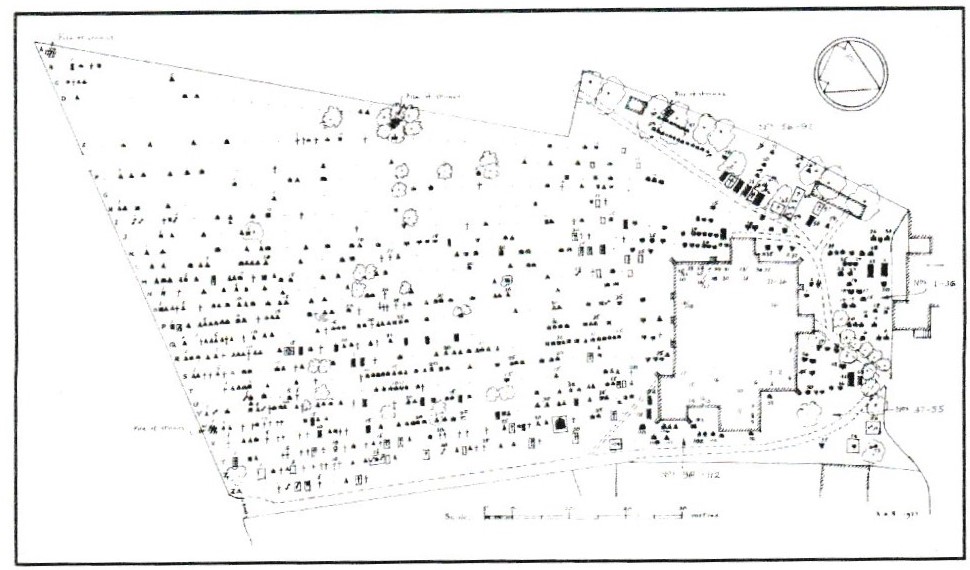
But Os being Os, he had to do it to his standards. He not only went round our and other churchyards and recorded every inscription in long-hand, but also laid out every grave as shown typically in the drawing below for St Bart’s (as he did for others), write them all out, copy each page and then bind each book and attach their titles in gold lettering. It was as if he could not stop once he had started as he did the same for at least the following churches.
Horley Baptists
Chartwood, St Michaels
Outwood, St John’s
Horne, St Mary’s
Nutfield, St Peter
Bletchingley, St Mary
Crawley Baptists
Ockley, St Margarets
All the above and others were covered in the same detailed manner. His dedication and the time that he must have expended in this work is remarkable which is another side of his character that must be admired. One of his sons recalled when he was quite young, that sometimes he went with him to assist.
He therefore laid down the irrefutable information about all known persons that had been laid to rest in the earliest Churchyard in Horley. Such basic data is still in constant use today.
By 1982, although small in member numbers, the Society decided to produce a series of “Great-Grandfather’s Horley” booklets featuring photographs of past scenes. This, we know, came about through Os’s efforts, by his writing the captions and securing the funding for its first publication, although his name does not appear in it. One would have imagined this would have provided him with the confidence and initiative to write and publish other titles, but this was not so.
He always preferred to help others and this was another aspect of his character.
When the Society increased its membership in the early 1990s several decided they wished to expand the series and Os was always on hand to assist. It became quite obvious that this was what he really enjoyed. Some of us would regularly visit various history centres in other counties to seek new information with OS always included and as the party were all retirees and all enthusiasts, it became a very happy pastime besides contributing directly to new publications.
In 1995 his knowledge and talents were called into use urgently because a developer had started to remove the burial ground alongside the Bethel Chapel in Lee Street which dated back to 1848. Unfortunately, most of the burial stones had been unearthed, but Os produced a diagram of where they were thought to lie originally as shown below. This helped immensely to ensure that this site will be protected for posterity and HLHS was further involved with this site in 2016.
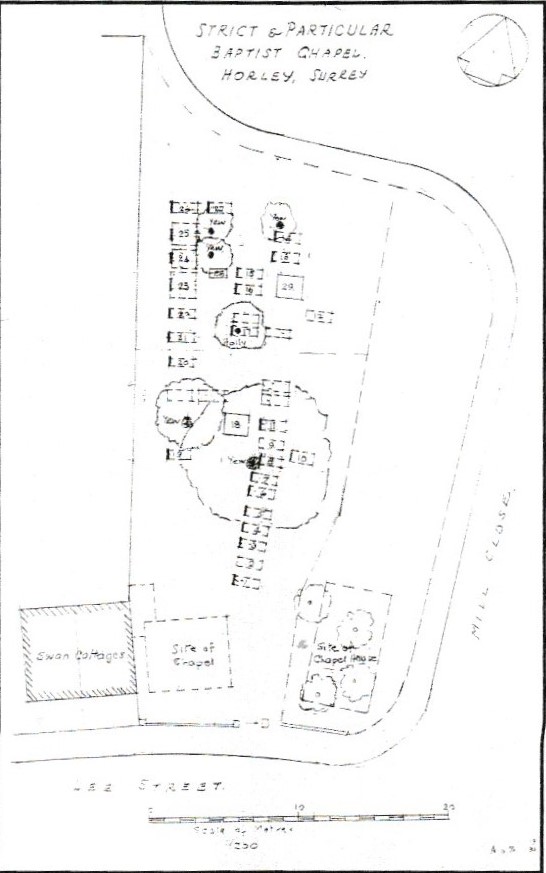
The diagram Os drew to assist in the replacement of tombstones in the Lee Street cemetery.
During all these activities, Os would continue to undertake his own personal research, be it family or local and to answer personal enquiries that he often received. In answering the latter, we often wondered how (1) he could write in such small size script and (2) how the person receiving it could read it. A typical example is given below. As always, his writing was extremely neat and the details given precise and covering a long period.
He did however undertake a considerable number of these, particularly in respect to the history of houses, for people who were interested to discover who had lived in them, or those enquiring from overseas.
He was however persuaded to write a brief history under his name about the Albert Brewery as his Father and Grandfather were so directly involved with brewing and public houses. It was published in “Brewery History” in 1996.
It is said that he could trace his history in the Burstow and Horley area back to 1660. That is some 10 generations from Os’s grandchildren today. This, perhaps, explains why he became a local historian with such extensive knowledge.
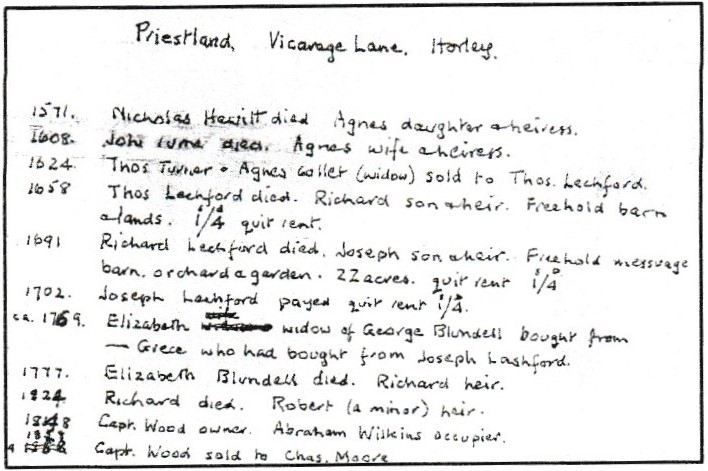
A very poor copy of a copy of a part summary Os had prepared from his research into the occupants of a house in answer to an enquiry.
When the Society formed the Horley Local History Centre in association with the Surrey County Council Library Services in 1995, Os always attended the two hours two days a week when it was opened in the Library. This was the first Centre to be set up in Surrey and the local history knowledge that he had acquired by that time really came to the fore. Not only did the enquirer who came to seek information readily learn what he/she came for, but so did we as volunteers as we listened. This was another aspect that obviously Os thoroughly enjoyed, not only did it bring him into contact with the public in general, but also with us the volunteers and members of the Society socially. He was then 80 years of age, so it also gave him another reason to regularly come into the town. This he did as long as he could manage to do so, well into his nineties, even when he had to discard his walking stick and he took to a mobility scooter he would whiz into the library to do his stint, sometimes quite dangerously.
He obviously really loved the subject of local history and we think this can be amply seen in the photo of him below taken in 1996. Several of us, including Os, had been involved in a difficult search for the deeds of a certain building in Horley.
One of our members – Bernard Davis, now deceased – came up with an idea for a Christmas present for Os. Bernard had a certain skill in writing ancient script, so he produced a spoof sales document in Os’s name. Bernard wrote it on rather dirty, dog-eared parchment-type paper in his lovely script, rolled and tied it in pink ribbon and presented it to Os. As the photograph shows, Os was so delighted with it and accepted it in the manner we had hoped.
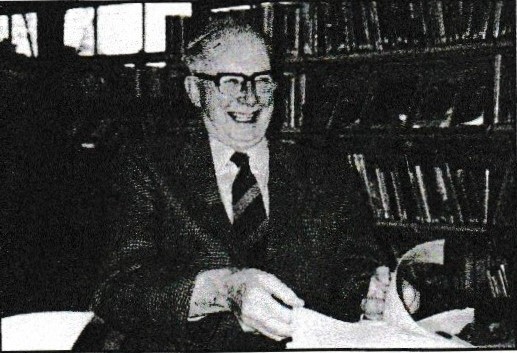
Os enjoying his spoof Christmas present at 81 years of age.
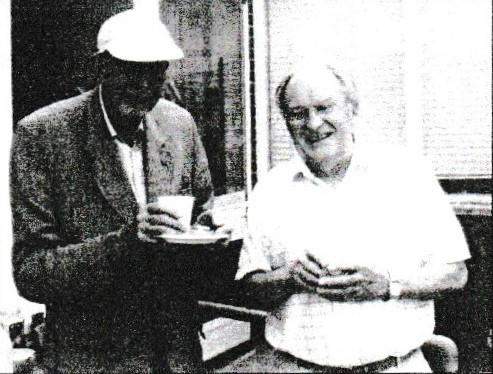
Possibly the last known photo of Os at Horley library celebrating the Queen’s Diamond Jubilee on 28th May 2012 with Brian Buss on the right.
How the History Society will always Remember Os
He was a quiet modest man with a very strong character, not given to saying a lot of words when a few would do. Sometimes he’d convey what he wanted to say without uttering a word. He had the ability to use his eyes, a smile or chuckle (lots of them), or shrug his shoulders and you knew. He never wanted to thrust himself forward, but was always willing to help anyone in any way.
He was extremely intelligent and if he did not know he would quickly find out and tell you later, although what he did know became legendary. He had an incessant thirst for knowledge along with such an inquisitive nature. He really should have been a candidate for the TV show, “Mastermind”. He was also a gifted craftsman, had very high standards in all he tackled, but never boasted about his achievements.
He would always dress smartly, always appeared in a tie and someone who was so pleasant to call a friend – a very good friend.
We will miss him terribly, but we will not forget him particularly for making such an impression on the Horley Local History Society, without having his name on enough books.
New members please note the above. This is why we hold this man in such high esteem. He is a very, very, hard act to follow, but someone well worth emulating.
Acknowledgments
The writers of this tribute have briefly included what they have recorded from working closely with Os for some 25 years, on so many different aspects of local history. They have also been kindly assisted by Anthony, John and their families, for which we say “Thank you”.