Explanatory Note
The booklet reproduced here was written by Elisabeth Lane, published in 1960 and is the follow up to another booklet entitled ‘Early Days in Horley, Sidlow and Salfords’ (1958) which is also accessible on this website.
The trio of historians responsible for much of Horley’s written early history, Elisabeth Lane, Jean Shelley and Os Brown are unlikely to be bettered by later members of Horley Local History Society and so this work is likely to remain as the most easily accessible research source for much of our early local history.
Due to the passage of time some of the names of locations described in this document may have changed but I doubt that anyone familiar with Horley will have any difficulty placing them.
I have not changed the monetary amounts from £.s.d. to decimal. Remember that our old currency started with pennies and their fractions and there were 12 pennies to a shilling, 20 shillings to a pound and that in 1800 as a benchmark £1 would now be the equivalent of £70 to us.
It was uploaded to the HLHS website by Doug Cox in November 2024 and the copyright is owned by Horley Local History Society.
HORLEY
IT’S CHURCH AND PEOPLE
THROUGH TEN CENTURIES
Elisabeth Lane
Author of Early Days in Horley, Sidlow and Salfords
Part author of Free men of Charlwood
© Horley Local History Society
Contents
Chapter
- Foundations – Prior to 1300.
- Under Chertsey Abbey, 14th Century
- Horley Churchwardens – their work and accounts, 16th Century
- Horley and The Reformation, 16th Century
- The Bristow Family.
- Under the Ownership of Christ’s Hospital, 17th
- Sidelights on the 18th and 19th Centuries
- The Last Hundred Years 1860 – 1960.

Horley Church in the 18th Century
CHAPTER 1
Foundations prior to 1300
“God is law say the wise. Oh then my Soul rejoice, for if He thunder by law, the thunder is still His voice”.
TENNYSON.
THE HISTORY of a church is essentially the history of man’s search for fellowship with the Living God, of God’s response to man’s search through the Gracious Personality of Jesus Christ, and of man’s continued worship of God in Christ. The records are of the outward trappings, of buildings and finance, the care of the poor, books and candles for shrines, and of all the homely things of everyday existence, yet the essential unseen movements, of human questing and Divine response, are always the life-giving factor, the vitality that moves ever forward to constitute new thought and vision, through union with One who declared Himself to be “the Way, the Truth and the Life”.
This search is no new thing. Man’s attempt to lift even the corner of the curtain between this world and the Beyond—the Other world in which he has always believed—is age-long and world-wide. Always he has sought to discover the Power behind nature, the Creator behind creation. Primitive man, living immeasurably closer to nature, needed above all things her gifts of fruitfulness and rebirth; of succour and salvation from natural disasters, from storm and flood, fire and famine; and for that gift, so necessary to survival, victory over his enemies. For these he prayed to the Power behind the things he knew.
TEUTONIC BELIEFS
In northern Europe this was clearly true. Their gods were the spirits dominating nature and man’s sojourn on earth. Woden or Odin was the supreme god and creator, the dispenser of victory—and he, with his wife Frigga, are remembered in our Wednesday and Friday; Tyr or Ti, god of battles, has given his name to Tuesday; Frey and his more famous sister Freyia were givers of fruitfulness, sunshine and rain, and all plenteousness; and one, sometimes considered as Woden’s son, but often too ranking above him, Thor, whose voice was the thunder, who flashed in the brilliance of the lightning and flung the thunderbolts. Here was a god of power, giving his name not only to the fifth day of the week but also to Saxon settlements in England.
Our knowledge of these and many other gods comes largely from isolated references in the Icelandic sagas, handed on by word of mouth and only written down in the 12th and 13th centuries, so that the early belief in their powers is not easily defined, but undoubtedly Thor was held in great veneration from most primitive times. [page 4] He was pictured as a ruddy man of enormous strength, riding the storm in a car drawn by he-goats, wearing gauntlets of iron to grasp the thunderbolts, and a miraculous girdle which increased -his power when his wrath and his temper, which were notably quick, were aroused. Nevertheless, he was always a friend of man, and his many exploits were waged against the evil giants and demons, to whom he was an implacable enemy. He was considered a dispenser of justice and a giver of fecundity, so that his blessing was sought in the rite of marriage, and his name often added to a personal name to safeguard the bearer.
In the great pagan temple at Upsala in Sweden on the site of the present Cathedral, in which was an altar for sacrifice with perpetual fire, and a place for the great sacrificial feasts, Thor’s statue stood magnificently “all adorned with gold and silver”. Though temple buildings existed in England, it seems more likely that at Thunderfield, “the open space of the god Thor”, altar was in the more customary grove of sacred trees, among which the oak was pre – eminent. That there were priests in such places to carry out the rites is certain, for they are especially exempted from bearing arms.
The festivals seem to have been at fixed times, in the autumn, mid-winter and spring, and though human sacrifices were offered to Woden, there is little mention of them in the case of Thor, but chiefly of horses and oxen, most valuable of beasts, and even of bears caught in the chase.
Here, then, are the foundations on which the first Christians could build—belief in invisible powers beyond and behind nature. As Tacitus wrote in the first century A.D. the Teutons “dedicate groves and woods and call by the names of gods that invisible thing which they see only with the eye of faith”. A belief, too, in another life in which the brave would be rewarded; a desire for crude law and justice; a trust in sacrifice as a means to obtain help; regular festivals at certain sacred places where the inhabitants were used to congregate, and a limited priesthood.
CONVERSION TO CHRISTIANITY
The name Horley or Hornley, “the clearing of Horn”, does not seem to have been used in early Saxon days, and it is almost certain that “Thunresfelda”, or Thunderfield, was the name given to a very large part, if not the whole, of Horley. It was only in the 12th century that a castle was built near the present Balcombe Road, and the name restricted to that small island within its moat. That being so, it is not necessarily at the present Thunderfield that Thor had his shrine. In 601 Pope Gregory sent instructions to his missionaries in England advocating the conversion of pagan temples into Christian churches, “in order that the people may the more familiarly resort to places to which they have been accustomed”. [page 5] Though, as has been said, it was unlikely that there was a “temple” at Horley, it is certainly possible that the grove of trees selected as a shrine was close to the ford of the river Mole; that there the first missionary planted the Cross, and, if that is so, there on the old heathen place of worship is the site of the church used continuously to the present day.
When and in what manner the Good News was preached is equally uncertain, though it is likely that the missionaries to the wealden villages travelled along the north downs, the Weald itself being practically impassable. St. Augustine had landed in Kent in A.D. 597, and had been well received by Ethelbert, though—and this is a curious sidelight on Saxon thought—the king received the saint sitting out of doors, and not under a roof, in order to reduce the power of his spells. His conversion was however complete. Augustine and his followers were given a house in Canterbury, and supported in every way in their mission.
CHRISTIAN PREACHING
The preaching of the Christian faith in Surrey was also undoubtedly made easier by the fact that, in 666 A.D., Egbert of Kent was holding this county as a “pretty princedom” under his brother-in-law and overlord, Wulfhere of Mercia, a fervent Christian. It was at this time that the boundless energy of St. Erkenwald was raising the first primitive structure of wattle and daub, thatched with reeds, on the Isle of Ceorot, which was later to become famous as Chertsey Abbey. The land at first consisted of only about 600 acres, but more was soon added and a new church of stone, glazed by glaziers especially brought over from the continent, was built to replace the first wooden building. Here The Saint remained as Abbot until he was made Bishop of London in 675.
The next 200 years of Christianity were made hideous by increasing Danish invasions and by the struggles for supremacy between Saxon and Dane. The battle of Ockley is believed to have been fought over this neighbourhood and many legends remain of fleeing Danes being cut down on the edge of the Mole: Canterbury and London were certainly captured by them that same year—851 A.D. About twenty years later Chertsey Abbey was itself attacked and fired, and it was not until the victories of Alfred, justly called “the Great” that the Christian faith was finally saved in the British Isles.
GIFT OF CHERTSEY
Thunderfield was one of the royal demesnes, and as such belonged to the king who, on his death in 901, left it by name in his will to his nephew Aethelm. It was, however, in the reign of his famous grandson Athelstan, “Rex totius Brittaniae”, that, as part of the Manor of Sutton, “Dunresfelda silvatica”, Thunderfield the forest, was confirmed as part of the possession of Chertsey Abbey. [Page 6] This grant, which was made “in the royal town which is called in English Kingston”, on December 16th, “1n the year of the Incarnation 933”, was a recapitulation of lands confirmed by King Athelstan, so that the actual gift must have been made at some earlier date.
The recapitulation itself is most interesting as showing the enormous area owned by the Abbey at that date. Thunderfield in the forest was certainly the most southerly of the Abbey’s possessions, and appears to have been the only one in the Weald. Its gift was again confirmed by King Edgar in 967 A.D. “Cum cubilibus porcorum quae illuc pertinent scilicet in Denresfelda.” The lair of pigs in the forest was evidently an item of considerable value.
ST DUNSTAN AND THE BENEDICTINE ABBEYS
The confirmation was made while St. Dunstan, as Archbishop of Canterbury, was undertaking his great reformation of Abbey life, so that the ‘Rule’ of St. Benedict might again be kept in its early purity. These reforms would therefore have affected Chertsey.
One wonders what the modern reaction would be to the monks’ day of prayer and work, as set out in the 10th century. Though this may not have been kept in every abbey in its entirety, it was not at the time considered particularly austere, The day started shortly after two in the morning with Nocturns, followed by five hours of devotion, including Matins and Prime—this in a church which, except for the wavering rays of candles or torches in the choir, must have been, for the greater part of the year, dark and intensely cold. During the day special masses, and the services of Tierce, Sext, None and Vespers, alternated with the work of the abbey until, finally, after Compline at about six o’clock, the monks in scapular, cowl and hood went silently to bed.
Their first and main meal was at two o’clock, twelve hours after rising. Meat was reserved for the sick, but fish, eggs and cheese, with fruit, vegetables, porridge, bread, butter and honey were all eaten, except in Advent when fats were given up, and further during the whole of Lent, when eggs and milk were also forbidden. As this would, in any case, have been a time of shortage of fruit and vegetables, the fare would indeed have been meagre.
Nevertheless, while the monasteries were, especially in the early days, essentially places of worship where the Divine Offices could be said in peace and security, they were also the only places of learning throughout Christian Europe, and it was in them that books were laboriously written and copied. A point that emerges strongly from Saxon church history is the enormous desire for the written word, the immense value of books, and the surprising number in circulation, and, added to this, the toil and slowness of their making.
Cuthbert, Abbot of Wearmouth, Jarrow, wrote to Lull, Archbishop of Mainz in Germany—himself an Englishman from Wessex —about 760. [Page 7] “You asked me to send you something of the works of Bede. I have been busy with my boys in making copies as far as we could manage this and I am sending you the life of St. Cuthbert. I would gladly have done more. But the winter just now has caused the most horrible suffering on this island, through bitter cold and ice . the hands of our copyists were so numbed that they could not get many books ready.” Again and again Lull asks for books, and many are sent to him, including Commentaries on Samuel, Ezra and Nehemiah, as well as on the gospel of St. Mark. Books were indeed considered the most precious of gifts, and immense care and beauty were lavished on their making. One reads of the four gospels “in letters of the purest gold on purpled parchment and illuminated”. This art of illumination with its brilliant colours, clear, strong outlines and vivid portrayal of men in action, their draperies seeming to flutter in the wind, as seen in the old manuscripts, is, indeed, something at which to marvel.
NORMAN CONQUEST
Few records remain of Horley at the time of the Conquest; and though “Hornley” is once mentioned among the possessions of the Abbey as devastated by William’s army, this manuscript is looked on with some suspicion by the experts. Certainly Horley was considerably south of the route under the downs taken by William’s army.
The population was probably still confined to those Saxons who, perhaps first as pig herds, had ventured down into the marshes of the Weald and found good rich land. Here they felled trees and cleared enough space for their own needs. There is no suggestion of any “common fields” in the parish, such as were shared by a compact community. In the Domesday Survey a nameless place in the Manor of Sutton is described, which is very likely Thunderfield. “The Abbey itself holds two hides (about 240 acres) of land and William holds the Abbey. There is one Bordar and one serf. In the time of King Edward it was worth twenty shillings, afterwards five shillings. Now ten shillings.”
When a church was built is also uncertain, but, in a deed of 1191, in which the Abbey is granted the right to appropriate the vicarage of Horley, among other places, to its own use, it is expressly mentioned that these rights had been acquired “at an early stage”. If a vicarage, surely a vicar and his church, so that it would seem that a church, which we know to have been in stone, had been standing some considerable time before the reign of Richard I.
AGREEMENT BETWEEN THE ABBOT AND JOHN DE WENGHAM
By 1262 a most detailed agreement was made between John Medmenham, Abbot of Chertsey, and John de Wengham, the tenant of 42 acres of Abbey lands in Horley. This land John was to hold for life, paying 20s. yearly, half at Easter and half at Michaelmas, for ten years, [Page 8] but five times as much — IOOs.— if he lived more than ten years! The interesting thing about this deed is that Henry de Wengham, afterwards Bishop of London, was vicar of Charlwood in 1242, so that it looks as though the family must have been a local one. From the taxation returns of Pope Nicholas in 1291 we know that the Horley living at that time was taxed at £14. 13s. 4d. and the tithe valued at £l. 9s. 4d.
The full list of vicars, as far as they can be traced at present, will be found in the Appendix. The earliest known is Walter the “parson” who witnessed a deed in 1218. Later comes a man with the wonderful name of John de Cromplehorn. Another Walter, Walter de Wavyndon was certainly vicar in 1331, when he was granted for life a croft of 4 acres lying near his house, with permission to enclose it, by that great Abbot of Chertsey, John de Rutherwyk, whose history and dealings with Horley follow in the next chapter.
CHAPTER 2
Under Chertsey Abbey 14th century
IN THE early 14th century a period of intense activity, both lay and ecclesiastical, opened for Horley. The great Chertsey Abbey, to which it had belonged for at least 374 years, when John de Rutherwyk was elected Abbot in 1307, was to be raised to the height of its power and prestige. Near Windsor, the Abbey was often visited by Edward Il, and royal letters are dated from Chertsey at least six times between 1308 and 1318. Queen Philippa also held her court there both in 1340 and 1341, while her husband Edward Ill was fighting in France.
Its possessions were immense, and, in addition to land in Wales and Berkshire, the Abbey owned over twenty churches in Surrey. These included—to take them in alphabetical order—BisIey, Great and Little Bookham, Byfleet, Chaldon, Chipstead, Chobham, Clandon, Cobham, Coulsdon, Egham, Epsom and Horley. More land in Comptom, Felsham, Effingham, Esher and Ash must be included in this remarkable list.
To the organization, administration and improvement of this large tract of Surrey, John de Rutherwyk, “most prudent and useful lord of our monastery”, a local man whose family possessions lay in Thorpe and Egham, brought enormous energy and skill, and in this golden age of monastic high farming raised his house by extensive purchases and many lawsuits to “a position of economic importance without parallel in its history before or after”.
He had spent his life as a monk at Chertsey, and it is possible that the speed with which he threw himself into the work may imply a certain criticism of his predecessor, Bartholomew of Winchester. It is [Page 9] certain that, with the exception of the year 1335, in which it is written that “he rested from the labour of his hands, and the fatigues of his heart”, his vigour and energy continued unabated throughout the 39 years of his reign as Abbot. It was indeed the cause of a good deal of murmuring and discontent among the monks endeavouring vainly to keep pace with the vast amount of work entailed.
Work began the very first year of his abbacy with a new “quay of stone” on the Thames, evidently to give better access for barges to his London hospice. Work at Ash this same year included the digging of ditches and heightening of land against flood water, and three stews “fit for fishes” with a house “suitable for a fisherman”, and in addition a new pigstye and dovecot were built. At Cobham also, where flooding was (as it still is) a problem, he had the manor house moated. A new cart house and grange for hay, and later a sheepfold, were also added. In the following years houses, mills, granges—both newly built or existing ones lengthened—oxsheds, sheepfolds, pigstyes and dovecotes follow each other in steady succession, while forestry was not neglected, and various woods, mostly of oak, were planted. Undoubtedly the greater the prosperity in the manors, the greater the wealth that poured into the Abbey coffers, so that it is no wonder the Abbot was eager to acquire new land. The esteem in which he was held by Benedictines all over the country is shown by the fact that he was four times called to the Presidency of the General Chapter of the Order.
Horley, which still consisted of scattered hamlets and farms centred round a large expanse of open land, though on the outskirts of the Abbey’s property, was by no means forgotten or left out of all this activity. First the church, which had possibly been only under the patronage of the Abbey, was taken over. It was on the “2 Ides of May” 1313 that Philip de Barthon, Archdeacon of Surrey, was given a mandate by the Bishop of Winchester to induct the Abbot or his Proctor into “corporeal possession”, so that Horley (here written Hornley) and Epsom “may be honestly served by fitting vicars”. If, as is likely, the Abbot came himself to take over this “corporeal possession”, it would have been only of the old church, of which almost nothing now remains; but the plans for the new chapel, which was built just about this time, probably by Ralph Salaman, may have been discussed. There is a further note in the Chertsey Cartularies that in 1331 a “new chamber” was built followed in 1339 by a new “kitchen”.
This word “chamber” is of particular interest. The early idea of a house as a single hall or room, where all slept and ate together, was being modified, and the first addition was a chamber where the owner and his lady might have privacy by day and sleep at night. It has however been suggested that, in this case, the new chamber may have been built for use as a Court room. The kitchen had, before this, generally been a separate building, but by de Rutherwyk’s time [Page 10] chimneys were becoming more common, and the kitchen at Horley may have been a direct addition to the central hall. It seems likely that these were made to the old Court House, which stood in the garden of the present Court Lodge Farm, and may have been for the greater comfort of the visiting monk-warden, who came to oversee the Abbey Farms. For Horley’s agriculture was also receiving considerable impetus, and building had already been going rapidly forward with a new grange for hay, an oxshed and a cart house all begun in 1315.
Exactly what in money or kind Horley sent each year to the Abbey will never be known, but the organisation was most carefully worked out. In order to ensure the constant supply of the needs of the monasteries in the way of wheat, barley, malt, bacon, lard, cheese, poultry, eggs and honey, a scheme was elaborated by which each manor sent up a quota or “farm”, i.e. a fixed annual payment in kind, once or twice a year on a specified day, and it was the duty of the reeve to deliver this to the Abbey.
Horley is, however, about 30 miles from Chertsey, and moreover quite on the outskirts of the Abbey’s property, so it is always possible that the crops were sold at the local market at Burstow and only the cash forwarded, whereby the cost of transport, which has been calculated at roughly 2d. a mile, could be saved, as was done in many parts of the country.
Perhaps a short digression may be allowed at this point. It was onAugust 8th, 1247, in the 32nd year of his reign, that Henry Ill granted the right to hold a weekly market and, even more important, an annual fair on “the eve, feast and morrow of St. Michael”, i.e. 28th, 29th and 30th September, to John de Burstow and his heirs. Before the days of shops in the countryside, this was a much sought after privilege, and could only be obtained from the King himself. In order that they might not become, in Bracton’s words, a “tortuous nuisance” they were never allowed to be held less than the curious distance of 6¾ miles apart. With other markets at Bletchingley, Gatton and Reigate, Burstow would hardly infringe this ruling.
The lord’s steward presided and took the dues, and a special court was set up under the intriguing name of Pypowders—a corruption of “Pied Poudré”, or Dusty Foot—for the benefit of traders who came from surprisingly long distances, and whose packmen had the dust of travel still on their feet. For these it was essential that justice should be immediate, in case of dispute. The pillory, which was usually set up for the duration of the fair, perhaps added point to its decisions.
Fairs were often on the Feast of the Dedication of the church, and it is noteworthy that, this fair being at Michaelmas, the earlier dedication of St. Bartholomew at Burstow appears to have been to St. Michael and All Angels.
Markets were usually held on a Sunday, but the following protest [Page 11] in parliament, in 1449, shows that, by some at least, this was not well received. Here is shown the “abhomunable wrongys and vylanys don to our Lord God and his holy seyntes” by the holding of fairs and markets on Sundays and the chief feasts “in which the principall festfull dayes, for grete worldely covetyse the peple is wylfylly more vexed and defouled in bodely labour in pycchyng and makyng of Bothis and Stalles, in beyng and drawyng, hevyng and shuffyng nothyng alas havyng in mynde the horrible fowlyng of here soules in gyleful bying and selling, moche lyng and fals forsweryng, with drounkenshipp and debating and specially in withdrawyng hemself and all her meyne (household) holich fro divine service.”
Be that as it may, these markets, and more especially the fairs, must have been a bright spot in the very drab and colourless lives of the peasantry and it is certain that there was much merriment and dancing and many games of strength and skill and that performing animals were greatly enjoyed. Pictures of performing bears, a horse dancing, to a pipe and tabor, monkeys playing at school, and a charmingly dressed dog dancing to a fiddle—all of this period—are still to be seen, while a Punch and Judy show hardly differs from its descendant in more modern days.
It is almost incredible that the money exchanged and carried by the merchants in the days of John de Rutherwyk was entirely in silver pennies, small coins like very thin sixpences. A gold coin struck by Henry Ill was not popular and was withdrawn, and it was not until January 1st, 1344, two years before John de Rutherwyk’s death, that two Florentine goldsmiths were called in to strike the first gold “Florin”, valued at six shillings.
No wonder that, carrying these heavy money bags, merchants travelled in some danger, and, by the statute of Winchester, 1285, it was found necessary to broaden the highways “so that there be no ditch, tree or bush where a man can lurk to do mischief within two hundred feet of either side of the road”. Oaks and great beeches might be left “so it be clear beneath them”
Money, or lack of it, was a constant problem to the Abbot. In spite of improved agriculture, the enormous amount of building taking place throughout Abbey lands must have been a great drain on its resources. A story is told in this connection that again brings Horley into the picture.
It is clear that, by 1318, Philip de Barthon, Archdeacon of Surrey, (the same who inducted the Abbot or his Proctor into Horley Church) had lent the Abbey the large sum of £100. We read: “Because the said Archdeacon was never accustomed to fail us in our need, but now also has most courteously regarded and relieved our most urgent poverty with £100 stirling paid to us in coin” therefore “mass was to be said daily for ever for his life and salvation while he lives, and for his soul when he shall have departed”. And this not casually, but by [Page 12] a monk whose name is “especially set in the notice board for this purpose”. Further, on the Archdeacon’s anniversary, they shall “beat the peal with all the bells, and there shall be made for him a solemn mass in the Convent”, and—which would surely have pleased the brethren—twenty shillings were to be spent on a “pittance” to improve the dullness of their usual diet, while 6s. 8d. was to be given to the poor.
It is here that Horley is mentioned, for this 26s. 8d. was to come from the “tenements formerly of Roger de Logges at Horle which are called Labbokeland” , and which had later been bought by the Abbey.
On his death in 1327 the Archdeacon bequeathed a further £250 for two chantries. Two masses were to be celebrated each day by two secular monks as chaplains, who were to be paid 54 marks, or £3. 13s. 4d., a year. They were to be given “an honest chamber suitable for such persons” near the great gate of the garden within the Abbey. They were to be allowed “sufficient litter, and two cartloads of brushwood yearly when provision is made for brushwood for the Abbot’s chamber”, and “a little clerk from the Almony shall minister to the same”. Many more details are given, and it was stipulated that they in their turn must not be negligent. It was laid down that, in case of sickness, for every mass missed 50 psalms and the Office for the Dead were to be said.
Labbokeland, mentioned above, is shown on the Christ’s Hospital map of 1602, quite on the eastern boundary of the parish, in the present Salfords. It has been suggested that the name comes from Bocland or Bookland, i.e. land whose title is secured to the owner by royal charter or “book”. This was a usual procedure in the reign of King Alfred, and it is possible that this may have been some of the land in Horley owned by the king, and left on his death by will to his nephew Aethelm.
AGREEMENT WITH WALTER DE WAVYNDON
It was in 1331, the same year that the new “chamber” was built at Horley, that a most detailed agreement was drawn up between “the Abbot and Convent of Chertsey of the Order of St. Benedict” and Walter de Wavyndon, vicar of the church at Horley, whose assent, it seems, was “freely given”. He was to retain all allowances that had been granted to his predecessors. He was also to hold “in perpetuity” for himself and his successors the house lately belonging to Michael de Waps, “well and truly built, with a barn, courtilage and a croft adjacent as well as ditches and fences belonging thereto”
A list follows of all the small tithes which would come to the vicar – the tenth of all fowls, calves, piglets, geese, lambs, wool, fruit and pannage – this latter, the right to pasture pigs on fallen acorns, was valued at Stumblehole, near Bures, “when it shall happen” at 4s. a year. He was also entitled to a tithe of the rents and “those of the houses of John of Kinnersley, William of Burstow and Nicholas of Horne”, and [Page 13] a tithe of the mills “other than that of the mill formerly belonging to William of Newdigate”, and might retain all fees for special services, funerals, anniversaries, etc. He was not, however, entitled to the “great tythes”, the tenth of all cattle, sheep and pigs, and the tenth stook in every field of grain, nor to the four-footed animals that were paid as mortuary dues on the death of a land owner. These more important acquisitions went to the Abbey.
A few notes from other sources may prove the resemblance of Local History to a jigsaw puzzle with its interlocking pieces, and to this, a great deal of its fascination is due.
From a deed in the British Museum comes the fact that Michael de Waps had alienated the house and 3½ acres to the Abbey twelve years before, at the same time that William de Newdigate sold them Horley Mill. The Vicarage, in Vicarage Lane, finally vacated in 1951, therefore belonged to the Abbey and could be granted “in perpetuity.”
From Burstow deeds, we find that Willelmus de Waps paid 17¾d. tax in that parish in 1332.
Kinnersley Manor near Sidlow had belonged in the 13th century to a Norman, Fulk de Archec. The John de Kinewadesl, who also paid 4s. 7¾d. tax in 1332 must be the man mentioned in the foregoing deed.
From family records, it is clear that William de Burstow was conveying land to the Abbey this very same year, probably meadows between Meath Green and the river, as it was said to be ‘ ‘bounded on the west by the waters of the Emele”, the old name for the Mole. His house was, very possibly, in Meath Green, as it was there that a descendant lived in Tudor times. Wherever it was, it was the second largest in the parish, taxed at 7s. 4d., only beaten by that of the Pickard family, with whom William de Burstow had just had a lawsuit in 1328.
The other two mills, from which Walter de Wavyndon might take the tithes, were at Sidlow and Lodge, which latter was part of Salfords.
BUILDING OF THE NORTH AISLE
It is evident that John de Rutherwyk, in addition to his labours for agriculture, also kept a watchful eye on the fabric and adornment of the churches and chapels under his control. We read of his giving red velvet vestments to Chertsey, and pictures of St. Katherine and St. Margaret. More important was his work at Egham, where he built a new chancel, and where his name can still be traced, incised in Lombardic lettering; and at Great Bookham, where his singularly graceful windows still survive, and the name is even clearer—”Constructa Johanne de Rutherwyka”
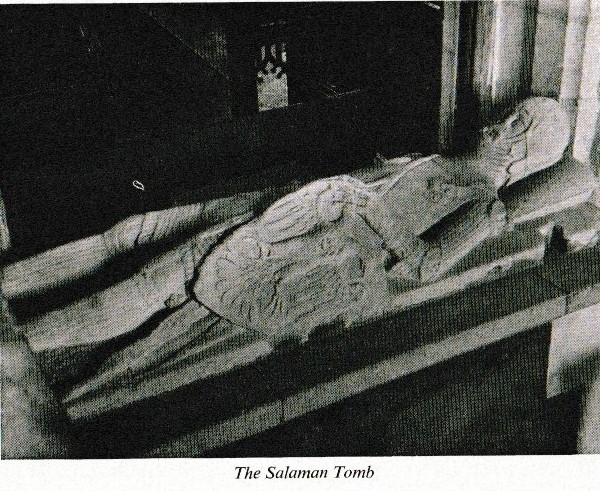
Horley has no such inscriptions. Nevertheless, it is certain that great additions were being made to the old church at this time, and that they were partly designed as the Salaman family chapel, where masses for the dead would be regularly said to assist them in the world to come.
The architecture of the present north aisle shows it to be distinctively early 14th century, the best period of Gothic building, and it probably dates from about 1315. The spire, with its huge timbers, a magnificent specimen of medieval carpentry, the porch and the arches into the nave, are all of the same date. The north windows still have the old design in their tracery, but this was, alas, renewed in the most unsuitable Bath stone in the late 19th century, though some of the beautiful ruby glass remains.
The connection with the Salaman family is proved by the old effigy of a knight in armour, of which a picture is given above. This lay originally on the floor, but now rests on what is doubtless the lid of the tomb. It is of Reigate stone, and the Victoria History describes it as “this remarkable effigy, undoubtedly the most interesting and finest, as a work of art, that remains in Surrey”. The knight bears a shield, on which are emblazoned the Salaman arms, a double headed eagle, charged on the breast with a leopard’s head, and in one of the quatre- foils of a nearby window this leopard’s head is repeated. The knight’s head rests on a cushion, a lion at his feet. His right hand must have held a drawn sword, but of this only the tip remains. The armour is chain mail, with sleeves to the elbow, and the knee pieces of plate.
[Page 15] Gauntlets, probably of leather, and roundels to protect shoulders and elbows are clearly to be seen.
It is the distinctive shape of the shield, “intermediate size between the small heater shape and the long one almost covering the body”, that makes it certain it was carved at almost exactly the same time that the north aisle was building—i.e. c. 1315—and it, in all probability, represents Ralph Salaman, father of the Roger who is known to have died some 28 years later, in 1343. It is curious to discover that the family, who owned land at Langshott, held it not from Chertsey Abbey but from Merton Priory, to whom they paid a rent of 5s. yearly.
The last decades of Ralph Salaman’s life were lived during the disastrous reign of the dissolute and irresponsible Edward Il, when the Scottish wars were draining England of both knights and wealth. Whether he ever went north with the Earl de Warenne, as did his neighbour William de Burstow will never be known. What seems certain is that he had a filial and godfearing son, and Horley owes much to this son’s care for his father’s soul in its journey through Purgatory.
No more is known of the family, except that Roger’s daughter married a certain Ralph Saunders, ancestor of Sir Thomas Saunders of Charlwood, and if, as is likely, she was an heiress, Langshott would in this way have passed out of Salaman ownership.
CHAPTER 3
Horley’s Churchwardens, their work and accounts
AFTER THE stress of building came years of quiet, but years filled with a faith that was seldom shaken—that “Mother Church” was the central point of all life. This was very largely true. Not only were the newly-born received into her membership, marriages blessed, and the soul speeded on its way at death, but almost all learning and teaching were in her hands; healing and the care of the sick were her concern, and architecture, drama, music and painting were largely dedicated to her use; while her festivals and holydays gave relief and change from secular work. Man’s passage through life was helped or hindered to an enormous degree by her care or neglect of this trust, as may be read in the great poem of Piers Plowman.
FURTHER GROWTH OF THE CHURCH
It is evident that, during the 15th century, the inhabitants were again at work. Perhaps the old church was in a state of decay. Whatever the reason, it is certain that about this time the decision was taken and the old church to the south of the Salaman Chapel was rebuilt. How curious it is that one of the smallest villages in the neighbourhood should have built the very large nave we know today, and how fortunate it is for modern Horley that their ideas were so spacious. Fortunate too that when the roof was raised the corbels, which originally supported the old roof, were left intact, jutting out above the arches which still connect the chapel with the new nave. They are practically the only visible remains of the early church.
At the same time a new inner doorway was made to the porch which is remarkable in many details, and a parclose screen added to give privacy to the sanctuary of the chapel, the lower parts of which were standing in 1881. The very beautiful brass, with the figure of a lady, now on the north wall of the sanctuary, also dates from this century, and is probably in memory of a Salaman, as its first resting place was the floor of the chapel. Here it was also seen in 1881, but “barbarously defaced by having the timbers of the organ resting on it”. The inscription to Joan Fenner, now placed on the wall below, does not belong to it.
It is noteworthy that a certain John Salmon was vicar from 1403 to 1410, but whether the spelling is a shortening of Salaman, or if he had any hand in the additions, one cannot say. It is however just possible that the scene in which Raymond de Cobham took the strong course of disclaiming his rights, or more probably his responsibilities, “before all the parishioners in church” on a Sunday in 1430, took place in the new building. Raymond de Cobham, whose home was at Gatwick Manor in the parish of Charlwood, owned Rowley Mill near Lowfield Heath. The Abbot of Chertsey was owner of Horley Mill further down the river Mole, and the quarrel arose as to who should repair the banks of the “watercourse” between the two. Three at least of Horley’s leading men witnessed the scene—John Burstow, here given his title of Esquire, William Jordan of Gatwick, and Henry Lechford.
These banks of the Mole are still making history, and at the time of writing are being surprisingly widened and altered. The river, though now no longer used to turn the wheels of the once essential mill, now has a more immediate use in carrying off the water from Gatwick Airport.
CHURCHWARDEN’S ACCOUNTS
By the early years of 1500 we become well acquainted with the affairs of the church, and this owing to a most extraordinary piece of good luck—the finding of the original Horley Churchwarden’s Accounts from 1505 to 1702 in the leather bound book in which they were written. In Manning & Bray’s History of Surrey, 1809, it is stated that these accounts, in a book “curiously embossed”, were bought by a Mr. Brand at a broker’s shop and given by him to the Editor, while in the book itself is written “Bt. of Mr Waight who told me he bought it at a sale by the Sheriff’s distress in the Borough” [Page 17] (Southwark), and below “A. E. Bray given by Rev. J. Brand 8th Nov. 1804”.
Where the book had been lying for the hundred years before it arrived at the distress sale will probably never be known, but its rescue has given to the local historian a remarkable insight into the history of the church through the days of the Tudors to the beginning of the reign of Queen Anne. It was later presented to the British Museum for safekeeping, and there it may still be seen. The experts are emphatic that the binding is original, and is very possibly the work of the same binder as that of a book now in Salisbury Cathedral.
Here we have the original writing of Horley’s clerks and churchwardens—including a few of their signatures—in all its endless and fascinating variety. Neat entries are followed by vast scrawls, educated writers by those who could only make their “mark”. Some of the entries are even upside down. Erasures are legion. The difficulty of deciphering is immense, especially in the earlier folios where the ink has become very faint, and it is not made the easier by the few who started boldly on a new page in the middle of the book, followed by others who more methodically filled in the blanks. None the less, it is the wonderful continuity that inspires admiration. Hardly a year passed, from 1518 to 1702, in which the names of the wardens were not entered and the amount of church money handed on to them by those who retired. Here is proof that even in the troublous days of the Reformation, and later in those of the Commonwealth, the life of the church went steadily on. From 1643 to 1660, for instance, Charringtons, Bristows, Woodmans, Heavers, Bonnicks and Shows, and many others, follow each other in steady succession, and not one single year passes without new wardens being elected to care for the upkeep and finances of the parish church. Sometimes it is noted that they are chosen “by the consent of the minister and parishioners”, sometimes “by the consent of the parish”, but chosen they were and they served their term.
CHURCHWARDENS
The ancient and honourable office of Churchwarden, originating at some unknown date in connection with the maintenance and repair of the church fabric, is definitely known to have existed in the 14th century, so that in all probability, Horley men had held this office since the days of John de Rutherwyk and the enlarging of the church.
By law the rector, who in Horley’s case was the Abbot of Chertsey, was always responsible for the chancel where Divine Service actually took place. This is expressly stated in an agreement in 1331 between the Abbot, John de Rutherwyk, and the vicar, Walter de Wavyndon— “the said Abbot and Convent wish to undertake the burden of the repair of the Chancel, the books and the ornaments which the Rector whether by law or custom has to bear”. The nave, however, where [Page 18] parishioners congregated, not only to attend services but also for many secular purposes, was considered their part of the building. Its upkeep fell on the whole village, each parishioner paying according to the amount of land he held and the number of animals he kept. The power to levy this rate, and the care and use of the money was in the hands of the wardens.
Two were elected each year at the Parish meeting—the word “vestry” was never used in medieval times—and a plan was followed which ensured continuity. Each served for two years, first with the previous warden, and then being himself joined by a new man. We read in the very first entries in 1518 that John Braye and Rychard Toode were together; in 1519 Rychard Toode was joined by Peter Bonwyk, and the next year Peter Bonwyk by John Barnyter. Though this arrangement naturally did not always hold good, it was the usual practice, and there is no suggestion whatever of a Rector’s Warden and a People’s Warden as is now the general custom.
A TUPPENY RATE
The first pages of the book are of absorbing interest, giving, as they do, a list of parishioners who each paid 2d., almost certainly a special rate levied towards the repair of the church. Here are the names of about fifty-one families, probably almost the entire number of freeholders. The first thing noticeable is that, unlike the earlier list of 1332 for tax assessment, these in 1500 all have regular surnames, names which recur continually through the following centuries. The heads of each branch of a family paid the rate. Thus “Owld Dewdeny” is followed by two Jhons, ( The name John coming from the Latin Johannes, the old writers were very casual as to where in the name they put the missing ‘h’. Jhon or John mattered not at all) a Thomas and a Rychard Dewdeny, while Kyllyck, Allingham, Addams, Showe (or Shove), Burstowe and Bonycke have each more than one representative. Even widows were not exempt, and four paid the twopence, including “Wacams” and “Allyns wyddowe”. Other family names, Wodman, Charynton, Heaver, Wynchester and Brooker are still well known in the neighbourhood.
This long list of eighty-nine names is the only one of its kind in the Accounts, and one wonders why especially it came to be written at this time. The answer may be found in the person of “Master William Burbanke, Bachelor of Law and Vicar here” from 1505 to 1521. Undoubtedly a forceful and businesslike person, we know that he was intent on bringing order into church finances, and keeping his churchwardens very much up to their work.
John Bristo and John Rugghey held this office in 1507 and, with them, the Rev. William Burbanke made the most detailed and careful agreement. They, as “guardians of the money of the parish church of the Immaculate Virgin Mary of Horley”, bind themselves that they will “actually present within the choir of the same church before the incumbant . . . and parishioners there 116 shillings of the goods of the same stock . . . and to place that sum openly, fully, and without diminution in the chest or treasury of the said church to be applied to the common use” and this under penalty of five marks (66s. 8d.). The document, in Latin, is dated “the feast of the Beheading of St. John the Baptist (August 29th) in the year of the Lord One thousand, five hundred and seven”, and is firmly signed “By me Wm. Burbanke”.
THE CHURCH BOX
The “chest or treasury” of this agreement recurs continually in the Accounts from 1518 to 1550, and the money handed over each year— varying from £2 1s. 3d. to £15 0s. 5½d., but being usually round about £8—is always noted as “Remayne in the Chyrche Booxe”. When the enormously greater value of money is taken into account, these must be reckoned as considerable sums to be held by such a small community.
Whether, in 1550, some violent dispute occurred, or the box was found to be unsafe one cannot tell, but the last entry of 1551 is erased in a most untidy fashion, and after that the money is always noted as ‘ ‘remayning in the handes off Henry Showe and John Bonwyck”, or whoever were the wardens for the next yearn
CHURCH EXPENSES
How was the money spent? Though in most cases the wardens were only careful to state the amount left in the church box, or handed over at the end of the year, they occasionally, to our great interest, wrote details of their actual expenditure. In the Latin agreement between William Burbanke and his wardens there is an account for the two years preceding, which must refer back to 1505, the year of his induction. This is to “all debts and repairs as well of the nave as of the books and other ornaments of the same church” or ‘ ‘ther accomptt for Reparations of bukes oder anowznments of the churche” as the wardens wrote it later in English. These cost £3 17s. 9d., including 5s. for “brasse for bellis” and 20d. for a gutter. During that time they had received 22s. 6d. for the “lncrease of the churche gudes and laundes”, 8s. 4d. for “Paschall pennes”, and 3s. 8d. for “Sancti Swithins farthynges”.
The very first entry in the accounts, which is undated, gives further details while John Woodman was churchwarden, and also mentions the price of books.
“Item layd owte for glasynge of the church 4s.
“Item to leves for washynge of the clothes of the church 6d.
“Item for a charges at EWEL vecytacyon 12d.
“Item to the plomars mendyng here the ledes 5s.
[Page 20]
“1tem for soder iij li at viijd a li & a halfe (3 lbs. at 8d. for I lb.
& a half) 1s. 4d.
‘Item expenses at the worke 4d.
“1tem for expenses at Kyngston vesytacyon at Myclemas 12d.
“Item for syndynge of the great bel clepper 10d.
“Item to Cheseman for that yt was behind & for thonge lether 2d.
“ & for the bokes 8d.
It is immediately followed by further ‘vecytacyons’ at Ewell and Kingston, which again cost 12d., and by “charges and coles for the plomar 6d”
The “leves for washyng” would be ‘lye’—a word still in use for water alkalised from vegetable ashes, used for this purpose.
‘ ‘Wesshyng of the chyrche gere” at the cost of 16d. is again entered in an account of 1542, with 9d. more for “coles”, 4d. for a “boke for the churche”, and another 4d. for “mendyng of yerns”. At the same time 9s. was paid for wax for altar candles—the usual price being about 6d. a lb.—while melting cost 4d. and striking 1d. A further sum of 6s. 8d. for “makyng of wex and mett and drynke and wyer with othere thynges longing to the church” seems to show that the making of the candles was quite a social affair and that the meat and drink consumed were paid for out of church funds. Did it perhaps take place in the older building, now incorporated in the Six Bells?
BOKE OF THE STOKES
One way of making money, which was fairly usual in country districts, is noted in 1533. This proves that the church itself owned cows which were let out to local farmers. The entry is headed “This ys the boke of the Stokes (i.e. stock or possessions) belongying to the churche of Horieghe, in the yere of our lord gode MCCCCCXXXlll”. There follows a wonderful page of the most untidy writing, and if the scratchings of heads equalled the scratchings out in the accounts, it must have been a worrying afternoon that was spent by the wardens. It seems, however, to have been finally settled that William Venrse took the two best kine “eche price” twenty shillings. Rychard Kelyk has “1 kowe” worth ten shillings, and nine others take either “1 kowe” or, more simply in three cases, “1 cow”, presumably also worth 10s. each.
No explanation is given, but in a “sartyfycath of George Payne constable and Hary Shoe and Thomas Copar Wardens . . . . what they can say as consarnyng the Quens Maiesties artecles”, they find an “obat”, (money for prayers to be said on the anniversary of a death) “owt of a stoke of to kyne the which was geven by John Wechaster . . . of four shillings yerely”. The date of this is possibly 1561, and it is altogether likely that the earlier cows were also given to provide money for prayers for souls in purgatory, with a proportion [Page 21] to be used for the poor still living in this world. This is seen in the rest of the certificate, which is connected with a rent of 6d. a year “for the finding of a lamp… and “lyke wyes four shillings and eight shillings a yere owt of a sartayne lands called Soldgons and Stoke croft to be stowed in bred and drynke for the powar”.
THE CHAPELS
Some of those to whom the cows were farmed out certainly served the church in other capacities. William Veners, for instance, had been churchwarden for the two years previously. The same names are also found among those responsible for the lights burning in the side chapels. One of these, dedicated to St. Nicholas, standing slightly to the west of the site of the present vestry, was cared for by the men. The other, to St. Katherine—the old Salaman chapel—was in charge of the wives. It is noteworthy that these were as punctilious as the men in stating exactly how much they had in hand at the end of each year, and handed to their successors. This varied considerably, but was often about £3.
The entries, like those of the Church Box, start in 1518, but one may be sure that the chapels dated from much earlier days, and that the two men and the two women who served annually were in a long tradition of service. Ceremonial lights on the altar were among the earliest usages of the Christian Church, and it was for these that they were especially responsible. For these also men made provision in their wills, as in 1499 when Thomas Cowper left “To each of 4 lights 4d., and to the church to buy torches 13s. 4d.”. He directed that his body was to be buried in the Chapel of St. Katherine, and the torches would have been used at his funeral.
The most fascinating part of these early entries is the fact that the church, far in advance of the lay courts of the manor, was just beginning to substitute English for Latin, and here both tongues are used quite indiscriminately. The very first entry of 1518 reads “Summa totalis Sancte Katarina luminis in the handes of the wyf of Johne Schows wyff & Wyllyam Munger wyff in the yere of our lord Milesimo CCCCCXVIII—xlvijs (47s.).” There seems here a little confusion about the “wyff”. The next year the entry is entirely in Latin, “Summa totalis Sancte Katarina luminis remanett in manibus uxoris Henrici Schow & Uxoris Wyllelmi Munger anno domini Milesimo CCCCCXIX”. Here no sum is given. In 1522 English is used, and the mixture continues to vary from year to year.
The care of the chapels and their candles, which were always made of wax (though tallow was used for lighting), continued uninterrupted until the early days of the Reformation. The men gave up, or at anyrate ceased to enter their names, in 1539 when Edmund Hewett and John Lescheforth had 26s. 8d. in hand. The wives of Robert Stapylhurst and John Gatelond, both of whom had had church cows, had [Page 22] only 11s. 6d. in 1540, and the last entry is a memorandum that 20s. of St. Katherine’s money had been handed over to John Gatelond, presumably by his wife. So the zeal of the reformers spread even to the obscure little village of Horley, and the chapels of St. Nicholas and St. Katherine were left unlighted and dim. It would seem that much simple piety was lost to the church when the women handed in their last 20s. to John Gatelond.
DISSOLUTION OF CHERTSEY ABBEY
If Horley’s chapels were unused and bereft of candles, a far greater tragedy was overtaking the Abbey of Chertsey, to which they had looked in all matters, both lay and spiritual, for the last 600 years.
It was during the abbacy of John Cordrey that Henry VIll had begun to cast envious eyes at the riches of the monasteries. Commissioners were sent, accompanied by liveried servants, arriving in pomp at the Abbey gates. They carried out their inquisition in the most high-handed fashion, proclaiming Chertsey “the foulest set of monks in the kingdom”, with further accusations of gross immorality. This need not be altogether believed for, though the Abbey had undoubtedly become lax, and its use had largely disappeared, they are in direct contradiction to an earlier report by Bishop Fox.
Henry, however, already determined on the dissolution of the Abbey, was only too ready to accept the statements made, and on July 6th 1537, the monastery, with its annual revenue of £659 15s. 8¾d., was made over to the King. On December 18th John Cordrey and fourteen monks, all that were left of one of the greatest houses in England, set off on their journey to Bisham Abbey on the Thames. That they were given asylum was said to have been a mark of especial kindness, and here they were to pray for the good estate of the King and his consort Queen Jane.
One wonders if they thought of the days, nearly thirty-six years before, when Catharine of Aragon, a young and happy bride, had been lodged and feasted at the Abbey before her short-lived wedding with Prince Arthur of Wales, elder brother to Henry. Many changes and much suffering had been endured by the Church since that gay event. Worse was to follow. Henry had promised the monks an endowment, but a letter to Thomas Cromwell six months later shows them in utter poverty and distress. Six months later, on June 19th 1538, the Abbot again made surrender and, as Lucy Wheeler sadly writes in her history of Chertsey Abbey, “with this broken man ended the long line of Abbots of Chertsey”.
[Page 23]
CHAPTER 4
Horley and the Reformation 16th century
THE CHURCHWARDENS’ accounts show nothing of the effect of the Reformation on the parish, and one would imagine that farmers and their labourers, living in a small village largely cut off from the outside world by quagmire roads, would have little knowledge of or interest in the events which led up to it. Nevertheless, the impact was to be felt by even the smallest communities. Though certainly there was widespread discontent with Papal exactions, and with many abuses in the medieval church, and matters were hastened and intensified by the King’s passionate desire for a divorce, yet the Reformation itself sprang in great measure from the ferment of new ideas, and a new vision to which men were awakened by the translations of the Bible
“that most precious jewel and most holy relic that remaineth on earth”.
Probably Horley did not buy a copy of Matthews’ early translation, though Cranmer hoped that this might be read by every person, but on May 6th 1541, while John Heaver and John Gelott were churchwardens, came Henry Vlll’s famous proclamation that a Bible “Of the largest and greatest volume” should be set up in every parish church. This was a second edition of the Great Bible, with a preface by Archbishop Cranmer, and it may be taken as certain that sometime during John Heaver’s two years’ tenure of office Horley parishioners would, for the first time, have heard the words of the Bible in their mother tongue.
Few could probably read for themselves, but the proviso in the proclamation ‘”that it be not read aloud to the disturbance of divine service” or that any layman should make “any common disputation” of what he read shows that much interest and reading aloud to the illiterate was expected. The next year Convocation ordered that a chapter of the New Testament was to be read in English after the Te Deum.
A little bill in the Accounts at this time shows John Heaver receiving 9s. for wax for the altar candles. There was also clean linen, for 16d. was “payd for wesschyng of the churche gere”. A new bell rope cost 12d. and a watch was kept on the dead awaiting burial.
So far there had been no change in the services, though parsons had been enjoined to see that the young were taught the Lord’s Prayer, Creed and the Ten Commandments in English, but Cranmer was at work compiling a new Litany which the King directed to be used, in June 1544, in view of the miserable state of Christendom, “so plagued with most cruel wars”. Litanies were no new thing. Indeed they had been used in procession in the 5th century, but this was written in the [Page 24] beautiful English tongue, whose rhythms and cadences still delight the ear, and whose petitions, and not the least. “That it may please thee to give to all nacions unitie, peace and Concorde We beseche thee to heare us good lorde”, still find an echo in the hearts of millions today.
The old King died on January 28th 1547, and events moved faster under the young Edward VI and his uncle, the Duke of Somerset. The first was a Royal Injunction that the Epistle and Gospel were to be read in English at High Mass, but only two years later the use of the Book of Common Prayer was made obligatory. On this Cranmer and a group of divines had been working for many months, part of the time in the Abbey cloisters at Chertsey, by then no longer a monastery. On Whitsunday 1549 Latin ceased to be the language of the church. John Heaver was again churchwarden, with Thomas Cowper, to see through this most momentous change, as he had been at the introduction of the English Bible some eight years before.
But this great reformation of the services was not the end. Henry had despoiled the monasteries. His son, and his son’s uncle, despoiled the village churches, and that with the most complete thoroughness, with the double aim of removing of all that could be considered Romish, and the filling of the King’s coffers. A first inventory had been made, but this had been insufficient. “Nevertheless, the King is informed that such goods in some places are embezzled or removed.” A further Commission, among whom was Sir Thomas Saunders of Charlwood, was set up and given great powers.
One can imagine the scene and the anxiety while the new inventory was being prepared in September 1552 by the churchwardens, and how carefully they made sure that nothing should be omitted, even to the “pece of damaske that was on the pycture off our ladye”. It was taken on September 30th, the “goodes juelles belles vestymentes and other ornamentes” being in the.custody of “Johanis Braye and Henrye Schowe beyng nowe churche wardens”.
Imprimis towe chalyces off syllver.
Item three vestymentes one of them ys red velvett and the other towe off single satten,
Item towe coppys one off them ys off blewe vellvet and the other ys olde and butt meane.
Item a pax off copper and a pyx off lattyn. ( a metal rather like brass)
Item three corporaces with caces one of them blewe vellvett.
Item a cross cloth off sylke and a holywater stocke off latyn.
Item towe greate canstyckes and towe that stoode on the allter.
Item iiii belles in the steple and iiii lytyll hand belles.
Item xxv Iatyn booles and iiii latyn armes off a latyn branche.
Item a cross off lattyn and crucyfyx off copper.
Item iiii allter clothes.
[Page 25]
Item a pece of damaske that was on the pycture off our ladye.
Item three staynd banner clothes and a canapy clothe.
Item a brass pan.
Item an herssclothe with a Whyte cross off sattyn.
Item a payre off olde sensors off lattyn.
Item three iern beames that servyd for lyghtes.
Item a crysmatorye off pewter.
Item tow syrplyces and a ratchett.
The great day arrived in October. The inventory was presented, and the following replies given to the searching questions.
“goodes, plate juelles, vestments belles and other ornamentes” were in safe custody, and the old inventory “is annexed”.
“We saye that the goodes kept behind lost sold or stolen syns the first inventory made doth appere in the newe inventorye heare after writyn, whatt and howe moche to whom and for whatt price when and for whatt cawse by whom and whose appoyntment.
According to the “bokes regesters escryptes and writynges . . . ytt apyerethe that all charges alowances and reconynges accompted and alowed theere remayneth due unto the churchewardens . nichill”.
“goodes that were perloyned or recelygently forgotten appeyr in the newe inventory folowyng”
A note follows that Richard Heaver and John Bray in the 5th year of Edward VI “sold to a man off London XL Ii (40 lbs.) of old wax for the sum of XXs” (20s.).
The Commission had done its work. What were the feelings of Horley as they later looked at their church? The altar bereft of its “cross off lattyn and crucyfyx off copper”, and of its “towe great canstyckes” whose candles would have lighted it. The gay and colourful vestments were no more. All that remained was one chalice—the other had been stolen—a hearse cloth to make a cloth for the communion table, four bells in the steeple and four hand bells. All the rest had been “appropriated to the king’s use”, the copper and brass being duly weighed. The “ornaments” given by Horley people through the years were sold for 22s. 8d., and even the small sum of 11s. 4d. “redi money” was added to this total and also taken. Austerity could go no further.
Nevertheless, the services went on, and some music must have been used. It is known that Charlwood had a small organ at this time, so that there may have been one also at Horley, though they had no stalwart churchman of the calibre of Sir Thomas Saunders to take an interest in it. Possibly it was some time before John Merbecke’s “Boke of Common Praier noted” i.e. set to music, was brought into use.
The entries in the Accounts from 1552 are extremely untidy and [Page 26] full of erasures—a terrible folio—but I am far from suggesting that this has any connection with the return to the Roman services under Queen Mary. In 1561 a new hand takes over with the entry “Payde to Mr. Vyckeres wyll” one shilling: This is the only reference to the vicar, Richard Lucas, whose tenure of thirty-nine years would have seen in its entirety the change from the Roman to the Anglican rite, including the final restoration of the English service by Elizabeth I. Whether it was at this time that the old dedication of the Church, which had been to the ” Immaculate Virgin Mary”, was changed to that of “St. Bartholomew”, or on which side the vicar’s sympathies lay, and how he and his parishioners reacted to the many changes will never be known. Certainly there was no break in the succession of clergy or of churchwardens. It may be that the impact of events seemed more gradual, and so made less upheaval than would appear to us when reading the pages of history books.
CLERK’S HOUSE
Another responsibility of the churchwardens was the Clerk ‘s House. This is shown on the 1602 map as “The clerk of ye Church, sometime p’cell of ye common”. It was carved out at the corner of Vicarage Lane, clearly where Clerklands now stands. This was one of their more important preoccupations during the years of the first Elizabeth, and the collection of the rent (18s. 8d.) and the care of the securities always known as “evidences” are continually noted.
There must have been farming land attached, also belonging to the church, for in the first mention of 1562 “yt ys so agread bytwene the wardens (Harry Showe and James Ewhurst) that the sayd John Allyngham shalbe Farmer to the clarkes howse & the churche crowte to kepe the reparacion courrent lycke & payynge therefore ys by the yeare”—26s. 8d. However it seems that some complications occurred as this entry is erased, and the next year a new tenant, with the high sounding name of Phylippe Islyngeton, was accepted, but with much more stringent regulations. “1tem yt ys agreade bytwene the wardens that Phylippe Islyngeton shalbe Farmer to the clarkes howse and land unto yt & one crofte at Plottes Brydge fellyng there no woodes Wythe owt the consent of the churche wardens”. Not only that, but they demanded a “‘Mr. Whytton” as his surety for the same rent of 26s. 8d. Why did John Allyngham fail to get the tenancy? Was he considered unlikely to keep the reparations “courrent lycke”, and more likely to be rather free with the felling of church timber?
A curious entry reads “Item the warden George Payne hath payde all the lordes rent unto Jhon now lorde off Staffam for the clarks howse unto the xxvi day of March 1572”. So far this has not been elucidated, but certainly the evidences of the clerk’s house remained in the hands of the wardens. In 1613, forty-one years later, a last entry reads “The evidence of the clarkes house ar in the hands of
[Page 27] Thomas Burgis”, who, with Henry Burstowe, was churchwarden for that year.
The church crowte, or croft, presumably near Plottes Bridge, is less often mentioned, but the rent paid in 1572 by Wyllyam Gylbard was 8s. a year.
BURIAL IN CHURCH
It would seem that, after death, it was a mark of superiority to be buried in the church itself “by accustomed use for breakyng off (of) the church”, as was written in 1561 when Rycheard Heaver paid the usual 6s. 8d. for burying his wife. This would ensure that the body, which was always buried without a coffin, would be left undisturbed, whereas it was necessary at intervals to re-dig the churchyard. Nevertheless, it was a constant problem for the wardens to collect the fee, and the recurring debts are passed from many churchwardens to their successors.
In 1567 there is a note “Remayning in the hand of Rychard Heavers wyddow For the breakyng of the churche for the buryale of her husband 6s. 8d.”. This is repeated the next year. Four years later she still has not paid, and by 1575 the wardens are noting that they still have to gather the 6s. 8d., but this time from Wyllyam Rughey. The widow seems to have dropped out of the picture. It is curious that in 1561 Richard Heaver should be burying his wife, and by 1567 his widow should be burying Richard Heaver, but this is the way it is shown and there is always the possibility that he married again in the interval.
John Adams also showed a marked unwillingness to pay for the burial of his wife, and the debt was finally taken over by John Heaver with that of his own wife. A welcome change must have been the receipt of 6s. 8d. from Thomas Lecheford “for the buryall of his son Edward”, the only entry other than that of a wife or husband in the Accounts.
THE REVEREND WILLIAM BROWN
The year 1561 in which Rycheard Heaver was burying his wife also saw the induction, as vicar, of the Rev. William Brown. This took place on June 26th, two years and five months after the Coronation of Queen Elizabeth I, Thomas Cowper and Harry Showe being his first churchwardens, and he remained vicar of Horley until ten years after her death. His name does not appear in the Churchwardens’ Accounts proper, but one may be pretty certain that he was the central figure at all parish meetings and kept a firm hand on church matters.
Many traces of his fifty-two years in the parish are still to be found. First and most important his neat handwriting in the Parish Registers. The first order for the keeping of a register of every “weddyng christnyng and buryeng” in England was made by Thomas Cromwell, for [Page 28] Henry VIII, in 1538. This, in the majestic English of the day, is well worth reading.
“I, Thomas, Lorde Cromwell, lorde privie seall, Viceregent within His realme, do for the avancement of the trewe honor of almighty God, encrease of vertu and discharge of the kynges majestie, give and exhibite unto you theise injunctions following to be kept and observed and fulfilled upon the paynes hereafter declared.
That you and every parson vicare or curate within this diocese shall for every churche kepe one boke or registere wherein ye shall write the day and yere of every weddyng christnyng and buryeng made within yor parishe for your tyme, and so every man suceedyng you lykewise. And shall there insert every persons name that shalbe so weddid christened or buried. And for the sauff kepyng of the same boke the parishe shalbe bonde to provide of their comen charges one sure coffer with twoo lockes and keys whereof the one to remayne with you and the other with the said wardens wherein the saide boke shalbe laide upp. Whiche boke ye shall every Sonday take furthe, and in the presence of the said wardens, or one of them write and recorde in the same all the weddinges christenynges and buryenges made the hole weke before. And that done to lay upp the boke in the said coffer as afore.” Fine for omission 3s. 4d.
They were, however, often written on loose sheets of paper, and sixty years later an order was approved by the Queen that parchment books should be used and the old registers copied into them.
It is evident that William Brown complied as far as he was able, for the names in the first register now in the vestry go back to 1578. Not only are they immensely interesting as giving a list of the parishioners of those days, whose names are followed in exact succession by those of the present, but, for those who have imagination, it is fascinating to compare all the different writings of vicars and clerks; to become also a little better acquainted with the people of Horley, their sorrows and joys, deaths, marriages and new births, as they are unfolded in these old pages. They start with the baptism of two little girls, Susana, daughter of Thomas Dudney, and Joan, daughter of Robert Cooper, both baptized on the 30th of November in the 22nd year of the reign of Queen Elizabeth l.
William Brown was certainly a man of standing and a considerable landowner, and, as such, was witness to a lease of land near Thunderfield for the imposing span of a thousand years, with the rent of 4d. a year to be paid in two halves of 2d. He would have lived with his wife Magdalen and his four children, Joseph, Benjamin, Phoebe and Sarah, at his vicarage in Vicarage Lane, but he also owned Russell’s Farm, from which Russell Crescent takes its name. This he left to Joseph, but it was again sold in 1613, a fortnight before the old man’s death. He himself was also left Rowles Farm and thirty acres by Richard Bonnycke. [Page 29]
They must have been friends of long standing. Richard had been churchwarden no less than seven times between 1559 and his death in 1596.
He was not however churchwarden in 1577, when the vicar presumably received the most extraordinary letter from a certain John Pryce. Who this “Pryce the preacher”, who signs himself so unsuitably “By yours in Christe”, and writes in so highhanded a fashion of using the order of the church, can have been, has so far not been traced. Whoever he was, he was no admirer of the vicar of Horley, and the flourish of his ending is surely made the more superb by the spelling of “ypocrite”! How this letter found its way into the Loseley collection of manuscripts, from which it is quoted, is another mystery.
“Certeyne notes of a letter conteyning 15 Articles sent by Pryce the preacher unto the vycar of Horley.
Mr. Vycar your sermon moving yesterday to love of brotherly love secretly I tell you truth & do admonish you of your frailties at this time privately not such as I have by heare-say but such as I know by yow & am able to prove them.
- Yow did not understand your texte.
- Yow made a bragge of diffynition of love & brought forth the contrary.
- Yow did burthen the texte with a wrongful carriage.
- Yow recyted commin places which the text eannot agree withall.
- Yow used ragged & foolish retoneke toward the maiestrate.
- How that yow broughte the maiestrate, minister and sworne men in, and no doore to let them in.
- That yow spake agaynst them that did not obey the maiestrates and yow an open foolish contemptuous breaker of the law & a seducer of others thereunto.
- That yow are not able to expounde the Scriptures.
- That you shamed the clergy at that sermon & yourself also.
- That yow thunder & abuse God’s worde to none effecte.
- That yow are bombasted with common places & ignorant to apply them.
- That yow are an Apostate for your calling to the ministry is but counterfeycte.
- That yow have an arrogant spirite.
- That yow do not know your degre & standinge.
- That yow are a seducer of the fonde & frantycke people, & last of all an ypocrite.
I doe send this brother in the mynistery, and this token unto you wishing you to examyne youre selfe & your speyrite & when you will talke with me you may, & Yf this admonycione will not take place I will use the order of the church by degrees, Yf you be greved, seke your counsayle, yfyou wilbe healed come unto me, and I wilbe [Page 30] ready to mynister unto you, I wyll deale playnly as I doe, charytablie putting my owne hand to this my wryting, and wish you so to deale with me.
Wrytten this present Tuesday after the Visytacyon, the 24 Sept. 1577.
By yours in Christe,
JOHN PRYCE.”
In all probability a Horley man himself, William Brown was lucky in keeping both sons in the neighbourhood. Joseph, the elder, became rector of Rusper in 1590, and the younger, Benjamin, was vicar of Ifield from 1596 to 1638, and is buried there.
Perhaps the most fascinating of all the Brown relics is the memorial stone on the north side of the chancel in Horley church. Unlike most genealogical tables, this reads not from top to bottom but from left to right. It was evidently cut by an engraver who had little idea of spacing, and, by the time he got to the grandchildren, there was no room even to complete many of their names. This has been done for clearness in the following translation.
“William Brown, Minister of this church for the space of fifty years, died 14 November 1613.
Magdalen his wife predeceased him, seventh September 1604, and Margaret his “spouse” fell a victim (to Death’s arrow) 17th February 1611.
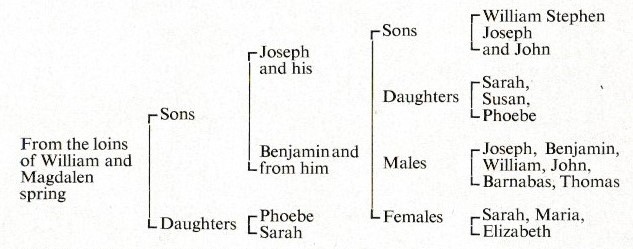
Doctrina Vitaque Greg(e)m (Qui Pasto)r Alebat. Christi Sereus Amans (Nun)c… Gloria Deo
The Latin should probably be translated:
“He who as a shepherd fed his flock with teaching and example, as a loving servant of Christ, has now once more sought his Master.”
In the Parish Register of 1613 occurs this notice: “Rev. William Browne clercke vicar of Horley having lived there the space of fifty years being of the age of four score years—four months departed this mortal life fourteenth of November and was buried the 16th of the same month.”
[Page 31]
CHAPTER 5
The Bristow Family
WILLIAM BROWN undoubtedly owed his position as vicar to the Bristows who, as lords of the manor of Horley, held the gift of the living though, at his induction in 1561, the head of the family was only a small boy often. They had always had the closest connection with the church, and, from the earliest list in the Accounts, when Wyllyam, Roberd and Jhon each paid their 2d., their names appear on almost every page. Benjamin, Richard, Walter, Henry, Robert, William, John and Thomas, either Burstow or Bristow, follow each other in all positions of responsibility in endless and bewildering succession.
Sir Edward Bysshe, Clarencieux King-at-Arms in the reign of Charles Il, and himself a descendant of the de Burstows, gives the key to their romantic ancestry, contained in one word on an old seal. It would seem that, in a deed giving the benefactors of the Abbey of Robertsbridge in the year 1190, there occurred the names of Stephen and Roger de Burstow, but on the seal attached they were expressly named as “Stephani” and “Rogerus filii Hamonis”. Now the FitzHamons were blood relations of the Conqueror and, like him, descended through the Dukes of Normandy from the Viking Rollo the Ganger, the scourge of English, Scottish and French coasts in the 9th century; but, unlike William, were not “Bastards”, the “Fitz” not bearing the stigma of later years.
Sir Robert FitzHamon, who died in 1107, bore the resounding titles of ‘Prince of Glamorgan, Earl of Corboile, Baron Therigny, Lord of Gloucester, Bristol, Tewkesbury, Cardiff, Conqueror of Wales, near kinsman to the King and general of his highness’ army in France”, and it was from his younger brother that Stephen FitzHamon, who had, it seems, acquired the manor of Burstow, was descended. As such the de Burstows were certainly the most important people in the two parishes. It was a curious freak of pronunciation which alternated the spelling of Burstow with Bristow for the family, while the village always retained the older form.
They were holding land in Horley by 1218, for sixty acres were released to Randolphe de Burstow in an agreement ratified at the Court of the Lord King at Bermondsey and dated “the 3rd year of Henry son of John”, The greatly coveted right to hold a weekly market and fair on “the even feast and morrow of St. Michael”, also granted by Henry Ill to John de Burstow on August 8th 1247, has already been described.
Only two years later come the echoes of a quarrel between this same John, now in the prime of life, and Peter of Savoy. It arose about [Page 32] hunting near Worth Forest, and became so acute that the suit reached the King’s court. Perhaps enough was told in “Early Days in Horley, Sidlow and Salfords” about this highly influential foreigner, uncle to the Queen, and his high handed depredations and cutting of trees, to show on which side the sympathies of the neighbourhood would lie. The first inquisition at Merton in 1249 states that ‘”the said John and his ancestors have always enjoyed the chace adjoining the forest of Worth up to the hedge of the said forest . . . nor were they ever impeded save by William de Wakehurst forester to Sir Peter de Sabaudia (or Savoy)”. A small point here is that William de Wakehurst probably lived at Rowley in Lowfield Heath, so that he was not far from the scene of dispute.
From Dover a writ was issued ordering that a jury “having no affinity with either side”, so that their findings would be strictly impartial, should enquire the date “when he was impeded in the enjoyment of that chace”. The final judgment must have given great pleasure to the de Burstows. In 1252 “‘The King accepts that John de Burstow and his predecessors always used the chace”, and further, ‘ ‘It is commanded to him Peter that he allows John to use the chace…. as they were accustomed to use it from ancient times and the time after the same”. “Accustomed use” gave a man a very strong position in medieval thought, and it is stressed again in the stipulation that he might not have any entrance into the chace other than he was “accustomed to have when the King committed the custody of those lands to him”.
At the end of the century John de Burstow was summoned to appear with horses and arms at a Military Council at Rochester, and the next year to perform military service in person against the Scots. Sir William, possibly a brother, must also have gone north, for he is described as “staying with the Earl of Warenne in the War of Scotland” Not only did they take their share of the fighting, but also a part in very early parliamentary government. John was returned as one of the two Knights of the Shire for Surrey in 1302 to one of the first regular parliaments of our constitution. Ten years later he was returned again, and he and John Hamme paid 4s. a day for attendance, plus journey charges—in all, the considerable sum of £19 4s. 0d.
By this time John de Rutherwyk had become Abbot of Chertsey, and was intent on making good his title to Abbey lands. William de Burstow certainly leased some of these, including land by the river “Emele” as has been written on page 13 and exchanges were made by which he received Mutteslond, Blackmores and Joyners “to be held of the Abbot”. The family also owned Hathersham and 120 acres in Smallfield, and the manor of Lodge (now Salfords). This seems always to have been let. It was held by Roger Salaman “by service of 36s. yearly and doing suit at John de Burstow’s Court every three weeks”, and later by John Bury. But by 1366 the de Burstows had sold the [Page 33] manor of Burstow, and only the Horley properties remained in their hands.
The first of the family, however, to become lord of the manor of Horley, with the gift of the living, was a certain Robert. It is very possible that he was born at Mutteslond (or Meath Green) in the house shown on the 1602 map, one of the places received in exchange from John de Rutherwyk and we read of him as churchwarden in 1525 and the following year. The family wealth was increased by trade. A Walter de Burstow had been a fishmonger as early as 1382, and Robert’s father and brother seem to have followed in the same profession, his father possibly being Warden of the Fishmonger’s Company.
Brother John the fishmonger finally settled at “his mansion house called Swaynes” in Leigh, and a tale about a later Henry, perhaps a grandson, makes superb reading. In an appeal in 1598 against Richard Lechford, lord of the manor of Shelwood, who, he declared, was “greedily thrusting after his lands”, Henry accuses him of having unlawfully assembled together a number of persons “armed and weaponed unlawfullie, some with long pikestaves, pitchforks and other unlawful weapons”, with which it seems they pulled down “one strong timber barn -and two oxhouses having in them 16 oxen”.
Worse was to come on July 19th when “Richard Lechford’s servants . . . about one o’clock after midnight forcibly did enter a close . and put in about 40 great cattle and one hundred great beasts more and the rioters sometimes on foot and sometimes on horseback chased the said cattle up and down till they had spoiled the grass, and afterwards drove away the cattle”. No comment is needed except to add that Richard Lechford was a Justice of the Peace at the time! One supposes that the “one hundred great beasts more” must have been young stock.
Of Robert’s two other brothers, Richard was a tailor and George a draper, and it was probably the latter who furnished the following account to Queen Katherine Parr in 1546:
“red, 5 coats for 5 minstrels. . .scarlet for a petticoat some grey for a coat for. . .the Queen’s foole also red for 5 coats for Queen’s players and red for a petticoat for ye Queen’s foole”. The total was £12 5s. 0d.
His nephew Nicholas also rose to great responsibility at Court, becoming Clerk of the Wardrobe of Robes and Wardrobe of Beds, in which capacity he travelled to Oatlands for the purpose of furnishing the house there with beds and other necessities; was in charge of the repairs at Hampton Court, which cost £911 4s. 0d; and through him £2,000 was paid to labourers working on the banqueting house “at the coming of the Admiral of France”.
A story is told that, when he accompanied Henry at the surrender of Boulogne, the King was so overjoyed at his victory that he flung [Page 34] his hat of plum coloured silk, trimmed with a small green ostrich feather, into the air. It was deftly caught by Nicholas, who was told that he might present it again on their return to England, when his services would be rewarded. He was finally given the rectory of Kympton in Hertfordshire, but, whether this gift was the outcome of his dexterity, we cannot say.
But to bring this long digression back to church affairs, Nicholas Bristow, as Clerk of the Jewels, was one of those to whom the jewels, plate, church ornaments and vestments received on the dissolution of the religious houses were to be entrusted for the King.
The break up of the Monasteries, with all that this implied in the sudden change of ownership of church lands all over the country, had also brought upheaval to Horley, and when the last monks left Chertsey Abbey, an end had come to six hundred years of continuous and steady ownership. The manor was quickly appropriated by one of Henry’s courtiers, Sir Nicholas Carew, but his time was short. Losing the King’s favour, he also lost his own head, and the land reverted to the Crown. It was given to another land “speculator”, Sir Robert Southwell, who also held Charlwood. Finally, in 1543, Sir Robert sold to Robert Bristow, but it is sad to think that the first local lord of the manor only lived for two more years to enjoy his possession.
His will, which he had made less than three weeks before his death, was read by the vicar, Richard Lucas, on December 8th 1545, his son Robert, then aged eighteen, being present. His estate included the manors of Horley and Lodge, the advowson and rectory of Horley with the tithes and glebe, two houses, a watermill and 280 acres. Two years before he had also bought 500 acres of furze or heath, but these are not mentioned at the later date. He left “a third of his estate to the king, according to the statute”, a third to his son Robert, and another third to his wife Anne, with the express provision that she was to live at the rectory.
This mention of a rectory is intriguing. Probably Robert lived at Court Manor Farm and, as he was lay rector, this was then known as the rectory; while the vicarage where Richard Lucas must have lived, was the house taken two hundred years before from Michael de Waps, as has been written on page 13.
Robert’s son Robert married twice, but died as a young man of thirty-two, expressing a wish to be buried in the chancel of Horley church. But a further and greater tragedy was in store for Horley, as well as for the family, when his small son also died in 1563 aged only twelve. It was during his short minority that William Brown was chosen as vicar, and the next eleven years after his death were spent in a lengthy lawsuit between his stepmother Lucy (who later married Edward Whyston), and his four aunts, Joan, Margaret, Anne and Agnes. These ladies had all married local men, Robert Jordan, [Page 35] John Woodman, George Taylor and Thomas Twynor, and the curious thing is that, though Lucy had a son John by Robert Bristow, John’s share was only Horley Mill and the surrounding land, when the suit was settled in 1574, while the manor was divided between his four aunts. They seem to have cared little for its possession, and all finally sold their quarter share to Sir Mathew Carew, who already owned Kinnersley.
Though no longer lords of the manor, Bristows have lived on in Horley from that day to this. Through good days and bad the work of churchwardens, overseers of the poor and surveyors of the highways went on without a pause, and Bristows took a leading part. John was warden in the last year of the century when he “’gave up his Account which came to £9 0s. 0d.” They had houses in many parts of the parish —Edmonds, Benhams, Crichland (Crutchfield), Massat Land, Meath Green, Wolvers and Hookwood all belonged at different times to members of the family.
To come to more recent days, Canon Rhodes Bristow, one of the Canons of Southwark Cathedral, is still vividly remembered for his vigorous preaching and strong sense of humour. And closer at home, and even nearer in time, at Haroldslea Farm Mr C. Bristow is making his name famous in the fat stock world. Among his awards in the three years between 1956 and 1959 are Supreme Champion, Reserve Champion, Overall Champion and Breed Champion. Surely a noteworthy effort this, to bring Bristow history up to date after at least 769 years of continuous history in one corner of Surrey.
CHAPTER 6
Under the Ownership of Christ’s Hospital 17th century
MATHEW CAREW had bought Kinnersley in 1587, and, by the next year, all four portions of the manor of Horley had fallen into his hands. For these he held two “courts” in the old rectory. In the Court Rolls of 1591, we read: “View of Frank-pledge of the Lady Queen with the first Court Baron of Mathew Carew Esq”. Here the freeholders and tenants ‘”acknowledge Mathew Carew to be Lord” and “each pay one penny for return of Seisin and Service”. However, Carew’s ownership was shortlived, for by 1600 he had sold to a certain James Cromer, who quickly resold in 1602 to Christ’s Hospital.
The Churchwardens’ Accounts make no mention whatever of this transfer, which must have taken place while Henry Lechford and Anthony Morton were churchwardens. It is only noted that, this year, “there remayneth seven and fourpence more than they have layd out”. [Page 36] The year before Nicholas Charrington and Richard Fenner had “made even with the church”.
If the Accounts are reticent, the Court Rolls give again a full account with the imposing heading “View of Frankpledge with the first Court of the Mayor Commonalty and Citizens of the City of London Governors of the Possessions and Revenues of the Hospitals of Edward King of England the Sixth of Christ’s, Bridewell and Saint Thomas the Apostle held there on the sixteenth day of May in the year of the Reign of our Lord, James . . . the first and of Scotland the thirty-sixth”.
There follows a very long list of landowners who have “defaulted”, by not attending the Court, and it is noticeable that Charles, Lord Howard, Earl of Nottingham and High Admiral of England has his fine, which in Mathew Carew’s time stood at 4d. raised to 6d., as do John Poyntz Esq., Henry Medler, Bartholomew Fromonds and Wm. Bond. It is also clear that a larger number than usual of tenants are “given a day” both to mend bridges and clappers, restore common boundaries and “rayles” and, as usual, to cleanse their ditches. In the matter of “spiced cakes”, Agnes Shoe and Bernard Humphrey are presented for breaking the assize. The new broom was attempting to sweep clean, but the court next year seems to show that success was not very great and, though the defaulters above had their fine raised further for this one year to 2s., Horley was still content with its broken down bridges and blocked ditches, and was still in trouble over the Common, and even “in mercy” for not “sufficiently repairing the stocks”.
To Horley, one of Christ’s Hospital’s most interesting possessions, is an old map probably drawn at about the time of purchase in 1602. This is now most beautifully restored and in safe keeping at the Surrey Record Office at Kingston-upon-Thames. Its value is enhanced by the fact that it shows not only farms and houses, but in many places gives the names of their owners at that time.
CHRIST’S HOSPITAL
The situation in London which lay behind the founding of Christ’s Hospital and the later purchase of Horley and other manors was truly appalling. The monasteries, to whom the poor and neglected had looked for succour and charity, and in which about one-fifth of the entire population is said to have been cloistered, had been dissolved. The streets of London were pitiful with the wrecks of humanity, those who were too young or too old to care for themselves, cripples, disabled soldiers, and beggars of every description.
Sir Robert Gresham, Mayor of the City, wrote in 1538 to Henry, his “most dradd beloved and naturall Soveraigne Lorde”, suggesting a remedy for the “ayde and comfort of the poor syke, blynde, aged and impotent persons beyng not able to help themselffes nor havyng no place certen where they may be refreshed or lodged at tyll theybe [Page 37] holpen and cured of their diseases and sickness”. He begged the King to give orders that the three Spytalls or Hospitals of St. Georges, St. Bartholomews and St. Thomas be given to the Mayor and Aldermen. This, after some delay, Henry agreed to, not only for the “greate paine and sorrow” of the poor and sick, but also because of ‘ ‘the greate infeccion, hurte and noyance of his Grace’s lovinge subjects, which of necessitie must dailie goe and passe by”. To these was added the church and site of the late Grey Friars, which, with other land adjoining, was to be used under the new name of Christ Church.
Henry died soon after signing the indenture, but the young Edward, having his heart touched by the pleading of Ridley, Bishop of London, and the prayers of his Court Preachers for those who “lye and creep, begging in the miry streets of London and Westminster”, took up the work “knowyng it to be the expresse commaundement of Almightie God to have compassion of his poore and nedie members” The Bishop, two Aldermen and six Commoners met the young King, details were drawn up, and the Charter bestowed only a very short time before his death. The proposals were that Christ’s Hospital was to become a home for “fatherless and other poore mens children” who could find there meat, drink, clothes, lodging and learning; that, considering the “corrupt nature of the children whoe being taken from the dounghill mighte one infecte another”, a sanatorium was to be opened at Finsbury, and infants kept in the country. For the lame and aged shelter should be provided at St. Thomas’ Hospital in Southwark, while the “ydell and lustie roges” should be consigned to a workhouse. Finally “Lazars” must be kept off the streets on a weekly pension.
So the streets were gradually cleared, the first tentative experiment towards the Welfare State came into being, and social work was being attempted apart from the Church. By 1552 Christ’s Hospital was opened to three hundred and eighty children, and, though it was admitted that the great problem of the first beadles was the running away of the inmates, and even that a number of them “being taken from the dunghill, when they came to the swete and cleane keping and to a pure dyett, dyed downe righte”, the great work went steadily forward. These early troubles over, education became the major preoccupation, the Foundling Hospital took its place as a Free Grammar School, and in 1566 the first “Blue” matriculated at Cambridge.
DAME MARY RAMSEY
Finance was naturally an abiding problem, the money received from the “poor boxes” in the various wards of the City being totally insufficient. To the credit of the first Governors “They fyrste thoughte good to begynne with themselves”, and each gave £10 or £20, according to their ability. Many other donations and legacies were received, and chief among these, towards the end of the century, the most munificent gifts came from Dame Mary Ramsey, widow of the Lord Mayor.
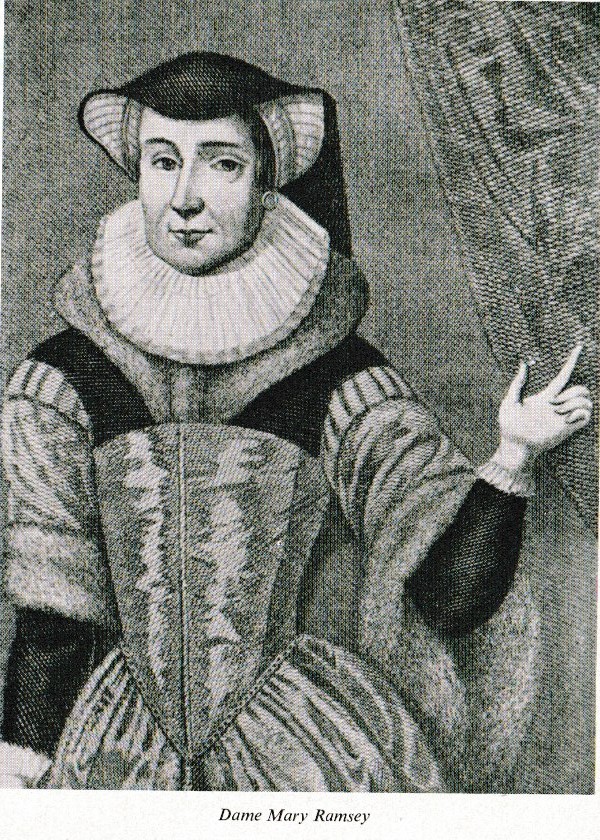
[Page 39]
Her good deeds are delightfully set forth in a tablet in the Christ’s Hospital church, and give not only a wonderful picture of the lady’s liberality but also of the bitter needs of the day.
“Behold the Workes of God done by his Servant Dame Mary Ramsey.
She hath given a yeerly maintenance for two Fellowes and four Schollers in Cambridge.
More, two Livinges of good value when they shall be come fit to supply them.
More, towards certaine Sermons to be preached in this Church yeerly.
More, in Christ’s Hospitall a free Writing-Schoole for poore men’s children.
More, in the Country a free Grammar Schoole for the poorer sort. The rest of the godly Workes done by this good Lady. She hath given a worthy maintenance to the poore of Christ’s Hospitall.
More, a bountiful gift for the healing of poore wounded Souldiers.
More, a liberall maintenance for ten poore maimed Souldiers.
More, a liberall maintenance for ten poore aged Widows.
More, a bountifull gift to release poore men out of prison.
More, a bountifull gift to relieve poore men in prison.
More, a yeerly Stipend to poore Maides Marriages.
More, to the reliefe of the Poore of foure severall Parishes. All of which severall gifts are for ever, (dated) 1596.
The “ten poore maimed Souldiers” each received a coat, cap and pair of shoes in addition to a pension of £2, but it is with the “bountifull gift to release poore men out of prison” that Horley comes into the picture. One gift of £500 was to be spent on buying lands in London, Middlesex and Surrey, the income from which was to be used “for the relief of such prisoners as should lie in execution or otherwise in the prisons of London or Southwark, who are detained in the said prisons for the sum of 40s. or under”, with discretion to pay more than 40s. ‘”for prisoners of good repute and behaviour”, but such toleration to be used as sparingly as might be, her object being to “encourage them that lie miserably imprisoned for trifling sums”.
With the capital the Governors purchased land at Horley, comprising the manor and advowson, and rather later Westlands Farm at Hookwood, Duxhurst and Collendean.
The prisons would have included Ludgate, Newgate, Marshalsea, White Cross, Southwark, King’s Bench and the Compters of Wood Street, but, alas, there is no means of knowing how many poor wretches were saved by money from Horley rents. By 1849 debt for less than £20 was no longer punishable by imprisonment, and after the Bankruptcy Act of 1861 no more claims were received and the [Page 40] money was finally transferred to the Hospital’s General Fund for education. However the pensions, £12 per annum to three maimed soldiers, and another £12 per annum to three widows, are still continued.
SMITH’S CHARITY
Dame Mary Ramsey’s benefactions were rivalled by those of Henry Smith, silversmith, and “Smith’s Charity” is still to be seen posted up year by year at Christmas time. The following account is taken from The Free Men of Charlwood.
“Many romantic legends surround this name. One calling him Dog Smith, tells how he went, disguised as a beggarman, from village to village accompanied by his faithful dog, for whom he never failed to beg a bone. Another legend tells how, having begged in every village in Surrey, he allocated his charity accordance with his reception. How in Newdigate a woman taking pity on the poor, cold beggar-man, stripped off her red petticoat to wrap around his shoulders, and so to Newdigate he left his money to distribute red petticoats among the poor women of the parish. To Rusper, where he was whipped out of the parish, he left horsewhips for the carters, and in Charlwood, where he was received more kindly, with a good meal of bread and meat, he bequeathed money to buy bread and meat for the poor.
“These legends have gone the way of much that is picturesque, for it is now known that Henry Smith was a silversmith of Silver Street, Cheapside. He was born, of humble parentage, in 1548 at Wandsworth, and amassed great wealth in his trade, which at that time, included that of banking and money lending, both of which were exceedingly profitable. He rose to be an Alderman of London, but his personal needs remained simple and, though married, he had no children. He invested his money in land, and in 1620 appointed trustees to devote the revenue to benevolent purposes, reserving only £500 a year for his own use. Many and various were the causes to which he devoted his munificence, The poor, the aged, the infirm, the apprentices and the workless all profited. He founded a scholarship at Cambridge, and left money ‘to redeeme poore captives and prisoners from the Turkish tyranie’.” Here indeed is the same cause to which Horley subscribed fifty-four years after his death. “He gave £1000 to each of the market towns of Surrey, and every parish in the county, except three, eventually benefited by his generosity. Varying sums were allocated to the villages.”
Horley’s share originally came from land in Worth which, in 1786, produced £5 12s. 6d. This was later sold, and the money now comes through the Charity Commissioners. About a hundred years ago Robert Blundell of Benhams was distributing the gift in church just before Christmas. It then took the form of warm clothing and material. [Page 41] Today Mr. Blundell’s granddaughter, Mrs Hughes, is Secretary to the four trustees who still administer the gift locally, and last Christmas £85 was divided between elderly people and widows with families to maintain. The scrutinizing of Smith’s Charity accounts and report is always the Parish Councils’ first duty at its Annual Meeting.
APPRENTICES
How did Horley care for its own poor in the 17th century? There is no mention either in the Accounts or in the Court Rolls of any workhouse in the village, though one seems to have existed, but, in accordance with the great act of Queen Elizabeth, Overseers of the Poor were regularly elected from 1604 onwards to carry on the work begun by the churchwardens, and every person had by law to contribute towards this end. Their duty was not only to maintain the poor, but to set them to work, and, in the case of children, to apprentice them nominally to a trade, but more often, one fears, as boy or girl of all work to some local master who had no choice but to receive the child.
There are seven apprenticeship orders in the Accounts, clearly written in great detail and often signed. In the case of Ann Williams, who was taken by John Chelsham, “he muste keepe the said Ann sufficient and untyll she come to xxjti (21) yeres of age”, and for this he received a mare and a colt from the girl’s father “in full sattysfaction”, and duly made his mark, being unable to write.
An Chamley’s father was dead when she was apprenticed to Jeremy Shooe, who received her with some household stuff to the value of 6s. 8d. He was also to be “eased in not paying to the poore for four years to come”. It is evident that the poor rate was a very real burden on all householders. This is on January 13th 1604, and is the first mention of overseers, of which there are three—Robert Woodman, Thomas Leacheford and Robert Burstow, though after this there are never more than two.
Susan Washforde was bound to Bernard Humphrey who had a place in the second seat in church, until she was twenty-four, “he to keepe her and finde her sufficient meate, drinke and apparell’ and for this he received a cow from the widowed mother. Her brother went to Ifield to be taught the trade of a tailor by Edward Woodman, and whose signature in the old book is exceptionally neat. Perhaps the boy was likely to be of more use than his sister, as Woodman only received 2s. from the overseers.
The only other definite trade mentioned is that of a shoemaker. This agreement bears not only the “marks” of the churchwardens but the signature of the famous vicar William Brown.
OVERSEERS OF THE POOR
Of their manifold other day to day duties, setting to work the able, relieving the sick, maintaining the poor and aged, either in work houses and by out relief, in money and clothes, etc. etc., there is no mention, probably because they were all in the day’s work, but overseers’ accounts were always kept separately from those of the wardens. During the Commonwealth they note 1s. 4d., 13s. 3d. and £4 17s. 3d. in hand in three consecutive years, but much more interesting is the mention, in 1667, that Richard Allingham and John Holmes “disbursed this last year £37 15s. 2d.”. Three years later only £22 13s. 0d. was spent, but after this expenses mounted steadily, and by the last year of the century had reached £82 0s. 5d.
It was this rapidly rising poor rate which led to the disastrous Act of Settlement and Removal which empowered the Justices to order the removal to his place of birth of any person renting a dwelling of less than £10, unless he brought with him a certificate from his own parish that they would take him back should he or his family become chargeable on the rates of the parish where he wished to settle. So the ratepayers sought to cover themselves, but it was partly this policy, together with the rapid rise in population, which led to the wave of pauperism which engulfed the whole country in the following century.
SEATING IN CHURCH
In one great particular land owners had a distinct advantage over their poorer brethren from the fact that a seat in church belonged by right to the occupiers of certain farms or land, as was stressed in “Early Days in Horley, Sidlow and Salfords”. There are two lists in the Accounts. The first in 1604, while William Brown was vicar, is very clear and neatly written and well spaced. It has sixteen names, and of these six used their own pews.
Richard Killick dwelling upon Wyes
Richard Todd usinge Lodge Mill
Nicholas Tulley for landes called Stiveildes
William Brooker for landes called Neweman’sfeild
William Weathered for landes called Hostlers
William Nye for landes called Christmas
Margret and Joane, the wives of Nicholas Tulley and William Brooker sit together with Anyse Dawlinge in the last seat. Seven others had also seats to dispose of “to whom he shall assigne it”.
It must be remembered that, in pre-Reformation days, the churches were bare of pews. Sometimes in the larger buildings a stone seat round the wall supported the old and infirm, and gave rise to the saying ‘ ‘the weakest to the wall”, but pews became more of a necessity with the vogue of sermons, when gradually “the exaltation of the pulpit accompanied the neglect of the altar”. Seats were allocated by the wardens in return for pew rents, and in Horley there was definitely “the formoste Seate” for Richard Killick, Thomas Saunder, Richard Todd and Robert Jordan, and the “nexte Seates” for the others.
[Page 43] Thirty years later a second list augments the first, the seats being for different holdings. The occasion was important, a new page was started well on in the book, and is firmly headed:
“The 5th of November 1634.
Memorandum the day and yere above written it was consented and agreed upon by the Minister and churchwardens parissoners of Horley that certaine seates within the North side of the Church of Horley should be disposed to these Inhabitantes of Horley as followeth videlicet.”
The minister was William Waller and there are about thirty-four names, including one woman, Widdow Rowlye. Many places still well known in Horley are mentioned, Benhams, Landons, Bures, Edgeworth and Cottinghams among them. The list ends conclusively “These setes were winescoted and planked and repared and paide for them above written”. There can have been no further argument as to the seating in the old north aisle of Horley Church !
One year before the great repairing and wainscoting of the seats took place a little entry throws light on church manners in Horley at that time. “John Ansteye is chosen by the consent of the minister and parishioners to see if ye younge men and boys behave themselves decently in ye church in time of Divine Service and sermon, and he to have for his panes 2d.”.
THE COMMONWEALTH
During the upheavals of the Commonwealth the south eastern countries were solidly behind Parliament and against both the King and the high church tenets of Archbishop Laud. Many among the congregations of the village churches were only too pleased to have an excuse to turn out their ministers as “malignant persons”. In Charlwood Thomas Mulcaster, the rector, was proceeded against— as it was written later—by “five or six of the very scum of the parish”, driven out and forced to earn a living as a schoolmaster at Merstham. Even there he was “Harassed and Perplexed by the Soldiers and on many a time in Danger of His Life”.
Much the same seems to have happened in Horley, (and it well be that the fine glass mentioned by Manning and Bray as existing in 1619, was destroyed at this time.) for we read that in 1647 Henry Prince was put in by the Parliamentary Commissioners but that in 1649 Mr. Aims (or Aymes) who was then vicar was summoned to the Court at Christ’s Hospital “to answere a complaint made against him for absenting himselfe from his cure for six weeks together, in all wch tyme he hath not preached to his parishioners there, but left them destitute”. The reply they received from the poor man shows his predicament. “It was” he said “in regard of some [Page 44] troubles that Mr. Jourdaine and 3 or 4 more of ye Parish which hee saith are Annabaptists had brought upon him by accusing him to ye Parliament for being a Malignant. Whereupon he was summoned upp to London to see what they would charge him withall and feed Counsell to pleade for him, and afterwards they used means to imprisson him and so deprived him of his libertie, and is at this present as he alleadgeth by their means sequestered from his living, soe that he could not performe his dutie and office as otherwise hee would had done.” Money must also have been very short, since for the past year he had “but £4 for his labour and paines bestowed among them, where off hee saith hee hath paid about £3 10s. 0d. to ye Parliament”, and it seems that he intended to “make his peace if hee may” or else resign.
In the Parliamentary Surveys of Church Lands, which took place between 1649 and 1658, it is stated that “Horley P’ishe hath a parsonage and a Vicarage under Christ’s Hospital the Vicarage and Glebe worth £50”, but, what is a little ominous for Mr. Aymes, it continues that it is “Unprovided with a preaching Minister by reason of late Sequestration”. However a curious little entry in the Churchwardens’ Accounts in that same year 1649, in very neat new handwriting, gives grounds for hope that he returned. The churchwardens are chosen only “by consent of the parish”, but this is followed by the entry “John Aymes for Overseers for ye poore, Henry Bonnicke, Robert Mansell” and the next year the churchwardens are chosen, and the accounts accepted, by “the minister and parishioners”.
The Parish Registers of these years make interesting reading. Though baptisms continue uninterrupted, and the writing is most neat and orderly, there is a complete gap of about six years in both marriages and burials from 1646, after the final defeat of Charles, to 1652, three years after his execution. In 1653 the custody of the registers was taken out of the hands of the ministers, and the following year it was ordained that the marriage ceremony should no longer be solemnized in church, but entrusted to a secular justice. Horley certainly complied. In a note in the register dated April 22nd 1654 is written “the parish register for marriages as well as burials was by Thomas Moore Esq., one of the Justices of Peace for County of Surrey the day and year above….”, and his signature occurs for two years. There are a lot of burials in 1654, and even more marriages “by John Coocke” minister of Burstow in 1658. Either it was that more were entered in the register, or that Horley was making up for lost time; and that two years before the Restoration.
Whatever the position of the minister, the churchwardens, overseers and surveyors from exactly the same families Woodman, Round, Bristow, Charrington and many others continue to be “chosen”, and served their year without a break. Though the “king’s” highway was a thing of the past, and John Sanders of Colingdean [Page 45] and Robert Palmer are elected only as “surveighers of ye highwayes” otherwise the work connected with the church, the poor and the roads continued uninterrupted, and in this last connection modern surveyors may look with some envy at the price of stone and carting in the following bill of round about 1700.
Paid Richard Cuddington for fetching of 20 load of stone £2 16s. 0d
Paid him for 6 loade of ston 6s. 0d
Paid Nicholas Whitmore for spreding of stone 2s. 0d
Paid William Perken for 2 load of ston 2s. 0d
My own team fetched 4 load of ston 12s. 0d
Paid Nicholas Whitmore for spreding of ston 9d
ARTHUR FENNER
The year 1646, in which the gap occurs in the Parish Registers, is also remembered in America! The link between the Old World and the New being in this case the Fenner family, long connected with Horley Church. In 1601, for instance, as churchwarden with Nicholas Charrington, Richard Fenner “made his accompt uppon the 27th day of December and made even with the church”. They were large landowners, and that same year Thomas the Elder of Horne died, leaving Tanners and Little Harrowsley to his youngest son and Lakeland to his eldest son Arthur.
Here is the interest. Arthur Fenner, who married Sarah Brown in 1613, the year her father the Rev. William Brown died, had, five sons. Of these, three, Thomas, Arthur and John, all left England in 1646 for the New World, and have descendants living, one of whom made the return pilgrimage to Horley this year.
As a young man Arthur had been an Ensign in “a troop of Horse under Lord Cromwell”. In Rhode Island he certainly made his mark. He bought his first six acres of upland in 1650 and, after a roving life and many changes, found himself, when trouble arose with the Indians, commissioned as “Chief Commander of the King’s Garrison in Providence”, and later as Governor’s Assistant and then Deputy. One wonders if the following little notice throws any light on his successes. “Everybody agreed that Capt. Arthur Fenner brewed the best beer in Providence Plantations. It commanded the high price of three shillings a keg. When the good Captain died his formula was publicly released. Among the ingredients such as malt, molasses, sweet balm and sage, the Fenner beer contained 1b. of finely ground iron.”!
Fenners lived on at Little Harrowsley until 1774, and longer in the neighbourhood, for in 1822 another entry in the Churchwardens’ Accounts shows – a William Fenner in charge of Smith’s Charity, and also giving out the bread each Christmas, at the cost of about £15 a year. [Page 46]
ENGLISH CAPTIVES our OF TURKEY
While no reference is made to the Restoration, the first and indeed the only, notice in the old accounts of Horley giving money to an outside object is found in 1671, when’ Charles Il had been back on the throne for about eleven years. The heading is as follows: “The names of such persons in our parish of Horley who did contribute toward the Redemption of our English Captives out of Turkey with the perticular summe what each individuale parissioner gave”.
This was no local collection, but the response to a national appeal for the relief of our own people whose misery stirred the hearts of church people throughout the country. A forerunner of the wider sympathy for the refugees of many lands and the immense effort being made on their behalf in the present year.
The list was headed by Mr. Mansom with 5s., and this was equalled by John Shoue (evidently a rich man for he gwve a bell to the church), and Thomas Perkins the vicar, but no sum was too small to be noted. John Weller and Francis Woodman gave 2d. each, and through gifts of 4d., 6d., 1s. and 2s. 6d., the fifty-one donors reached the grand total of £2 15s. 11d. The money was taken to St. Saviours, now the Cathedral at Southwark, and presented with many other such offerings at the Biship’s Visitation. The receipt “Rec. of Mr. Perkins Vicar of Horley £2 15s. 11d. Towards the Redemption of Slaves is stuck in the 2nd volume of the registers. Horley must have felt that, for such a small community, it had not responded unworthily to such an appeal, and it is sad to think that piracy in the Mediterranean went on as a very real danger up to the time of Nelson, some 140 years later.
This chapter may well end with a bill found among Sir John Charrington’s papers, which, if it shows a considerable amount spent on eating and drinking, yet does not stint on the sermon. Who “my Father” was is unknown, but probably a Horley man.
“The burial of my Father who died this twenty-fourth day of June, buried 27th, 1677.
For three bushels of wheat 12s. 0d
for shrub (a cordial made from fruit juice and spirit) 10s. 7d
for butter for a barrel of beers 5s. 0d
for a coffin 10s. 0d
for the Clerk 2s. 0d
for a sermon 10s. 0d
£3 3s. 7d
CHAPTER 7
Sidelights on the 18th and 19th centuries
AFTER THE violent changes of the Reformation and no less violent interlude of the Commonwealth, the Church of England as a whole settled down in the first three-quarters of the 18th century to a peace that bordered on stagnation. It was even perhaps a little difficult to find the way to Horley Church. Manning, writing as late as 1809, says “The church stands half a mile from Turnpike, Reigate to Crawley, but no road passes it and whoever goes to it must return by the way he went. The road passes Gatwick. You cross the Mole here, a stream of no great size, by a wooden bridge, and by a circuitous lane find your way to the church, having gone a good way beyond it”
Inside, the family pews, already a hundred years or so old, still gave a place for a quiet nap during the tediously long sermons. “The old seats disguised by the addition of a top gallant bulwark to keep out the draughts and curiosity and facilitate a quiet snooze.”, as they were described by Major Heales in 1877 in his article in the Surrey Archaeological Collection.
Nevertheless the whole structure of life was about to change. In the Midlands and the north the industrial revolution was getting under way, and by the end of the century every coach from the south must have brought news of the upheavals of the French Revolution. There were many reasons to cause the Church to turn in her sleep, and far sighted men to preach reform and, among others, endless praise must be given to the vision and work of two brothers, John and Charles Wesley, and their friends in the great Methodist movement. This they definitely started within the Anglican Church, of which the Wesleys remained priests for the whole of their lives, and in which Charles’ wonderful hymns of faith are still sung by countless congregations up and down the country.
Some old Horley bills from the beginning of the century show that minor repairs to the church were being carried out. In the first “beer at the ringing, mending the bell wheels and wine and bread for the sacrament” came to 17s. 8d. Bell ropes cost £l 5s. 4d., and further work on the bells and bell brasses £3 16s. 7d.
Probably John Thorpe was a first rate carpenter, but his spelling is somewhat imaginative. This is dated March 19th 1721.
“Then received of James Rosel the som of 15 shillings in foll for mending the gotaes (gates??). At Horley Church. I say received by mee John Thorpe.”
And the next year [Page 48]
The plommers bill for work don at horley Church the 20 of September 1722.
for new casting of 10. 3. 12 poundes of ould lead £2. 14s. 4d.
for 9-3-3 poundes of new lead at 18shillings pr lb. £8. 16s. 0d.
for 48 poundes of sothar £1. 16s. 0d.
for 5 days work for 3 of us £2. 0s. 0d.
for half a days work for 2 of us 2s. 9d.
£15 9s. 1d.
In a glazier’s bill for ‘ ‘worck done at horiey church” in 1723, 78 quares cost 6s. 6d., and a further “I foots and 8 inches new leaded and 9 foots repaired” 1s. 6d.
These repairs were all carried out while Samuel Billingsley was vicar, and the church was again “repaired and beautified” in 1790 during the incumbancy of Peter Whalley. One year later, he was followed by William Sparrow, perhaps a delicate man, who seems after thirteen years to have found the damp of Horley insupportable. Here, at any rate, is a licence from his Bishop giving him leave to be absent.
“We Brownlow, Bishop of Winchester, hereby licence you William Sparrow, Clerk Vicar of Horley in the County of Surrey within our Diocese and Jurisdiction, to be absent from your said Benefice for two years from the date hereof, on account of the actual Infirmity of Body of yourself and your wife, it being medically certified that you labour under a Pulmonic Complaint and further on account of your serving as a Stipendiary Curate at Walthamstow in the County of Essex. Given under our hand this first day of January in the year of our Lord 1804.”
It was lucky for Horley that he left a most energetic curate whose name appears in a wonderful “Plan or Map of the Church-yard of the Parish of Horley… showing Burying ground of every Several Family Seating in Church etc. etc. Taken in the year 1806 by the Reverend Samuel Steele and Martin Bray Jun.—Ambrose Mansell, Richard Flint, Churchwardens”.
So runs the inscription, and the plan has many points of interest. It shows that the box pews, in which the congregation sat, were each still definitely allotted to a particular dwelling house, as in the 1604 and 1634 lists, the difference being that in the early lists it seems that only one seat for the occupier was specified, while in 1806 he had the whole pew and so apparently would have had room for the family. In fact, across several of the pews in the nave is written “Womens seats”. For these pews the occupants would have paid pew rent and very possibly kept the key. Petridge Wood, Horse Hills, Horley Mill, Newnhams and Wyatts are shown both in the early lists and the 1806 plan, otherwise the names have changed.
[Page 49]

Not only the nave and north aisle are full of these seats but they also stretch up into the chancel where the Vicarage, Lodge, Court Lodge and Kenersley all have pews. Here, too, on the north side, steps led up to the pulpit, below which was the reading pew, and next that another for that most essential person, the parish clerk. In the old chapel of St. Nicholas, which had been modernised and went by the name of the Bastwick Chapel, (perhaps a corruption of the word “Gatwick”?) and which opened into the chancel from the south under a flat timber beam, were more pews. These belonged to Horley Land and Lady Land, with a large pew for Gatwick and two more for “Gatwick Servants”. This is the only house except the Vicarage whose servants had special seats. “Doctor Borer on the Common” sat in the north aisle.
The first pew in the nave belonged to “Blundells, Horley Mill”, and behind this are eight others filling the whole space to the west door. Above this was one of the Minstrels’ Galleries where the singers and musicians sat. By great good fortune four bound books of metrical psalms and anthems, sung at this time in Horley Church, have been preserved, handed down for over a century from father to son. The paper has a watermark of about 1825, and the music, copied from many sources, is beautifully written by hand. Each book contains a separate part—treble, alto, tenor and bass—and Mr. Blundell Edwards who has them in safe keeping writes: “The reason for a [Page 50] single line in a big book is that it could be propped up, or held up, in front of the instrumentalist and over his shoulders the singers could read their part”. This picture of the old choir is made the more delightful by the knowledge that two brothers King, from Dean Farm, Salfords, always came in their smock frocks. These early musicians, who thus led the singers with either flute, clarinet, violin, cello, or bassoon, would all have owned their own instruments, but sometime later the first organ was installed and this was most curiously placed in another gallery over the north door as may be seen in the picture on the previous page.
To return to the plan of 1806. Here, most curiously, the Salaman monument is briefly described as “Hermit”. Why a figure in full armour should be taken for a hermit is something of a mystery. Only one free seat is shown in the nave, but other benches which ran along the chancel walls on each side of the altar and a timber seat almost in front of it, are also “common seats”.
A most meticulous plan of the surrounding churchyard shows to which family each group of graves belonged; who had head rails and who the more permanent tombs. Halliday, Constable, Woodman and many other well known names are shown with their exact place of burial. Not only did Samuel Steele have a major part in making this careful plan, he was also responsible for buying the old chest in the vestry for £4, and he was still in charge when the great decision was taken to scrap all the old bells and hang an entirely new peal.
THE NEW BELLS
A most detailed description is given in a later volume of the Churchwardens’ Accounts of the buying of these new bells in 1812, when James Brazier and John Newnham were churchwardens, and of the considerable amount spent by parishioners.
The first entry is of a notice given out in church, on November 17th 1811, that “the peal of bells being very much out of repair . . . one cracked . . . That the churchwardens desire the inhabitants of this parish to meet them at John Millers the Six Bells on Friday next at 4 0’clock to consult concerning the repair of the Bells”. At this meeting, on November 22nd, attended by Mr. Mears, the bill for liquor amount to 17s. 6d., but the important meeting at the Six Bells took place nearly a month later. Here three estimates from Thomas Mears, who also on examination had found “the timber work going into decay”, were “distinctly” read by the vestry clerk, William Ede. The first, of £498. 13s. 8d., with an allowance of £300 for the old bells, leaving £198 13s. 8d. to be found by the parish, was accepted. This was “To cast a peal of 6 good and musical church bells in tone and tune” and to include six new clappers at £7 7s. 0d., six stocks and six wheels £62 0s. 0d., and six new setts of ironwork etc. etc.
The names of those who signed the book, and to whom all honour [Page 51]
is due for having chosen the best bells, and so the most expensive estimate, are S. Steele, minister, John Newnham, James Brazier, churchwardens, James Halliday (his mark), Nich. Sanders, Ambrose Brooker, James Packham, Edward Tullett, Rich. Blundell, John Miller, Martin Bray, James Peters, Edward Banks and Thomas Humphrie, inhabitants. (The population of Horley in 1811 was 942 persons.)
The question of transport came up the following March, and it was decided “that Edward Tullett of Horley should take up the old bells to the foundry and bring back the new bells . . . he to have Eleven Pounds for the journey”. It must however be remembered that the main road to Redhill was not yet made, and when the great day arrived and the six bells were loaded on to Edward Tullett’s waggon, it was found necessary to harness three more horses, belonging to Mr. James Packham, to drag the waggon to the ‘”Turnpike Road leading from Horley Common to Reigate”. However, it seems that the whole journey, taking the old bells to Whitechapel, and bringing back the new, only took five days from Saturday, 20th June, to Wednesday 24th, and on July 1st they were triumphantly rung.
The Rev. Samuel Steele, curate, and James Bray had been up to check the weights, which will be of interest to bellringers, the new bells being 2 cwt lighter.
6 Old Bells 6 New bells
Treble 5 cwt 3 qtr 14 lbs 5 cwt 2 qtr 0 lbs
2 6 cwt 0 qtr 15 lbs 5 cwt 3 qtr 5 lbs
3 7 cwt 3 qtr 5 lbs 6 cwt 3 qtr 5lbs
4 7 cwt 1 qtr 8 lbs 7 cwt 3 qtr 11 lbs
5 9 cwt 1 qtr 7 lbs 9 cwt 2 qtr 7 lbs
Tenor 13 cwt 3 qtr 25 lbs 12 cwt 3 qtr 8lbs
Total 50 cwt 1 qtr 18 lbs 48 cwt 1 qtr 8 lbs
Apart from the cost of the bells themselves and transport, there was a certain amount of incidental expense. Mr. Newnham of Ardingly had £l Is. 0d. “for his trouble in examining the bells with regard to their being in tune”. New bell ropes cost £3 14s. 0d., and the great dinner for twenty-nine inhabitants, £3 19s. 9d. which included the ringers’ fee to open the new peal. Again in 1813 : “To John Miller for new and sound Holes and Timber to strengthen the Tower £23 14s. 3d.” On the new 3 bell an inscription was made that “Henry and John Shoue gave the original in 1673”.
The two additional small bells of 3 cwt each, “making the peal complete of the Eight”, were hung in 1839, and a long list of subscribers entered in the Accounts.
[Page 52]
THE BELLRINGERS
No list of the bellringers on that great occasion in 1813 has been found, but that they have been worthily followed is shown in the Attendance Books of the Horley Church Bell Ringers Society. These go back to 1891 when ringers seem to have spent, not made, money. Not only did they each pay 1s. to join and a monthly contribution of 3d., and fine themselves regularly a further 3d. for non-attendance at services or practices, but they each subscribed 6d. a month towards their excursion. The last book ends suddenly on May 19th 1940 with the names of A. Bull, C. Razzell, W. Slaughter, W. Taylor, R. Beale, F. Sadler, G. Illman, F. Lucas and G. Woodman. War had made bellringing a call to danger from invasion, and not to the worship of God.
Not only had bells been rung Sunday by Sunday, but many “changes” rung by Horley men and their friends are shown in the books of the Surrey Association of Change Ringers, and on boards and cards still in church. The earliest to be found is in 1892, a Grandsire Triple rung by A. Songhurst, J. Kenward, G. Staplehurst, F. Dewey, W. Edwards, S. Kenward, F. Wickens and G. Rothwell. Since then many peals are noted from 1900 onwards, and among them, perhaps the most interesting because unique in this part of the world, Worcester Treble Bob Major (5,120 changes rung on February 20th 1921 in 3 hours 6 minutes), London Surprise Major (5,024 changes) in 1932, the first peal in this method, and, the same year, Londonthorpe Surprise Major (5,152 changes in 2 hours 58 minutes). Oliver Sippett and Alfred Bull were the leading bellringers.
In 1927 death watch beetle was discovered in the steeple. Though repairs were carried out to the uprights while the bells were being recast, the same trouble is found today. No one is waiting more anxiously than the bellringers for the joyful day when it will be safe to ring again.
SOME BILLS AND A LETTER
A few items from the accounts of the early nineteenth century throw a little light on prices at that time and the letter that follows seems to show that the effort to “improve” Horley is not an altogether modern phenomenon.
1812 Edward Tullett straw for thatching of clerk’s Cottage. £2. 12s. 6d
1814 New brooms. Is. 6d
1814 Clearing Church yard. 3s. 0d
1816 By cash for a letter. 6d
1826 Mrs Jordan 2 day’s cleaning church. 2s. 0d
1826 Horse cart and man ½ day. 2s. 6d
1826 Dec. Paid Dod. 3 doz. Sparrows. 1s. 0d
1826 “ “ “ Cleaning churchwalk. 4s. 0d
[Page 53] 1826 March Thomas Harding 4 doz. Sparrows Is. 4d.
1826 Sparrow Bill. 1s. 8d.
At this time the annual salaries of the Parish Clerk and Sexton were £2 2s. 0d. each and that of the “Singing Choir” £1 1s. 0d.
The letter is as follows:
“To the Churchwardens and Overseers of the Parish of Horley Surrey. Gentlemen it is time thare was a stop Put to the goeing on att George Monk’s all day long of a Sunday and severall Night in a week the house is full of Men drinking of Sider while thare wifes and Children is starven at home and it is a harbour for lazy girls which brings trouble to the Parish and the ruing and destructsion of many a family which Monks dont do it for want now he as got money houses and land and a house furnished as well as any farmer in the Parish and is as well of it is you Churchwardens and Overseers duty to put a Stop to it and you should have done it Long agoe ifyou had done your duty. April 25, 1835.”
CHAPTER 8
The Last Hundred Years 1860—1960
IF THE first breath of new life was blowing in the 18th century, it had become a great wind by the mid 19th, stirring the Church further from her lethargy. From the Oxford of Keble, Pusey and Newman, as from many other quarters, a new vision of urgent needs and responsibilities, both to missions abroad and to church people at home, was spreading over the country.
In Horley it was realised that new churches and chapels were essential for the growing and scattered communities, and it is curious that it should be almost exactly a hundred years later, while this book is being written, that this need has again become so urgent and demanding. If, then, this last chapter is largely concerned with bricks and mortar, with building, enlarging and restoring, it is because this is both the effect and proof of the church’s vitality. Readers must fill in for themselves the picture of the work that goes on—Within the new walls, the day to day and week to week services of worship, and, most significantly of all, the greatly increased attendance at the central service of Holy Communion; and outside the ceaseless work that continues among the ever increasing population.
To write adequately of these things in a small book is impossible, but in the pages that follow no one can fail to notice the large number of parishioners, who all through the century and right up to the present day, share in this vision of a growing and expanding church, and who had, and still have, generosity to carry it into effect. Their names are far too many to mention individually, but it seems right [Page 54] that the greater benefactors, to whom present and future generations owe so great a debt, should not be entirely forgotten.
SIDLOW
The north of the parish which borders on Reigate takes its name from the Saxon woman who owned the mill, Sidilufu. Here the River Mole takes a sudden sweep to the west, the small manor of Kinnersley lying further upstream on its right bank and Bures Manor lower down on its left. Originally in the manor of Banstead, it has always been quite distinct from Horley proper, and still remains a quiet country hamlet, though now cut by the London to Brighton road.
Being over three miles from Horley Church, it was obvious, especially in the days before cars, that another church to serve the needs of the rural population of about 900 was badly needed. It was therefore at Sidlow that the first church building in the parish for about 450 years took place. Mr. Sherrard of Kinnersley Manor gave the land, and the older part of the rectory, believed to be Tudor though since added to, and also a generous subscription to the church itself. Among other subscriptions £500 was received from Mr. Clutton of Hartswood, who was the architect.
The first services were held in 1861, and plans are now in progress, under the rector the Rev. A. H. Shergold, for a great centenary celebration of its dedication. In 1865 the district was formally constituted a parish, and the living a rectory, with the “glebe”, which paid £75 towards the stipend of the rector, as far away as Anerley in Kent.
RESTORATION OF THE CHURCH
A restoration of the Parish church itself, on a very large scale, was carried out by parishioners in 1880, while Mr. Peckover was vicar. The architect was Mr. Blomfield. The whole work cost £3,161 and this included lowering the level of the floor, making good the nave roof, moving the organ from its position in the gallery over the north door to the Bastwick Chapel, re-hanging the bells, and £83 for the purchase of a cottage. The most generous contributors were the Governors of Christ’s Hospital, who gave £500, and Canon Bridges of Langshott who not only gave £600 but, in addition, furnishings for the altar, while the reredos (now removed) was given by Mr. E. W. Shooe in memory of his ancestors who had long lived in Horley.
That the galleries and the old box pews attached to various houses and farms were done away with for ever, and the seating almost doubled with the present pews, was all to the good, but the most unfortunate, indeed tragic, part of this restoration was that the fourteenth century windows in the north aisle were removed and entirely renewed in Bath stone, though it would seem that some of the old ruby glass was replaced. However greatly this vandalism, may be deplored yet, it must be admitted that the restoration as a whole [Page 55] brought a new sense of space and order. The boast was indeed largely justified that “the ancient church is now unsurpassed by any in the Rural Deanery, and the present parishioners must be largely satisfied in handing it down to their successors in so fit and proper a condition to the Glory of God and to the honour of His Name.”
SALFORDS
Not only was the Parish church being so largely restored, but at exactly the same time money was raised for a Chapel of Ease near the old Tollgate at Salfords to meet the needs of that side of the parish. The cost of building was £500, the land being given by Mr. Russell Miller, and the parsonage built by the Maple family of Petridgewood, and, be it noted, these had also given generously to their Parish church. Another benefactor is one whose name is still well known in the district – Mr. Joseph Hall. The little church was dedicated in 1881 by Bishop Thorold, famous as creator of the new diocese of Southwark and builder of the new nave to its Cathedral. It was served for many years by curates from Horley and it was in one of the first Privy Councils of her reign that Queen Elizabeth ll provided for the new Parish of Salfords and Lower Earlswood.
In spite of a later enlargement, this small church has for many years been quite inadequate for the growing population. Again the demand for a better church is being met. A sense of continuity was provided when, in September 1958, Mrs Kate Peters, a witness of the dedication in 1881 and a former vergeress, laid the doorstep of the old church as the foundation of the new. This stone marks the beginning of a tremendous venture by the Rev. Peter Lewis, the parish priest, for Salfords has decided that as far as possible their church shall be built by the voluntary labour and skill of their own people, something surely almost unique in the Surrey of 1960, and wholly admirable.
SOUTH AISLE
In 1889, only nine years after the great restoration, a young man, with a brilliant record as Scholar of Sidney Sussex College, Cambridge, came to Horley from Hurstpierpoint, where he had been Chaplain and Mathematics Master, and became curate to Mr. Peckover. The next year Mr. Peckover resigned and Henry Thomas Lewis was instituted vicar on April 2nd. Many in Horley still remember how greatly he was loved during his long ministry of forty-four years.
When he arrived, Horley was hardly more than a large village. Albert Road was finished but houses were still being built in Lumley Road, and Massetts Road was a green lane. The main road, too, was still cut by the level crossing, near the present subway, with the old railway station on its right.
The church itself consisted only of the nave and north aisle, but [Page 56] congregations were growing, and ten years after his arrival Mr. Lewis was presiding at a meeting in the new church room in Albert Road to discuss additional accommodation. The discussions bore fruit, and by December 12th 1900 the new south aisle being finished and the organ moved to its present position, the dedication service took place. This was followed the next day by a Confirmation Service for 110 candidates. The cost of £3,014, to which the Constable family gave the most generous subscription of £750, almost equalled that of the restoration twenty years before, so that in two decades over £6,000 was spent by parishioners on their church. This was very far from being the end.
BOMBING OF THE CHURCH
Mr. Laker had been vicar for three years when, on Thursday March 20th 1941, at 8.58 p.m. two land mines were dropped by parachute. One fell in the field to the west of the church. The other scored a direct hit on the houses exactly opposite the Lych Gate, which were totally destroyed. Miraculously only one man was killed, but great damage was done to the roof of the church, especially on the south side, from which all tiles were stripped, and to the windows, where almost all the glass was shattered. Many turned up the next morning to help with the clearing up, and these give a woeful account of the scene, and of the mess and piles of rubble which completely buried the Sanctuary carpet. Nevertheless, the great wonder was that the spire, organ and clock escaped destruction, and, even more surprising, the electric light continued to function.
That was Thursday. On the following Sunday services were “as usual”. Ninety-three attended Holy Communion at 8 0’clock, the church was completely full at 11.00, and another 400 were there for Evensong at 3 0’clock. And this in spite of the “bitter cold” of a church, the roof covered only with a tarpaulin, windows empty of glass, and with a March wind blowing.
The work of restoration was delayed by the war, but first aid repairs were carried out by Mr. E. F. Anderson. At his suggestion, tiles from the bombed houses opposite, being right both in size and colour, were used to re-roof the Church, thus saving parishioners at least £100. The final work was carried out by Messrs Hoad & Taylor, and by Mr. Mitchell.
During this time the 14th century arches, found to be displaced by the bombing, were also partially taken down, and they and the corbels above were replaced in exactly their old position. Practically all the glass had to be renewed. The east window which had been in memory of Rev. H. Hughes who died in 1871 has an entirely new design on the old theme. The west windows, also entirely new, was given by Mrs Milbanke of New York in memory of her ancestors, the Constables of Mill House.
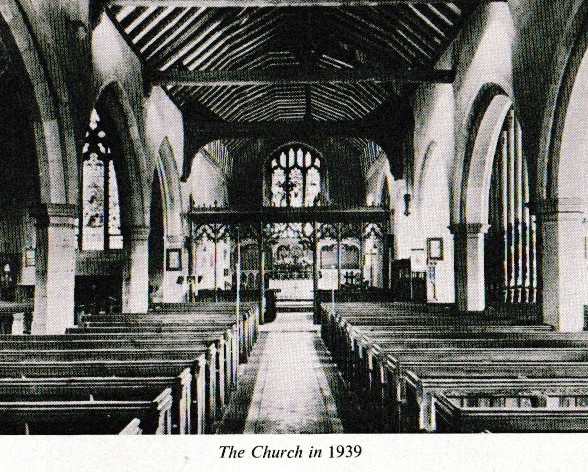
A marvellous bit of restoration was carried [Page 57] out on the east window of the north aisle, of which about half remained. It is now almost impossible to distinguish between old and new. The ruby glass in the small windows was mercifully intact. Even this year, 1960, the work is not complete, and more trouble has been found in the inside of the roof, which is being attended to, to the sound of much hammering.
The parish owes a great debt to the Rev. John Torrens, who was instituted vicar in 1950, and to his churchwardens Mr. Bennett, Mr. Cramp and Mr. Rowe for the care with which all the troublesome problems have been met, and the repairs carried through. Among other changes the old reredos, not a thing of beauty, has been removed, and the screen, also modern, taken down and placed at the west end. There is now an uninterrupted view of the altar, and this is, as most think, a great improvement.
THE BAPTIST CHURCH
Baptists have worshipped in Horley for over 200 years. They may well look back with pride to their founders, the men who met in the first little meeting house in Newgate Street in London in 1612, and from whom, as one biographer puts it, “there flashed out first in England the absolute doctrine of Religious Liberty”. Pride too in those who, together with many others, suffered grievous persecution under the Stuarts for a faith they would not renounce, “holding forth this faith even in the midst of all trials and afflictions, not accounting [Page 58] our goods, lands, wives, children, fathers, mothers, brethren, sisters, yea our own lives dear unto us, so that we may finish our course with joy; remembering always that we ought to obey God rather than men”. This faith had led them to dissent from many usages of the Anglican Church, one of their chief tenets being that baptism should only be administered to the proved believer, and not to the untried babe.
The first meeting house in Horley was built in 1760. This was replaced early in the 19th century by a chapel, whose little graveyard is still to be seen in Lee Street. It was in this chapel that its builder, Edward Miller, was minister for twenty-seven years.
In 1879 the building of the present church was begun. Both the church itself, which is said to have cost £l,100, and the land on which it stood were the gift to Horley of Mr., afterwards Sir, Samuel Barrow. Here his great faith in the future was certainly shown in good measure, for, at the time of building, there were only eleven members of the Baptist community, including his own family. It was fully justified. Eighty years later, under its present minister, the Rev. J. T. Willmin, the church is filled with congregations of round about a hundred twice every Sunday. Plans are already in hand for a new schoolroom, the present one being far too small for the youth activities and the growing sisterhood—a sisterhood whose wonderful loyalty to their church is a shining witness to their faith.
The Baptists also have a chapel at Norwood Hill which, in 1959, was entirely rebuilt in brick to replace the older wooden building.
THE PLYMOUTH BRETHREN
The Plymouth Brethren are also moving forward with new work, especially among the young, centred on their little Chapel in Lee Street. This was built in 1930 and it is hoped soon to replace it with a larger building.
THE METHODIST CHURCH
John Wesley has been referred to in an earlier chapter on the 18th century. One of England’s greatest preachers, with his message of the Saving Power of Christ, and the necessity of individual turning to God, he seemed to speak directly to the soul of each hearer. The response was enormous. Much of his life was spent in the saddle, and it has been reckoned that he must have ridden some 5,000 miles a year preaching to his countrymen from Cornwall to the Moray Firth.
He visited Surrey in 1771 and preached at Reigate. According to his Journal, about twenty to thirty attended in the morning and a hundred in the evening, but it was not a good meeting, and his comment was “Dull indeed as stones, but cannot God ‘out of these stones raise up children unto Abraham?”
At the beginning of the hundred years under review a Primitive [Page 59] Methodist Chapel stood on the site now occupied by Woolworth, but in 1910 a Wesleyan Methodist church schoolroom was built in Victoria Road at the cost of £800. Again, vision was needed, and was forthcoming, to buy the whole strip down to the road, and it is on this land that the new church, opened on June 11th 1960, was built. It is a fine spacious building, with the interior brickwork used to carry out the architectural design, but the first thing that will catch the eye is the great cross hung before a deep blue curtain. A cross, not portraying the humiliation of the Crucifixion, but made radiant by faith in the power of the Resurrection.
The cost of the church was £20,OOO, a large proportion of which was borne by the members themselves. Their enthusiasm is surely indicative of their continuing faith in the future, and the great sense of fellowship that prevails among them under the leadership of the minister, Rev. Bertram Woods.
In Wesley’s own words, “There is no such thing as a solitary Christian”, and to attend the Methodist church and mix with its people is to know just how true that statement is.
THE ROMAN CATHOLIC CHURCH OF THE ENGLISH MARTYRS
For very little short of a thousand years the Catholic Church alone passed on the Christian faith in England, from generation to generation, and without its ceaseless witness there could have been no knowledge from which the reformers could begin. Many however refused to accept this reformed faith and suffered persecution and in some cases martyrdom for their belief.
In 1537 the Benedictine Abbey of Chertsey ceased to exist. Almost exactly 400 years later, the right to public worship having been restored to them in 1778, the Benedictines came back to Worth. At Horley in 1929 the stable at “The Chestnuts” in Ladbroke Road was converted into a chapel. Then in 1935 a small asbestos church was put up on the same site, the first in Horley since the Reformation, and was dedicated to these martyrs for their faith. This church is however quite inadequate, both architecturally and in size, for the congregation of about 500 now living in Horley.
A new site was acquired in 1952 and, most curiously, this is “Clerklands”, the bit of land shown on the 1602 map as belonging to “the clerk of ye Church sometime p’cell of ye common”, and about which more was written on page 26. In this way again the Roman Church is linked with the past and, local historians will hope that this link may be noted and remembered though the name is to be changed to “Marylands”. The reason for this is clear, the first dedication of the Parish Church being to the “Immaculate Virgin Mary” and the Church which will be started this year will be of great interest. The aim is that no pillars shall interrupt the view of the altar from any position in the church. It will therefore be octagonal, with eighteen [Page 60] windows, designed on a new principle, thick slab glass in concrete— not lead—a process also being used by the monks at Buckfast Abbey. Another innovation unusual in this country, the little belfry will be entirely separate from the main building. The cost will be high, about £30,000 but of this £10,000 is already in hand, and about £3,500 is coming in steadily each year—all, or nearly all, from a basic 1s. a week from the faithful, under the enthusiastic leadership of Father Woolmer.
CHURCH FELLOWSHIPS
No history of the church would be complete without mention of a movement, perhaps springing from the friendships made in the stress of two World Wars, that is bringing its influence into the homes and everyday lives of the people. It is not confined to any one outlook or age. Fellowships for children, youth, young wives, mothers, even for grannies and grandfathers are springing up, all making for friendship among themselves and loyalty towards the church, where they worship—a movement of the greatest value to the future.
And to the future one looks at the end of this history, and so especially to the new churches of St. Wilfrid and St. Francis.
ST WILFRID’S
It was in an old “row” in the parish, which still bears the name of Horley Row and which originally faced on to the vast common, that the first Horley school was built in 1834. We are lucky in having a photograph of the first schoolmaster, Mr. Wingood.
Here, in 1937, the Education Authority having vacated the old and dilapidated building, evening mission services were started by the Church of England Men’s Society, “C.E.M.S.”, under that wonderful old man of Horley, Mr. George Edwards, whose wheelwright’s shop was so near at hand. These were to have far-reaching consequences, and continued, with one break during the war, until June 1959. Then came the challenge and the opportunity. It was taken, and in three months of “hard” but enthusiastic voluntary labour a place of worship was created, very lovely with its soft grey and pink walls, its curiously shaped arches, and creamy gold curtain behind the altar. This at the cost of only £175. It was ready for the first services by September 21st of the same year, and continues to serve some 5,000 of Horley’s inhabitants, mostly living in new estates. Needless to add that plans are already on foot for a larger building in the not too distant future. A pleasant footnote is that the first baby to be baptised was Michael, son of the Rev. Norman Alexander, curate-in-charge.
ST FRANCIS
St. Wilfrid’s has taken over and wonderfully adapted an old building, but St. Francis is a completely new church. A new church with a [Page 61] new look, designed by a Horley architect Mr. Tapner, and, as daughters are always doing, transforming the old traditions into new shapes.
The land near the Balcombe Road, worth £3,000, was given by Mr. F. D. Edwards. This was large enough for the church, the parsonage and—a modern essential—a large car park. Speed is also a modern attribute, and the following dates are very suggestive. The first sod was cut in September 1957. The house, built first, was ready by May 1958, but a month before this, in April, the foundation stone of the church was laid and in October of the very same year, in under six months, it was dedicated by the Bishop of Kingston. The cost of building was approximately £13,000, raised by voluntary subscriptions and loans. All the furniture has been by gift, one donor giving everything needed for the worship of the Sanctuary, including surplices for some twenty boys and three men. Music, indeed, plays a very important part in the services and this choir is singing a new setting for the Communion Service, with the air sung by the men and congregation, and the boys weaving a descant—again a new interpretation of an old tradition by the curate, the Rev. John Presswell.
Large congregations and intense vitality are the hall marks of this new church. The fine hall, which, in the tradition of the mediaeval nave, can be used either for services or for secular purposes, is in constant demand, and a new addition is already being planned.
EPILOGUE
To go back through the centuries. There can be little doubt that the first Saxon missionaries planted a wooden cross where they held their first service, and later built their first church. A procession from the Parish church, carrying a large wooden cross and setting it up by the Balcombe Road, near the old Saxon track, preceded the cutting of the first sod of the new church.
The circle of the past is complete. The parish churches have, in spite of their many vicissitudes, setbacks and failures, passed the faith of Christ, the Way, the Truth and the Life, through the generations to bear new fruit in many branches.
This book is dedicated to the Church of the Future.
[Page 62]
Incumbents
NOTE. This list of vicars has been made on Manning and Bray’s foundation and other names added as found.
1218 WALTER. “parson” a witness.
1234 WILLIAM DE DAGGLYNWORTH. Willelmi Dagelynworth
vicarii ecclesie de Chabelam Chertsey Cart. 1230.
1283 Jan. 31st WALTER DE STOTEFORD admitted to Rectory of Honey. Register of John de Pontissara. Sy. Rec. Soc. note, William de Stoteford vicar of Banstead 1326.
1324 Oct. 24th JOHN DE CROMPLEHORN vicar Charlton Adams Somerset 1323. Weevers Somerset Incumbents
1328 May 10th THOMAS DE ROSELYNGTHORP.
1331 May 8th WALTER DE WAVYNDON see pages 12, 13.
Registers lost 1345—1366
1377 March 10th JOHN ALEYN OR Alwyn exchanged with vicar of Epsom.
1377 GEORGE or ROGER DE APERDELE exchanged with John Alwyn vicar of Leatherhead.
1384 HENRY DE MERSTON vicar mentioned in deed re Gatwick.
WILLIAM WEST resigned 1399 in exchange for Epsom.
1409 Feb. 20th JOHN SALMAN. was vicar in 1427.
Registers lost 1415—1446
JOHN THURTHULLE resigned 1447
1447/8 5th Feb. NICHOLAS SHORTEHEESELL resigned 1450
1450 11th April JOHN MORTON resigned 1457.
1457 2nd April GODFREY BROMLEY resigned 1461.
1461 17th Nov. HENRY OKERE, died 1474.
1474 14th July JOHN PLUMPTON.
Registers lost 1492—1500
1505 WILLIAM BURBANK A.M. Vicar Stanwell Mx. 1521-2. Hennessey’s Novum Repartorium. See also Churchwardens accounts and pages 18, 19.
No date WILLIAM BISHOP of Darien (?S. America) Resigned in 1522 on pension £8 per annum.
1522 16th April RICHARD LUCAS, died 1561. see pages 26, 34.
1561 26th June WILLIAM BROWN. See Memorial tablet, Horley church and pages 27—30, 42. No degree or other benefice died 1613.
1613 1st Dec. GEORGE NEEDHAM
1616 ANTHONY HUGGETT.
Registers lost 1616—1626 and 1643—1664
1626 WILLIAM WALLER see page 43.
1647 Nov. 26th HENRY PRINCE, put in by Parl. Comm. S.A,C. XXVII.
1649 JOSHUA AYMES,
Note in Parish Registers. “Mr. Thomas Moore one of the ‘Jesteses of the pece’ married a couple in 1654 and continued to officiate till Jan. 1655/6. In 1657 entry of a marriage by John Bonnicke minister of Leye and then by John Coocke Minister of Burstowe. see pages 43, 44”.
1657 ROBERT HACKINGES
1666 SAMUEL WELLS.
[Page 63]
1669 May 25th THOMAS PERKINS B.A. Resigned 1672. see page 46 1672
May 3rd THOMAS NORTON M.A.
1690 Oct. 10th BENJAMIN LONG also had living of Walton.
1701 July 29th SAMUEL BILLINGSLEY. Prebend of Chichester. Archdeacon of Surrey, also living of Newdigate. See page 48.
1725 July 16th THOMAS TRIGG, died 1767.
1768 Feb. 19th PETER WHALLEY. Upper Grammar Master Christ’s Hosp. 1760-1776. also living of St. Margaret Pattens, London.
1791 July 22nd WILLIAM SPARROW. See page 48. Curate Samuel Steele.
1817 19th Feb. FREDERICK WILLIAM FRANKLIN.
1828 8th Aug. EDWARD RICE D.D. Upper Master Christ’s Hospital. Trinity College Cambridge. Established two school rooms, one for boys, one for girls, and house for master and mistress. Built the long drive in the Vicarage garden and made up the road thence to the Thorns, because Vicarage Lane was impassable in winter.
1853 WILLIAM HUGHES, died 1871. Old East Window was in his memory.
1871 EDMUND GEORGE PECKOVER see page 54.
1890 2nd April HENRY THOMAS LEWIS M.A. Cantab. Scholar Sidney Sussex College, Cambridge. Assistant Mathematics Master Hurstpierpoint College. See page 55.
1934 19th July WILLIAM CHARLES REEDER M.A.
1938 28th Nov. JOHN CHARLES LAKER see page 56.
1947 24th sept. JOHN RODBOROUGH PAGET A.K.C.
1950 15th Feb. JOHN HERBERT TORRENS M.A. st, Edmunds Hall, oxford and Christ’s Hospital. See page 57.
Reference has been made to the following:
HISTORIES OF SURREY. Victoria County and Manning and Bray.
SURREY ARCHAEOLOGICAL COLLECTIONS.
CHERTSEY CARTULARIES. Trans. Surrey Record Society.
CHERTSEY ABBEY. Wheeler. “RELIGIOUS ORDERS IN ENGLAND” Knowles.
“CANTERBURY CATHEDRAL PRIORY” Smith.
“ST. DUNSTAN OF CANTERBURY” and “WANDERING SAINTS” Eleanor Duckett.
“HISTORY OF CHRIST’S HOSPITAL” Trollope.
‘ ‘ANNALS OF CHRIST’S HOSPITAL” Pearce.
“PARISH CHEST” Tate,
“CHIPS FROM THE OLD CHURCH CHEST” Lewis.
“HORLEY ITS CHURCH AND RECORDS” Alfred Jonas.
“FREE MEN OF CHARLWOOD” Sewill and Lane.
“EARLY DAYS IN HORLEY, SIDLOW AND SAL-FORDS” Lane.
MANUSCRIPTS: Horley Churchwardens Accounts. British Museum. Add. Charter 61 73; Court Rolls of the Manor of Horley; “History of the Bristows” Jenkins; Notes by the late Mr. C. D. Hawley F.R.I.B.A.; Loseley MSS. No. 767; Also Original map of Horley, c. 1602 from Christ’s Hospital on loan to Surrey Record.