No 35 Munitions Store
Horley, Surrey
In World War One
By Brian Buss
©Horley Local History Society
1st Edition 2002
2nd Edition 2007
3rd Edition 2012
Contents
Introduction 3
Background History up to 1939 3
The Estate during WW2 3
Where was the WW1 Munitions Site? 4
What Happened at the Munitions Site & When 5
Photographic Evidence 5
Local Concern 7
Other Aspects 8
In Conclusion 8
References 9
Fig 1 Horley Gardens Estate in 1943 10
Fig 2 Aerial View of Proposed Site for
Horley Garden Estate c1935 11
Fig 3 Composite Plan of Houses in Estate within
WW1 Munitions Site with Footpaths, Hedges, etc 12
Fig 4 18 Pound Shrapnel Shell Assembly 13
Fig 5 Group in Costumes at Munitions Site 14
Fig 6 Gas Shell Dump in Surrey 15
Fig 7 Women Workers who Filled Shells 16
Fig 8 Inspection Department at Munitions Site 17
Fig 9 Civilian “On War Service” Badges 18
Fig 10 The Painting Department 19
Fig 11 The Box Factory Department 20
Introduction
I came to live in Horley in 1966 and bought a new house to the SW of Horley railway station on what was known as Horley Gardens Estate, or Hall’s Estate. As retirement loomed ever closer, I became interested in the history of the area and the Estate. Why Hall’s Estate and what were these rumours of a World War One munitions site in the locality? On joining the Horley Local History Society it was easy to establish that I was living not far from the edge of what was once a huge open common, named of course, Horley Common. Some sites of existing farm buildings could still be identified as those at the same locations on the 1602 map prepared when Christ Hospital in London bought much of the land in Horley (Ref 1). For example, the last remaining building of Spears Farm (variously spelt Spires, Spiers, Speirs and Speeres) could still be seen from my bedroom window and some of Fisher’s Farm buildings still survived on the eastern side of the railway off Limes Avenue. Both once stood on the SW edge of the common and this was my starting point to carry out further research.
The findings of the initial research were first produced as a note in 2002 for placement in Horley Library within the Horley Local History Centre (with copies to HLHS archives, SHC Woking and the Imperial War Museum). However, during the following five years several additional aspects of the munitions site came to light. These were incorporated in the 2007 edition. Similarly in late 2011 further information about other work undertaken at the site has been made known and this is given in this 3rd edition.
Background History up to 1939
It seems most probable that the land around my house had been part of Spears Farm from at least 1602, and perhaps before that, up to the time railway construction commenced through Horley around 1840. By the shape of hedge lines on the 1870 1/2500 scale Ordnance Survey maps, the railway appears to have cut through part of this farmland. Also, the exact boundary between Spears land and that of Russells land, once a farm to the NW of Horley railway station, appears uncertain. Perhaps the back garden fence line of houses to the south of today’s Russells Crescent defines it, as the area north of this line was developed around the end of the 19th Century.
Spears farmland is thought to have remained unchanged from around 1840 until 1935 when Mr J W Hall, a developer from south London, bought 100 acres to the south of Russells Crescent, up to what is now known as the Gatwick Stream. He laid out a series of concrete roads whose names he then chose that still remain to this day. The remaining area of land he divided into 350 residential plots. On each, he offered to erect a house from a range of architect designs. The price of a plot with a 3-bedroom semi-detached house was £725 and for a 4-bedroom detached house from £1195 to £1495, prices that are considered expensive for the late 1930s in this part of Surrey. Buyers could if they wished, employ a builder of their choice. Up to the start of World War 2 only around 50 houses had been erected, some only part completed, of which just over half were built by J W Hall, mostly along the start of The Drive (Ref 2). Mr Hall’s sales brochure at the time was entitled “The Horley Gardens Estate” which has remained as a general description of the residential area to the SW of Horley station (Ref 3). However, many senior residents in 2002 still referred to it as Hall’s Estate for the obvious reason.
The Estate during World War 2
Considerable research was undertaken in the early 1990s to determine what happened in Horley during World War 2 (Ref 2). This covered the Horley Gardens Estate in some detail to find the extent of a Royal Canadian Engineers open store as well as RAF and WAAF billets for ground personnel working on nearby Gatwick Airfield. The open store consisted of Nissen hut parts, camouflage materials, wire netting, etc, with living accommodation and associated buildings for all military personnel. Except for St Hilary’s School buildings in Fairfield Avenue opened in 1939, all other habitable houses remained occupied by their owners or tenants throughout the war.
The Canadian military vacated their billets in 1943 to take part in the invasion of Sicily. Shortly after, Italian prisoners of war were moved from their camp on Norwood Hill to occupy these billets, as many of them worked in and around Horley. Following the end of the European war, RAF and WAAF personnel along with the POWs, quickly left their temporary wartime accommodation on the estate. Civilian squatters hurriedly occupied them, some on the very day they were vacated. Most billets and huts were used as living accommodation for several years because members of the forces returning to civilian life found there to be a severe shortage of houses and materials to build them. Although the [Page 4] authorities at first attempted to remove the squatters, they eventually regularised their occupation as tenants until new housing became available in the locality. Eventually all the huts, etc, were demolished and almost the whole of the Estate was finally developed for residential purposes.
The siting of all the buildings erected for these wartime activities were accurately established, including a loop railway siding, and were detailed in Ref 2 (see Fig I). Except for the building erected as a squash court in Michael’s Crescent that was used later by the Scouts, all other major traces of World War 2 occupation were removed completely. However, some items like railway sleepers and live ammunition dated around 1942, were found as new residents first laid out their gardens.
During this early research about WW2, several elderly citizens that were interviewed spoke of a World War I munitions site on land where the Estate is today, that employed many women. As this was not the subject of the research in hand it was noted but not taken further at the time.
Where was the World War 1 Munitions Site?
Confirmation that a munitions site existed in Horley came from Parish magazines. One dated October 1918 (Ref 4) reported the death of a women worker from the ‘munition factory’. It was not as a result of her work or conditions, but from pneumonia following an attack of influenza that was widely prevalent in the country at the time. Also, in a 1919 issue (Ref 5) a ‘peace procession’ was reported commencing in ‘Munitions Road’. The location of this road can only be surmised as no local maps of the time, or later Town Guides, etc, identified it.
Several of my neighbours on the Estate came to know of my search for the location of the munitions site and asked if I could identify various concrete and brick foundations in their gardens that had proved too difficult to remove. My first concern was why hadn’t these been located during the WW2 research? The answer was obvious as we had only looked where we knew World War 2 buildings once stood and so these foundations must belong to another period. As no farm buildings stood well away from Spears Farm itself, they most likely could have been associated with the munitions site. Examination of the foundations proved most interesting, especially in their relation to one another, but taken together they neither defined the shape or extent of separate buildings or the extent and exact location of the site. The last two features mentioned were however found from a most unexpected source.
In the late 1990s, a new neighbour took possession of one of the 1930s houses just a few doors away and commenced redecorating some of the rooms. In a cupboard he found hidden one of J W Hall’s late 1930’s brochures mentioned above that he gave to the History Society (Ref 3). It included an aerial photograph showing the extent of the planned estate on mostly undisturbed farmland except for a swathe where some form of development had taken place. As can be seen from Fig 2, it occupied a sizeable proportion of the proposed estate and remnants of buildings could be discerned within the boundary of the disturbed land. Also, what appeared to be a central track ran the length of this site as if it was a railway siding from the main Brighton line that had once entered at the site’s southern end.
As no known development had taken place in this location between 1918 and 1935, the extent of the disturbed land was assumed to be the boundary of the World War 1 munitions site in Horley. From the 1913 1/2500 scale Ordnance map the eastern and northern boundaries followed existing hedge lines while the western boundary bisected almost centrally, a large 30½ acre field that necessitated a realignment of one of several footpaths that crossed the farm land. Hence the area of the munitions site was estimated to be about 15 acres.
When the concrete and brick foundations that had been examined were superimposed on a reproduced plan of the site shown in Fig 3, all were found to be either parallel to, or at right angles, to the assumed central railway siding. This confirmed that they were parts of buildings on the munitions site. One set of foundations was not found until around 2004 when the Grosvenor Close development took place off the southern part of Upfield. However, an insufficient number of foundations have been identified to date that would permit a detailed layout of the site to be constructed. Also, the photo of the site lacked sufficient definition to construct such a layout. An extensive search was made to identify whether an original copy or, negative of this aerial photo existed that with present technology might assist in this task, but again without success.
[Page 5]
What Happened at the Munitions Site and When?
In July 1915 a conference was held by the Ministry of Munitions to consider how the increase in shell production could be set up to meet the growing demands of the army (Ref 6). It decided to establish some 15 National Filling Factories and Horley became a depot controlled by one. This is assumed to be the Royal Arsenal, Woolwich, see Fig 8. Ref 6 as it describes Horley as a ‘Depot for completing foreign ammunition in 1915 and 1916′. From Appendix Ill of the same Ref, production figures for Horley are given for the years 1916 and 1917. Also, a letter from the site dated October 6th 1916, (Ref 7) gave its address as: ’35 Munitions Store, Ministry of Munitions, Telephone Horley 94, Telegrams, Munidepot Horley’. But for the above reason, it could not have been operating other than for a simple storage site as its name implies, before late 1915 or early 1916. By January 1918, the telegraphic address had changed to “Cockles, Horley’. Perhaps this was for security reasons while selecting a word with a play on shells?
The first correspondence found is dated 18th September 1916 (Ref 8) from Major General Shaw, General HQ, Home Forces, Horse Guards, London SW, to Horley Parish Council, stating “that the munition works have not as yet been scheduled for special protection against possible raids by hostile aircraft”. This was obviously in answer to an earlier letter from the Council that has not been found. This suggests the site was up and running well before this date and the Parish Council were no doubt overly concerned that the site could become a target for enemy attack. The production statistics given in Ref 6, App Ill supports this conclusion as Horley achieved its maximum output in 1916.
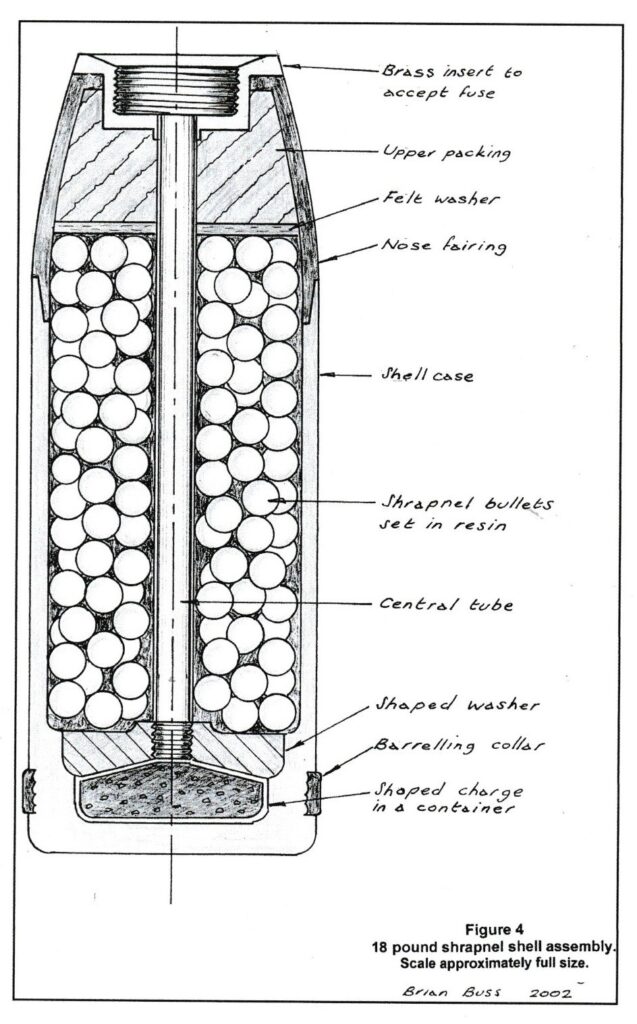
From Ref 6 the main activity during 1916 and 1917 was filling 18 pound shell cases with shrapnel bullets. This type of shell case was approximately 3¼ inches diameter and 9 inches long, made from forged steel supplied from either or both American and Canadian companies. The process of filling is thought to have consisted of placing in the base, a shaped charge in its own container, and then a lining, perhaps made of paper, inside the shell case. This was followed by a base packing into which was screwed a tube the length of the shell case that would carry the explosion triggered by the fuse installed at the opposite end and so ignite the charge. (The type of fuse was selected and fitted on the battlefield.) Around the tube several hundred small spherical lead or steel balls, called bullets, were poured and the whole held in place with resin topped by a felt washer. An upper packing, possibly made of wood, shaped to fit the internal dimensions of a nose fairing, was then fitted over the central tube. This packing was recessed to accept a brass insert that was itself screwed to the upper end of the tube. The nose fairing was then fitted over this packing to fit tightly around the upper part of the shell and rigidly attached to the shell case. This insert had an internal thread that would accept the selected fuse. (See Fig 4) It is not known whether the component parts were manufactured on-site or supplied by outside sources. Furthermore, no evidence was found concerning the handling of explosive materials, therefore it is assumed that the shaped charges arrived on site within their own containers.
In 1916, 3,158,500 such shells were filled and in 1917, 1,578,600, making a total of 4,737,100. No other records have been identified to suggest the munitions site undertook other related activity other than for the production of wooden cases in which to transport shells. However, Ref 4 suggests that the site was still functioning in July 1918, but to date no other production records have been located.
Photographic Evidence
Besides the aerial photo of the extent of the munitions site given in Fig 2, several other photos were given or loaned to the History Society.
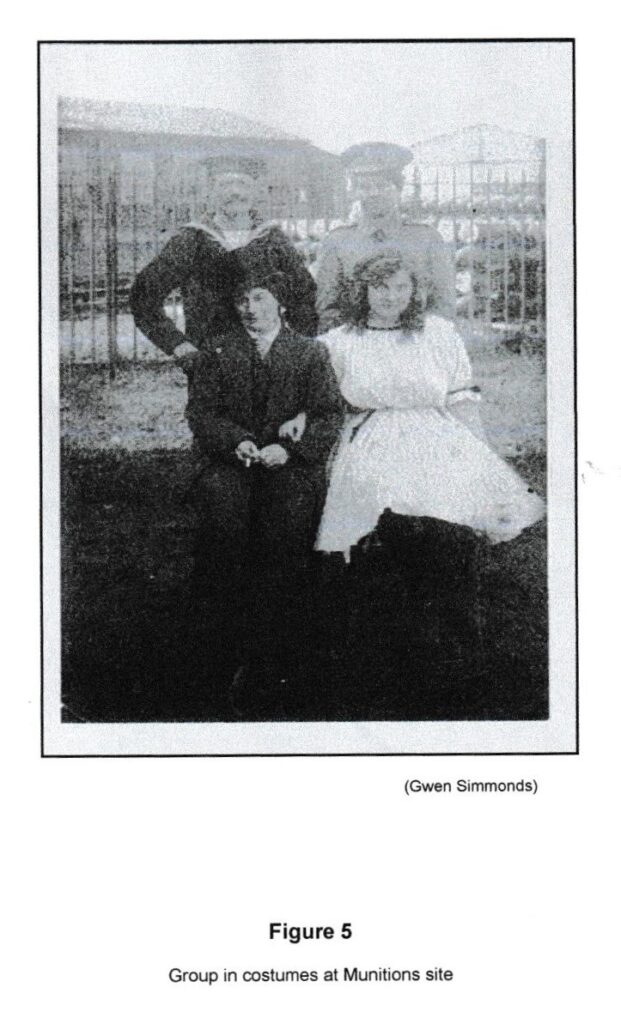
One consisted of a group of people in various costumes situated outside of fencing by the munitions site who were purported to have worked at the site (Fig 5). The background in the photo reveals several interesting features. The wall of the windowed shed at the top left is of wooden clapboard suggesting a structure easily erected for temporary purposes. At the foot of the building can be seen two railway tracks to confirm that a siding existed. Between the two persons standing and on the right-hand side behind the fence there is a large stack of shells. These appear to be far larger than the 18-pound type described above. Perhaps they were merely stored at Horley rather than worked on although it is surprising to see explosive munitions so close to works buildings. Also, the fence does not appear to offer a great deal of security for a military installation unless it was an internal fence and the [Page 6] photo was taken within the site itself? However, the only place the external fence is as close to the railway siding is at the northwestern extremity of the latter, hence the group might have been outside of the site. Finally, were all in the group engaged as employees at the site, as they appear to be in fancy dress? The sailor’s hatband reads HMS Victory but he could not have been a legitimate matelot as sailors were not permitted to grow just a moustache. Also, the army uniform appears to be worn by a woman and looks devoid of certain paraphernalia normally worn by soldiers such as regimental badges, etc. Perhaps the costumes were in aid of some form of celebration like the end of the war and was the top hatted lady really smoking so close to a munitions store? The elderly part-sighted owner of the photo who was related to one of the women, could not unfortunately provide answers to the above questions.
Another undated photograph was found miles away from Horley, loose in an unrelated second-hand book. It appeared in a newspaper that must have been published after WWI. It depicts many hundreds of shells with the caption “GAS SHELL DUMP IN SURREY” – Workman removing the mustard-gas shells from a dump near Gatwick Racecourse which has been causing annoyance to the villagers of Horley” (See Fig 6). From the steam-driven vehicles seen in the photo, it suggests a date in the 1 920s. As the southern end of the site was only some 500 yards from the edge of the racecourse property, it is thought these shells might have been within the munitions site boundary, but they could not have been filled on the site for two important reasons. One, the plant required to manufacture mustard gas and fill shells at that time was extremely complex, akin to a major chemical plant. Two, the British were not able to manufacture mustard gas shells before the middle of 1918 (Ref 9). It is therefore virtually impossible that such a small site as Horley could have possessed the necessary capability. However, different types of shell could have been stored at Horley as suggested above as it was alongside a direct line to Newhaven, a port used extensively to transport military equipment to France during World War I. If these shells really contained mustard gas and were just left after the end of WW1 as the photo implies, then the potential hazard they represented is beyond one’s imagination.
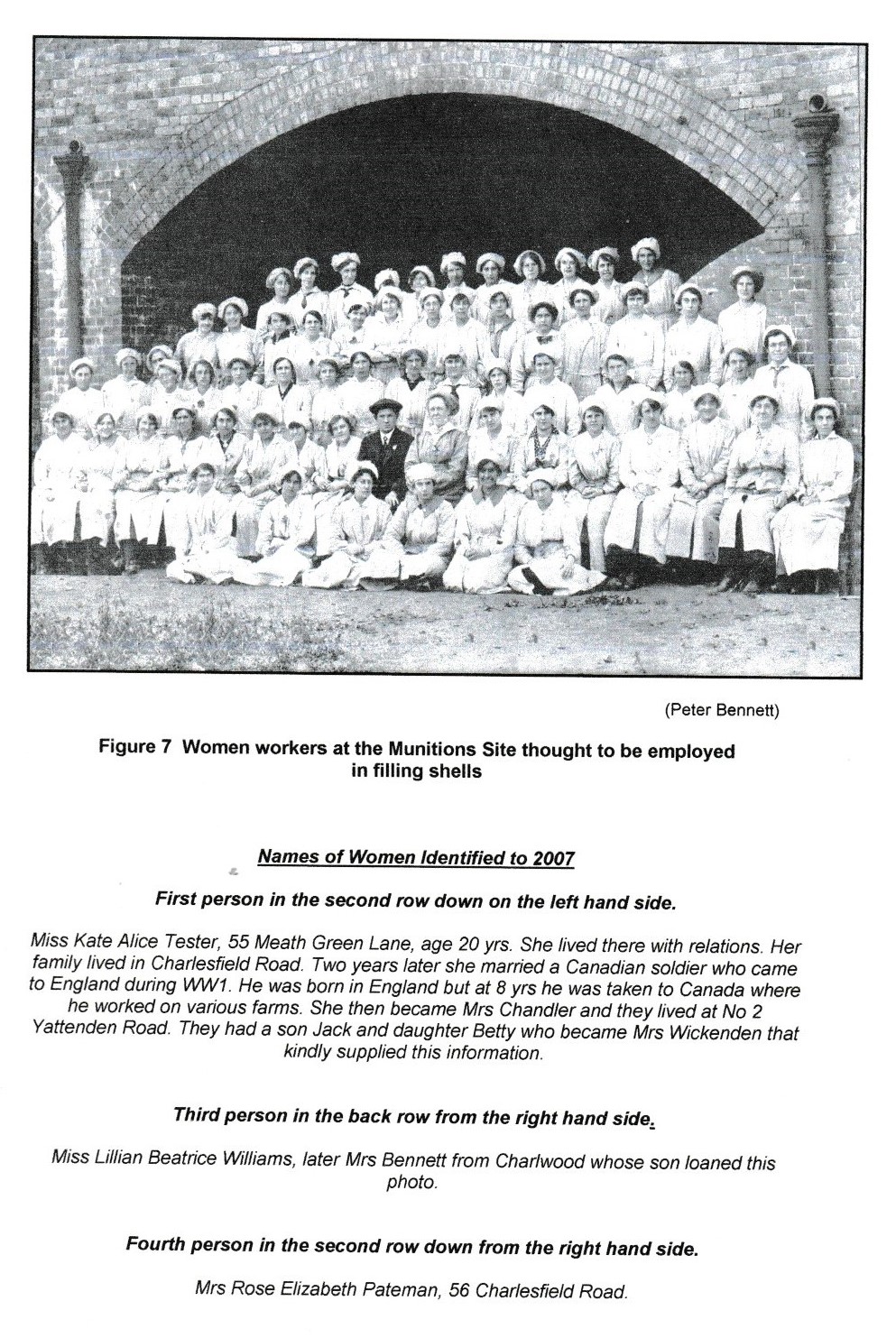
Fig 7 was initially thought to show the majority of the female staff who worked at the site, but information received in 2011 revealed that another department existed consisting of many more female workers. These were employed on making wooden cases in which to transport the filled shells. (See Fig 11) As all the female workers in the Fig 7 photo are wearing light coloured overalls it is assumed they are from the same department and most probably were those employed on the actual filling of the 18-pound shells. Two interesting features of this photo are; only one male is included, presumably the foreman, and the background. By a study of the brickwork the group appear to be positioned in front of the inner curve of the arches under Victoria Road leading to today’s railway station. The arch is the present auditorium of the Archway Theatre before the stage extension was added after World War 2. The question must be asked, why was it taken there when the Munitions Site was well beyond the other side of the arch and what was the reason for taking it and the date? Perhaps it was taken immediately after the end of WW1 as most of the overalls appear exceptionally clean.
Despite a copy of this photo being on display in Horley Library for well over 12 months, only 3 persons have been identified, one whose son kindly loaned the photo to the History Society. Part reason for so few identifications is of course the more than 90-year time interval and because the majority was thought to be workers from south London. Horley’s population in WW1 was relatively small at less than 6000 and many were in reserved agricultural occupations.
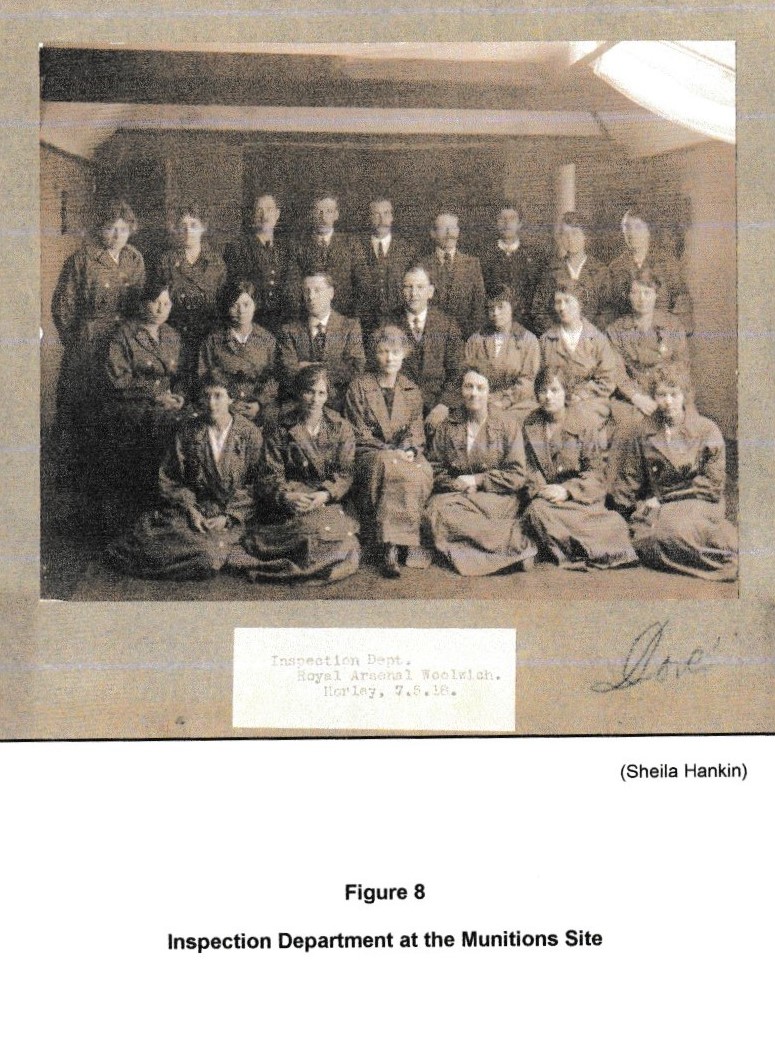
The indistinct caption on the original photo in Fig 8 reads; “Inspection Dept. Royal Arsenal Woolwich. Horley 7.5.18. This photo is significant for several reasons. The caption confirmed that Horley was most probably a depot of Royal Arsenal Woolwich as this information was not given in Ref 6. The number of males to females at that time suggests that the demand for a high standard of accuracy from such a department was necessary to overcome so many known shell failures in the field. Also, does the date of 7 May 1918 perhaps suggest that this Department had finished its work at Horley and a photo was considered desirable for archival or personal reasons? The above production figures in Ref 6 do not go beyond 1917 so unless there was production of another type of shell that is not listed it would not necessarily be required to retain so large a department to inspect munitions just being stored? Another point of interest is the type and colour of the female overalls that are entirely different to those shown in Fig 7. Finally, the photo was probably taken by a Horley studio photographer working at Doré in Station Road, now the High Street, rather than the staff visiting the studio in their working clothes. Perhaps this suggests it was taken for administration purposes rather [Page 7] than for personal reasons? The photo was loaned to the History Society by the daughter of one of the men in it.
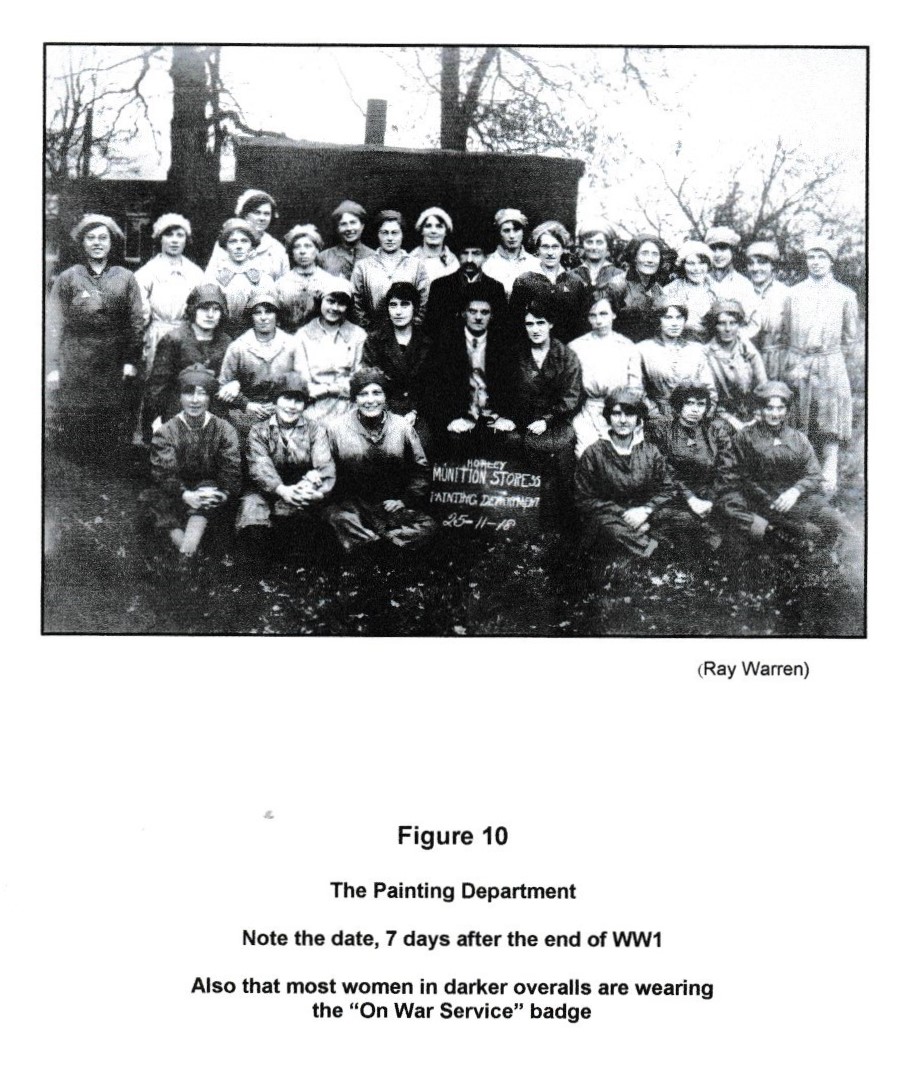
Fig 10 is a photo of the Painting Department taken a week after the date of the armistice. As mentioned previously, one of the female workers in this Department died in July 1918. Even so there are 30 females and 2 males shown. This appears to be quite a large Department for a comparatively medium sized site whose title is a “Store” and begs the question was certain munitions brought to Horley just to be painted? Also was it still working after the end of WW1? – judging by the state of some of their overalls it suggests that it was. Most of the women in the darker overalls appear to be wearing the “On War Service” badge shown in Fig 9 and their overalls do not appear soiled. Perhaps they were office staff rather than hands-on painters? Only one is known, she is on the extreme left-hand side named Louisa Flint from Albert Road.
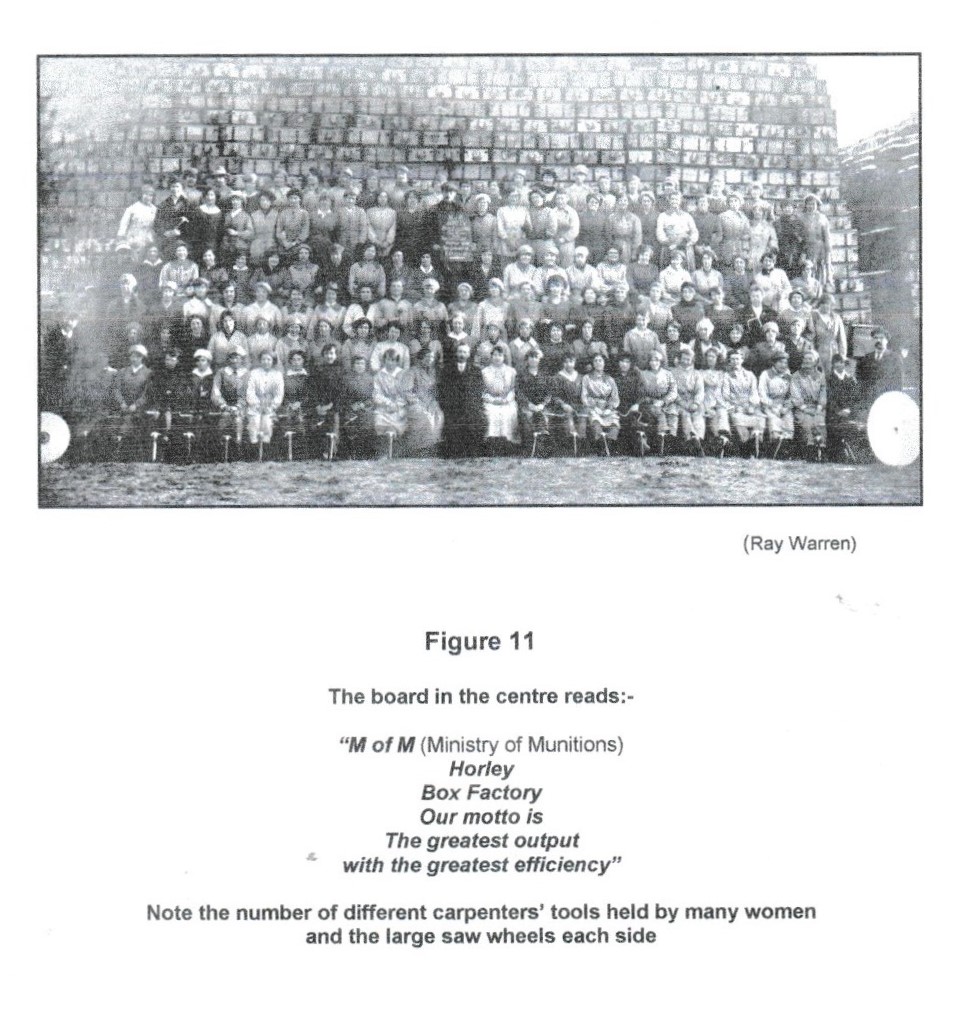
Fig 11 shows that another large Department existed on the site as already mentioned, called the “Box Factory”. It is not known whether this Department produced shell cases just for the 18 pounder shells filled on site or whether it constructed cases for other shells made elsewhere. From the number of cases seen behind the workers in the Department that appear to be of the same size, there is estimated from just the front face alone to be around 700. If the stack was built in a pyramid fashion, the minimum could be around 1500 and there is obviously another stack alongside. The end and side view of the cases certainly appear to be of a size to hold at least 4 shells shown in Fig 4 so the site would have had to produce almost one and a quarter million cases to transport its 1916 and 1917 production of filled shells unless some were returned. Therefore, it is no wonder that the “Box Factory” would have required the 130 female workers shown in Fig 11. The board in the middle of the photo reads, “M & M (standing for Ministry of Munitions) Horley, Box Factory, Our Motto, The Greatest Output with the Greatest Efficiency.
The carpenters’ tools are shown by the number of hammers and brace and bits held by many of the workers. The obvious number of different coloured overalls also show up but few if any of the “On War Service” badges can be easily seen. Presumably the different overalls indicated the various duties undertaken by the workers. The two large circular saw discs each side clearly indicate the size of different machines that they operated.
The only thing missing with this Fig 11 is the date when it was taken. Perhaps if the filling of the shells in Fig 4 came to a halt by 1918, then there would be no longer any requirement for further shell cases and the photo could have been taken then. However, the board with the motto suggests that production might have been still underway.
Local Concern
From copies of other correspondence during the war, several aspects that concerned Horley Parish Council, and presumably local residents, can be appreciated. For example, Ref 10 from the Senior Stores Officer on 23 November 1916, states that a ‘compensation allowance of £1.0s.0d (One Pound) (has been decided) for each occasion six members of your (Horley Fire) Brigade have to stand-by after a Zeppelin alarm has called them out’. This most probably represented almost the entire strength of the Brigade at that time. Hence it was not available to attend other fires during those periods.
Local residents must also have complained about the noise and fumes emitted by the site as in a letter to Horley Parish Council dated 11th January 1917 (Ref 11) from the Superintending Munitions Stores Officer, it stated; ‘I….have already given instructions for alterations to be carried out, so that the noise of exhaust from gas engine will be abated’. From its wording, it is not clear whether there was more than one gas engine or the word ‘the’ was omitted. Horley did not have its own electricity supply until 1927 so perhaps the site generated its own supply that was required for 24/7.
From Ref 12, the ‘Not in My Back Yard’ attitude prevailed even in those days. The following was a resolution passed by Horley Parish Council on 12th March 1917 and sent to the Ministry of Munitions of War at Whitehall on the 14th of that month:- [Page 8]
‘There is a rumour that land adjacent to this Parish is to be taken for the purpose of building further Munition Works of a very dangerous character and this Council views with very grave concern any further commandeering of land in the direction of inhabited houses in this Parish.
This Council trusts that the Ministry of Munitions will be able to assure them that any further extensions of the present works will be in the direction of Three Bridges (where there is plenty of available land) and which is in less proximity to the inhabited part of the Parish’.
The Council’s suggestion to extend southwards appears odd as this would encroach on racecourse property towards both the stand and the railway station beyond. Also, the Grand National race meeting was held at Gatwick in 1916, 1917 and later in 1918 that would no doubt have been extremely unpopular with the general public if the last two meetings could not be held. Why not suggest extending westward where there was adequate space unless the purpose of the extension was as the letter implied, “of a very dangerous character”? It could, of course, have been quite separate from 35 Munitions Store as the resolution did say “land adjacent to this Parish”, but the reply appears to refute this.
It did appear to be only a rumour as the Ministry was quick to reply just five days later (Ref 13) stating, ‘…..the Ministry are not at present considering the extension of the Horley Munition Stores, and in the event of any extension being found necessary at a future date, due consideration will be given to the locality of the houses in the vicinity’. Typical of official correspondence it did leave the door open, but no further reference to the extension of the site has been found and from the site photo (Fig 2) it does not appear to have taken place.
Other aspects
As well as describing in some detail the funeral of the young girl in July 1918, Ref 4 also provides an insight into other aspects of the site. She was employed as a painter and some 60 women attended in their munitions dress and were referred to as ‘munitionetts’. (There are 64 in Fig 7, 15 in Fig 8, 30 in Fig 10 and 130 in Fig 11) The girls from her department wore blue overalls while those from other departments wore grey. Eight women from the site, all named, acted as coffin bearers, possibly a most unusual sight at that time. Only three men from the site attended and this may have indicated the small proportion of men to women who worked there.
An idea of the working hours and payment of the women employed on the filling of the shells can be gained from an undated copy of the church magazine published after WW1. It stated that during the week, the industrial hands worked a twelve hour shift, one week by day and one week by night for six days. On Sundays volunteers came in, working from 9.30am to 7pm with one hour break for lunch and half an hour for tea, for which they were paid 4d an hour and in that eight hours they were set a target such as completing (filling?) 88 shells. At least one church nearby held a short service starting at five past one to enable these relief workers to have their ‘little bit of Sunday’. Presumably the volunteers were known persons who received some form of training before working on Sundays.
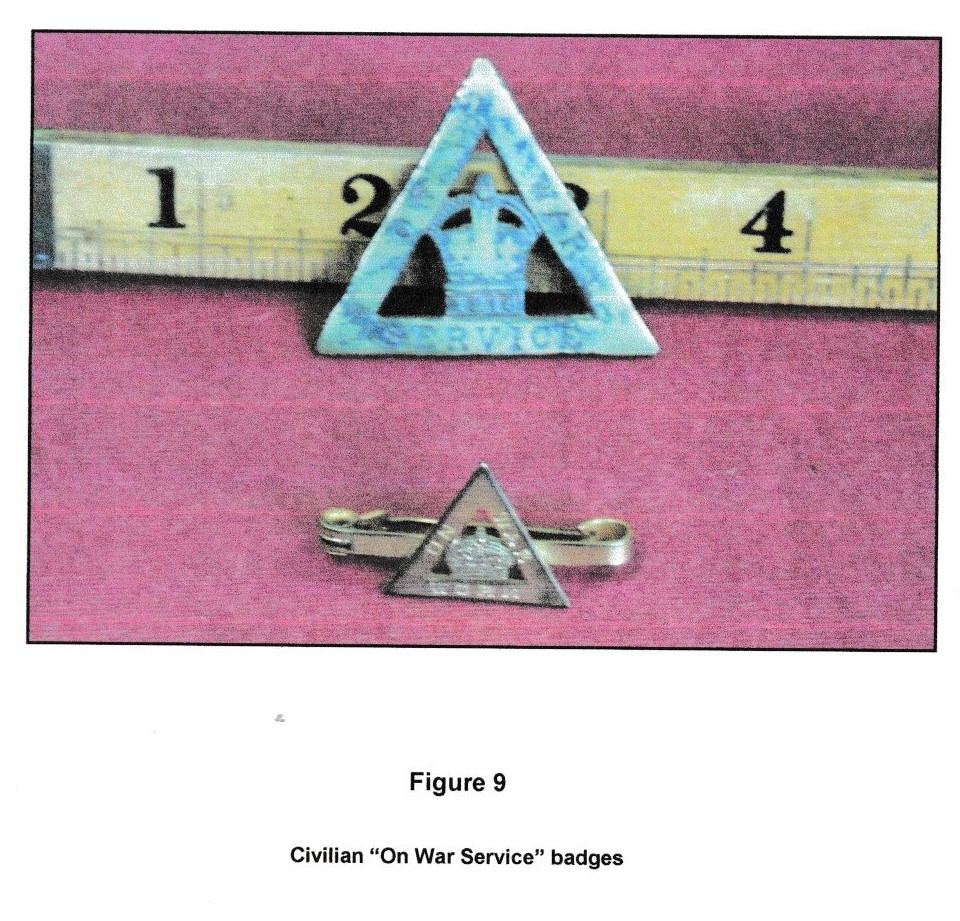
There were many people during World War I who were unable to join the forces through ill health or were in reserved occupations but still undertook work of importance to the war effort. Because it was not obvious they were doing so through their outward appearance and because they often received jeers by passers-by, the government issued a small triangular shaped badge for both males and females who were so engaged as already mentioned. The two sizes of badge are shown in Fig 9 and carry the plain words around a crown, “On War Service”. The smaller one was for use with dress wear. The full size one shown in Fig 9 was, in fact, found in a garden in Horley some way from the site. Many of the females shown in Fig 7, two in Fig 8 and eight in Fig 10 are wearing such a badge.
In Conclusion
The location and extent of No 35 Munitions Store at Horley from 1916 to 1918 have been established, but the exact layout of the site including the railway siding, has not. Some concrete and brick foundations have been found that appear to support that a railway siding ran the length of the site, but no shell cases or shrapnel bullets have been found or reported found in the vicinity of the site. Its main activity was most probably the filling of almost 5 million 18 pound shrapnel shells during 1916 and 1917 [Page 9] when the Horley site became a Depot of one of the main National Filling Factories believed to be the Royal Arsenal Woolwich. Other munitions activity during those years and up to the end of WWI might have taken place, but no details have been found although details of a “Box Factory” has been established. Photographs do, however, suggest that other shells were stored at Horley as its name implies. Also, the site probably employed in excess of 250 workers.
The site remained derelict from 1918 until around 1935 when a developer bought the land that included the site. By the start of World War 2 about 16 of the houses then built, or partly built, were within the boundary of the munitions site. Most were occupied as were those outside of the boundary. The remainder of the site and the surrounding undeveloped estate became an Army open store and Air Force billets. Many of the wartime hutments were taken over by squatters after the war, following which the entire estate was eventually developed almost as originally intended in 1935.
All that remains today to mark where the munitions site buildings once stood are a few concrete and brick foundations within about ten gardens. However, in 2004 Grosvenor Close was developed and in clearing the site, foundations of a large building were unexpectedly exposed. They measured approximately 60 ft by 20 ft with the long dimension lying almost parallel with the assumed railway siding as shown in the revised Fig 3. Although they necessitated removal this find could suggest that perhaps other foundations still exist below the surface in the gardens of houses that sit within the boundary of the old site.
References
1. Christ’s Hospital map of Horley c 1602, Guildhall Library, London, (reduced copy held in Horley Library.)
2. Horley in Wartime, Brian Buss & Bernard Davis, 1994, Horley Library.
3. The Horley Gardens Estate: A sales brochure published by Builders: J W Hall & Son Ltd, 148 Addiscombe Road, Croydon, C late 1930s.
4. St. Batholomew’s Parish Magazine, October 1918.
5. St. Batholomew’s Parish Magazine, August 1919.
6. History of the Ministry of Munitions, 1922, Vol XIII pp148 to 155 & App lll pp 242 & 243 Imperial War Museum, London.
7. Letter from No 35 Munitions Store, Horley to F J Nightingale, Horley Parish Council, October 6th 1916, SHC 6296 Box 87.
8. Letter from GHQ Home Forces to F J Nightingale, Horley Parish Council, 18th September 1916, SHC 6296 Box 87.
9. The Poisonous Cloud, L F Haber, Oxford University Press, 1986.
10. Letter from No 35 Munitions Store, Horley to F J Nightingale, Horley Parish Council, 23 November 1916, SHC 6296 Box 87.
11. Letter from No 35 Munitions Store, Horley to Mr F J Nightingale, Horley Parish Council, 11 January 1917, SHC 6296 Box 87.
12. Resolution passed by Horley Parish Council on Monday 12th March 1917, SHC 6296 Box 87.
13. Letter from Ministry of Munitions at War to Horley Parish Council, 19 March 1917, SHC 6296 Box 87.
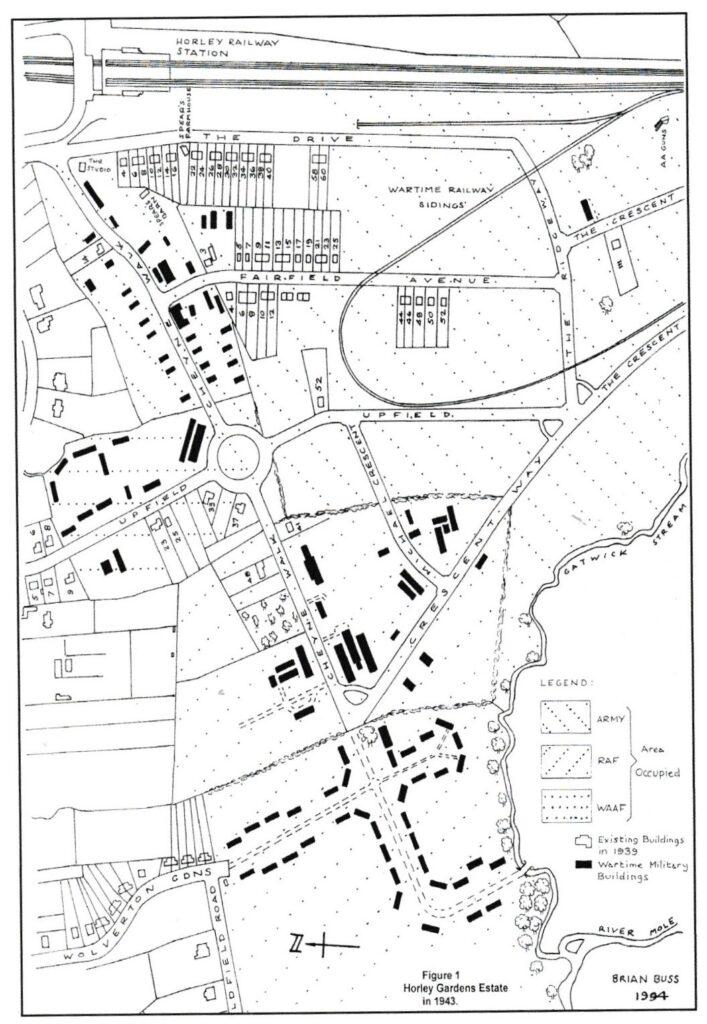
Figure 1: Horley gardens Estate in 1943.

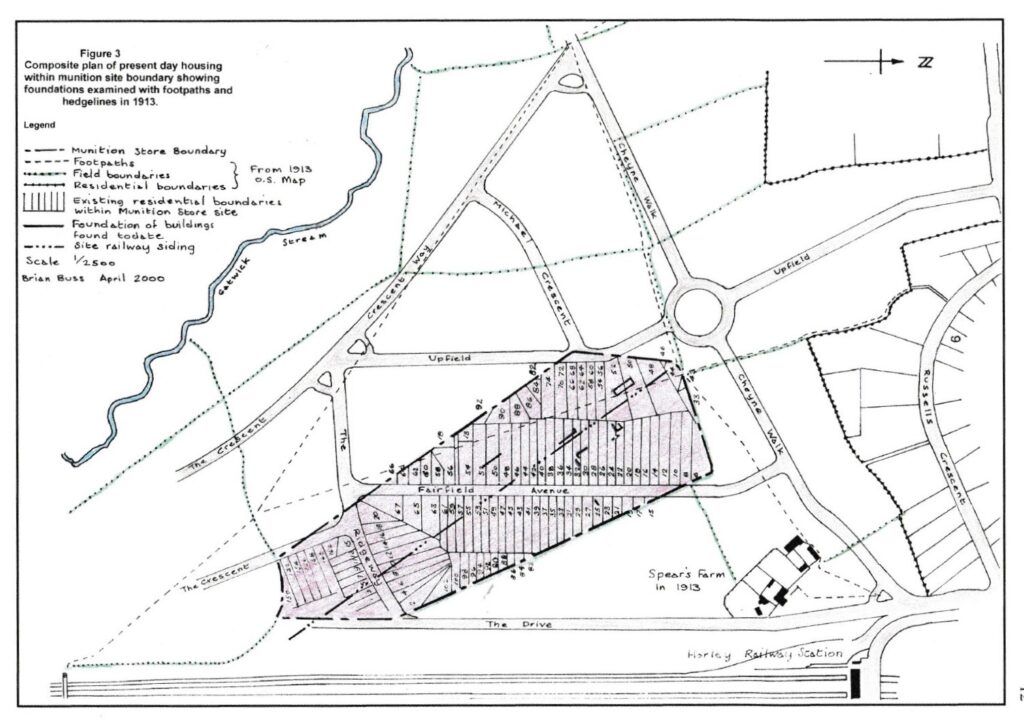
Figure 3 : Composite plan of present day housing.