High Trees School – WW2 Evacuation
The account reproduced here is taken from a short leaflet published in 2021 by Sue Hill and distributed in Woolacombe.
It was uploaded to the HLHS website in July 2024 by Doug Cox.
Reflections by Joy ? – of the War Years
High Trees School at Woolacombe
The first year was fine, 1939 to September 1940, as we rented a house in Clevedon, Somerset, where my grandparents lived and we stayed down there for a while and nothing much seemed to be happening in London, so we returned (my mother, sister Gill and myself). My father just visited us as he worked for the War Ministry. My brother was at school in Buckinghamshire (Stowe) as he is nine years older than me.
But, oh dear, along came 1940 and in September the bombing started to get really bad. We had been sleeping every night in an air raid shelter under our house in Wimbledon and we could hear all the gunfire and barrage balloons in the sky and in the morning, we looked for shrapnel in the garden and collected it. (I think my brother must have put me up to that.)
Well, it was destined that we were to go to a school which was in the throes of uprooting itself from Horley in Surrey to a safe place called Woolacombe in North Devon. My sister and I were taken to Woolacombe by car, I think by my mother and father, but he had to get back to London so he didn’t stay for long.
We were taken to an hotel called Chatsworth and introduced to the two headmistresses, Miss Tucker and Miss Young.

We were each clutching a soft toy, I had a dog and Gill a cat, you could Wind them up and they played a tune, but that was soon to be broken and the dog and cat lost in the turmoil of everyone moving.
We were taken to the Hotel next door called the Westcliff (seen in the photo below, the next house up Rockfield Road)
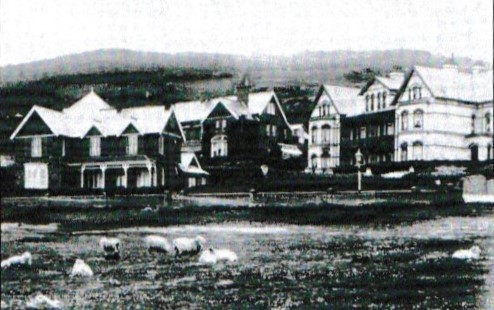
and given tea; all I can remember of this meal was some awful jam, it turned out to be marrow and ginger. There were not enough beds to go round our first night, so we had to double up, Gill and I slept top to toe. She started to cry and a big girt who we were sharing the room with told us she didn’t want any blubbing so I had to quickly dry her tears up in case we got into trouble. Anyway, her brother was sleeping with us and he never seemed to stop talking and was very excited with the situation he found himself in, so that helped a lot.
I’m not at all sure what happened the next day but t rushed to see my mother in her car waiting by the letter box and sat and talked to her. I’m sure Gill wasn’t with me, but then she was only a baby and I was all of Six and a half. I did this for about three days and then one day she wasn’t there; it took me some time to realise she was not going to come, I wasn’t to see her for a long time, as London was so unsafe.
I was put in the little ones’ house, Bentley, to start with so that I could be with Gill; there were a lot of cots there (I had a bed) as children slept in cots a lot longer in those days. I expect they took up less space, and space was needed with those children. Boys and girls and little babies, there was one called Sheila Anderson and she wasn’t even a year old. She stayed at High Trees until she was thirteen. Bentley was run by Sister Rymer, she was extremely strict, she used to read out a list after lunch of the children who had misbehaved and you then had a good whacking with a wooden spoon! You just hoped your name wasn’t on her list. My poor little sister was teased by one of the day boys called Digby Jennings, who told her in the middle of her lunch that he had seen her name on Sister Rymer’s list, poor Gill couldn’t eat another thing. She was so relieved when she wasn’t!
I can remember being sick a lot at Bentley because they gave us hot milk at bedtime with honey in it and you had to drink it, so I was sick. (Better than having the wooden spoon.)
One day I went off to dancing Class at the Rathleigh. I wasn’t allowed to return to Bentley as I was too old for that house and had only been keeping Gill company. I hadn’t even said goodbye to her. (That was the second time I had been denied saying goodbye.)
The juniors, of whom I was one, slept on the top floor of the Rathleigh. I was put in with two sisters, the younger one, poor thing, had this awful bad luck of being a bed wetter. There was no sympathy shown to her at all, in fact she had her nose rubbed in it, but that didn’t seem to cure her either!
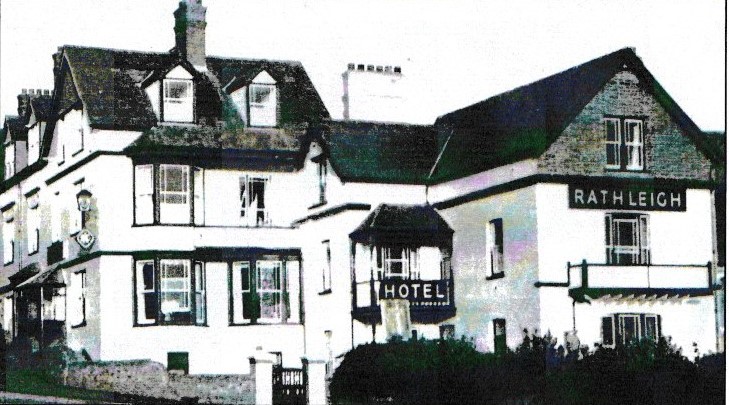
The Rathleigh Hotel, on the corner of Beach Road (then known as Station Road) and West Road. It is now The Tides Inn with Bar Electric along West Road.
Life sort of went in a routine, up at 7 a.m., breakfast at 8.00, why we needed an hour to put on our clothes I don’t know, although in the winter we did wear liberty bodices with of rubber buttons to be done up. After breakfast someone would shout out on the landings what we had to put on to walk to school. Usually coats, berets and walking shoes. When everyone was ready, we would walk in a crocodile to school. If you misbehaved you walked in the gutter. Miss Young would walk on the left-hand path and us on the right to Westcliff, whatever the weather. The clothes in those days were not very warm like they are today and in winter we froze. There was no heat when we got to Westcliff either, a lot of us were covered in chilblains. I only got them on toes and how they itched, but the poor ones with them their fingers, they had to wear bandages as they broke open.
We did lessons all morning except for a half-hour break when we played on the grass by the sea and did a lot of skipping. I don’t know what the boys did as I kept out of their way. I didn’t like boys as they were always rolling about and fighting each other. We then had lessons until lunchtime, we walked back to Rathleigh for lunch and then walked back to Westcliff for afternoon lessons. We had green wooden desks and chairs and had to stack them up to make it easy for the cleaner, whoever that may have been. I think it was a man called Trinder.
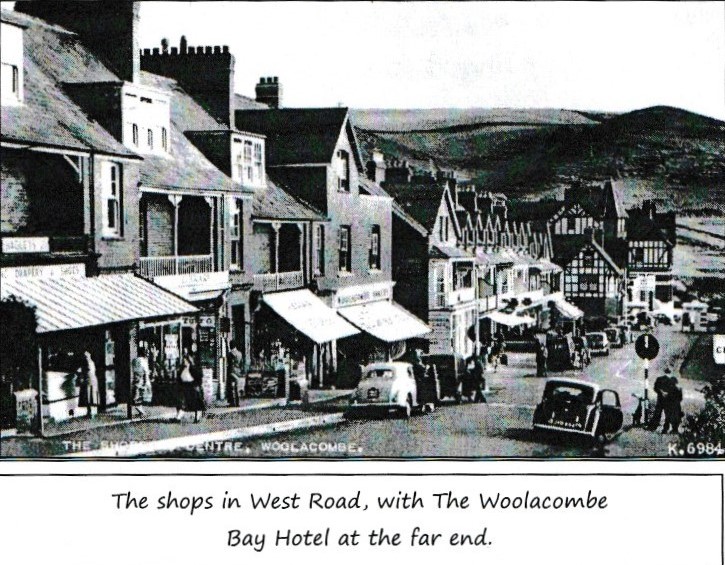
Saturdays – letters home, all written much the same, and in the afternoon, tuck from the shops in Woolacombe. Broken biscuits, Fry’s chocolate bar, and an apple, and a few sweets. We could wear shorts in the summer. That was my favourite day. We could play on the beach too.
Sometimes Pung (Miss Young) would read us a story in her study. I remember her reading us “Ballet Shoes” by Noel Streatfield. Also, sometimes we would sing hymns, which we chose.
Sunday – Church, lunch, walk.
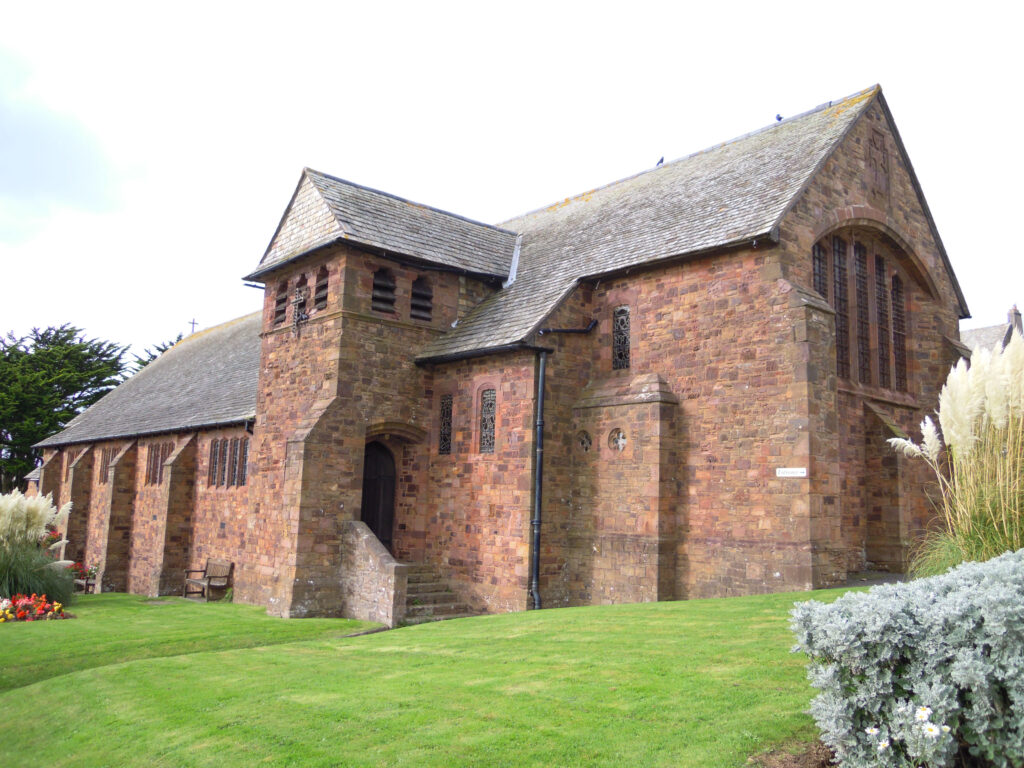
St Sabinus’ Church in Woolacombe.
In the evenings except in high summer, Pung would let us have jigsaw puzzles, draughts, Ludo, snakes and ladders, and we chose all these things from her study where she had shelves full of things. She always kept us busy in the evenings. We also played fivestones and Jax (Jacks), we all got very skilful at these games. Jax was really good, I think I could give anyone a good game still!
In the summer evenings we would play any amount of hopscotch games on big Beach. Ball games and catching bean bags, and we would have races. We went to bed when the sun was still full in the sky. It was very difficult to go to sleep, when we could read really well it was fun to read our books, but if you were caught you had to sit on the mat outside Pung’s bedroom door. You would sit there hoping she wouldn’t come to her room and find you there because you got into more trouble, anyway I think Matron only made you sit there for ten minutes but it seemed a long time when Pung could catch you. You went back to bed thankful she didn’t.
We had a half holiday on Wednesdays when we could play on Big Beach and chase the Orphanage children who were evacuated to Woolacombe too. In fact, they chased us as much, and we were very frightened at times hiding from each other!
Bartrum Gables was the big school down at the Watersmeet Hotel and we rather looked up to them and called them ‘The Posh School’ because they had umbrellas!
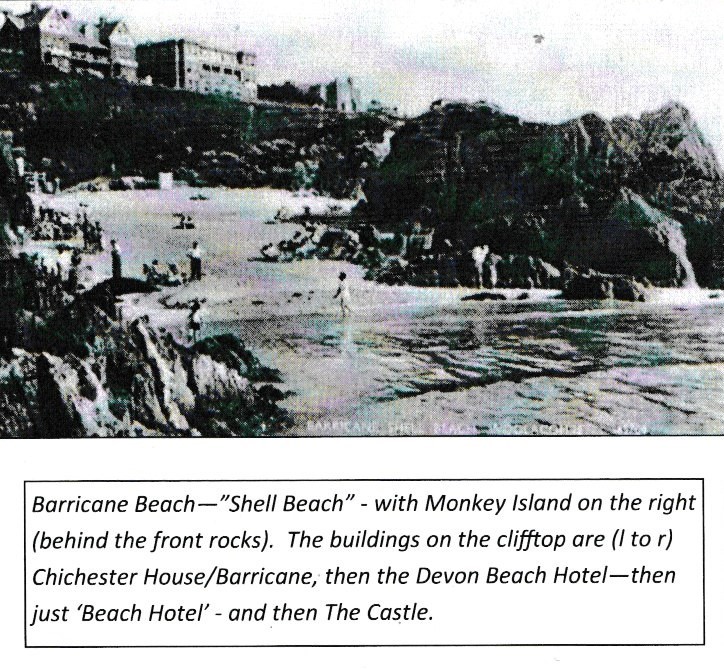
We often had to stay at school for the holidays, but it was much nicer then, as everything was relaxed and we could play a lot on the beaches. Shell Beach was great fun and we created lots of games of make believe on the rocks. Pung used to take us swimming in the summer, she never went in herself, in fact I never saw a grown up in the water, come to think of it.
At Easter time we used to go to Kiniver Valley and pick wild daffodils, there were hundreds of them, and then came the bluebells and wild iris. Primroses grew everywhere, and later on the thrift. We were always walking up the Donkey Path to Twitchen. I loved it when we got to the wood, but often a time we had to turn round before we got there, so disappointment, but it meant a shorter walk.
As the War progressed there were times when there was a brief lull in the bombing and we got home for the holidays. We were woken up early when we were going home as we had to catch the 8 a.m. train from Mortehoe Station.
Having put our things in a tiny case, the trunk went ahead of us by P.L.A. (Passengers’ Luggage in Advance) and having had breakfast, I was so excited, I hadn’t slept all night long. still think in the whole of my life that was the most exciting and magic time for me. The taxi arrived to take us to the station, it probably was the only one and made several journeys as we were piled in, too many to fit it (which they did). Our cases went on an open-back lorry. I expect someone’s fell off, but never mind. It was always done in the dark, this exercise, which made it even more fun. I expect we did go in the light too, but I can’t remember that. It took six hours to get to Waterloo, so we had to have lunch on the train, we were dished out with some sandwiches but never any drink. I don’t know why, perhaps they thought we would be sick.
When we got to Waterloo Mummy would be there to meet us, it was just like heaven, so wonderful four whole weeks before us of warm rooms and beds and hot toast by the fire, but of course air-raid warnings which I dreaded, that warning sound struck fear in my heart and mg teeth would begin to chatter as soon as I heard the planes coming over. I so badly didn’t want to get killed as I was enjoying everything so much at home. We would have to go and sit in the cellar until the all-clear.
It all went so quickly and it was time to return to Woolacombe. How I thought I hated that place and must we go back again? The day dawned when the car would arrive to take us to Waterloo Station, I hoped all the traffic lights would be red and we would miss the train and one day all the buttons had come off my blouse and as Mummy sewed them on I thought “Good, we’ll miss the train!” – but we never did.
Armed with our turkey sandwiches and little suitcases containing our night clothes, rations book, some sweets and a soft toy, we would gather at the station and find all the children going to Mortehoe. There were always a lot of troops at the station going off to the War. Everyone looking and feeling miserable, and trying to be so brave, One or two did play up: a boy called Nunkiville kicked the porter well before he was forced into the train. We would pool our sandwiches for the journey and have lots to drink (we weren’t sick!). We would ride in the luggage racks; we were in trouble if we were caught. I used to look out of the window and cry a bit, hoping no-one would notice me. I just said I had a cold, we all tried very hard not to cry as it looked weak and babyish, considering we were only about eight or nine it took some doing to be brave,
When we got to Mortehoe at 4 0’clock (we had left London at 10 a.m.) we were met with the taxi to get to our houses. Us two to Rathleigh. Pung was always there to greet us in, she wouldn’t have any fuss, straight upstairs to our rooms to get ready for high tea, it was always baked beans. They are quite sticky things as the best of times, so you can imagine how difficult they were to eat when you had a huge lump in your throat, they just wouldn’t go past. After tea we unpacked our belongings and took our ration cards to the kitchen and pocket money to Pung who put it in little bags with our names on. We used to buy National Savings stamps to help the War Effort.
We were lying in our beds and the wind was whistling and making the windows bang, when someone said it was leap year. I can remember feeling very pleased because I thought it meant the year would leap by, not give us an extra day!
I can also remember lying in my bed at Woolacombe hearing one solitary plane overhead, and as it droned on I thought it might be a German one. I got myself so frightened I was sick all over the blue Iino. I had to spend next day in bed as they thought I was ill. I didn’t dare tell them it was fright. To this day if I hear a plane at night I think back to that night and remember it all so clearly and the fright. I was frightened a lot in the war. I always thought What if Mummy and Daddy were bombed in London and I would never see them again, it was an awful fear which always hung over me. I thought when it’s over I will never be frightened in my life again.
The school went through the normal childhood diseases: Chicken Pox — we were all kept in bed and had bread and milk every morning — that’s lumps of bread dropped in milk — ugh, we used to drop it on the floor by the bed next to the wall. Mumps — only two of us didn’t get it, me and my friend Ann Picket. (Her father was a prisoner of war under the Japs. I never did hear if he came home.) The only dangerous disease was Scarlet Fever, which one girl got, she had come from the Middle East and been torpedoed twice! Everyone was sent home who could go, but I stayed at Woolacombe. Pung made us spend as much time as we could out of doors and on long walks. There wasn’t another case and Ann Jordan recovered, so all was well.
Pung kept us fully informed about the way the War was going. I can remember her telling us that the Germans had got a really lethal ship called the Tirpitz, that frightened me all day long. I thought that will be our end now… It was wonderful news when I heard it had been sunk.
Also we were always brought down to hear Mr. Churchill on the wireless at 9.00 p.m. Half asleep, we would gather on the stairs to hear “This is London speaking”.. Mr Churchill. I can’t remember what he said from that time, as I was too tired to take it in, the only thing that affected me was that it all sounded quite stirring. (Of course, I know what it was all about now and I had got the “stirring theme” right.)
I always thought if the Germans come in by sea I shall gather a few things up and run for the station, to take me home. There was a of of gunfire and shooting at targets on Big Beach. There were also a lot of posts on Big Beach so planes couldn’t land, I was told.
When my parents did come, which wasn’t often, they always stayed at The Mount Hotel in Ilfracombe. It was wonderful to stay over there with them and go to the Scala Cinema but then The Mount was taken over by the Wrens, and they didn’t come any more.
My brother came down to see us, he was in the Army by this time, he was about 18 or 19. I can remember sitting with him in Combe Martin on Hangman’s Hill, he told me he was going out to India or Burma, anyway somewhere he didn’t want to go, we sat discussing the War and I was really frightened again, for him and myself. I thought I may never see him again and he was such fun and such moral support for me, he always helped me over the awful homesickness of Woolacombe. (He died of cancer four years ago.) To me he was a hero and in the end he never had to go anywhere, because the War finished in May 1945.
Mg Father had a £100 bet that the war in Japan or VJ Day would end on his birthday. August 15th 1945, and it did, so we had double celebrations.
We had left Woolacombe in July and were returning to High Trees in Surrey in October. What a lovely long holiday we had that year — 1945.
Postscript: Some extra memories:
I remember a girl called Valerie Taubman falling out of the taxi on the way to the station, there were too many of us in it and she fell out as the doors in those days were not very secure. We told the man but he didn’t believe us at first, until he saw her running up the road after us, she hadn’t hurt herself at all! That same morning one of the boys’ suitcases fell open, on the crossing on the line, that was alright as the train was still chugging up from llfracombe so everything was put back in the case before the train got slowly into the platform.
The other thing I can remember in August every year the C.S.S.M. (Children’s Special Service Mission) arrived and we all built an enormous pulpit on the beach, Mr. and Mrs. Bath ran it, there was a text put up on the front in flowers and a small contraption was brought onto the beach which Mrs. Bath played and we sang choruses, e.g. “Wide wide is the ocean”. In the afternoon we did tide fighting and played all sorts of games. I don’t know how long they were there for — but it was great fun.
Oh, Pung always cut the toes out of our sandals so we could wear them for another year!
Joys notes end here but the same booklet contained this note from Greville Watts who added his memories to Joy’s.
High Trees at Woolacombe
I recently stayed in Woolacombe for the first time since 1945 when. at the age of ten, I left High Trees for a prep school (Belmont) in Sussex. Unfortunately, in my otherwise voluminous family archive there are no papers relating to my time at High Trees which I joined at Horley, Surrey, aged five, a few months before the evacuation.
I was therefore very pleased with the help given by Woolacombe Tourist Office and Mortehoe Museum, which included the booklet on Joy’s story. That certainly revived a few of my fragmentary memories. I found her recollections delightful and I wish I had the same recall.
I was, of course, with the boys in Chatsworth, a few of whom went a bit wild and broke into some nearby houses for adventure. I acquired a black eye in a fight with one of them and had to try to explain it away during my mother’s visit as the result of “a collision with a lamp post”. The adults present gave knowing nods and winks! My other principle memory of life in Chatsworth is of the endless milk puddings (rice, sago, tapioca etc) which I detested and have seldom eaten since.
However, I did well at school subsequently, so the education must have been reasonably sound and we were
probably more healthily nourished than many of today’s children.
As to the military activities in Woolacombe, I well remember the American soldiers on the streets of the village handing out gum, sweets and biscuits to passing children. But I have no memory of actually witnessing their practice landings (for D Day) in the bay. I can only imagine that the Misses Young and Tucker had forewarning of such events and kept us well away from any viewpoint. Walks on the Donkey Path and Morte Point, treks to Black Rock and playing on Shell Beach are my main recollections. I find the military history is well covered in publications by Richard T Bass (“Spirits of the Sand”) and “Devon at War” by Gerald Wasley, both published in the 1990s.
High Trees School, founded in 1922 and closed in 1984, was the subject of a short history by Brian Buss and Richard Cooper of Horley Local History Society. This is now out of print but I found a pdf version on the internet. This is well worth reading since the school had more than its share of drama and tragedy and the Misses Young and Tucker were remarkable and determined women. Unfortunately, the history book has little to say about the Woolacombe years.