‘THE STREET WHERE YOU LIVE’
The story of Horley’s road names
David Hall had the original idea for this book in the late 1990s and, following a period of lengthy research, it was published as a 90 page book by HLHS in 2000.
The early years of the 21st century saw the expansion of Horley following the Horley Master Plan. A massive growth of homes followed and David’s book was soon out of date.
Around about 2020 the committee of HLHS decided to update and reprint the book and Veronica Ballard (a long standing member and a contributor to the original research) offered to undertake this task.
Although completed in 2023 Veronica’s updated version was never sent to print because our booksales generally have slowed considerably. The committee also felt that it was a subject that could better be covered by an online version rather than a hard print book.
We are delighted to finally add it to our website and hope that it will continue to be a reference point for any local resident curious to know about the street where they live.
It’s early pages are just as David wrote them and some of the contributors named have passed away: Os Brown, Jean Shelley, John MacFarlane, Peter Blakey, Richard Cooper and Peter Gwynne and others. All of these former members are fondly remembered.
Doug Cox
January 2025
David Hall 2000
ISBN 0 9519291 9 4
Published by Horley Local History Society
SECOND EDITION UPDATED BY VERONICA BALLARD 2023
THE STREET WHERE YOU LIVE
The Story of Horley Road Names
David Hall
ACKNOWLEDGEMENTS I should like to acknowledge the help and support from many members of the Horley Local History Society, the Horley Local History Centre and the staff of The Surrey History Centre for the production of this book. In particular my thanks go to Veronica Ballard, Pete Blakey (who as a postman knows a lot about roads!), Os Brown, Brian Buss, Richard Cooper and his wonderful collection of postcards and photographs of old Horley, John McFarlane, Jean Shelley and Peter Gwynne, who has never forgiven the person who named his road!
Others, without whose help this would have been a much more difficult task, are:- Edna Anderson, Cyril Edmonds, Michael Hall and the staff at the Reigate and Banstead Borough Council. I am also indebted to the friends and relations of many of the smaller builders in the district and various residents of the town who have been able to pass on those little snippets of information which are so valuable to a, hopefully, budding local historian.
My thanks also are extended to the local staff of nationally known building companies such as Bovis Homes, Croudace Ltd, Laing Homes South East Thames, Wates Builders and Wimpey Homes.
This book is dedicated to Barbara,
my long suffering wife
“Are you still up there typing?”
CONTENTS
Acknowledgements
Introduction
The Historical Context
Horley Roads — An Alphabetical Survey
List of Abbreviations
Glossary of Place name Terms
References
Appendix A- List of Major Builders in Horley
and Associated Roads
Appendix B-Roads on Langshott, The Acres and Westvale Park
vi
INTRODUCTION
Many of those people who live in Horley must have wondered now and then — ” How did my road get its name?” I hope that this book will provide the answer. I have concentrated my efforts on the main part of the town as we know it today – more or less the area covered by the 1994 Reigate and Banstead Borough Local Plan, that part of East Surrey which was controversially described by the Planning Inspector of the day in 1993 as “Land Beyond The Green Belt”. This coincides with the area defined by Horley Ward Boundaries. So for my purposes the northern boundary is the Burstow Stream, the eastern follows this stream towards the motorway near Smallfield and then southwards towards Thunderfield. The southern boundary is defined by the M23 Gatwick spur and the Gatwick to Longbridge section of the A23, whilst the western boundary is formed by the River Mole from Longbridge up to its junction with the Burstow Stream again in the north-west corner of Meath Green. I have in the main confined my study to the area which is also the subject of the 1848 Horley Tithe Map and Apportionment documents. My apologies to those Horley residents who live in the more rural area to the east of the town beyond Thunderfield Castle, Haroldslea and Harrowsley Green and towards Smallfield. I have only briefly referred to developments in this area as the information in the Horne tithe documents is not nearly so detailed as that given in the Horley documentation.
In compiling this book I have tried to verify from local historical documents as many names of people and places as possible. Attempts have been made to identify the names of the major building contractors that have been associated with a particular road. This latter task was not very easy, as so many builders over the years have ceased trading for one reason or another.
There are some roads that have defied rhyme or reason as to how they acquired their particular names. This of course does mean that the reader is free to carry on this work by doing some more investigative work on this subject or develop his or her own pet theory!
David Hall
THE HISTORICAL CONTEXT
WHO CHOOSES ROAD NAMES ?
The roads and street names affect us all today. A person’s address has become part of everyday life and one’s identity. This book is an attempt to chronicle the way in which the names of roads and streets of Horley came about. Some are quite obvious – Brighton Road, Balcombe Road – named after the places to which they lead. Some are named after local farms or notable houses that perhaps have been demolished to make way for a modern development – Court Lodge, Tanyard Way, and Kingsley Road. Some after people – national historical figures have lent their names to Victoria Road, Albert Road, Drake Road etc, whilst others have been named after local notable personages — Blundell, Benham and Lechford, all of whom made their mark on Horley’s earlier history. Some have more remote historical or geographic connections, some have a thematic connection, such as the “Bird” names off Witherdale and some are just whimsical, for instance – Witherdale!
How do the names of modern roads and streets get chosen? Current practice in the Borough of Reigate and Banstead is for a developer (if he is developing an estate) to submit a name or a list of names to the Borough Planning Department. The Borough Officer responsible for this work has to operate within the boundaries of two pieces of legislation — The Town’s Improvement Clauses Act 1875 and the Public Health Act 1925. There is also some guidance from Royal Mail to make it easier for our postmen, or post ladies (should it be post persons or is it postal delivery operatives, to be politically correct?) to deliver letters to our houses.
Developers for their part often try to make their choice of names relevant to the area of the development or use a common theme. The local authority officer will sometimes suggest suitable names. In the Borough of Reigate and Banstead the practice is that once the name has been agreed between the developer and the officer, then the suggested name is forwarded to the local ward councillor for his or her approval. So perhaps some of the blame for peculiar names can be laid at the door of your Borough Councillor!
THE MAPS OF HORLEY
How did Horley get its network of roads that we know today? The town’s current development has followed roughly five phases, which can be studied by referring to maps of the area. We are fortunate in having access to some very good early maps of the Horley area.

Horley 1602 — based on the Christ’s Hospital Map
A few scattered farms and the manor on the edge of a marshy common
The first one of these maps is the 1602 Christ’s Hospital Map, which is held in the City of London Guildhall Library. This map shows the ownership of the land at the time when Christ’s Hospital became a major landowner in Horley. The land was farmed by local people and the rent and dues which they paid were collected by Christ’s Hospital, the income generated was then used to help pay for the Hospital’s charitable work in London. The map shows the rudimentary road system of the day. They could hardly be called roads; they were just tracks – bumpy and dusty in summer and virtually impassable troughs of mud in winter. A very good description of Wealden tracks was penned by Daniel Defoe in his “Tour Through the Whole of Great Britain”. Some local footpaths also came into being which can still be followed today.
At this time, the beginning of the 17th century, the recorded road system shows tracks leading to the outer edges of Horley Common. There was no Brighton Road as we know it today. The road from London to the South Coast went via Reigate and Horsehill to pass through Povey Cross and thence southwards. There are no roads shown passing through Horley. There is a track leading across the common to the south from the site of The Chequers, then a house called Bolters (possibly the local ale house). The most important local road at that time was probably that which joined the mill on the River Mole, Lee Street, Horley Row and then went off in an easterly direction to Smallfield and Burstow via Tanyard Farm and Langshott.
The houses that are shown on this 1602 map are most likely to be the larger ones associated with the farms that bordered the common.
The next map of interest to this study is the 1812 map of Horley Manor and Common. This map was prepared for the proposed enclosure of Horley Common.
By now most of the local turnpike road system was in place. The new Balcombe Road had been laid across the common in 1809. It is most probable that this new turnpike road was the first road in the area to be built as a metalled road. A direct road from “The Chequers” linked “The Thorns”, now known as the “Air Balloon”, to St Bartholomew’s Church and then on to meet the Brighton Turnpike at Povey Cross. A track, that is now Massetts Road and a road locally known as “Mud Lane”, that was later to become Victoria Road, had also appeared to give a direct link with the new Balcombe Road. Interestingly, the map shows very little in the way of house building although the population was growing, albeit slowly.

Horley — The 1812 Inclosure Map
The shaded area shows the extent of the original Horley Common. There is already
a considerable amount of field enclosure to be seen.
The third, and most important map in this study, is the 1848 Tithe Map. Although this map shows only fairly minor changes to the road system, such as the straightening out of the Brighton Road from “The Thorns” to The Avenue, it also shows the most far reaching change which was to affect the three spread out hamlets that made up the Horley of the day — the coming of the London and Brighton Railway. (Later to become the London, Brighton & South Coast Railway.) Already, only a few years after the coming of the railway we see signs of new building.

Horley — The 1848 Tithe Apportionment Map
All the field boundaries and the London Brighton Railway are in place
The various editions of the Ordnance Survey Maps from 1870 up to the present day record the steady growth of the town and its road network. The 1919 map shown in this study is based upon the 6” Ordnance Survey maps of the district. It shows the considerable development that had taken place in the later Victorian era in Horley. Albert and Lumley Roads were in place, where artisans’ cottages and small houses were built. Massetts and Russells Farms were now sites for large detached houses, Ringley Avenue was also the setting for more homes, whilst off Horley Row, Charlesfield Road was nearing completion. Two housing estates on the outskirts of the town made their appearance at this time, the Parkhurst Garden Estate to the north of Lee Street in 1902 and the Gardens Estate off the Balcombe Road in 1912. The map shows only a handful of houses in Avenue, Silverlea and Balcombe Gardens but it does show the undeveloped plots. The first example of ribbon development in Horley can be seen along the new Brighton Road.
The 1936 and the current O.S. maps show the steady growth of the town between the two world wars. The 1936 Map shows the basic road pattern for the beginning of the Horley Gardens Estate (Cheyne Walk, Upfield and The Drive). This area became a large military camp during WW II complete with its own railway loop. Southlands and Hevers Avenues are also in place – but not to be finished until after WW II. The beginning of development in Bremner Avenue, off Lee Street, is also to be seen. Castle Drive is nearly complete and building has started in Haroldslea Drive and The Close. By this time Limes Avenue had also been laid out but it is not shown on the 1936 O.S. map. Houses had also been built in Balcombe Road and Smallfield Road.
Last but not least is the map produced by the Borough of Reigate and Banstead for inclusion into the Horley Master Plan documentation showing the current status of the town’s development as at November 1998.
THE GROWTH OF THE TOWN
Horley, like most places in history, probably had an uncertain and very slow start. Firstly, there was the very slow development of an early settlement in the weald from pre-roman times up to the period of the Enclosure Acts of the 1700s to the 1800s. In 1602, the time of the Christ’s Hospital Map, it is thought that the population of the Parish of Horley was approximately 450. By 1710 it had risen to about 560. In 1801, the time of a local census, the parish population was 871, which had grown to 942 in 1811 just before the common was enclosed. The second phase was initiated by the coming of the railway in 1841. By this time the 1841 census, which included Salfords and Sidlow, showed that there were 1583 souls living in the parish. This large increase was due to the influx of temporary railway workers building the London to Brighton railway line. The 1851 census figure was 1415. It is most probable that the population of those parts of the parish that made up the core of the scattered community — Horley Row, Lee Street and Horley Street, the part around the Church — was about half of the total parish population, so the embryonic town was home to about 800 people.
The 1848 Tithe Map shows just the beginnings of the town growth sparked off by the coming of the London & Brighton Railway. This second phase of steady development was stopped by the 1914 – 1918 World War I (by which time the population in 1914 was about 5800). The third phase, sparked off by the “Homes Fit for Heroes” housing drive after the war, which was later to be checked by the depression, was halted by the 1939-1945 World War II. In 1939 the population had grown to some 8000 and by the next census in 1951 (there was no census taken during the war in 1941) the population was 11,394, just before the next big expansion of the town.
The fourth phase, the post war boom of the 50s and 60s accounted for most of Horley, as we know it today.
The fifth last big phase in the 80s resulted in the building of Langshott and some other outlying areas. The 1991 census figures for the town wards brought the population up to 19,267.
At each phase more and more roads were added until we have the local network of roads, streets, ways, closes and drives that make up the Horley Town of today.
A DESCRIPTION OF THE ROADS
It is perhaps worth describing what had happened to the farmland in Horley as a result of the enclosures of the 17th and 18th centuries.
The 1812 map of the Manor of Horley shows a long narrow common together with just how much land had been enclosed and who owned it. Numerous farms had been built on the edge of the common. Some are still identifiable today and some remain only as names of areas or road names on the town map.
By 1848 the whole of Horley Common had been enclosed and the very accurate Tithe Map had been made of the area. This map is of particular importance as it was made just after the London and Brighton Railway line was driven through the area. The coming of the railway and the construction of the first Horley Station acted as a spur to the rapid growth of three loosely associated hamlets on the edge of the common:- Horley Row, Lee Street and Horley Street, this being the name given at that time to the area around St Bart’s Church. These three areas were amalgamated into an embryonic town.
It is also noticeable that by this time the majority of the through roads of the town are in place. From this time onwards road building is almost entirely confined to the provision of access to housing developments, whereas previously roads were built primarily to facilitate the transport of goods locally to farms and the mills and also to the local markets. It is very interesting to see just how few new through roads have been built in Horley since 1848. The Smallfield Road was completed at some time after the last of the enclosures were enacted in the latter half of the 19th century. Wheatfield Way, which acts as a spine road on the Langshott Estate, was built in 1983.
THE TITHE APPORTIONMENT RECORDS
Contemporary records in the shape of the “Tithe Apportionments” were also generated in association with the Tithe Map which showed who was the landowner, who was the tenant or occupier, the plot number, a description of the land and/or premises and also what the land was being use for at the time:- arable, meadow, ley or pasture etc. The description is sometimes the name of the plot, such as “ Barn Field ” or its size, “3 Acres” or “Cottage and Garden” or some other such description. Sometimes there is nothing recorded, where this has occurred the author has indicated it as “None” in the later alphabetical section. Where the description is given as “Allotment” this refers to the fact that this piece of land has been allotted to a particular person, not that it was, as is referred to today, as a small plot on which to grow your garden vegetables!
The actual method of determining an allotment was, in some parts of the country drawn by lots. In others it was based upon a person’s traditional usage of parts of the local common land.

Horley – The 1919 Map The town begins to grow
Using this information, reference is made to the names of fields on which both road and housing development has taken place – after all most of Horley was at one time a “Greenfield Site”. The reference used is the previously mentioned 1848 Tithe Map and its related Tithe Apportionment plot number. The original of this map is held at the new Surrey History Centre at Woking.
We are fortunate to have a very accurate copy of the fascinating Tithe Apportionment Map in Horley Library. We also have a copy of the associated Tithe Apportionment documents on microfilm together with a legible transcription made by members of the Horley Local History Society. This has made the task of writing this work very much simpler than it might have been.
For each road the author has tried to identify the origin of its name, when the road was came into being, who was the major developer and also its relation to the 1848 Tithe Map plot numbers. The references are given as follows, for example: – Benhams Close, off Benhams Drive, near “The Chequers” is built on a small plot of land which is described in the 1848 documents as being owned and occupied by Mary Blundell, it was given the plot number 1211 and is described as Blacksmiths Field. In this book it is referred to as:- T.M. 1211: Blacksmith Field. The present day boundary on the current Ordnance Survey maps almost coincides with those on the 1848 map.
Some developments are still easy to identify, the present and past boundaries are identical, as will be shown if one studies the old and current maps. For instance, the total extent of the houses, gardens and the road which we know as Hevers Avenue covers all of plot 1344 described as “Part of Allotment” in the 1848 documents, in other words the ends of the back gardens are on the old hedge lines of 1848.

Horley — The 1936 Map (With later additions)
The Horley Gardens Estate, to the south of the town, is now clearly visible on the
map. This was to be the largest single housing development to be seen in Horley
prior to the 1939 — 1945 World War.

Horley — The 1998 Map
Horley as we know it today — Meath Green, Landens Park, Cheyne Walk and the
Gardens Estate, Langshott and Court Lodge all in place.
The last two maps in this section show the enormous spread of the town between 1936 and 1998.
The 1998 map shows just how much the town has grown since the days just before the second world war. There are hardly any large open spaces between the roads now within the current town boundary.
What the future brings we know not, at the time of writing. Those of us interested in the history of the town hope that some of the old name connections will be maintained in the proposed implementation of the Horley Master Plan. It is possible that by 2016 the town population will have grown to some 28 – 30,000 with even more odd names for our roads and streets!
The following pages of this work consist of an alphabetical directory of the road names used in the town up to December 1999.
David Hall 1999
………………………………………………………………………………..
NOTE BY VERONICA BALLARD
During the twenty four years since David produced his book, the town has expanded enormously due to the implementation of the Surrey Structure Plan of 1994 which in turn produced the Horley Master Plan and the need to provide more homes in the area. There have been two main areas of development, the North East Development named The Acres and the North West Development, named Westvale Park. We discovered that the additional 2,400 homes have created over 90 new road names. The people of Horley and the Horley Local History Society have helped Reigate & Banstead Borough Council and the developers to select appropriate road names. However, as David pointed out there are always some mysteries where no-one knows the origin of a name in spite of these being named in the recent past!
The Acres is a development of about 700 homes, built to the North East of the town by Barratts and their sister company, David Wilson Homes, with a further section, Langshott Park, built by Bovis Homes between 2010 and 2016.
The land around Great Lake farm was farmed in the 1860s by the Surridge family who discovered that willow grew well on the damp soil. Percy Surridge used to repair worn cricket bats. He expanded the business and began the sports equipment company of Surridges, 1900-1993. His grandson Stuart, 1917- 1992 played cricket for Surrey and was the team captain in 1952.
Very few of the fields had names allocated to them on the 1848 Tithe Map other than the size of the field in acres. eg, Four acres. Road names were selected with topographical names eg. Coppice, farmers names and local family names from the past.
Westvale Park is providing 1570 homes to the North West of Horley. At the time of writing, [03/23], phases 1 and 2 are complete and the final phases between Meath Green Lane and the A23 is well underway. It is being built by a consortium of developers; Charles Church, Crest Nicholson, Fabrica and Taylor Wimpey. The groundwork began in 2014 and the first houses were occupied in 2017.
It was suggested that as the development was being built 100 years after the start of the First World War, some of the roads should commemorate the names of the ‘Horley Fallen’ whose names are recorded on the war memorial and investigated in the then recently published book, ‘Men of Horley’ researched and written by Doug Cox. Other roads chosen included names of farms, farmers and fields from the 1848 Tithe Map.
The most recent additions have, in the most, been dedicated to women of note who have a place in our country’s history.
What follows is an alphabetical list of all road names used in Horley up to the end of 2023.
Veronica Ballard 2024

Horley 2020 showing how Horley has expanded with the North West Development,
The Acres and in the North West with Westvale Park.
HORLEY ROADS – AN ALPHABETICAL SURVEY
Abbreviations used in tithe map references:
A Allotment [as in allotted to a person or persons]
As. Allotments [land away from one’s residential home where one can rent a plot to grow home produce
Ac Acre
Cot. Cottage
Cot & Gdn. Cottage and Garden
Hmst. Homestead
Med. Meadow
Orch. Orchard
Pt of. Part of
T.M. Tithe map of 1848 followed by field number and name from the apportionment
A glossary of name place terms. Oxford English Dictionary.
Bay A bank, embankment or dam around a field or lake.
Bourne A small stream or brook often drying up in summer
Close An enclosure or quadrangle.
Cote A shelter, mainly for animals, or cottage.
Croft A small enclosure, usually attached to a house.
Dene A deep wooded valley, a vale of a rivulet.
Denshire Clay grassland where the turf has been turned and burnt
Downe Archaic spelling of down – an undulating hill.
Glebe Land assigned to a clergyman as part of his benefice.
Gratton A stubble field
Grove A small wood.
Hurst A copse, wood or wooded eminence. A ford made
by a bed of sand or shingle.
Lake Stream (Old English) A body of water surrounded by land.
Lawn Untilled grass covered ground, a glade in a wood.
Lea, Ley or Lay Another name for a meadow, arable under grass.
Mead Poetic for meadow, land permanently covered with grass.
Plat Plot (Middle English)
Slip A narrow field or plot.
ABINGER KEEP
The first of the 6 “Keeps”. The developer formed a small group of houses around a court-like small square. Named after the village of Abinger, Surrey. Built by Wates Ltd in 1982.
T.M. 1383: None.
ACORN CLOSE
A woodland thematic name. Built by Wates Ltd in 1987.
T.M. 1384: Further Longshot.
ALBERT ROAD
Named after Prince Albert, Queen Victorias Consort. One of the earlier developments in the town, started after the railway came to Horley in 1841. It is said to be the first road in the town to be specifically developed for residential purposes. It has some interesting weather-boarded cottages.
T.M. 1459, 1460 & 1461: AU Pts of A.
ALBURY KEEP
The 2nd of the “Keeps”. Named after Albury, a village near Guildford in Surrey. Built by Wates Ltd in 1982.
T.M. 1389: Common Field.
AMHERST ROW
Right Hon. Amherst [1773- 1857] was a Gov. General of India in 1823. His family owned vast amounts of land in the Horley area including land that was once the common ,[Albert road and Southlands avenue] plus land in the Meath Green area .He married Mary Sackville and lived at Knole near Sevenoaks.
T.M.1117 Oasterfield
ANDERSON WAY
Dougie Anderson was a local builder who spearheaded the Horley Swimming Pool Committee in order to raise funds for a community pool which was built adjacent to the Court Lodge Playing Fields. The new pool was built on land occupied by Court Lodge Secondary School and then used for youth activities and adult education. The new pool was opened in 2012.
T.M. 1325 Middle Field
ANNING CLOSE
Mary Anning of Dorset, [1799-1787] was a palaeontologist who discovered dinosaur fossils in the cliffs at Lyme Regis. Westvale 2022
T.M.
APPERLIE DRIVE See also Bayhorn Lane
A recently named old private road which leads from the Balcombe Road to what is now the Little Manor complex, formerly known as Bayhorn or Bayhorne. At one time the old lane led directly to the edge of Horley Common. Prior to about 1810 it was known by various names. It was owned by John de Apulderle in 1322, then as vernacular spelling changed it was Apperleigh, Apperlie, Aperlane, Apurley, and in 1791 Beggars Bush! In 1828 it is referred to as “Bayhorn otherwise Aperlane”. The old house dates back to the 17th Cent, with later extensions. Gradual infilling of the surrounding land has taken place. The last major development being the erection of 3 Swedish “Skandahus” in 1994. This was also the first time the “T” appeared to make “Baythorne”, most probably the result of a typographical error on a planning application.
T.M. 1620: Hmst & Gdn, 1620a: Occupation road.
In the latter part of the 19th century a very large number of streets and roads were named after Queen Victoria and Prince Albert. This coincided with the upsurge of national pride and the flowering of the British Empire. It was the municipal “Thing To Do”. Surrey now has no less than 25 Albert Roads, 8 Regent Roads and 42 Victoria Closes, Crescents, Roads and Streets! This pales into insignificance when one counts the 57 Queens Roads, Streets and other suffixes! A few of these Queens road names may be attributed to some of our previous female royal personages of course, but most of these are connected with Queen Victoria. Horley is no exception with its Albert Road, Victoria Road and Queen’s Road all built in the 19th century. This was later followed by Victoria Close and very recently by Consort Way in the 20th century.
APSLEY ROAD
A field name whose origin may refer to an apsed shape parcel of land ie of a semi circular shaped meadow or grazing land. It is of Old English in origin. Built by Bovis 2014.
T.M. 423 Apsley Meadow
ARNE GROVE
Part of the Landen Park Estate. Was this road named after the composer of “Rule Brittania”, Dr Arne ? Built by Gough Cooper in 1976.
T.M. 1283: 2 Ac.
ASHLEIGH CLOSE
Off Sangers Drive, part of the Ringley Oak Estate development which was built on part of Apps Farm. Who was “Ashleigh”? Despite a long search with the help of The Association of Circus Proprietors of Great Britain there does not appear to be any connection with “Sangers” of the circus fame. Further investigation has revealed that the name was suggested by Mr Ernie Lower who was a local Councillor in the 1950’s. Although spelt differently it might be in memory of H.H. Ashley, the well known Chairman of Dorking and Horley R.D.C. during WW.l. He was in charge of the Air Raid Precautions organisation throughout the war. Built by Croudace Ltd in 1955.
T.M. 1449 & 1504: None.
ASTOR GARDENS
Gated estate of 9 houses built in Church Road by demolishing one house and buying parts of back gardens.
It was named for Nancy Astor [1879- 1964] who was the first woman to sit in Parliament. Beaufort Homes 2020
T.M.
AURUM CLOSE
Off The Grove, 11 blocks of flats which all have the names of golf courses except for one! Built in 1978 by Croudace Ltd. A redevelopment on the site of two large houses in The Grove,Aurum and Withycombe. Aurum is the Latin name for gold and Withycombe is a small village in Somerset. The connection to the house names is not known.
T.M. 1440: Pt of A.
The following comments apply to the 11 blocks of flats in Aurum Close:- Cherry Lodge A local course at Biggin Hill.
Deepdale This is the odd one out! Despite a thorough search through golf club directories there does not appear to be a golf course of this name. The only reference found so far is that it is the name of the home ground of Preston North End football club!
Gleneagles 3 very famous golf courses attached to the 5 star hotel of the same name in Scotland.
Lytham The Royal Lytham and St Anne’s course near Blackpool. The venue of many open championships.
Moor Park 2 courses near Rickmansworth, North of London.
Muirfield The home of the Honourable Company of Edinburgh Golfers. Possibly the best course in the world.
St Andrews The birthplace of the game! The most famous links in the world with no less than 5 courses to choose from!
St Georges Near Weybridge, Surrey. Comparable to Wentworth.
Sunningdale The most attractive and exclusive English course near Ascot, Surrey.
Troon Royal Troon, another famous Scottish championship course on the Firth of Clyde.
Wentworth 3 courses, home of the World Match Play Championships at Virginia Water, Surrey.
AVENUE GARDENS
Part of the original pre W.W.I Gardens Estate. Not to be confused with The Horley Gardens Estate. Started in 1912 and completed in the 195O’s. Some infilling and redeveloping has occurred. Various builders.
T.M. Parts of: 1434, 1435, 1436: Pts of Plat & med.
AVONDALE CLOSE
First of 3 roads with “River” themes. Built by Croudace Ltd in 1975. T.M. 1150: Bakers Croft. 1151: None. 1152: Chalk Field.
AYRTON DRIVE
Named in honour of Dr. Hertha Ayrton, [1854 -1923] a British engineer, mathematician and suffragette. She was the first woman to read her own paper on her research of the electric arc and ripple marks in sand to The Royal Society. Westvale 2020
T.M.1121 Long Field
BADEN DRIVE
Named after Lord Baden-Powell the founder of the Scouting movement. Built on a large plot of land which belonged to the Horley District Scout Association. The 6th Horley Scouts obtained a new Scout H.Q. from the deal. Built in 1985 by Federated Homes Ltd.
T.M. 1296: 2 Ac.
BAILLIE CLOSE
Joanna Baillie [1762-1851] poet and dramatist whose plays were written mainly in verse. She was a friend of Sir Walter Scott. Westvale 2022
T.M.
BAKEHOUSE ROAD
Still situated alongside is the house that was the public bakery of 1791 of Horley Row with its bow lattice window and its Wesley Room (See Wesley Close) where the local Anabaptists met. The modern estate was built by Bovis Ltd in 1975.
T.M. 1225: Hmst &gdn. 1226: Orchard. 1233: First Meadow. 1239: None.

The Old Bakehouse prior to its renovation. Now off Bakehouse Road
BALCOMBE GARDENS
Part of the original pre-World War I development by the Gardens Estate. Started in 1912 and completed in the 1950’s. Various builders.
T.M. 1434, 1435 & 1436: Pt of Plat & Med.
BALCOMBE ROAD
Self explanatory. One of the local turnpike roads built across Horley Common in 1809 from the Chequers to Cuckfield in Sussex, it was probably the first road in Horley to be built fully metalled. A tollgate once stood just south of the junction with Victoria Road East. Some early development occurred at the northern end prior to W.W.I. Two large houses, Cranbourne and The Chatelet, have been redeveloped as modern flats and houses on their old sites. (See Cranbourne Close and Chatelet Close) A few 1900’s cottages still stand, as does the old garage which was once the home of the Horley Car, which sold for 100 Guineas (£105) in 1904. Seven more houses were built in the mid 1930’s by Edmonds Snr. adjoining The Chatelet. On the other side of the railway bridge a few houses were built prior to W.W.I to the north of the King’s Head. The main development occurred during the 1920’s and 30’s, south of the Kings Head where John Crewdson built a number of houses. Various other builders added to the housing stock over the years and some post war infilling has occurred.
T.M. (East Side) Starting at the Chequers & going South. 1355, 1359, 1360 & 1390: All Pt of A. 1391: Kings Head Inn, Gdn & Building. 1417: Pt of 15 Ac. 1418: Pt of Meadow Field. 1420: Further Field. 1440: Common Lands.
1437: Occupation Road. 1436: None. 1591 & 1592: Pt of A. 1603, 1627, 1628 dr 1641: AllA’s. 1642: Hse dr Gdn. 1643: Hse dr Gdn. 1670: Pt of A. Phis takes us down as far as the M23 Gatwick Spur Road.
T.M. (West Side) Again starting at the Chequers. 1354, 1353: As. 1454: Coppice. 1453 dr 1452: Pt of A. 1450:None. 1449, 1448 dr 1447: Land by Horley Station.
1445: None. 1442: Pt of A. 1441: A. 1590: Toll House Gdn. 1589: Pt of A. 1604: Pt of A. 1620: Hmst dr Gdn. 1622, 1623 dr 1626: Pts of A. 1644: Old Enclosure. 1646 dr 1669: As.
The Dell Just off the Balcombe Road by the side of the embankment built to carry the road over the railway. A small development of flats built by C. F. Edmonds in 1960. This piece of land is the first occurrence of ownership, in 1848, by The London and Brighton Railway Co.
T.M. 1355: Pt of A
BANKS CLOSE
George Banks lived in Lee Street before enlisting in the Royal Garrison Artillery. He went out to the Western Front in August 1915. He died, aged 38, on 20th January 1919 and is buried at Belgrade Cemetery in Belgium Westvale 2017.
T.M 1102 Bridge
BARLEYMEAD
The first of a thematic “Cereal” group of road names on the Langshott estate. Langshott was once a manor in its own right in the locality. Built by Wates Ltd in 1982.
.T.M.. 1389: Common Field
BARNFIELD DRIVE
A field name from the Tithe Map. Westvale 2021
T.M. 1101, 1137 Part of Allotment
BARTON CLOSE
George Barton lived in Parkhurst Road and was a regular soldier who lost his life at Gallipoli 29/06/1915.
Westvale 2021
T.M.1125 Clapper Field
BAY CLOSE
Part of the Poynes Estate built by Wimpey Ltd in 1980. The names of this estate have local connections with both the Manor of Horley and the Manor of Lodge. Bay Close is probably named after a field marked as “Baye Field” in the north of Horley Manor on the 1602 map.
T.M. 1135: 3 1/2 Ac.
BAYFIELD ROAD
Once the nearby ponds on the Manor Estate drained into a huge lake 600 ft long by 100 ft wide surrounded by a bank or “bay”, giving the name “Bayfield”. It is quite possible that these large ponds were used to keep fish for the Manor House. Built by Walter Smith in 1957.
T.M. 1322: 3 Ac.
BAYHORNE LANE
There is a local debate as whether it is “Bayhorne” or “Baythorne”. An older track was upgraded to a road when Bayhorne Farm was rebuilt in 1902 to give access to the new farm and the fields beyond. On some maps it is shown as a “U” shaped track or road. However it is thought that the through way was closed off with the rebuilding of the farm. The lane now serves a small industrial estate which was on the site of “The Horley Sanitary Laundry”, the farm and also a few small dwellings. The name “Bayhorn” first appears in local documents in about 1810. In the 1998 Electoral Roll the name is given as “Baythorne” but in 1999 it is back to “Bayhorne”. On the 1848 Tithe Map Bayhorne Farm was surrounded by small fields.
T.M. 1618: Pt of3^/4 Ac. 1623: Pt of A. 1624: 3 Ac.
BENHAMS CLOSE
The name “Benhams” can be traced back to 1347, when the Manor of Horley was still owned by Chertsey Abbey, as it had been since the 8th cent. In charge of the Abbey was Abbot John de Benham. Nearby there is still an old house called “Benhams”, now much altered. The houses were built by Croudace Ltd in 1956 as part of one of Horley s larger post war estates.
T.M. 1211: Blacksmith Field.
BENHAMS DRIVE
See the previous entry. The main part of the Croudace development started in 1956 with later additions.
T.M. 1207:Chalk Field. 1211: Blacksmith Field. 1215: White Gate Field. 1217: Moat Field. 1218: Kitchen Mead. 1219: Morgans. 1220: Thistley Field.
BIRCHWOOD CLOSE
The first road in the Croudace Ltd Tanyard Farm development. There are plenty of birch trees nearby in Langshott. Built by Croudace Ltd in 1983. T.M. 1350: Pt of A.

Benhams, once a farmhouse off Horley Row. Now screened by trees and almost invisible from the road.
BIGNALL AVENUE
Herbert Bignall, a local runner, carried the Olympic Flame through the borough on its way to the 1948 Olympic Games.
T.M. 1170 The Orchard
BLACKSMITH ROAD
This is a field name although the nearest blacksmith was on the A23, Bonehurst Road, just beyond The Chequers. Barratts & David Wilson ,The Acres c2011
T.M. 1211 Blacksmiths

BLUNDELL AVENUE
Named after one of the most prominent Horley families going back to 1623. Teddy Blundell is caricatured by the cartoonist Matt and shown as the ‘Father’ of the Constitutional Club. The Blundells came from Hutchins Farm. Both Benhams and Hutchins Farms belonged to the same families for 200 years. Built by Sidney Cronk in 1955.
T.M. 1325: 5Ac. 1329: Long 4Ac.
BLUNDEN WAY
Blunden Shadbolt was alocal architect who designed and built a number of Tudor looking houses, known as “wibbly-wobbly houses” as he would not allow his workmen to use spirit levels or plumb lines
T.M 1271 Occupation
BOLTERS ROAD
Named after “Bolters”, the ale house, the earlier name of the Chequers, now the Gatwick Thistle Hotel. The references to Bolters go back to 1537 and possibly earlier, well before 1602, the date of the Christ’s Hospital Map. Nos 1 & 3 were built by Croudace Ltd in 1956. The remaining houses were built in 1974.
T.M. 1151: None. 1154: Further Sheaves.
BOLTERS ROAD SOUTH
See previous entry. Part of the Meath Green Estate. This road is not really south of Bolters Road, nor near where “Bolters” once stood! Built in 1956 by the Eagle Construction Co Ltd which went into liquidation before finishing the road.
T.M. 1131:3 Ac Grove Field. 1132: Crab Tree Field. 1147: Shrive Tree Field.
BONEHURST ROAD
The main south to north road out of Horley towards London known to present day drivers as the A23, Brighton Road. Formerly Bournehurst Road or Lane — possibly relating to the bourne or stream, now known as the Burstow Stream. An alternative derivation of the name is that of the 15th century family called Bonere, or Bourne, who lived in a nearby farm called Bonners. The “Hurst” meaning a nearby wood. In 1602 it is referred to as Erbridge Street. On the western side of the road the old blacksmith’s forge still stands adjoining some old cottages.
T.M. 1208, 1209 & 1210 described as Cot & Gdn.
On the eastern side stands The Grange and its surrounding land. The Skylane, formerly a 1930’s road-house known as “The Wagonshed”, was built on the old Bonehurst Farm site.
T.M. 1156: Hmst & Gdn. The large houses were mainly built in the 19th Cent. T.M. 1159: Outhouse Med. 1206: 2 Ac. 1205: 3 Ac 1204: 5^2 Ac.
The latest development by Howard Homes is of 3 large houses, 50A, 50B & 50C, which have been built between No 52 and No 50. There has been some redevelopment and infilling of No 58 next to Cedar Lodge the home of Sheppey Glue Ltd for many years. The Oaks flats were built in 1986 and Carlton Court was built in 1976 on the site of the old house of the same name. Its entrance now being in Sarel Way.

The Wagon Shed, now The Skylane Hotel
BOURNE AVENUE
Sidney Bourne was born in 1895, one of five children and lived in Albert Road. He enlisted into The Queens Regiment at Guildford on 27th July 1915. He fought at The Battle of the Somme and died in this action on 3rd July 1916. He has no known grave and is commemorated on the Thiepval Monument.
T.M 1098 Inward Long Croft
BRACKENSIDE
The first of the thematic “Heathland” group of names in Langshott. Built by Wates Ltd in 1983.
T.M. 1389: Common Field.
BRAMLEY WALK
Named after probably the best cooking apple! Built by Wates Ltd in 1988.
T.M. 1403: Little Field.
BREMNER AVENUE
Who was Bremner? This road was built before there was a famous footballer of this name! 12 houses were built in the 1930’s. The remaining houses were built just after WW II, in 1946 by Anderson Building Contractors for D & H. R. D. C.
T.M. 1325: 5 Ac.
BRIARS WOOD
A woodland name on the Langshott Estate. Built by Wates Ltd in 1982. T.M. 1364 & 1365: None.
BRIDGES CLOSE
Named after the Bridges family who owned the land from 1671 until 1923. Built in 1999 by Laing Homes on part of the redevelopment of “The Defence” football ground which straddles the boundary of Horley and Horne Commons.
T.M. 1405: Pt of 5 Ac.
BRIGHTON ROAD
Another self-explanatory name. Previously known as Thorns Road until about 1900. Named after the Thorns Hotel, previously a house called “The Thorns”. It is thought that it was called this because of the thorn trees that grew on that part of the common. There is a small group of shops with living accommodation over between Lumley and Albert Roads built between the wars.
T.M. 1455 & 1461: Pts of A.
Another parade of shops was also built on the northern side of the road to the east of Southlands Avenue in the 1930’s. They have now been amalgamated to form the “One Stop Shop”. Further west some dozen houses were built on the town side between the “Air Balloon”, formerly the “Game Bird” and originally “The Thorns”, and Church Road in the late 1890’s. T.M. 1484: 1482 Meadow.: Hse & Gdn. 1481: Orchard, old enclosure, Pt of Plat .On the other side of the road between Church Road and the lychgate of St Bart’s stands a row of mainly 19th century houses with later additions.
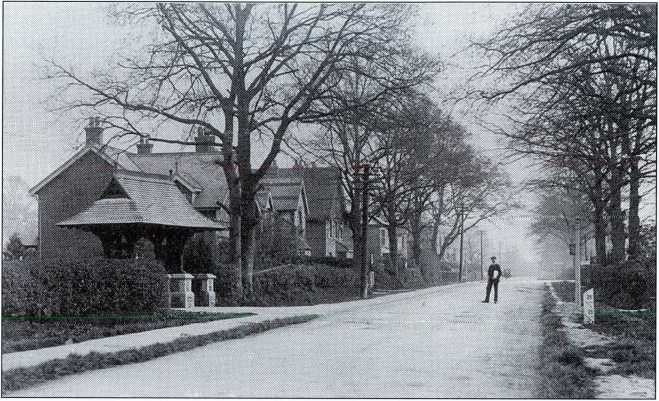
What no cars? The Brighton Road about a century ago after the lychgate had been built at St Bart’s to commemorate the South African War
A few 1950’s maisonettes stand on the corner of Sangers Drive.
T.M. 1501: Pickets Farm. Hmst & Gdn. This is also the site of “Ringley Oak” one of the early Horley houses dating back to before 1500. The Associated Ringley Oak Farm, also locally known as Apps’ Farm, was used for a short time in the 195O’s as “Lord George Sangers Animal Farm” when the circus elephants were housed there during the demise of this famous circus. A small group of houses, Nos 4-8, nearly opposite St Bart’s was built on T.M. 1522: Pt of Streets Fields. The present houses are on the site of those destroyed or severely damaged by a WWII landmine.
Church Walk Built opposite the St Bartholomew’s Church. Built in the 1950’s
T.M. 1522: Pt of Streets Fields.
Lumley Court This block of flats was built on the site of the old Horley Cottage Hospital in 1986/87. The Hospital was officially opened on 3rd May 1903 by Lily, the Duchess of Marlborough. The building, erected in 1889, was for two years a private house, it then became the Horley Temperance Hotel before taking on its role as the town’s hospital until its closure in 1983.
T.M. 1455: Pt of A, Meadow.
BROADLANDS
Was it named after the home of the Mountbatten family in Romsey or just a general agricultural thematic name? Built by Wates Ltd in 1983.
T.M. 1398: First Long Shot.
BROADMEAD
Another agricultural name. Built by Wates Ltd Between 1983 — 87.
T.M. 1383: Coombers.
BROCKHAM KEEP
The 3rd of the “Keeps”. Named after Brockham, a village near Dorking in Surrey. Built by Wates Ltd in 1982.
T.M. 1388: None.
BROCKLEHURST WAY
Thomas Pownall Brocklehurst was born in Horley in 1887 and lived at Kinnersley Manor. His father was a principal local landowner and before the war, Thomas studied law. He was a Captain with the 2nd Queens by September 1915 when he was wounded in action at Loos. He was killed on the first day of The Battle of the Somme, July 1st 1916 and is buried in Dantzig Alley British Cemetery, Mametz.
Westvale 2017. T.M. 1270 Furley
BROOKWOOD
Another of the “Heathland” group. Built by Wates Ltd in 1983. There is a part of the wooded area to the N.E. called Brook Wood. It is probably coincidental that this road is called Brookwood.
T.M. 1389: Common Field.
BROTHERTON AVENUE
Esme Brotherton M.M. was born in Guildford, married Lilian Holdforth at St. Bartholomew’s in Horley and probably moved into Lumley Road with her family. He enlisted as Pte. Brotherton, 2540 in the 25th Cyclists Battalion [The London Regiment]. At some point he was awarded the Military Medal for bravery but was killed in action, aged 27 on 6th August 1917 and has no known grave. He is commemorated on the Menin Gate at Ypres. Built by Westvale Park Consortium 2017.
T.M. 1114 Woodhouse
BULLFINCH CLOSE
The first of a group of thematic “Bird” names. Built by Gough Cooper in 1987 for the Family Housing Association.
T.M. 1284: Denshire Field.
BURGESS ROAD
The Burgess family were tenant farmers as listed on the Tithe Map of 1848. Built on Langshott Park, The Acres by Bovis c2014
T.M.1186
BURTON CLOSE
A new infilling development off Russells Crescent. Between Nos 18 – 20. The first 3 houses were built by Berkeley Homes in 1994. A further 3 houses were built by Plummer in 1998.
T.M. 1554: One and a half Acre
CAMBRIDGE LODGE PARK
The Cambridge Hotel was once a coaching inn known as The Kings Head before a new pub was built on The Balcombe Road. It was later owned by George, Duke of Cambridge and lived in by Mrs Fitz-George according to the 1851 census. A small development of mobile homes.
T.M.999 House, Pleasure grounds and garden
CAMPBELL GROVE
This Campbell was a land owner and farmer in this area according to the 1848 Tithe Map. Built by Westvale Park Consortium 2020
T.M. 1286, 1287 6acres
CARLTON TYE
One of the odder names! Carlton, named after the up market hotel, and Tye? According to the O.E.D. which gives several definitions a “Tye” (n) can be:- “An enclosed piece of land, enclosure, close; also an extensive common pasture”. A Kentish or East Anglian dialect term. No known local connection, the nearest being Brambletye. Built by Wates Ltd between 1984 and 1987.
F.M. 1401: First Meadow. 1403: Little Field.
CARTERSMEAD CLOSE
Named after an agricultural occupation? Another of the Tanyard Farm roads. Built by Croudace Ltd in 1983.
F.M. 1357: 10 Ac.
CASTLE DRIVE
Named after the supposed castle at Thunderfield. The history of Thunderfield is a constant source of research by many local historians. The estate was built by various builders mainly in the 1930’s. One of the few unadopted roads in the town.
F.M. 1591: Pt of A. 1592 & 1593: None.
CAVELL WAY
Edith Louisa Cavell [1865- 1915] was a British nurse who is celebrated for saving the lives of soldiers from both sides without discrimination and for helping some 200 Allied soldiers to escape from German-occupied Belgium during the First World War. She was arrested, found guilty of treason and shot by a German firing squad. Westvale 2020
T.M. 1106 Denshire Field
CHAFFINCH WAY
Another of the “Bird” names. Built by Gough Cooper for the Family Housing Association in 1978.
T.M. 1264: Smithers Field. 1284: Denshire Field.
CHALKFIELD ROAD
A field name probably used because of its use on heavy clay. Bovis c2016
T.M. 1181,1187,1178, 1179 all named Chalkfield
CHANTRY CLOSE
Associated with the Church ownership. Opposite “Chantry House” in Vicarage Lane. Built in 1956 by Anderson Building Contractors.
T.M. 1340: Allotment
.
CHARLESFIELD ROAD
Named after Charlesfield House, the home of Mr George Strawson, the Horley greenhouse manufacturer and local benefactor, which stood on the corner of Horley Row. It is said that he was a strict Total Abstainer and that his employees had to sign the pledge. It is ironic to see that a public house, originally “The Rainbow”, and now “The Bull”, was converted from his house. One of the earlier developments of the town. Building started in the late 1890’s. The triple cottage row, Nos 58 – 62 is reputed to have been built from the bricks and window frames taken from Horley’s original railway station. Some Local Authority houses were built at the end of the road for the Reigate Rural District Council in 1931.
T.M. 1341: Allotment
CHARM CLOSE
Another of the “Bird” names. A “Charm” of Goldfinches being a rather poetic collective noun! Built by Gough Cooper in 1978.
T.M. 1285: Second 4 acres
CHATELET CLOSE
Built on the site of a large house of the same name built for Dr Muter, who is thought to have owned the first motor car in Horley. Built in 1980 by Ferndale Homes.
T.M. 1355: Pt of several As. The first occurrence of land ownership by the London and Brighton Railway Company.
CHEQUERS CLOSE
Named after the “Chequers Hotel”. One of the most important inns of Horley. It is thought that The Bolters ale house became The Chequers in 1722. The Chequers sign may have been derived from the coat of arms of the Earls de Warenne of Reigate. In the early 15th Cent, the de Warenne family were granted a monopoly of ale house licensing in the district. The estate was built in the early 195O’s by Anderson Building Contractors for the Dorking and Horley Rural District Council.
T.M. 1347, 1349: Pts of A.
CHEQUERS DRIVE
See previous entry. Built by Anderson Building Contractors and C. E Edmonds in the early 1950’s.
T.M. 1346, 1347 71349: Pts of A.
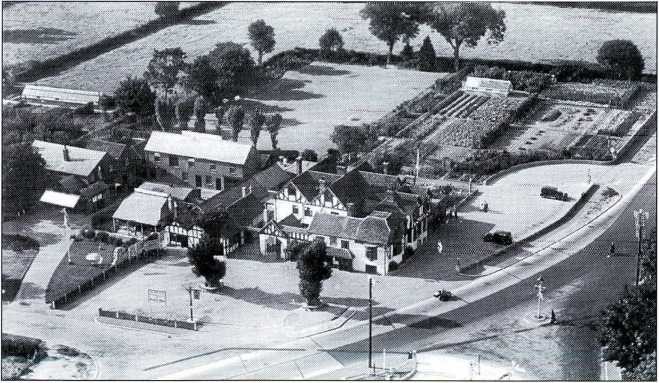
From this early 1930’s view of The Chequers Hotel it would seem that they grew all of their own vegetables.
What is more, from the dark piles in the garden, they were all organically grown as well!
CHESTERS
Why Chesters? There is no known local connection. Built by Gough Cooper In 1978.
T.M. 1281: 3 Ac. 1283: 2 Ac.
CHESTNUT ROAD
Another early development. The Nonegate Cottages on the south side of The road were built in 1888, most of the remaining houses were built in the 1920’s. Danby Court being built on the site of the former large house, Danby Lodge, in 1967.
T.M. 1202: Long 4 Ac. 1205 562 Ac.
CHEYNE WALK
Laid out in the 1930’s. An upmarket name for the beginnings of the Horley Gardens Estate. The land was purchased by J.W. Hall in 1935. The Name was used by Mr Hall in his earlier development off Addiscombe Road in Croydon. Most of this area was used as a W.W.II. depot and camp site for service personnel stationed at Gatwick. It later became a Prisoner of War camp before being taken over by post war squatters. The odd mortar bomb and hand grenade still turns up as residents dig their gardens! In WWI it was used as a munitions store. The post WWII building was mainly carried out by Walter Smith and C. F. Edmonds in the mid 1950’s. The estate covers a very large area originally owned by Christ’s Hospital.
T.M. 1524: Chalk Field. 1529: Beech Field. 1541 & 1542: Pt of 8 Ac. 1543: Appletree Field. 1556: Barnfield. 1557: Barn Plat. 1559: Pt of A.
CHURCH ROAD
Self explanatory, although it was earlier known as The Street. Originally one road, it was split into two when the Brighton Road was re-aligned as part of the turnpike between The Chequers and Povey Cross in 1816. The part near the town has been rebuilt at various times.
T.M. 1472, 1473 & 1474: All Pts of A. 1476: A. 1485: Pt of A.
The western end near the church was developed in the late 1880’s. There were a few houses near the inn and the church that made up one of the three hamlets of the area in 1602. “The Six Bells” really dates from around 1450 and not the claimed AD 827. The person who carved the 827 lived in the 20th century!
T.M. 1502: None. 1517: Tullocks. 1519: Streets Field.
CHURCHVIEW CLOSE
Opposite St Bart’s Church. A new infill development built in 1989/90. T.M. 1512: Tullocks. 1517: Cott & Gdn
CHURCH WALK See Brighton Road
CINDERFIELD ROAD
This road is named after Cinderfield Farm on Meath Green Lane. It is a 17th century timber framed house with rendered cladding below, tile hung above in ’fishscale and diamond’ patterning with a plain tiled roof. It has some 20th century alterations, possibly by Blunden Shadbolt.
T.M. 1095 Sheep water Meadow
CLARENCE COURT
Also named after an upmarket London hotel. Built by Wates Ltd in 1988. Tm 1404: Pond Field.
CLARENCE WAY See previous entry.
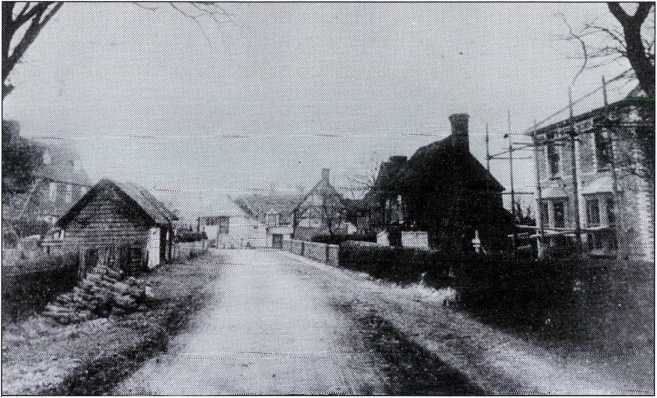
New houses being built in Church Road in about 1900
CLIFTON CLOSE
Named after Elizabeth Clifton who farmed the land in 1848 as a tenant of Sir Henry Bridges. Built by Laing Homes as part of the redevelopment of “The Defence” football ground. This land is just outside the Tithe Map area of Horley.
It adjoins T.M. 1405: Pt of 5Ac.
CLOVERFIELDS
A new name for the housing development on the rather unattractively named “Gasworks Field” Built by Wimpey Ltd in 1997/98.
T.M. 1390: Pt of A.
COLLINGWOOD CLOSE
Is this named after Horley’s department store or an admiral of the same name? Mrs Collingwood, the owner of the store disclaimed any involvement with its name! A Tanyard Farm road. Built in 1983 by Croudace Ltd.
T.M. 1357: 10 Ac. 1358: 5 Ac.
CONISTON CLOSE
Perhaps an obvious connection with Malcolm and Donald Campbell, former speed record holders for both land and water but if so, it’s the wrong Campbell! The racing Campbells raced on Coniston Water and lived at nearby Hookwood. Westvale Park Consortium 2017
T.M.1103 Denshire
CONSORT WAY
A fitting name to connect Albert, The Prince Consort, to his Queen Victoria! A short road joining Victoria Road to Albert Road. Built as part of the ill-fated Rush and Tompkins town centre re-development in the early 1980’s. The Victoria Road end was the site of Shipman and King’s Art Deco “Regent” cinema. The road provides access to various commercial offices.
T.M. 1469: Pt of A.
CONSORT WAY EAST
Another part of the town centre redevelopment joining the High Street to the eastern end of Victoria Road. The road was part of the “Planning Gain” when the Payless D.I.Y. store was built. The developers paid for the road to be built. It also gives access to some of the commercial buildings around the Central Car Park, one being the listed railway goods shed built in 1840, “The Factory Shop”, and the new Waitrose Supermarket which has been built on the Payless site. Horley’s first railway station built in 1841 was sited behind today’s Factory Shop.
T.M. Horley Station.
COPPICE WAY
There are many wooded areas on the 1848 Tithe Map with the name of coppice which is a small area of woodland which is regularly cut down to stimulate growth and for fire wood.Bovis c2014
T.M. 347,491,493,500,501,706, 712, 713, 957,958,1010 T.M]
COPSE LANE
Near the wooded area of Langshott, a copse? Built by Wates Ltd in 1987.
T.M. 1382: Hog Field. 1383: Coombers.
COURT LODGE ROAD
In the Middle Ages the Court Lodge area was the seat of the Local Government. The first section of this road from Vicarage Lane, once the edge of Horley Common, was called Hall Street and led directly to Horley Manor. The Manor was situated where today’s Anderson Leisure Centre now stands. The Church Officers and the Manor Court regulated all local affairs. Most of this large area was owned by Christ’s Hospital. The estate was built in 1965 for the Dorking and Horley Rural District Council.
- 1507: Occupation Road & Ponds. 1319: 6 Ac. 1320: Hither Field. 1321: Further Field. 1330: 3 Ac. 1331: 7 Ac. 1332: Vicarage Meadow.
CRANBOURNE CLOSE
Named after the large house that stood on this site. Built in 1961.
T.M. 1355: Pt of several As.
CRESCENT WAY
A straight road leading to The Crescent, laid out in the mid 1930’s by J. W. Hall. Mainly built by C. F. Edmonds in the mid 1950’s. The three white blocks of semi-detached houses were built by Anderson Building Contractors.
- 1569: Great & Little High Field. 1570: 9 Ac. 1573: Footpath Field. 1574: 4Ac. 1578: Pt of 4 Ac.

CREWDSON ROAD – JOHN CREWDSON
John Crewdson started a very successful building contractor’s business in Horley in 1913. He and his son Reg built scores of houses in the town and also many public and government buildings in the South of England. He was the first chairman of the Dorking and Horley Rural District Council when it was set up in 1933. He is now remembered in Crewdson Road and his son, Reg, is remembered for setting up the local charity known as the Crewdson Trust. John built Stonecourt” on Smallfield Road for his own use and also the attractive bungalow on the corner of Rosemary Lane and Balcombe Road.
CREWDSON ROAD
Named after the successful local developer and builder John Crewdson. Originally it was called Station Close. Built in the mid 1930’s.
T.M. 1446: None. 1447: Land by Horley Station.
CROXFORD CLOSE
William Croxford’s parents lived in Gatwick Cottages in Horley. He served in the Royal Welsh Fusiliers and is known to have won the M.M. for bravery. He died in action as his unit was preparing for the battle of the Selle on 15th October 1918, aged 33. He is buried in Hermies Hill British Cemetery near Bapaume. Built by Dentons 2019.
T.M. 1587 Pt of Allotment.
DARENTH WAY
The 2nd of the “River” names. Built in the 1970’s by Croudace Ltd.
T.M. 1130 & 1149: None.
DAY CLOSE
Charles Robert Day was born in Horley in 1894 to John and Alice Day who lived at 94 Albert Road. He enlisted at Guildford and joined the Royal Field Artillery. It is thought that he died just before the 3rd Battle of Ypres, aged 23 on 22nd July 1917. He is buried at Chester Farm Cemetery, 3 miles south of Ypres. Built by Westvale Park Consortium 2017.
T.M. 1099 Orchard Long Croft
DEEPFIELDS
Part of the Hutchins Farm estate adjoining the Horley Cricket Club grounds. Has Deepfields a cricket connection? Built by Algery Homes in 1983.
T.M. 1247: 4Ac. Chalk Field.
DELTA BUNGALOWS See Michael Crescent
DELTA DRIVE
Not actually Delta shaped, it serves Delta House, the Borough Council run sheltered accommodation flats. Built in 1958, extended and renovated in 1987 when the external balconies were enclosed.
T.M. 1543: Apple Tree Field. 1569: Great & Little High Field.
DENE CLOSE
Why a “Dene” in Horley? Hardly a deep wooded valley! Built by Gough Cooper in 1974.
T.M. 1264: Smithers Field
DENORAS CLOSE
Built on the site of a house and stables called Denoras Rest on the east side of Meath Green Lane. Possibly a word made from the names Den and Nora? 2020
T.M. 1140 Bob’s
DENSHIRE FIELD
This is one of the field names from Landens Farm. Denching was bringing pasture under the plough and involved cutting the turf and burning it. The burnt clay was then ploughed back into the soil to improve it. Westvale 2017
T.M. 1103, 1264, 1284
DOWNE CLOSE
Again why a “Downe” when Horley is so flat! The archaic spelling of “Down” a hill. Built by Gough Cooper in 1974.
T.M. 1264: Smithers Field. 1265; Barnfield.
DRAKE ROAD
Named after our famous seafaring bowls player and circumnavigator, Sir Francis Drake, 1540?-1596. Built by Admiral Homes in 1997 as part of the redevelopment of the Court Lodge School grounds.
T.M. 1318: Bayfield.
DREWELL CLOSE
Robert John Drewell was a sapper with the Royal Engineers whose service record was destroyed in World War II. His unit saw service on the western front including Loos and the Somme. He lost his life at The Battle of St Quentin on March 23rd 1918, aged 23 and has no known grave. Westvale 2020
T.M. 1279 4 acre Long Field
EAMES CRESCENT
Possibly a ‘typo’ error as this word may be Eccles, who were a farming family from the Meath Green area in the 1920s. Built by Westvale Park Consortium 2019.
T.M. 1284, 1285 First 4 acres, Second 4 acres
EARHART DRIVE
Amelia Earhart was an American aviation pioneer; the first woman to fly solo across the Atlantic Ocean. She mysteriously disappeared whilst on a solo flight across the Pacific Ocean. Westvale 2020
T.M 1136 Upper Gratton
ELSON ROAD
Charles Elson was born in 1877 and enlisted with the West Surreys in 1911.He served in France from 1915 and died on the opening day of the battle of the Somme, July 1st 1916. Westvale 2020
T.M. 1279; 4 acres
ELM TREE CLOSE See Horley Row
EMLYN ROAD
The River Mole at Horley was once known as the Emling or Emlyn Stream. Built in the early 1960’s.
T.M. 1321: Further Field. 1322: 3 Ac.
EWELANDS
Another Langshott agricultural connection. Built by Wates Ltd in 1983.
T.M.. 1384: Further Long Shot.
FAIRFIELD AVENUE
Named after Fairfield Road, Croydon, where J. W. Hall had also built houses before starting on the Horley Gardens Estate. For a short period just before WWII St Hilary’s school for boys was sited in this road. Building started just before W.W.II and completed for Dorking and Horley Rural District Council and other builders by 1966.
T.M. 1565: Three Cornered Field.
FAIRLAWNS
Most probably named after the personal house of the builder, Mr Walter Smith of Warlingham. Built in 1958.
T.M. 1442 & 1443: Pts of A.
FALLOWFIELD WAY
Another agricultural connection on Tanyard Farm development built by Croudace Ltd in 1983.
T.M. 1358: 5 Ac.
FENWICK CLOSE
Ethel Fenwick [1857-1946] was a former matron of St.Barts Hospital, London, who campaigned for the state registration of nurses to ensure that they were properly trained. Westvale 2021
T.M. 1121 Long Bridge
FERNDOWN
The odd one out of the group of names used by Bovis Ltd on the Kingsley School for Girls development. Built in 1975.
T.M. 1230: Cottage. 1233: First Med.
FIELD BANK
A newer road on the western fringe of The Acres close to the railway bank. Built by Bovis 2016
T.M. 1200; 3 acres
FIELD CLOSE
Many of the Tithe Map 1848 names end in the word field. Built by Bovis C2010
T.M. 1196
FIELDVIEW
Actually there is not much of a view of a Langshott field from this road! Built by Wates Ltd in 1983.
T.M. 1361: Common Field.
FIRLANDS
Part of the “Heathlands” group. Built by Wates Ltd in 1983.
T.M. 1389: Common Field.
FISHERS
Just to confuse everyone this is in Langshott and nowhere near Fishers Farm in Limes Avenue! Built by Wates Ltd in 1983.
T.M. 1383: Coombers.
FLINT CLOSE
The Flint family were land owners as shown on the 1848 Tithe Map. Built by Bovis c2011
T.M. 1192; 6 acres Common field
FLOWERS CLOSE
George Flowers originally came from Lincolnshire but married Sarah Taylor at Horley in 1901. They moved to Portsmouth where he joined his ship, HMS Good Hope as a carpenter on 2nd August 1914.She was hit by the Scharnhorst on 4th November and sunk within half an hour with the loss of the whole crew of 900. George is commemorated on the Portsmouth Naval Memorial.
T.M. 1281, 1282 2 acres, 3 acres
FURNEAUX CLOSE
The Furneaux family farmed in the Meath Green area in the 1920s. Built by Westvale Park Consortium 2017
T.M. 1272 Peabarn
FURZE CLOSE
Furze is a thorny evergreen shrub and was one of the 1848 Tithe Map field names, This close was added to the former Horley Defence Football Ground [see Jennings Way] Built by Laing 2001.
T.M. 1196 Saw Pit
GOLDCREST CLOSE
Another of the “Bird” group. Built by Gough Cooper in 1978 for the Family Housing Association.
T.M. 1285: 2nd 4 Ac. 1286: 2M Ac.
GOWER ROAD
Another nautical connection by Admiral Homes Ltd. Named after Admiral Sir Erasmus Gower, 1742 – 1814, who served in the Navy for 59 years! Built in 1997 on part of the old Court Lodge School playing field.
T.M. 1318: Bay Field. 1319: 6Ac.
GRANARY CLOSE
Off Bakehouse road, an obvious choice. Built in 1975 by Bovis Ltd.
T.M. 1239: None.
GRATTON CLOSE
Upper and Lower Gratton fields were owned by the Francis family. This road is in competition with The Avenue for being the shortest road in Horley. Built by Westvale Park Consortium 2019-2020
T.M. 1136 Upper Gratton, 1123 Lower Gratton
GRASSMERE
Part of the “Cereal” group. Built by Wates Ltd in 1982.
T.M. 1362: Common Field.
GRAYS WOOD
No record of such a wood in the Horley area, but it is the name of the architect for the project, a Mr Keith Gray! It is a later extension to the Langshott development. Built by Wates Ltd in 1994.
T.M. 1406: None.
GREENFIELDS CLOSE
The close is on the site of Greenfields Farm. Built in 1974.
T.M. 1143: Greenfields Farm. Hmst & Gdn. 1144: Barn Field.
GREENFIELDS ROAD
Another part of the Meath Green Estate development. Named after Greenfields Farm. Built by the ill-fated Eagle Construction Ltd. in 1955/56.
T.M. 1145: Lower Field. 1248: Denshire Field. 1249: Orchard Field.
GRENDON CLOSE
Part of the Hutchins Farm Estate. Grendon is a small village in Northants. Built by Algery Homes in 1983.
T.M. 1245: Barn Field.
GROSVENOR CLOSE
Small infill development behind Upfield. c2004
T.M.1544; 4 acres
GROVE ROAD
One of the early developments of the town started prior to W.W.I as part of the Parkhurst Gardens Estate. Various builders. The unusual feature of this road is that it changes its name at the far corner of its length.
T.M.. 1256: A. 1257: 6Ac, Simes.
HAINE CLOSE
This road was named as a result of suggestions from the public. Reginald Leonard Haine was born in Purley and later lived in Easebourne, near Midhurst. During WW1 he was awarded a V.C. for his action in leading his men near Gavrelle. His parents lived at Clipsham in Ringley Avenue during the late 1920s. Bovis c2016
T.M.1178 Moat field
HAMILTON CLOSE
An infill development behind Upfield. Built by Banner Homes [Cala] 2006
T.M. 1543 Apple Tree field
HARDY CLOSE
Vice-admiral Sir Thomas Masterman Hardy, 1769 – 1839, was captain of H.M.S. Victory at the Battle of Trafalgar at which Admiral Nelson met his death. Built by Admiral homes in 1997 on part of the old Court Lodge School playing fields.
F.M. 1318: Bay Field.
HARELANDS CORNER
The 1602 map shows “Harlande” as a field on the corner of what is now Horley Row and Meath Green Lane owned by “ Burner freeholde to the Manor of Horley”. Strangely today’s Harelands Corner has its street sign on the opposite side of the road that was on Horley Common. The present houses were built in 1925 for the Reigate Rural District Council.
T.M.. 1342 Allotment.
HARMONY ROAD
No idea how this name was chosen. It is close to Charm Close! Representation of peace.
Built by the Westvale Park Consortium 2018
T.M 1282 First 4 acres
HAROLDSLEA
In Saxon times the area adjoining Thunderfield was called “Herewoldesle” and the chief of the little settlement may have been “Hereweald”. There are some 22 different spellings of the name from 1202 until 1891 when it became “Haroldslea”. After the dissolution of Chertsey Abbey a brick house was built here. There is an unsupported local legend that Haroldslea House was haunted! Outside the Horley Tithe Map area.
HAROLDSLEA CLOSE
See the previous entry. This small estate was the first of the Croudace Ltd developments to be built in Horley in 1953.
T.M. 1603:
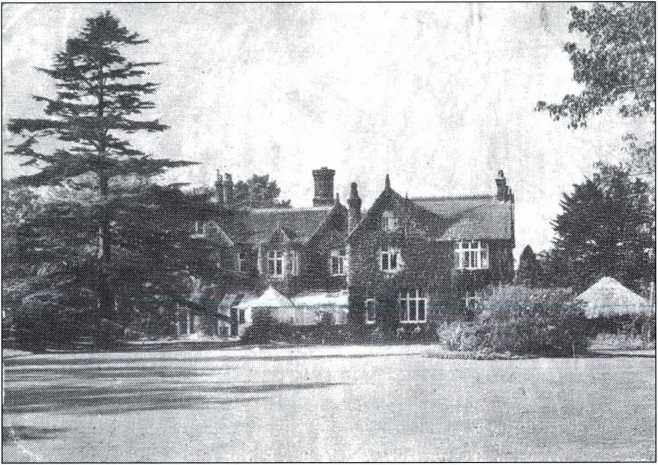
Haroldslea House in its heyday in 1934. The photograph is taken from the Knight,
Frank & Rutley sale brochure
HAROLDSLEA DRIVE
See previous entries. Mainly developed in the 1930’s. There were 3 Art Deco houses built at this time, two of which still survive relatively unaltered. Various builders including John Crewdson. A new development of 6 houses was built by Country Homes Ltd in 1998 on the site of Newstead Hall.
T.M. 1592 & 1593: None. 1595: A. 1599, 1600 & 1601: None.
HARP ROAD
Harp Field was one of the fields on Landen Farm. Built by Westvale Park Consortium 2017.
T.M. 1270 Furley
HARROWSLEY GREEN LANE
An old trackway that led across Horley and Horne Commons. Outside the Horley Tithe Map area.
HARVEST SIDE
Another of the “Cereal” group. Built by Wates Ltd in 1982 – 83.
T.M. 1362: Common Field.
HATCHGATE
Named after the house that once stood on this site. Marked on the Tithe Map as “Whitegate”. The house later was renamed “Woodroyd”, hence the Woodroyd Estate. Later still it was known as “Old Hatchgate”. It once marked the western end of today’s Massetts Road with a white gate, hence the name. Wates “Dormy” houses were built under licence in 1954 by Pitman Brothers of Merstham.
T.M. 1533: Hatchgate House and Gdns. 1534: Orchard.
HAYFIELDS
Part of the “Cereal” group on Langshott. Built by Wates Ltd in 1982-83.
T.M. 1362: Common Field.
HAZELHURST
Another of the “Woodland” names. Hurst being the old English name for a wood. Built by Wates Ltd in 1987.
T.M. 1371: Coomber Field. 1372: Great Meadow.
HEATHERLANDS
Part of the “Heathland” group of roads off Stockfield. Built by Wates Ltd in 1983.
T.M. 1389. Common Field
HEDINGHAM CLOSE
Is there a connection with Castle Hedingham or Sible Hedingham in Essex? Built by Bovis Ltd in 1984.
T.M. 1385: Hmst & Gdn. 1386: None.
HERITAGE LAWN
A “Lawn” (Archaic, dialect) is a rather up-market name for “an open space between woods: – a glade” Built by Wates Ltd in 1984.
T.M. 1364: None.
HERONSWOOD COURT
This may have been named in conjunction with Larksfield built by Wimpey 1998-99 on part of the former ‘Gasworks’ Field.
T.M.1390 Pts of Allotment
HEVERS AVENUE
Named after the Hevers or Heavers family who were local land owners in the 15th to 17th Cent. Started in the 1930’s by private developers. Some Council houses were built after W.W.II. for D & H. R.D.C. in 1951/2. More private dwellings were also built by C. E Edmonds at the southern end of the road.
T.M. 1342: Ac.
HEVERS CORNER
See the previous entry. Built for D & H. R.D.C. in 1951
T.M. 1344: Pt of A.
HIGH STREET See also Station road
Strangely enough High Street only came into being officially in 1961, until then it was known as Station Road. It originally served the first railway station which was built in 1841 and stood between today’s Factory Shop and the subway. The present station was built in 1905. The line of the road, which joins Massetts Road to the King’s Head on the Balcombe Road and Smallfield Road crossroads, appears on maps going back to 1812. It is not known for sure when the first houses were built along its length. By the time the Tithe Apportionment Map was drawn up in 1848 the first buildings had appeared near the western side of the level crossing. With the coming of the railway, building in what is now the town centre, gathered momentum and only a few years later houses had sprung up almost along its entire length. Many were later converted into shops by building on a single storey front extension. Examples of this development can still be seen today in No 42, the Gatwick Arms and No 36, and its nextdoor neighbour No 34, Halifax Pic. Most of these earlier shop conversions have been replaced by newer buildings.
T.M. 1451: Pt of A. 1457: Pt of A. 1458: Pt of A, Hse, Shop & Gdn. 1459: Pt of A. 1470: Pt of A, Cot & Gdn.
HILL MEAD
This is a field name for houses on Westvale Park.
T.M. 1274 Peabarn
HILTON COURT
Yet another up-market London hotel name in Langshott. Built by Wates Ltd in 1988.
T.M. 1404 Pond Field.
HOADLEY ROAD
This is the eastern link road to the Westvale Development, built during 2019 -2021 to allow access to the final building stages of Westvale Park. William Hoadley was a tenant farmer and according to the 1848 Tithe Map he farmed a number of ‘parcels of land’ in this immediate area.
T.M. 1083,Oasterfield,1082,1120,1121,1118 Hoops Croft,1136,Upper Gratton,1117 Oasterfield
HOLMBURY KEEP
The fourth of the “Keeps”. Named after Holmbury St Mary, a Surrey village south-west of Dorking. Built by Wates Ltd in 1982.
T.M. 1388: None.
HOMEFIELD CLOSE
Another of the Tanyard Farm group. Built by Croudace Ltd in 1980.
T.M. 1357: 10 Ac.

Note the caption “Station Road” on this old postcard. The card is date stamped
“HORLEY R.S. O. – 7.15 PM 25 J A 05”. This was at the time when there was a
sorting office at the railway station which is indicated by the letters R. S. O. —Railway Sorting Office.
HONEYSUCKLE CLOSE
A small development of houses off Briars Wood built by Persimmon Homes Ltd in 1988. The new houses are adjacent to Catts Cottage, one of the oldest houses in the Langshott area, dating back to about 1600.
T.M. 1369: Slip. 1370: Cott & Gdn.
HONOUR GROVE
It was felt that after naming many of the Westvale roads after the fallen of Worl War I, the word honour would tie in with the theme of Remembrance.
HORLEY ROW
Many of the oldest houses in Horley Parish were built around the hamlet of Horley Row, which was a row of houses that stretched from the Chequers to Hutchins Farm. These houses were all set back on the southern boundary of the Manor of Lodge, some 50 yards to the north of what is now the road, originally called Horley Mill Lane because it led to the mill on the River Mole. The modern buildings on the southern side of the road are part of the large Chequers Drive Estate built by Anderson Building Contractors and C.F.Edmonds in 1951. No 5 is unique in that it has a brick representation of the 1951 Festival of Britain logo included on its gable end. This was inserted by Doug Anderson not only to commemorate the Festival of Britain but also to mark the birth of his son Paul! It was built one evening when the local building inspector, who did not favour the idea, was not on site. By the morning the cement had set hard and the inspector obviously decided not to object anymore! Some of the older houses near Charlesfield Road were built around 1900. Some infilling on the northern side of the road took place as part of the big 1975 Bovis development. More infilling and conversion of old buildings was carried out in and around Anderson’s yard by Doug Anderson at various times.
T.M. 1255: Pt of A
.Elm Tree Close On the southern side of the road. Named after the famous Elm tree that stands outside the Chequers that with others stood on Horley Common. Many years ago a resident of Horley regularly slept in the hollowed out trunk to demonstrate his commoner’s rights. The old peoples’ bungalows were built in 1954 as part of the Chequers Estate.
T.M. 1349: Pt of A.
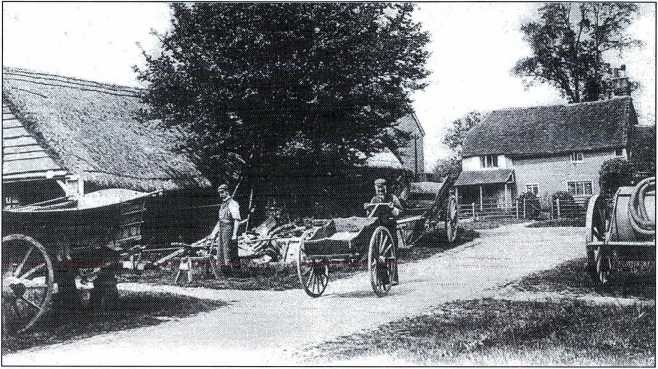
The wheelwright’s shop in Horley Row before it became Anderson Building
Contractors Yard and later converted into houses.
Orchard Close Also on the southern side of the road. There was an orchard in the cottage garden of this plot. Part of the infilling. Built in 1979
T.M. 1342: A.
Yew Tree Close Named after “Yew Trees”, one of the old adjacent houses on the northern side of Horley Row to the rear of the close. Built by Anderson Building Contractors in the 1960’s.
T.M. Horley Row.
Kenya Court On the northern side of the road. Why Kenya Court? No known association with Kenya has been found. Built in 1961 by Kind & Co of Leytonstone.
T.M. 1255: Kiln Platt, A.
South Parade The block of shops with flats above does have a Southerly aspect! Also built in 1961 by Kind Sc Co.
T.M. 1255: Kiln Platt, A.
HURST ROAD
A short continuation of Grove Road. Another part of the Parkhurst Gardens Estate started prior to WWI. Various builders.
T.M. 1257: 6Ac. Simes.
HUTCHINS WAY
Hutchins is the name of the 15th century house at the western end of Horley Row and for many years the home of the Benhams Farm managers. Built in 1983 by Algery Homes.
T.M. 1247: 4Ac. Chalk Field. 1253: Old Meadow.
HYPERION WALK See The Drive
Built for Gatwick Housing Association in 1967. Backing onto the railway line.
JENNINGS WAY
Named after Major Jennings, the local owner of the land from 1923, when he bought it from the Bridges family, until 1948 when he gave some of his land to Horley Football Club. It was a memorial to those people of Horley who gave their lives in the second world war to defend this country. The football ground was called “The Defence”. The name of the road was suggested by the Horley Local History Centre. The houses were built by Laing Homes in 1999. This land is partly outside of the Horley Tithe Map area where it adjoins Horne Common.
T.M. 1405: Pt of 5Ac.
JOHNSON CRESCENT
Another notable woman, Amy Johnson CBE [1903-1941] was a pioneering English pilot who was the first woman to fly solo from England to Australia. She lost her life over the Thames Estuary in 1941.Westvale 2020
T.M. 1120 Upper Judge
JUBILEE CLOSE
Possibly Queen Elizabeth’s Coronation 60th Jubilee. Built by Barratts & David Wilson c2014
T.M.1198
KELLER CLOSE
Helen Keller [1880-1965] was an American author and disability activist who had lost her sight and her hearing following an illness at nineteen months old. Westvale 2021
T.M. 1121 Long Bridge Field
KELSEY CLOSE
Named after the Kelsey family who were farmers and later landowners of large parts of the Christ’s Hospital land in Horley. Built in 1967 for D & H. R.D.C.
T.M. 1332: Vicarage Mead.

Major Jennings kicks off the ball at the first football match to be played on Horley
FC’s new ground, ‘The Defence’, Smallfield Road at the start of the 1950 season.
The match was between Horley and Redhill. The ground is now a housing development.
KENYA COURT See Horley Row
KIDWORTH CLOSE
Part of the Hutchins farm estate. Where does the name Kidworth come from? Built in 1983 by Algery Homes.
T.M. 1253: Old Meadow.
KILLICK ROAD
Sidney & Harvey Killick were bothers in a family of 8 children. Sidney served with the East Kents and was wounded near Wulvergham on 29th/30th April when the enemy carried out a gas attack and then a barrage of artillery fire. He died on 1st May 1916.
Harvey served with the Royal West Surreys and was at the Battle of the Somme on the opening day, July 16th 1916. His battalion sustained dreadful casualties including Harvey who is buried at Dantzig Alley Cemetery near Mametz. Built by Westvale Park Consortium 2017.
T.M.1114 Woodhouse
KILN CRESCENT
There are a number of field names associated with Lime Kilns as many farms had their own kiln. Limestone [chalk] was burnt in a kiln and the quicklime produced was spread on fields to improve the soil. Westvale Park Consortium 2017
T.M. 1105 Sheepwater Meadow
KILN LANE
Possibly named after the nearby Kiln Field (T.M. 1252) Built as part of the Bovis development in 1975.
T.M. 1239: None.
KIMBERLY CLOSE
Part of the Court Lodge development. Is it a girl’s name or is it named after the South African mining town? Built for Reigate and Banstead Borough Council in 1986.
T.M. 1319: 6Ac.
KINGFISHER CLOSE
A small close built on back gardens off Vicarage Lane 2020-2021. Not far from the River Mole where these elusive birds have been spotted.
T.M.1325 Arable 5 acres
KINGS ROAD
Named as a partner for Queens Road. Home to Horley Health Centre and a few houses originally built for the Surrey Police. The clinic was built in 1966 and the surgery in 1976. The surgery was officially opened by Sir Gorge Sinclair, the M.P. for Horley at the time.
T.M. 1468: Pt of A.
KINGSLEY CLOSE
Named after Kingsley School which was housed in a large mansion formerly known as “The Elms” which was on Horley Row. This was once the home of an important wealthy Horley family the Webbers. Mr Henry Webber has the distinction of being the first chairman of Horley Parish Council when it was created in 1897 and also at the age of 68 he was the oldest man in the country to have joined up to fight in the first World War. He was killed on active service bringing supplies up to the front line. Most of the former school land forms the Bovis development off Horley Row. However this close is part of the Eagle Construction development built in1956-59..
T.M. 1131: 3 Ac Grove Field. 1132: Crab Tree Field.
KINGSLEY ROAD
See the previous entry. The western end was built by Eagle Construction and the Eastern end is part of the Croudace development of 1975..
T.M. 1146: Lower Field. 1147: Shrive Tree Field. 1148: 3 Ac Lane Field. 1149: None. 1150: Bakers Croft. 1151: None.
KNOWLES ROAD
Harvey Knowles was married to Elsie Mary Baldwin and lived in Albert Road along with his two children. He joined the Royal Sussex Regiment and was posted abroad on 31st August 1914. He saw action at the Battles of Mons, Marne, Aisne and Ypres. He was killed at Loos on 29th September 1915, aged 29 but his body was never found so he is commemorated on the Loos Memorial. Built by Westvale Park Consortium 2017.
T.M. 1109 Occupation
LADBROKE ROAD
Most probably named after Labbokland (1324) which was derived from Bocland or Bookland. Land whose title was secured by Royal Charter or “Book”. The part between the railway and the Brighton Road was built prior to W.W.I. There has been some later rebuilding. Various builders.
T.M. 1204: 5^/2 Ac. 1355: pts of several As.
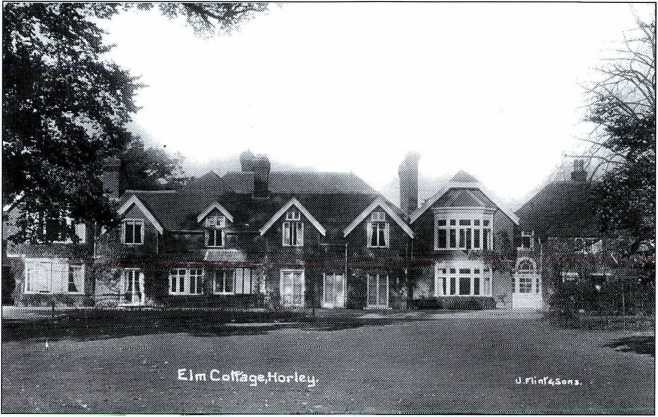
The Elms, the home of the Webber family for many years. It later became Kingsley
School. Demolished to make way for the large Bovis development of the 1970’s.
LAKE LANE
One of the many drove roads running from south to north in the area joining Cross Oak Lane and Langshott via Great Lake Farm. This area may be used for future development. A barn conversion has been added to the farm.
T.M. 1170: Orchard. 1171: Great Lake Farm, Hmst & Gdri; 72: Orchard by Brook
LAMBYN CROFT
Another of the odd whimsical names on Langshott. According to the developers the name Lambyn Croft appears to reflect a “may be” manor house! A “Croft” is a small enclosure. Built by Wates Ltd in 1987.
T.M. 1374: Part of Coomber Field.
LANDEN PARK
Named after Landen Farm, a corruption of London, its original owners name. Built by Gough Cooper in the mid 1970’s.
T.M. 1263: A. 1265: Barn Field.
LANGSHOTT
Langsett in 1226, Langshete in 1319, the name may be derived from “A long seat or angle of land”. The name is used to describe an area of Horley as well as being the name of one of the very old lanes which crossed the northern edge of the common. Tanyard Farm dates back to around 1500 and Langshott Manor has its own history going back into the same period. At present the line of the roadway forms the northern boundary of the town. There has been considerable development on the south side of the road by Croudace Ltd and Wates Ltd to form the Langshott Estate. A few houses were built in the 30’s in the woods adjoining Langshott. Two new large houses were built by Twiggen Homes Ltd in the grounds of “Woodlands”. Most of these houses are outside the Horley Tithe Map area.
T.M. 1192: 6Ac. Common Field.
LANGSHOTT LANE
A one-time road through from Smallfield Road to Lake Lane. Horley’s only windmill stood on the corner of the lane about 100 m from the Smallfield Road end. The mill worked until 1875 and was demolished some 25 years later. The lane is now closed off to through traffic since the development of the Langshott Estate by Wates Ltd in the 1980’s. Some earlier development in the 1930’s.
T.M. 1364, 1365 & 1366: None (Now all footpaths) 1387: None. 1393: Windmill Meadow.
LANGWOOD DRIVE
This road was named after the house that stood on this land. Built in 2015.Outside the Horley Tithe Map area.
LARKFIELDS
A new name for part of the Gasworks field. Built by Wimpey Homes Ltd in 1998.
T.M. 1390: Pt of A.
LAWRENCE GARDENS
Dorothy Lawrence,[1896-196] was a journalist who secretly posed as a man in order to serve as a frontline soldier during World War I. She worked as a sapper for 10 days before she surrendered, aware of the risk she posed. Westvale 2020
T.M. 1113 Mid Croft

Langshott Manor the home of the Bridges Family from1671 — 1923. It was then
owned by Major Jennings until the mid 1950’s. It is now a small luxury hotel
LE MAY CLOSE
Named after the last owners of Yattendon Lodge, who were also the licensees of “The Chequers”. Built by C.E Edmonds in the mid 1960’s on the site of the old Lodge.
T.M. 1350: Pt of A.
LECHFORD ROAD
Named after the Lechford Family who farmed and owned large areas of Horley in the 16th & 17th centuries. Built in 1955 by Tulse Hill Properties who wanted to call it “Linroy Avenue” The Horley Local History Association at that time were able to persuade D & H. R..D.C to commemorate the Lechford Family.
T.M. 1541 & 1542: Pts of 8 Ac.
LEE STREET
Formerly Estret and Le Stret, later Horley Mill Lane. The early meaning of “Street” was to refer to a road of some importance; it led to the mill. There are some very old houses sited along this road, including No’s 53, 69, Wisteria Cottage, Old Bell House. No 148, 172 and the old Baptist burial ground near the site of Horley Mill. Further development includes some pre – WWI houses and later building by various builders. Some Council houses were built for R.R.D.C. in 1925 and also for D & H. R.D.C. in 1965.
T.M. North Side, 1257: Ac Simes. 1297: 2l/2 Ac. 1298:2^4 Ac. 1299: F/2 Ac. T.M. SouthSide, 1321: Further Field. 1322: 3 Ac. 1323: 4Ac. 1324: 2 Ac.
LIMES AVENUE
Lime trees were planted here before the housing development was started in 1936 by J. W. Hall and completed by various builders. The entrance to the 15th century Fishers Farm is now off the Avenue. The farm was on the western edge of Horley Common. Redevelopment and infilling has taken place in recent years. See Stafford Place and Stocks Close.T.M. 1586, 1587, 1588 & 1589: All Pts of A.
LINCOLN CLOSE
The first part of a thematic “County” development off Suffolk Close. Built in 1993/94 by Wilmot Dixon Housing for the London Quadrant Housing Trust and the Tower Housing Association.
T.M 1538: Meadow Field
LITTLEFIELD CLOSE
This was one of the field names on the 1846 Tithe Map Built by Westvale Park Consortium 2017
T.M 1105 Little Field
LITTLE MEADOW
Another rural field name from the 1848 Tithe Map. Built by Bovis c2015
T.M.1198 Platt
LONGBRIDGE ROAD
Named after the “Longbridge” which spanned the River Mole. This name goes back to the 14th Cent. Built in 1965 by C.F.Edmonds. Another block of flats was built in 1997.
T.M. 1523: 6Ac. 1524: Chalk Field. 1526: Berry Grove.
LONGBRIDGE WALK
See the previous entry. Built by Emmerton Homes in the early 1970’s.
T.M. 1524: Chalk Field.
LONGCHAMP CLOSE
Not a particularly “Longfield”. It backs onto a house in Smallfield Road of the same name. Built by Wates Ltd in 1988.
T.M. 1403: Little Field.
LUMLEY COURT See Brighton Road
LUMLEY ROAD
Most probably named after Sir William Lumley, 1763 – 1850. After a most distinguished career as a soldier he later became an important personage in the royal household. He served no less than four monarchs. He was Groom of the Bedchamber to Queen Victoria.
The road was started after the railway came to Horley in 1841. Most of the houses were built prior to W.W.I. by various local builders. There has been some infilling and redevelopment.
T.M. 1455, 1456 & 1457: Pts of A.
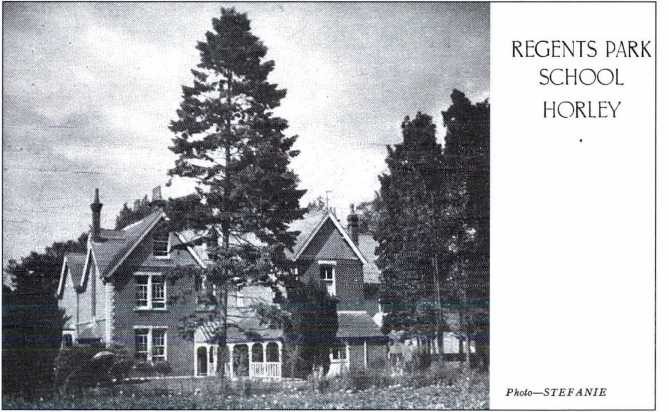
This postcard was produced for the school which was on the site of Cooper Lodge.
It is now a residential home with appartments.
LUSCOMBE WAY
Geoffrey Alfred Luscombe was a Lt. Commander in the Royal Navy, which he joined as a naval cadet at H.M.S. Brittania in 1901. He saw service on HMS Juno, HMS Dominion and finally HMS Blackmorevale, a minesweeper. His ship hit a mine off Aberdeen on May 1st 1918 where he lost his life. Westvale 2020
T.M.1279 4 acres
MAIZECROFT
Part of the thematic “Cereal” group on Langshott. Built by Wates Ltd in 1982- 83.
T.M. 1388: None
MALLARD CLOSE
Named after wild ducks? Built by Howard Homes in 1997 on ground that was sold off from the site of Bakers Croft School. [Update 2021] Apparently, a family member liked ducks and Mallards in particular.
T.M. 1221: None.
MALTHOUSE LANE
This name was given to the small development on the land immediately next to the Landen Farm house and its outbuildings. Malthouse is the name of one of the fields. Built by Marden Homes c2010.
T.M. 1869 Malthouse
MANN AVENUE
Dame Ido Mann DBE, FRCS [1893-1983] was a pioneer in the field of ophthalmology and anatomy, who researched functions and diseases of the eye. She was the first woman to hold a professorship at Oxford. Westvale 2020
T.M.1113 Upper Gratton
MANOR CLOSE
Named after the Manor of Horley at Court Lodge. The old Court Lodge Manor House was the seat of local Government. The Lord of the Manor hardly ever attended at the local courts so his Steward presided over the proceedings which were recorded on long strips of parchment known as Court Rolls. Two courts were held. Court Baron dealing with the transfer of land and Court Leet handling minor offences. Built in 1969 for D & H. R.D.C.
T.M. 1506: Englands. 1507: Occupation Road and Ponds.
MANOR DRIVE See Previous entry. Built in 1968
MAPLE CLOSE
John Maple who owned Maples, a famous London store of the 20th century began his retail career as a boy working in the shop by the Lee Street mill. Built in c2012
T.M.1321 Further ‘Moors’
MASSETTS ROAD
Named after Massetts Farm. One of the old roads in the town which ran along the edge of the common. Most of the present development dates back to the 1900’s. Various builders. Some newish redevelopment.
T.M. North Side, 1471, 1472, 1473, 1474, 1475 & 1476All Pts of A. T.M. South Side, 1536: Meadow by Hatchgate. 1537:Hmst & Gdns. 1544: 4 Ac. 1545: Big Med. 1549a: Encroachment. 1550: Pt of A.
MAYNARD DRIVE
William Maynard lived in Earlswood and enlisted with the The Queens, the county Regiment of Surrey early in the war. By September 1915 he was on the Western Front at Givenchy. His battalion advanced on a narrow front but the Germans mounted a counter attack where William was killed on 25th September 1915, age 28. He has no known grave but is commemorated on the Loos Memorial. Built by the Westvale Park Consortium 2017.
T.M. 1269 Malthouse
MEADOWCROFT CLOSE
Named after the large nearby house. Built in about 1950.
T.M. 1625: 5 Ac. 1626: Pt of A. 1644 & 1645: Old Enclosures.
MEADOWSIDE
Part of the “Heathland” group on Langshott. Built by Wates Ltd in 1983.
T.M. 1389: Common Field.
MEADOW WAY
There are many meadows on the Tithe Map. This road is adjacent to an open space. Built by Barratts and David Wilson on The Acres, c2010
T.M. 1192 6 acres common, 1193 6 acres orchard
MEATH GREEN AVENUE
Various spellings have been used over the years, Moy Green, Moythe Greene. The Avenue was built in 1925 for Reigate Rural District Council.
T.M. 1251: Vicarage Meadow. 1252: Kiln Meath Green Lane when it was green
MEATH GREEN FARM CLOSE
Meath Green Farm stood at the northern end of the Westvale development. Its buildings stood adjacent to the lane just before the first bend. Built by Westvale Park Consortium 2018
T.M 1113 Mid Croft
MEATH GREEN LANE
See the previous entry. It was possibly an old drovers road between Horley Row and the common and Reigate. There are a few old houses to be found along the way. “The Croft”, “Cinderfield” and Ladyland Farm. Modern development has taken place south of “Greenfields”. “Bramley Court” was built on the corner of Parkhurst Road in 1989. Council houses were built in 1925 for R. R.D.C. Some older style houses were built on the western side in the 1900’s. A few more were added in the 50’s and 60’s.
T.M. West Side, 1256: Pt of A. 1261, 1262 & 1263 A’s.
T.M. East Side, 1251: Vicarage Meadow. 1255: Kiln Plat Allotment.
MERIDIAN GROVE
Why Meridian? The Greenwich Meridian passes through East Grinstead some 11 miles to the east! Built by Wates Ltd in 1983.
T.M. 1383: Coombers.

It is 11 miles from the Greenwich Meridian and not in the middle of Langshott either!
MICHAEL CRESCENT
Named after J.W.Hall’s grandson on Horley Gardens Estate. Built by C.EEdmonds for D & H. R.D.C. in 1955.
T.M. 1293: Great & Little High field. 1570: 9 Ac.
Delta Bungalows 12 retirement bungalows were built in 1987 when Delta House was renovated.
MIDDLEFIELD
Built by Wates Ltd in 1987 just in the middle of the field!
T.M. 1384: Further Long Shot. 1388: None.
MILL CLOSE
Built near the site of Horley Mill, hence the name. Built by Mclennan Ltd in 1963.
T.M. 1293: Meadow (Aptly then owned by Edward Millar!)
MILLFIELD CLOSE
This is possibly named after the windmill that stood to the north of the Smallfield Road near Langshott Lane
Built c2011.
T.M. 1392 Pt of Allotment
MOSFORD CLOSE
Part of the Hutchins Farm Estate. Why Mosford? Built by Algery Homes in 1983.
T.M. 1247: 4 Ac. Chalk Field.
MOY GREEN DRIVE
This is one of the old names for Meath Green derived from Moythe. Built by the Westvale Park Consortium 2017.
T.M. 1112 Upper Barn, 1112, Middle Croft,1106 Denshire,1270 Furley
NEWLANDS CLOSE
Also part of the Hutchins Farm Estate. Was it named after the famous Surrey beauty spot? Built by Algery Homes in 1983.
T.M. 1246:3 Ac.
NEWMAN ROAD
John Newnham was a tenant farmer according to the 1848 Tithe Map. [ Alteration of spelling?] Built by Barratts and David Wilson on the Acres c2010.
T.M. 1192; 6 acres common
NIGHTINGALE CLOSE
Another of the notable women roads built during the final phases of the Westvale Park 2021. Florence Nightingale, OM ,PRC ,DStJ, 1820-1910, is well known for travelling out to the Crimea with a group of nurses to establish hygienic nursing care for the injured soldiers. She was known as The Lady of the Lamp as she toured the wards at night carrying a lantern. She was a social reformer, statistician and the founder of modern nursing. Westvale 2020
T.M. 1137 Barn Field
NORFOLK CLOSE
Another of the “County” group off Suffolk Close. Oakley House was built in 1993/94 by Wilmot Dixon Housing for the London Quadrant Housing Trust and the Tower Housing Association.
T.M. 1538: Meadow Field.
OAKLANDS
A woodland name in Langshott. Built by Wates Ltd in 1984.
T.M. 1401: First Meadow. 1402: Further Meadow.
OAKSIDE COURT
A woodland name for a large flat complex. Built by Wates Ltd in 1987.
T.M. 1383: Coombers.
OAKSIDE LANE
See previous entry. Built by Wates Ltd in 1987.
T.M. 1383: Coombers.
OAKWOOD ROAD
This road cuts through what was once a coppice. Were there lots of oak trees? Development started after the railway came to Horley in 1841 and continued until the 1980’s. Some of the large houses date from 1890, the smaller “Dormy” style from the 1930’s were built by Aylings of Croydon.The maisonettes were built in the 195O’s. Various builders. Later development at the northern end by Brunts of Burstow and other local builders.
T.M. 1353: A. 1451, 1452 & 1453: Pts of A. 1454: Coppice

This picture of the northern end of Oakwood Road was taken in about 1904.
All of the people, except for the horse rider, have been identified
OASTERFIELD WAY
A field name implying a connection with oast houses and brewing? This name can be found on the Tithe Map. Westvale 2021
T.M. 1082 Arable
OATLANDS
Easily confused with Oaklands. Part of the “Cereal” group on Langshott. Built by Wates Ltd in 1982/83.
T.M. 1388: None. 1389: Common Field.
Oatlands Flats See Warltersville Way
OLDFIELD CLOSE
An infilling off Oldfield Road to the rear of “Whitehatch”. Built in 1978. by R. J. Slight.
T.M. 1523: 6Ac. 1524: Chalk Field.
OLDFIELD ROAD
Another of the older roads of the town constructed on part of the 19th century Woodroyd Estate. Mainly built in the early 1900’s. Various builders.
T.M. 1523: 6Ac.
ORCHARD CLOSE See Horley Row
PALMER CLOSE
Part of the Poynes Estate, named after Lady Palmer, a 17th Century local landowner. Built in 1980 by Wimpey Homes.
T.M. 1133 & 1134: Pts of 6Ac.
PARKHURST GROVE
An infilling development between Parkhurst Road and Grove Road built in 1985 by Croudace Ltd.
T.M. 12576 acres Limes
PARKHURST ROAD
Parkhurst is the name of a house in Meath Green Lane. The principal part of the Parkhurst Gardens Estate started in 1902 and finished in the 1990’s. This is one of the older developments on the edge of the town in its day. Various builders.
T.M. 1260: Dung Croft! 1261 & 1262: As. 1294: 3 Ac. 1295: 17/2 Ac. 1296: 2 Ac. 1299: C/2 Ac.
PARKLAWN AVENUE
Part of the Hutchins Farm Estate built by Algery Homes in 1983.
T.M. 1147: Shrive Tree Field. 1227: 4 Ac. Chalk Field.
PARKVIEW
Opposite Horley Recreation Ground, built after W.W.II by Bishop and Clarke Ltd.
T.M. 1462: A.
PARKWAY
See previous entry. Started just prior to WWII, finished after the war by Bishop and Clarke Ltd.
T.M. 1462: A.
PARSONS CLOSE
Named after Mr G.H.S. Parsons, a local benefactor who gave Horley District Scout Association a plot of land off Parkhurst Road in 1928. This later became the Headquarters of the 6th Horley Scouts. The close is part of the site redevelopment. Built in 1985 by Federated Homes.
T.M. 1296:2 Ac.
PEABARN ROAD
This unusual name is one of three Pea Barn fields around Landen Park Farm shown on the 1848 Tithe Map.
Built by Westvale Park Consortium 2017.
T.M. 1270 Furley
PEACH ROAD
Ernest Alfred Peach was one of five children and lived at Keepers Cottage on Langshott where his father was a game keeper. Ernest became a gamekeeper at Faygate but enlisted at Chichester joining the Royal Field Artillery. In 1916 he was on the Somme at Delville Wood and Flers-Courcelette. In summer1918 his battery moved to Givency where he was killed on 12th June aged 30. He is buried at Houchin British Cemetery, south of Bethane. Built by Westvale Park Consortium 2017.
T.M. 1095 Sheepwater Meadows
PEEKS BROOK LANE
Right on the edge of the Horley town area. A truly rural lane running parallel to the M23 from near Smallfield to Shipley Bridge. It is thought to have been part of a significant S-N track many centuries ago. Outside the Horley Tithe Map area. A few scattered houses.
PEPPIATT CLOSE
The Peppiatt family owned a butcher’s shop in Station Road, now the High Street. It stood between Albert Road and Lumley Road. Built by Bovis on Langshott Park, The Acres in 2016.
T.M. 1175 Arable Tanyard, 1178 Moat, 1181 Rainbow
PERRYLANDS LANE
It joins Peek Brook Lane to Broadbridge Lane in Smallfield. Outside the Tithe Map area.
PINE GARDENS
Named after the three big pine trees that grew in the garden of the one of the houses demolished to make way for this re-development of No’s 9-13 in Church Road. Built by Bryant Homes Ltd in 1992.
T.M. 1447 & 1477: Pts of A.
POWELL CLOSE
Another part of the 6th Horley Scout development. Named after Lord Baden-Powell, the founder of the Boy Scout Movement. Built by Federated Homes in 1985.
T.M. 1296: 2 Ac. 1297:2 Ac.
POYNES ROAD
The Poynes family were 16th — 17th Cent, landowners in both the manors of Lodge and Horley to the north of the present town. The Poynes Road Estate was built by Wimpey Homes in 1980.
T.M. 1134: Pt of 6 Ac. 1135: 362 Ac. 1140: Bob Field. 1141: Phittles and Occupation Road.
PRIESTLANDS CLOSE
Priestlands is a house on Vicarage Lane. These houses were built on the site of Swindon’s cycle shop in Lee Street in c2001
T.M..1323 Meadow
PRIMROSE AVENUE
What a pretty name! Not really an avenue but it is part of the Reigate and Banstead Borough Council 1976 development of The Drive.
T.M. 1563: Kiln Field. 1566: Spiers Mead.
PRIORY CLOSE
Reigate Priory was granted some land in Horley by Chertsey Abbey in 1347, which they kept for many centuries. The Priory built two splendid houses at the time – Priestlands in Vicarage Lane and Cheswick Farm in Meath Green Lane. The present development was built in 1955 by Sidney Cronk Ltd
T.M. 1328: 1 Ac Plat.
PUTNEY CROFT
This is another field name on Landen Farm, but may have been wrongly transcribed from the handwritten copy of the Tithe Map. It could be Pultney which is not far from Poultry! Built by Westvale Consortium 2017
T.M. 1273 Peabarn
QUEENS ROAD
Named after Queen Victoria. Mainly built at the turn of the century by various builders. Some later re-building. Queens Court, built by C.F.Edmonds, and Braeside were built in the 1950’s.
T.M. 1467: Ac.
RAILFIELD GARDENS
This road may be named after a number of field names on the 1848 Tithe Map pertaining to having railings, probably wooden post and rail instead of a hedge. Built by Barratts and David Wilson c2014
T.M. 517, 533, 1164 all named Raily
RAINBOW CLOSE
This was one of the few field names, other than acreage in this area on the 1848 Tithe map. Did it mean that a number of different crops were grown in rainbow fields? Barratts & David Wilson 2014
T.M. 1198 Platt
RAMSEY CLOSE
Named after Dame Mary Ramsey, widow of the Lord Mayor of London in the last decade of the 16th century. Dame Mary gave £500 to Christ’s Hospital and later bequeathed a further £2000 to purchase land in Surrey — Court Lodge Manor and Duxhurst. Built for D & H. R.D.C. in 1967. T.M. 1331: 7 Ac.

Dame Mary Ramsey, 16th century benefactor of Christs Hospital, Horsham.
RATHBONE CRESCENT
Another notable lady. Eleanor Florence Rathbone, [1872-1946] was an independent British M.P. and campaigner for women’s rights and family allowance benefits. Westvale 2021.
T.M. 1122 3 acres
RAYMER WALK
Who was Raymer? Part of the Bovis Ltd development in Langshott built in 1984.
T.M. 1387: None. 1397: “100 Acre” actually 1 Ac ! Really small fields often had “big” names
REEVES CRESCENT
Joseph Reeves lived in Weybridge and worked as a salesman in an Islington grocery business. When his father died, his mother remarried and moved to Lee Street in Horley. He joined the Royal Fusiliers and was on the Somme in 1916 at Delville Wood in September and the River Ancre in November where he was killed on 13th November 1916, aged 24. He is buried at Beaumont Hamel. Built by Westvale Park Consortium 2017
T.M. 1273 Peabarn.
REGENTS MEWS
This was an infill site on Victoria Road where a number of Edwardian semidetached villas were demolished. Built c2000.
RICHARDS AVENUE
Henry George Richards was born in 1875 and was employed as a bricklayer. He lived with his wife and three children in Albert Road. He was classified as B1, had a slight cough and was sent to a ‘Works’ Battalion in the Middlesex Regiment in November 1916 This could have been because of his age or his health. He was hospitalised in the City of London Hospital in Victoria Park and discharged from the army in June 1917 suffering from Tuberculosis. He died on 6th October 1917 and is buried in St. Bartholomews Churchyard, Horley. Built by Westvale Park Consortium 2017
T.M. 1273 Peabarn
RICKWOOD
Another Langshott agricultural thematic name. Built by Wates Ltd in 1983.
T.M. 1361: Common Field.

Oh that it were like this now ! No parked cars, just one horse and cart.
RINGLEY AVENUE
Named after the nearby Ringley Oak Farm. The 16th century listed cottage still stands on the Brighton Road. Another of the older developments of large houses built in the 1900’s and later. An early photograph shows a gate at the eastern end of the road to stop cattle straying from Massetts Road.
T.M. 1472: Pt of A.
RIVERSIDE
The aptly named road on the banks of the Gatwick Stream, one of the main tributaries of the River Mole. This was part of 9 acres given to the local authority by Mr J. W. Hall after he had bought the land for the Horley Gardens Estate. Some building for D & H. R.D.C. in 1958 – 61 and later private development.
T.M. 1570: 9 Ac. 1571 & 1572: Meadows.
ROFFEY CLOSE
Named after the 16th – 17th century land-owning family in the Court Lodge area. Built in 1967 for Dorking and Horley R.D.C.
T.M. 1331: 7Ac.
ROSEMARY COURT
Is it named after the herb? Rosemary for remembrance. A local authority old peoples’ home off Court Lodge Road. Built in 1966 for D & H. R.D.C. 2020 [ Now demolished and site redeveloped]
T.M. 1321: Further Field.

The Station Tavern which stood on the corner of Rosemary Lane and Station
Approach. Note the pony and trap waiting for a fare!
ROSEMARY LANE
It is shown on the 1848 Tithe Map as Moses Lane, The name of the licensee of the Station Tavern at that time. The inn stood on the corner of Rosemary Lane and Station Approach. Later, Mr John Crewdson, the developer and builder of nearby properties changed the name to attract potential buyers. Some development in the 1930’s, some post W.W.II and the later redevelopment of Rosian Court private sheltered accommodation on the sites of Violetta in the lane and Mayford in The Grove. Swallowfields flats, in two blocks, were built on the site of The Station Tavern in 1997. T.M. 1445: None. 1447: Land by Horley Station.
ROTHERVALE
The 3rd of the “River” names. Built by Croudace Ltd in the 1970’s. T.M. 1221: None.
RUDGWICK KEEP
The 4th of the “Keeps”. Rudgwick is a small village in West Sussex. Built by Wates Ltd in 1983.
T.M. 1388: None.
RUSSELLS CRESCENT
Named after Russells Farm that stood close to Massetts Road on the edge of the common. At one time there was a sign at one end of the road that indicated “Russell Crescent” and at the other was “Russells Crescent!” Another of the earlier developments built in the 1900’s by Arthur Jennings, a local builder. Some later redevelopment. Wykeham House, 1996, private nursing home on the site of “Alndyke” and Hampton Lodge flats 1987 on the site of “Deb-O-Rah”.
T.M. 1545: Big Meadow. 1547: Orchard. 1551: Cott & Gdn, Old enclosure.
1552 & 1553: Pts of A. 1554: lp2 Ac.
RUSSELL SQUARE
This site is at the town end of Russells Crescent [see above]. It was first developed as a nursery garden until an office block was built on the land and occupied by airlines including Dan Air and Virgin. Built by Rydons 2014.
RUSSET CLOSE
Another road named after an apple! Built by Wates Ltd in 1988.
T.M. 1401: First Meadow

The second road in Langshott to be named after an apple.
Nearby is a road named after probably the best cooking apple, Bramley Walk.
RUTHERWICK CLOSE
One of the most famous names in Horley’s early history is that of Abbot John de Rutherwick. In the early 14th century he was Abbot of Chertsey Abbey which owned the whole of Horley at that time. He was a magnificent estate manager according to some contemporary records. By other accounts he never visited Horley! Built in 1967 for D & H. R.D.C.
T.M. 1330: 3 Ac.
RYELANDS
Another “Cereal” Langshott name. Built by Wates Ltd in 1982 – 83. T.M. 1362: Common Field.
SANGERS DRIVE
Named after “Lord” George Sanger, one of the most famous circus proprietors of all time. From the 1900’s the circus had its winter quarters in Horley and Smallfield. Built by Croudace Ltd in 1955 as part of the Ringley Oak Estate. There were some later additions in I960 when the road was renumbered.
When the circus was disbanded after WWII some elephants were kept on one of the fields of Ringley Oak Farm prior to the re-development.
T.M. 1499 & 1500: None. 1501a: Plat. 1503: None.

Sanger’s elephants at their winter quarters. The postcard is dated 31st Jan 1905
SAREL WAY
Originally to be part of the Grange Gardens Estate and to be called Chestnut Walk, but it ended up as Sarel Way. According to some South African friends of the author, Sarel is not an uncommon Afrikaans boy’s name. Built in 1975 by B. Sired Ltd. Two blocks of flats Carlton Court, on the site of an old house of that name and Haversham House are part of the development.
T.M. 1202: long 4 Ac. 1204: 5^2 Ac. 1205: 3 Ac. 1206: 2 Ac.
SAXLEY
Another of the odd Langshott names. There is a Saxley Cottage in Meath Green Lane, however the connection is unknown. Built by Wates Ltd in 1983.
T.M. 1384: Further Long Shot.
SEACOLE WAY
A notable woman, Mary Jane Seacole [1805-1881] was British-Jamaican nurse and business woman who set up the ‘British Hotel’ behind the lines during the Crimean War to give assistance to sick and wounded military personnel. Westvale 2020.
T.M.1137 Barn Field
SEYMOUR MEWS
This road is part of the Malthouse Lane development. It is named after one of the nearby farm cottages on Landen Farm. Built by Marden Homes c 2015
T.M. 1269 Occupation
SILVERLEA GARDENS
Part of the pre -W.W.I development of the Gardens Estate started in 1912. Various builders and some re-development over the years. There is one remaining plot belonging to Surrey County Council bordering the present Oakwood School site.
T.M. 1434, 1435, 1436 parts of platt and meadow
SKIPTON WAY
Why Skipton in Horley ? The name of a Yorkshire town. See the entry for Sarel Way. Built by B. Sired Ltd in 1975. 4 blocks of flats were also built during this development: Brookwood House. Burstow House, Longyard House and Willow Court.
T.M. 1157: Brook Mead. 1158: Middle Mead. 1159: Outhouse Mead. 1160: Little Acre. 1161: Shed Mead. 1206: 2 Ac.
SMALLFIELD ROAD
By 1848 most of this road was in place across what had been common land. The road from Horley to Smallfield was completed in 1870, although the 1870 Ordnance Survey Map shows the road as going as far as Horley Common Farm. The farm was roughly on the site of the present Smallfield Road and Wheatfield Way roundabout. Development near the town took place in the 1930’s and late 50’s. Built by Crewdson and other builders. Some ribbon development towards Smallfield is outside the Horley Tithe Map area.
T.M. South Side, 1409: Hmst & Gdn. 1411: Further Orchard. 1412: Gdn. 1413: Old Furze Field. 1414, 1415, 1416 & 1417: All Pts of 15 Ac.
T.M.. North Side, 1392: Pt of A. 1393: Windmill Meadow. 1395: Mill Field. 1396: Gdn. 1400: Hmst & Gdn. 1401: First Meadow.
SMALLMEAD
A bungalow development off Smallfield Road. Built in 1956 by Brazier Estates Ltd. The Horley Local History Association suggested 21 old Horley family names but the developer chose Smallmead!
T.M. 1416 & 1417: Pts of 15 Ac.
SMITHBARN CLOSE
Was there a barn owned by a Mr Smith? Built by Croudace Ltd in 1978 — 79 as part of the Tanyard Farm development.
T.M. 1357: 10 A.
SOVEREIGN WALK
This is a royal connection being an infill development off Victoria Road on the site that was once Henrys Garage. Built in 2017
SOUTHLANDS AVENUE
Part of a large development that started in the mid 1930’s by T. J. Braybon and finished after WWII by Anderson Building Contractors in 1949.
Recently discovered on a 1913 map that a house named Southlands stood on the Brighton Road opposite Albert Road. It was demolished when the road was built.
T.M. 1345, 1346 & 1347: Pts of A.
SOUTH PARADE See Horley Row
SPIERS FARM CLOSE
This development was built on the site of Spiers Farm House and on some of the open land behind it between The Drive and Fairfield Avenue. It was built in two stages including one by Crayfern Homes from Southampton 2009.
T.M. 1579 Field Path
SPIERS WAY
Named after Spiers Farm on the Horley Gardens Estate. Built by Bishop and Clarke in I960, the flats were built a few years later.
T.M. 1579: Field Path.
ST GEORGE’S CLOSE
Named after the patron saint of England! Belgravia Court, a large block of flats was built by Miller Buckley Ltd in 1982.
T.M. 1448 & 1449: Land by Horley Station.
ST HILDA’S CLOSE
Named after the former St Hilda’s School. The house, which was the school, still stands on the corner of Oakwood and Yattendon Roads. The close is built on what used to be the school playing field. Built in 1982 by Edgeplace Ltd.
T.M. 1452: Pt of A.
STAFFORDS PLACE
A large infilling of the very long gardens of houses in Limes Avenue. This area was once intended for use as private tennis courts. Built by McLean Ltd in 1991.
T.M. 1586 & 1587: Pts of A.
STANTON CRESCENT
Elizabeth Cady Stanton [1815-1902] was an American writer and activist for the women’s rights movement in the United States during the mid to late 19th century. Westvale 2022
STATION APPROACH
An obvious name. The present road was formed from part of what had been The Grove and a new road which was built when Horley Station was rebuilt in its new position on the bridge in 1905. Some private development just post WWII by John Crewdson. The Swan Inn was demolished to make way for St George’s Close and a similar fate befell The Station Tavern to make way for two blocks of flats, “Swallowfields” in 1997.
T.M. 1446: None.
STATION ROAD
Another obvious name. The road originally went from the town centre cross-roads, via a railway level crossing, to the Balcombe Road and Smallfield Road crossroads. The section from the level crossing to the Balcombe road being known as Station Road East. The town end was renamed High Street in 1961. As has been previously mentioned the station was moved in 1905! We do not like to be hurried in Horley!
Most of the development occurred in the late 1890’s and early 1900’s. The shops on the southern side of the present road were known locally as “Bedstead Row” This was partly to do with the decorated structures which adorned the single storey shop fronts which had been added onto the existing houses. This was a fairly common way of converting houses into shops in Horley. Heathfield Cottages now wedged between today’s commercial buildings is the exception.
T.M. 1449 & 1450: Land by Horley Station.

Horley had its own engine named after the town! No 507 an 0-6-2 tank engine of
The London, Brighton and South Coast Railway built in 1900.
STOCKFIELD
Another agricultural name. Built by Wates Ltd in 1983.
T.M. 1361 & 1389: Common Fields.
STOCKS CLOSE
An infilling off Limes Avenue. Built by Countryside Homes in 1995.
T.M. 1586 & 1587: Pts of A.
STONECOURT CLOSE
Named after the adjoining “Stonecourt”, a large house built by Mr John Crewdson, the local builder, for his own use. The close was mainly built in the mid 1960’s by Truscott Developments.
T.M. 1409: Hmst & Gdn. 1423: 5 Ac.
SUFFOLK CLOSE
Part of a thematic “County” group off Massetts Road. A redevelopment of the old house and grounds which were the local offices of the Dorking and Horley Rural District Council. The Multiple Sclerosis Society’s “Brambles” Respite care home was built in 1987 [later becoming Smallbrook care home] and the other housing was built by Wilmot Dixon Housing in 1993/94 for the London Quadrant Housing Trust and the Tower Housing Association.
T.M. 1537: Hmst & Gdn. 1538: Meadow Field. 1539: H/2 Ac.
SUMMER ROAD
Is this a field name for a field that could only be used in Summer? There is a Spring field on the 1848 Tithe Map but this one is unknown. Built by the Westvale Park Consortium 2017
T.M. 1098 Inward Long Croft
TANNER
Probably a ‘typo’ for Turner, Arthur Bert who lived with his parents in Elm Cottage, Mill Lane. He enlisted in Horley and joined the Royal Field Artillery. His Division, the 39th was involved in action at many of the major battles throughout 1916 and 1917 including The Somme and the Third Battle of Ypres. It seems certain that Arthur Turner was killed in the German offensive launched on 21st March 1918 but as he has no known grave, he is commemorated on the Pozieres Memorial, about 5 miles north east of Albert. Built by Westvale Park Consortium 2017.
T.M. 1112 Upper Barn
TANYARD WAY
Named after Tanyard Farm as part of the main development by Croudace Ltd in this part of the town. Built in 1978 – 79. Four blocks of flats were built, three of which have got local names:- Harrowsley Court, Herons Wood Court and Great Lake Court, the odd one out is Fairstone Court. A tan yard was where leather was tanned and there was a dammed area on the Burstow Stream used for this purpose.
T.M. 1356: Pt of A. 1357: 10 Ac. 1358: 5 Ac. 1359: Pt of A.
TARHAM CLOSE
Part of the Poynes Estate. There is a field called “Tarham” shown on the 1602 Christ’s Hospital Map to the north of Ladyland Farm. Built by Wimpey Homes Ltd in 1980.
T.M. 1135: 362 Ac. 1141: Phitties & Occupation Road.
THATCHERS CLOSE
Is this named after Margaret Thatcher or a rural craftsman? The last road of the Tanyard Farm Development. Built by Croudace Ltd in 1980. T.M. 1357: 10 Ac.
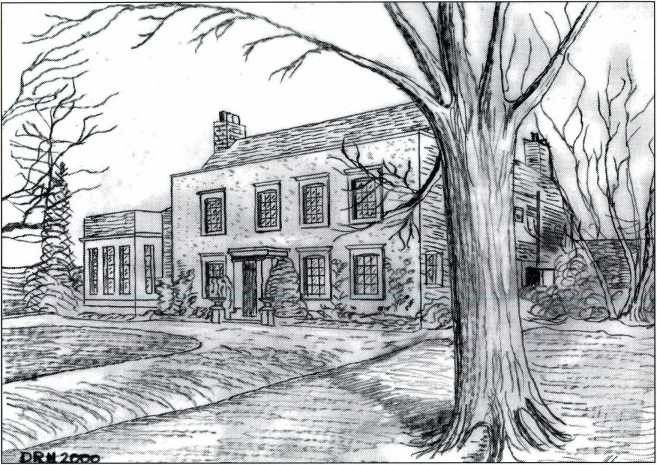
“Hatchgate”, the old. house that used to stand at the end of The Avenue.
An old house with a classical front added in about 1800. Demolished in about 1953.
THE AVENUE
A short tree lined road that originally led from the Brighton Road down to the big house called “Hatchgate”. At one time known as Woodroyd Avenue. It was once part of the boundary of Horley Common. New houses were built in 1973 by A. J. Slight.
T.M. 1476: A. 1522: Part of Streets Fields.
THE CHESTNUTS
A modern block of flats off Ladbroke Road built by C. E Edmonds in the mid 50’s on the site of the former house of the same name which was used as the presbytery of the adjoining corrugated iron Catholic Church before it was itself moved to the new purpose- built Church of the English Martyrs in Vicarage Lane in the early 1960’s.
T.M. 1204: 5P2 Ac.
THE CLOSE
A “Y” shaped road off the Balcombe Road, not really a “close”. Built mainly in the 1930’s. Various builders.
T.M. 1627: A. 1634 & 1635: None. 1636: First Slip. 1638: None
THE CORONET
A truly circular road built in Coronation Year, 1953 by A. J. Wait.
T.M. 1621: 2 Ac. 1622: Pt of A.
THE CRESCENT
Another of the roads laid out by J. W. Hall on the Horley Gardens Estate in the mid 1930’s. Just one house was built before the outbreak of hostilities in 1939. It is now partly a local authority development. Some built by C. E Edmonds in 1951 — 53. Two blocks of flats were added in 1956:- Ridgeway House and Crescent Court.
T.M. 1568: High Field. 1578: Pt of 4 Ac. 1579: Path Field.
THE DELL See Balcombe Road
THE DRIVE
One of the early roads laid out on the Horley Gardens Estate by J. W. Hall in the mid 1930’s. Some private building before W.W.II. by J. W. Hall. More post war by D & H. R.D.C. in 1948. Gatwick Housing Association built Hyperion Walk in 1967/8. Atkinson Court flats for the elderly were also built in 1967 and named after the Chief Housing Officer of D & H.R.D.C.
T.M. 1345, 1346 & 1347: All Pts of A
THE FIELDINGS
Another of the Langshott agricultural names. Built by Wates Ltd in 1984.
T.M. 1363: 7Ac. 1364: None.
THE GLEBE
A re-development of the original Horley Vicarage. Built in 1962 by C. F. Edmonds.
T.M. Vicarage House & Grounds.

“Mayford” one of the old houses in The Grove demolished to make way for “Roslan
Court”, the retirement flats built by Macarthy and Stone.
THE GROVE
Originally this road ran from Station Road East to Victoria Road East, but when the present railway station was built in 1905, that part running parallel to the tracks became part of Station Approach. The houses were an early development after the railway came to Horley. 5 substantial houses were built in the late 1890’s for gentlemen who worked in the City. All of them have subsequently been demolished and redeveloped. Grovelands flats were built by C. F. Edmonds in 1968/69 on the site of the house of the same name plus the adjoining old house, “The Chestnuts”. See the entry for Aurum Close.
T.M. 1443 & 1444: Pts of A.
THE MEADWAY
A rural name. Built in 1955 by Parwin Properties.
T.M. 1387: None. 1395: Mill Field.
THE RIDGEWAY
There is a slight hill on the Horley Gardens Estate, hence the name. Laid Out before WWII in the mid 30’s. Some post war building by Bishop & Clarke in 1949. More local authority homes in 1955 by C. F. Edmonds.. T.M. 1567: Pond Field. 1568: High Field. 1573: Footpath Field..
THE SPINNEY
There are a few trees on the edge of this plot off Bolters Road, do they constitute a spinney? Built by Croudace Ltd in 1974.
T.M. 1151: None.
THOMAS WATERS WAY
This piece of land south of Haroldslea Drive was accessed by the demolition of a couple of houses. The road is named after a land owner who is shown on the 1846 Tithe Map. Unusually the first name is also used to avoid confusion with a nearby road, Warltersville Way. Built by Martin Grant Homes 2015
T.M. 1600, 1601, 1602, None
THOMSETT DRIVE
Charles [Charlie] Thomsett [1897-1918] was a private in the 11th Battalion Royal Fusiliers. He spent much of the war in Egypt and Salonika and did not return to France until July 1918.He is thought to have died in action near St. Quentin on 03/10/1915. Westvale 2021
T.M.1121 Long Bridge
THORNTON CLOSE
Named after the 17th century local land-owning family. Part of the Court Lodge development. Built in 1970 for D & H. R.D.C.
T.M. 1318: Bay Field. 1507: Occupation Road & ponds.
THORNTON PLACE
See previous entry. Built in 1968 – 69.
T.M. 1507: Occupation Road & Ponds. 1511: Causeway Field.
TODDS CLOSE
Off Poynes Road, probably named after Todde’s Mill, the 16th century watermill which stood on the Salfords Stream in the Manor of Lodge off Lodge Lane. Richard Todde was the last miller. Built by Wimpey Homes in 1980.
T.M. 1133: Pt of 6 Ac.
TOWER CLOSE
This close was built on the site of Rutherwick Tower, Horley’s only tower block. Re-developed in 1995. Built for the Bradford and Northern Housing Association
T.M. 1130: None. 1131: 3 Ac Grove Field.
TWYNER CLOSE
On Langshott. Is there a connection with a cottage called “Twyners Croft” in Smallfield? Built by Wates Ltd in 1987. Some larger houses were added at a later date.
1376: T.M. 1374: Pt of Coombers. 1375: Orchard & Field. 2 Ac Meadow.
TYRELL WAY
Alfred Tyrell served with the 1st East Surreys and died on the Somme aged 19 on 29/07/1916. He is commemorated on the Parson’s Plaque in St. Bart’s Church and the Horley Infants School plaque. Westvale 2021.
T.M. 1123 Gratton
UPFIELD
One of the Horley Gardens Estate roads that were all laid out at the same time in the mid 1930’s. Named after Upfield in Croydon also developed by J. W. Hall. Some private pre-WWII development. More post war building for D &H. R.D.C. in 1954 — 56.
T.M. 1543: Apple Tree Field. 1544: 4 Ac. 1569: Great & Little High Field.
UPFIELD CLOSE
See the previous entry. Built in 1957 for D &H. R.D.C.
T.M. 1568: High Field. 1569: Great & Little High Field.
VICARAGE LANE
This road was to have been called Vicarage Road but someone made a mistake in making the sign and Vicarage Lane was what appeared! This fact is recorded in some of the old Parish Council Minutes. The Vicarage used to be on this road on the site of what is now The Glebe. The old houses “Priestlands” and “Chantry House” still stand. This road was one of the boundaries of Horley Common. Some development had occurred by the late 1930’s. Various builders.
T.M. 1324: 2 Ac. 1325: 5 Ac. 1326: PriestlandsFarm, Hmst & Gdn. 1327: Cott & Gdn. 1333: Plat. 1340, 1341 & 1342: As.
Between the Brighton Road and Sangers Drive the large block of flats, “Southlands” was built in 1988 on the site of three former houses, “Elm Lodge”, “Dales” and “Dales Cottage” by Persimmon Homes Ltd
T.M. 1497: Orchard.
VICTORIA CLOSE
A development off Victoria Road. Built by T. H. Houslip & Co in 1955. More maisonettes were added at the northern end of the site in I960 by C. F. Edmonds. Before this plot was developed the area was used for a variety of purposes; Motor coach parking for customers at The Thorns public house, for circuses and fairs. During WWII it was the site of a large emergency water tank for fire fighting. This remained until the houses were built.
T.M. 1463: Hse & Gdn. 1464: A.

Victoria Road in 1955. The trees on the left are where Elizabeth Court now stands.
The large roof is that of The Regent Cinema. We actually had grass verges in those
days- however it looks as if they could do with cutting!
VICTORIA ROAD
Named after Queen Victoria. Originally this road joined “The Thorns” on what was then Thorns Road (The Brighton Road), later to become “The Game Bird” and now “The Air Balloon”, to the Balcombe Road. The coming of the railway spurred on development. Some late Victorian building took place in the town centre. Prior to its late 19th century metalling it was locally known as “Mud Lane” which aptly described it in wet weather! 1930’s development on the eastern side with infilling in the 1950’s and re-development in the form of The Orchard and Elizabeth Court in 1977, with Magnolia Court in 1989, has taken place. More re-development by Barrett Homes has just started on the sites of the large Edwardian houses No’s 139 — 143.
T.M. Western Side. 1471: Pt of A. 1473: Pt of (Arch. 1550 & 1550a: Pts of A. 155 l:Cott & Gdn, Old Enclosure, Pt of A. 1587: Pt of A.
T.M. Eastern Side. 1441, 1443 & 1444: Pts of A. 1467: A. 1468 & 1469: Pt of A. 1470: Pt of A, Cott & Gdn.
VOICE ROAD
Arthur Voice was born in Horley in 1895 and lived in Albert Road. He joined the Royal Navy and was based on HMS Pembroke at Chatham where he was classified as a tradesman, a painter from his civilian days. On the night of 3rd September 1917 the Naval Base was targeted by Gotha Bombers and 131 men were killed. He died in this bombing raid aged 22 and is buried at Gillingham Cemetery. Built by Westvale Park Consortium 2018
T.M. 1269 Malthouse
WARLTERSVILLE WAY
Mainly built in the 1930’s in the grounds of a large Edwardian house called “Oatlands”, which has been since divided up into flats. The road was put in to serve some modern houses. Two bungalows were added after WWII, one by Horne in 1980 the second by Trevtass Ltd of East Horsley in 1985. The name Warltersville is very unusual. According to The Royal Mail there are only two roads with this name in the whole of the U.K. Warltersville Road, London N19 and Warltersville Way in Horley. There is a Warlters Road and a Warlters Close in London, N7. There is also a Warltersville in Port Macquarie in New South Wales. The late Warlters family of Dorking and London is the common factor; however, the reason for the Horley connection is as yet unknown.
T.M. 1623: Pt of A. 1624: 3 Ac.
WATERVIEW
Aptly named, the houses on this road look out onto a small pond. Built by Wates Ltd in 1991.
T.M. 1404: Pond Field.
WATERSIDE
There was a pond in the corner of this plot which was part of the Kingsley School grounds. It was filled in during the development. Built by Bovis Ltd In 1975.
T.M. 1222: Home Meadow.
WEATHERHILL CLOSE
Right on the Horley – Smallfield boundary, close to the M23 and a remnant of Weatherhill Common. Not on the Horley Tithe Map. Built post W.W.11.
WEBBER STREET
This is the main spine road running north to south through this new development. It is named after Henry Webber who was the Mr. Horley of his day. He was born in Tonbridge on 3rd June 1849, and was educated at Tonbridge School and Pembroke College Oxford. He joined the Stock Exchange in 1872 and married Emily Morris of Lingfield in 1874.
He moved to The Elms in Horley Row, now Bakehouse Road and later Greenfields in Meath Green. He became an influential figure in Horley affairs being a founder member of Surrey County Council in 1889 and the first chairman of Horley Parish Council in 1894. He was a county magistrate and a church warden.
He was a keen sportsman and when WW1 broke out he tried to join up along with his three sons. He was eventually allowed to join the South Lancs and appointed to Horse Transport. He was behind the lines on the Somme and tasked with bringing up supplies by horse. On 21st July 1916, an enemy shell landed nearby and he was killed. He is buried at Dartmoor Cemetery aged 68, one of the oldest men to be killed in the conflict. See ‘Men of Horley’ and ‘Henry Webber’s Horley’ via HLHS. Built by the Westvale Park Consortium 2017
T.M. 1114 Woodhouse, 1118 Upper barn, 1113 Middle croft,1103 Denshire, 1271 Occupation, 1270 Occupation.
WELLINGTON WAY
Named after the Duke of Wellington, why? It is the main road of the Hutchins Farm Estate built by Algery Homes in 1983.
T.M. 1146: 3 Ac. 1247: 4 Ac, Chalk Field. 1253: Old Med. 1245: Old Orchard.
WESLEY CLOSE
Named after John Wesley, the famous founder of the Methodist Church. In the old Bakehouse, in Horley Row, there was a room built by the Anabaptists, this was later known as the Wesley Room. The so-called chapel was beautifully preserved for 150 years. The name is not really relevant as it is unlikely that Wesley ever preached there. The close was built in 1975 by Bovis Ltd.
T.M. 1223: Orchard. 1224 & 1225: Hse & Gdn. 1226: Orchard.
WESCOTT KEEP
The last of the “Keeps”. Named after the village of Westcott, near Dorking. Built by Wates Ltd in 1983.
T.M. 1388: None.
WESTLEAS
Another of the Gough Cooper mysteries! Built in the late 1970’s.
T.M. 1264: Smithers. 1265: Barn Field
WEST MEADS
This is a later addition to the Langshott Estate. There is a West Field on The Tithe Map. Built c2010.
.T.M. 845 West Meads
WESTVALE ROAD
This is the access road to the Westvale Park development from the A217.There are no known reasons where it was called Westvale, other than it is on the west side of Horley. Built by the Westvale Park Consortium in 2015.
T.M. 1118, Inward Long Croft, 1119 Orchard Long Croft,
WHEATFIELD WAY
The main through road of the Langshott Estate with an agricultural thematic name. Built by Wates Ltd in 1983. This road cuts through 11 old fields.
T.M. 1357: 10 Ac. 1358: 5 Ac. 1361 & 1362: Common Fields. 1366 & 1367: None. 1383: Coombers. 1384: Further Long Shot. 1398: First Long Shot. 1399: Meadow. 1400: Hmst & Gdn.
WHITE CLOSE
Geoffrey White V.C. was born in 1896 and lived in Charlwood attending Parkfield, Haywards Heath and Bradfield College, before joining HMS Brittania. He served in the Channel Fleet and on the China Station before marrying Sybil Thomas with whom he had two sons and a daughter. Early in 1914 he was posted to a newly commissioned battleship, HMS Monarch, until he returned to submarines in September 1915. He received his V.C. following the action he took after his submarine was hit by a torpedo in the Sea of Marmara. He steered his vessel, HM Submarine E 14, towards the shore whilst remaining on deck, to give the crew a chance to escape. He was hit by a shell and his body never recovered. He died on 28th January 1918 and is remembered on the Portsmouth Naval Memorial. Built by the Westvale Park Consortium 2017.
There are 4 more Whites names on the war memorial
T.M. 1101 Barn Meadow
WHITTAKER DRIVE
David Michael Whittaker was a popular farmer at Bayhorne Farm who delivered eggs and potatoes for many years. He was chosen as a Horley name by local people for some road names on the Acres development. It was built by Barratts & David Wilson on the Acres c 2014.
T.M. 1183; Birts 4 acres, 1185 Birts Orchard, 1186 1187 8 acres
WHITECROFT
A large block of flats off Barleycorn Meadow, access is from Woodhays. Q.V. Built by Wates Ltd in 1983.
T.M. 1361: Common Field.
WHITMORE WAY
Named after Mr Whitmore, the owner of the land. It is a short road off Lee Street which serves a small industrial estate and the new Brethren’s Meeting Room built in 1990 — the first service being held on 1st January 1991. It also gives access to an old cottage, No 172 Lee Street.
T.M. 1308: First Meadow.
WICKHAM CLOSE
Was this named after William Wickham or Wykeham, the Bishop of Winchester (1595?) Or was it named after many of the other Wickhams, Wikehams or Wykhams who were all associated with the church in Surrey? Built by Sidney Cronk Ltd. in 1955.
T.M. 1325: 5 Ac.
WILLIAMSON ROAD
This is one of the Horley family names chosen by the public for a new road on The Acres.. It commemorates Dr. Charles Williamson who settled in the town as doctor in 1901. He was the first of four generations of the family who saved lives in Horley for over one hundred years. Built by Barratts & David Williamson 2014.
T.M. 1187; 8 acres, 1181 Rainbow
WILLOW BREAN
A “Brean”, according to the Oxford Dictionary of English Place Names, is possibly a Celtic name derived from “Brez”- a hill. There are not many hills in Horley! Built by Gough Cooper in 1974.
T.M. 1263: A. 1264: Smithers Field.
WILLOW BANK
The riverside willows are a fair way across the field! Another part of the Court Lodge School re-development by Beazer Homes in 1998.
T.M. 1319: 6Ac.
WILSON GROVE
The Wilson brothers both joined The Queen’s Royal West Surrey Regiment sometime before 1911. Thomas, born in 1889, became a regular soldier. His first major action was probably at Gheluvelt to try to prevent the German advance. However, he was wounded, evacuated back to England where he died of his wounds on 5th December 1914. He is buried in Manchester Southern Cemetery.
Richard, born 1895, arrived in France on 5th July 1915.He was caught, probably by sniper fire near Givenchy and also evacuated to England. He recovered but was discharged as medically unfit. He married Carrie Brotherton and they had a daughter. He died late in 1918, aged 23. Westvale 2018
T.M. 1281 3 acres
WINDMILL CLOSE
Near the site of Horley’s former windmill which stood in the next field. This plot was also the site of Horley’s market. Building started in I960.
T.M. 1392: Pt of A.
WITHERDALE
A northern valley in Horley? Built by Gough Cooper in the 1970’s for the Family Housing Association.
T.M. 1283: 2 Ac. 1284: Denshire Field. 1285: 2nd 4 Ac. 1286: Two and a half Ac. 1294: 3 Ac.
WOLVERTON CLOSE
Wolverton, Bucks was once a famous railway town. It is now part of Milton Keynes. There are also small villages or hamlets of the same name in Hants, Warwickshire and Wilts. The connection with Horley is unknown. Built in 1957 by C. E Edmonds.
T.M. 1529: Beech Field.
WOLVERTON GARDENS
See the previous entry. Some building started in the mid 1930’s prior to WWII. It was finished off post war by C. F. Edmonds in the 1950’s
T.M. 1522: Pt of Streets Fields. 1529: Beech Field. 1530: Middle Field. 1531: House Field.
WOODCOTE
A shelter in a wood? Built by Wates Ltd in 1984.
T.M. 1363: 7Ac.
WOODHAYS
A road on Langshott that links Wheatfield Way with Stockfield. It provides access to the northern end of Stockfield and the large block of flats “Whitecroff’ and also to Rickwood. There are no houses on this road.
T.M. 1361: Common Field.
WOODHOUSE FIELD LANE
This road is named after one of the fields on the 1848 Tithe Map. Built by the Westvale Park Consortium 2017
T.M. 1280 6 acres, 1287
WOODLANDS
Backing on to part of Langshott Wood. Built by Wates Ltd in 1991.
T.M. 1382: Hog Field.
WOODMAN WAY
Henry Woodman was a tenant farmer in this area of The Acres as shown on the 1848 Tithe Apportionment
T.M.1174 Meadow, 1175 Tanyard,
WOODROYD AVENUE
Part of the late 19th century Woodroyd Estate. The estate itself was named by one of the owners of the large house variously known as Hatchgate, Whitegates (The name on the 1848 Tithe Map), Woodroyd (between 1903 and 1909) and The Old Hatchgate. The house stood at what was then the junction of Massetts Road and The Avenue. Building commenced prior to 1919 and was completed some years later.
T.M. 1523: 6Ac.
WOODROYD GARDENS
See the previous entry. Built by C. F. Edmonds in 1956 at the southernmost end of the estate.
T.M. 1527: Stock Croft. 1528: Bridge Field.
WYSEMEAD
Another of the Wates whimsical names. Built in 1987.
T.M. 1372: Great Meadow. 1373: Homestead. 1374: Pt of Coomber Field.
YATTENDON ROAD
Named after Yattendon Lodge, the large house that stood on the Brighton Road until the late 1960’s. Yattendon is a small village near Newbury in Berkshire. The connection with Horley has not been found as yet. Early Victorian maps of the area, now known locally as Yattendon Park, show an avenue of trees, a few of which still remain, running from the big house to the end of Yattendon Road that were in a line parallel to Lumley Road. It is thought that there was a proposal to carry the road right through to meet up with the Brighton Road, but this was never completed. Most of the houses were built in the late 1890’s.
T.M. 1451: Pt of A.
YEW TREE CLOSE See Horley Row

The old level crossing and Yattendon Road Post Office, now a beauty salon.
REFERENCES
A Brief History of Haroldslea. Peter Cox. Horley Local History Society
Christ’s Hospital Map 1602. London Guildhall Library
The Chequers. Os Brown, Brian Buss & Bernard Davis. Brian Buss 1997
Court Roll of Horley Manor
A History of English Field Names. John Field. Longman 1993
Horley in Wartime. Brian Buss & Bernard Davis. Brian Buss 1994
Horley Local History Society archives
Maps and Houses of Horley. Jean Shelley. Horley Local History Society
Oxford Dictionary of Place Names
Surrey Archaeological Society Collections
Street Names No 2. Judith Marshall. Reigate & Banstead Heritage Trust.
Tithe Map and Apportionment 1848. Surrey History Centre
The Place Names of Surrey. English Place-Names Society. C.U.P.
APPENDIX A
The Major Builders in Horley and Associated Roads
ADMIRAL HOMES
Drake Road
Gower Road
Hardy Road
ALGARY HOMES
Deepfields
Grendon Close Hutchins Way Kidworth Close Mosford Close Newlands Close Parklawn Avenue Wellington Way
ANDERSON
Bremner Avenue Chantry Close Chequers Close Chequers Drive Crescent Way Elm Tree Close Horley Row Southlands Avenue Yew Tree Close
BISHOP AND CLARKE
The Drive
The Ridgeway Parkway
Parkview
Spiers Way
BOVIS
Bakehouse Road Ferndown Granary Close Hedingham Close Kiln Lane Raymer Walk Waterside Wesley Close
CREWDSON
Balcombe Road Crewdson Road Rosemary Lane Smallfield Road Station Approach
CROUDACE LTD
Ashleigh Close Aurum Close Avondale Close Benhams Close Benhams Drive Bolters Road Birchwood Close Cartersmead Close Collingwood Close Darenth Way Fallowfield Way Haroldslea Close Homefield Close Kingsley Road Sangers Drive Smithbarn Close Tanyard Way Thatchers Close The Spinney
C.F. EDMONDS
Cheyne Walk
Chequers Drive
Crescent Way
Grovelands
Le May Close
Longbridge Road
The Chestnuts
The Crescent
The Glebe
The Ridgeway
Wolverton Close
Wolverton Gardens
Woodroyd Gardens
Queens Court
FEDERATED HOMES
Baden Drive
Parsons Close
Powell Close
GOUGH-COOPER
Arne Grove
Bullfinch Close
Chaffinch Way
Charm Close
Chesters
Dene Close
Downe Close
Goldcrest Close
Landen Park
Westleas
Willow Brean
Witherdale
LAING HOMES Bridges Close Clifton Close Jennings Way
SIRED Sarel Way Skipton Way
WALTER SMITH Bayfield Road Cheyne Walk Fairlawns
WATES LTD Abinger Keep Acorn Close Albury Keep Barleymead Brackenside Bramley Walk Briars Wood Broadlands Broadmead Brockham Keep Brookwood, Carlton Tye Clarence Court Clarence Way Copse Lane Ewelands Fieldview Firlands Fishers Grassmere Grays Wood Harvestside Hayfields Hazelhurst Heatherlands Heritage Lawn Hilton Court Holmbury Keep Lambyn Croft Longchamp Close Maizecroft Meadowside Meridian Grove Middlefield Oaklands Oakside Court Oakside Lane, Oatlands Rickwood, Rudgewick Keep, Russet Close Ryelands Saxley Stockfield The Fieldings Twyner Close Water View Wescott Keep Wheatfield Way Whitecroft Woodcote Woodhayes Woodlands Wysemead
WESTVALE PARK CONSORTIUM builders; Crest Nicholson, Charles Church,Fabrica, Tayor Wimpey A2,Dominium
WIMPEY HOMES Bay Close Cloverfields Larkfields Palmer Close Poynes Road Tarham Close Todds Close
APPENDIX B
Wates Roads on Langshott
The “Broadmead” group
Broadmead
Copse Lane
Middlefield
Acorn Close
Woodlands
The “Carlton” group
Carlton Tye
Oaklands
Bramley Walk
Russets Close
Longchamps Close
Water View
Grays Wood
The “Cereal” group
Harvestside
Ryelands
Hayfields
Grassmere
Maizecroft
Barleymead
Oatlands
The “Clarence” group
Clarence Court
Clarence Way
Hilton Court
The “Field” group
Stockfield
Rickwood
Fieldview
Millfield Close
West Meads
Whitecroft
The “Fieldings” group
The Fieldings
Woodcote
Heritage Lawn
The “Keeps” group
Abinger Keep
Albury Keep
Brockham Keep
Holmbury Keep
Rudgwick Keep
Wescott Keep
The “Oakside” group
Oakside Lane
Oakside Court
Hazelhurst
Wysemead
Lambyn Croft
Twyner Close
The “Wheatfield” group
Wheatfield Way
Broadlands
Ewelands
Saxley
Fishers
Meridian Grove
Road names on The Acres
Field Names
Apsley Road
Blacksmith Road
Chalkfield Road
Coppice Way
Railfield Gardens
Rainbow Close
Farmers
Burgess Road
Flint Close
Newman Road
Woodman Way
Local Families
Haine Close
Peppiatt Close
Whittaker Drive
Williamson Road
Topographical
Filed Bank
Field Close
Little Meadow
Meadow Way
Road Names on Westvale Park
“Fallen” soldiers
Banks Close
Barton Close
Bignall Avenue
Bourne Avenue
Brocklehurst Way
Brotherton Avenue
Day Close
Drewell Close
Elson Road
Flowers Road
Killick Road
Knowles Road
Maynard Drive
Peach Road
Reeves Crescent
Richards Avenue
Tanner Crescent
Tomsett Drive
Tyrell Close
Voice Road
Webber Street
White Close
Wilson Grove
Field Names
Barnfield
Denshire Field
Gratton Road
Harp Road
Hill Mead
Kiln Crescent
Littlefield Close
Oasterfield Way
Peabarn Road
Putney Croft
Woodhouse Field Lane
Farms & Farmers
Amherst Row
Blunden Way
Cinderfield
Campbell Crescent
Furneaux Close
Meath Green Farm Drive
Moy Green Drive
Famous Women
Anning
Ayrton
Cavell Way
Eahart Drive
Fenwick
Johnson Crescent
Keller Close
Lawrence Gardens
Mann Close
Nightingale
Rathbone Crescent
Seacole


 Horley Fire Station 1902 – 1966 photo HLHS


