Category: About Horley

Alfred Vanderbilt and his stagecoach

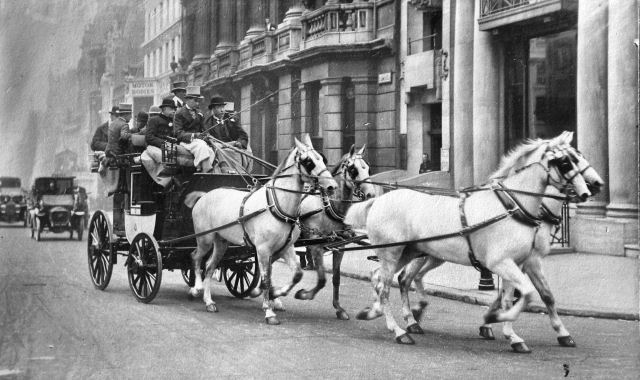
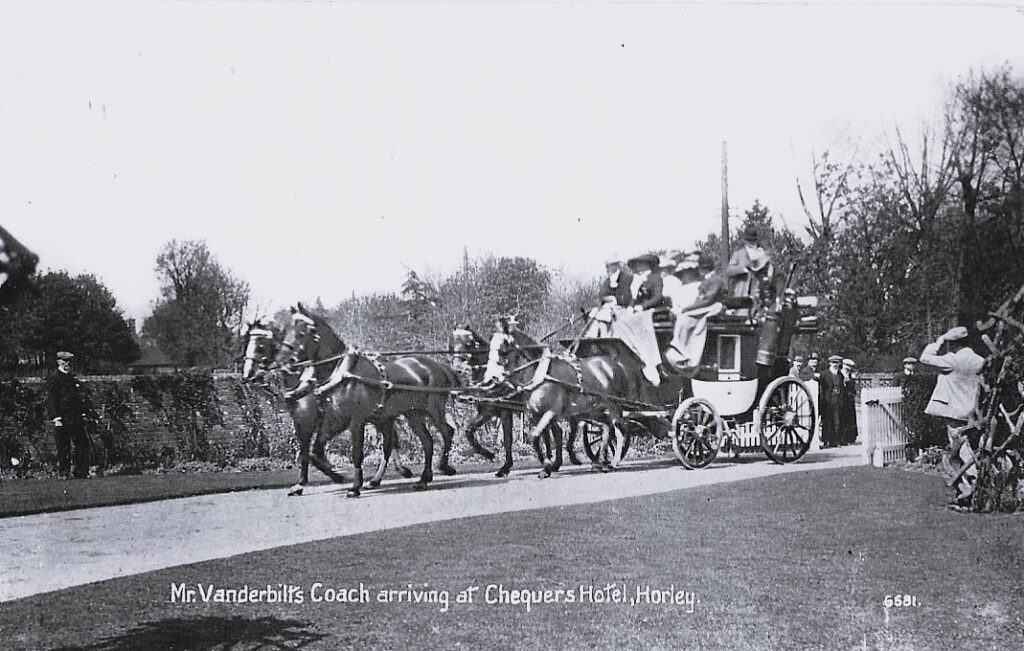
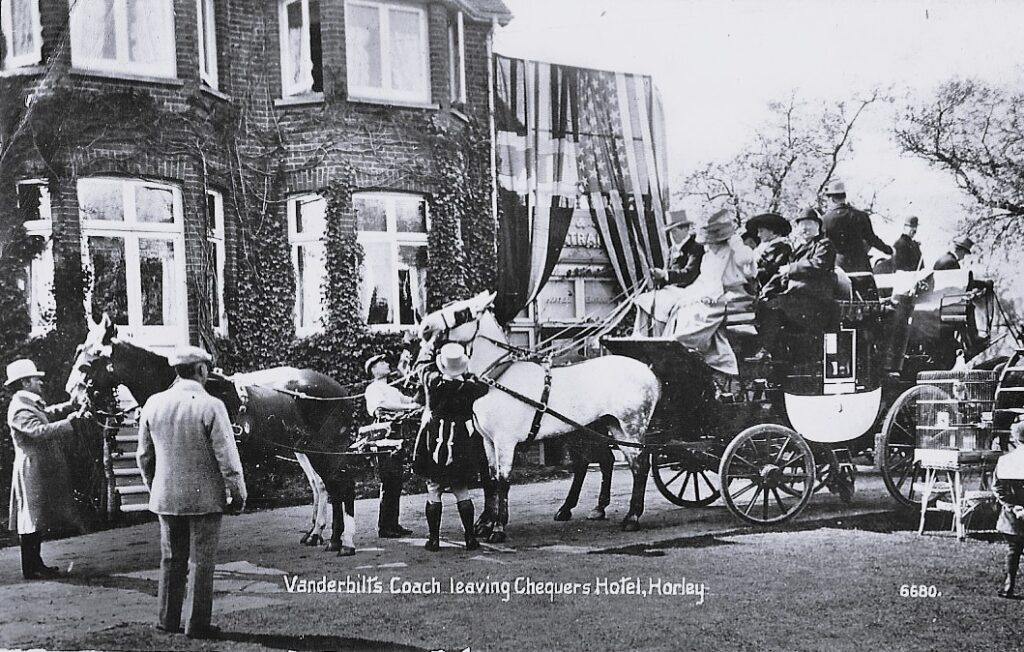
The name Vanderbilt is associated with Horley for the simple reason that Alfred Vanderbilt ran a pair of stage coaches (Meteor & Venturer) from London to Brighton in the early 1900’s and used The Chequers Hotel (now disgracefully renamed The Halt and Pull) on the A23 to change horses and refresh his passengers. This was not a strictly commercial service and was deliberately priced to keep the general public away. These journeys were essentially a jolly day out for the gentry.  We had now entered the motorised era of motoring and the first London to Brighton Car Run had taken place in 1896.
From The Chequers the route would have continued to Povey Cross and then south across what is now Gatwick Airport via Lowfield Heath and southwards via Crawley towards Brighton.
He also used other routes via Epsom and Dorking.
This was long after the heyday of the stage coach travel era which had really ended by the mid 1800’s.
The most celebrated event associated with this journey took place in 1888 when, at Ascot, a wager of a thousand guineas to 500 was made that a coach could not be driven to Brighton and back in eight hours, the one way record then standing at four hours, 21 minutes. James Selby, a well known professional coachman, partner in a coachbuilding concern and somewhat of a public character of the time, took up the challenge. At 10.0 o`clock on 13th July his `Old Times` departed the White Horse Cellars with six passengers plus guard, all experienced `whips` themselves. Police had been briefed to keep key intersections clear whilst ostlers changed teams sixteen times, often in record time and in one case taking only 40 seconds!
Never once leaving the box and pausing at the `Old Ship` at Brighton only sufficient to record the event, Selby arrived back in Piccadilly ten minutes within the challenge and with `half London` turned out to see him pull up.

For many years Mail was delivered from London via a stage coach. This service ended on 1st June 1905.


  • The last Mail stagecoach on Clayton Hill – 1st June 1905.

Alfred Gwynne Vanderbilt Sr. (October 20, 1877 – May 7, 1915) was an American businessman and member of the Vanderbilt family. A sportsman, he participated in and pioneered a number of related endeavours. He is believed to have died in the sinking of the RMS Lusitania.
During the 19th century a great deal of enthusiasm for horse drawn coaching arose amongst some very wealthy enthusiasts who began forming clubs to show off their horses and coaches and holding competitions. These activities soon became known as the London Coaching Season. In 1907 Vanderbilt brought over from his Oakland Farm in the United States 26 coaching horses for the first International Horse Show. His horses were considered ‘coarse’ by his English counterparts and not of the standard they were used to, never the less he won many of his events.
He started to entertain his friends by driving them, in his horse drawn coaches, from London to Brighton using a relay of horses. He enjoyed this coach driving so much that from 1908 he started a regular, but seasonal, London to Brighton service using a coach named “Venture”. The coach ran from London to Brighton one day and returned the next. Vanderbilt is reported to have often driven the coach himself “dressed as for Ascot races, complete with grey top hat“.

Leaving St James’s Street, London

Vanderbilt was a member of the Coaching Club of New York and his coach, which was named Venture, was custom built in 1903 by coachbuilders Brewster & Co. The coach was actually a “heavy park drag – made road style” and was eventually restored by the Preservation Society of Newport County and is on display at The Breakers, Rhode Island.

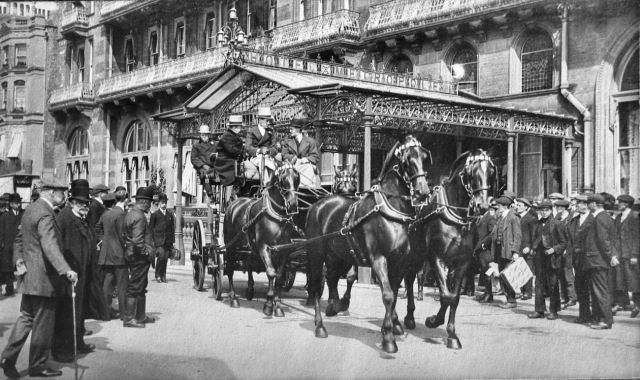
Arriving at the Metropole Hotel, Brighton.

On May 1, 1915, Vanderbilt boarded the RMS Lusitania bound for Liverpool as a first class passenger. It was a business trip, and he travelled with only his valet, Ronald Denyer, leaving his family at home in New York.
On May 7, off the coast of County Cork, Ireland, German U-boat, U-20 torpedoed the ship, triggering a secondary explosion that sank the giant ocean liner within 18 minutes. Vanderbilt and Denyer helped others into lifeboats, and then Vanderbilt gave his lifejacket to save a female passenger. Vanderbilt had promised the young mother of a small baby that he would locate an extra lifejacket for her. Failing to do so, he offered her his own life vest, which he proceeded to tie on to her himself, since she was holding her infant child in her arms at the time. Many considered his actions especially noble since he could not swim and he knew there were no other life vests or lifeboats available. Because of his fame, several people on the Lusitania who survived the tragedy were observing him while events unfolded at the time, and so they took note of his actions. He and Denyer were among the 1,199 passengers who did not survive the incident. His body was never recovered.
There has been some historical confusion as to which member of the Vanderbilt family was booked on the Titanic in 1912 and recent studies have determined that his uncle George Washington Vanderbilt II was actually booked to travel on the Titanic along with his wife Edith and daughter Cornelia, not Alfred Vanderbilt.

Memorial to Alfred Gwynne Vanderbilt

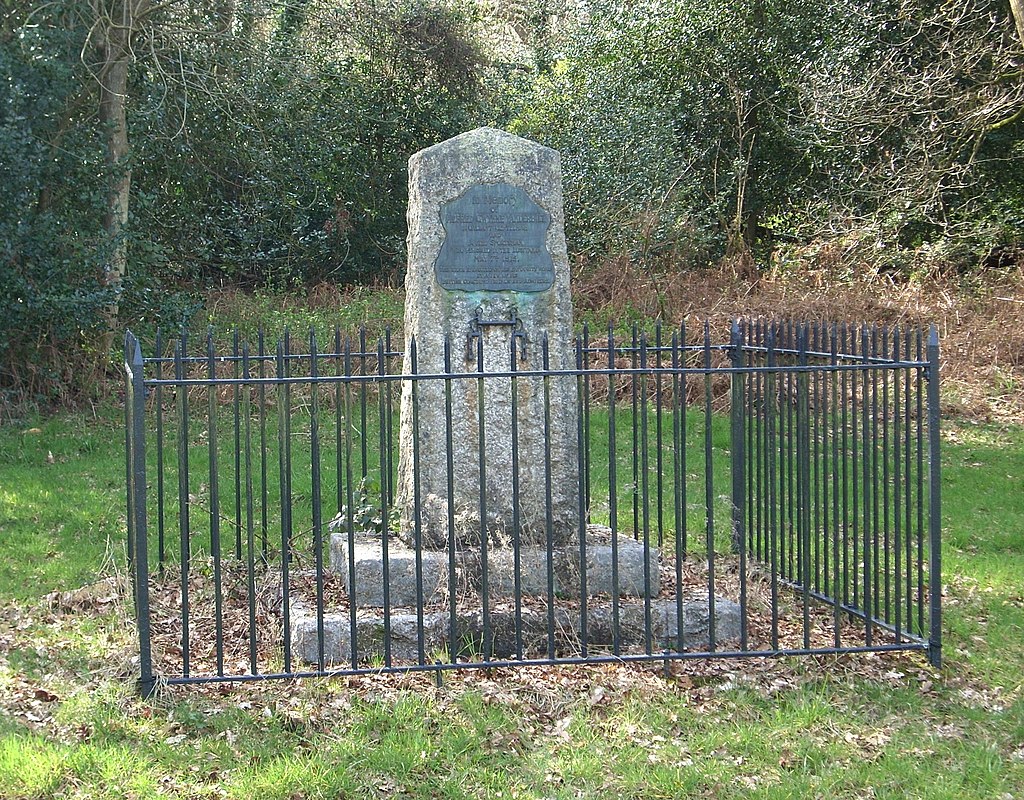
A memorial to Vanderbilt was erected on the A24 London to Worthing Road in Holmwood, just south of Dorking.
The inscription reads, “In Memory of Alfred Gwynne Vanderbilt a gallant gentleman and a fine sportsman who perished in the Lusitania May 7th 1915. This stone is erected on his favourite road by a few of his British coaching friends and admirers”.
The memorial carries an image of a horse’s bit.

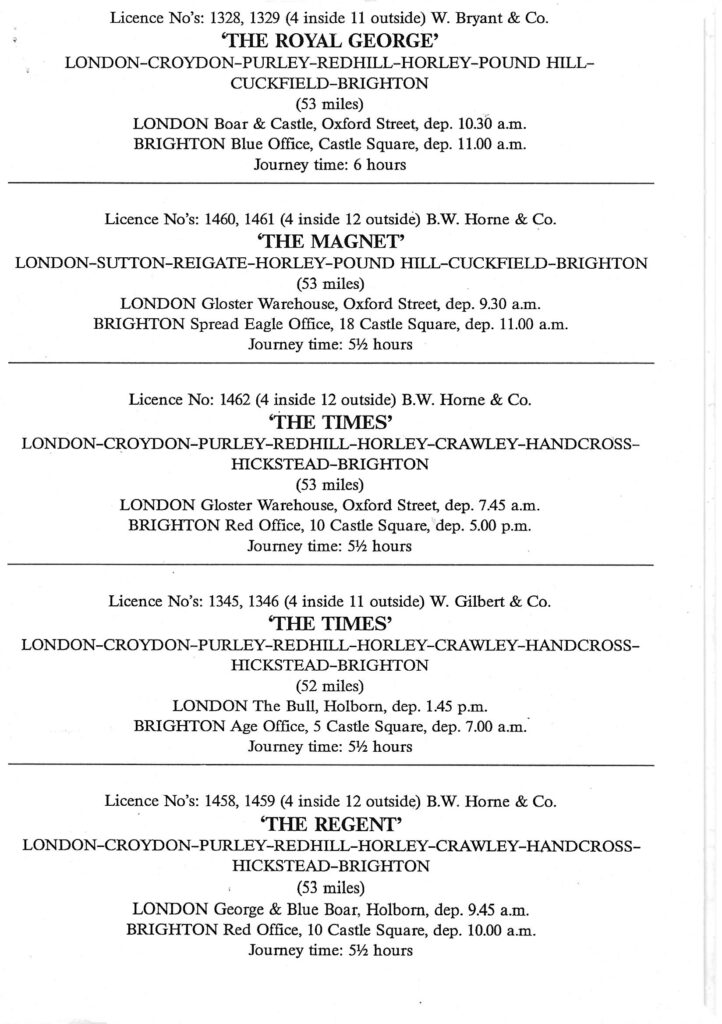
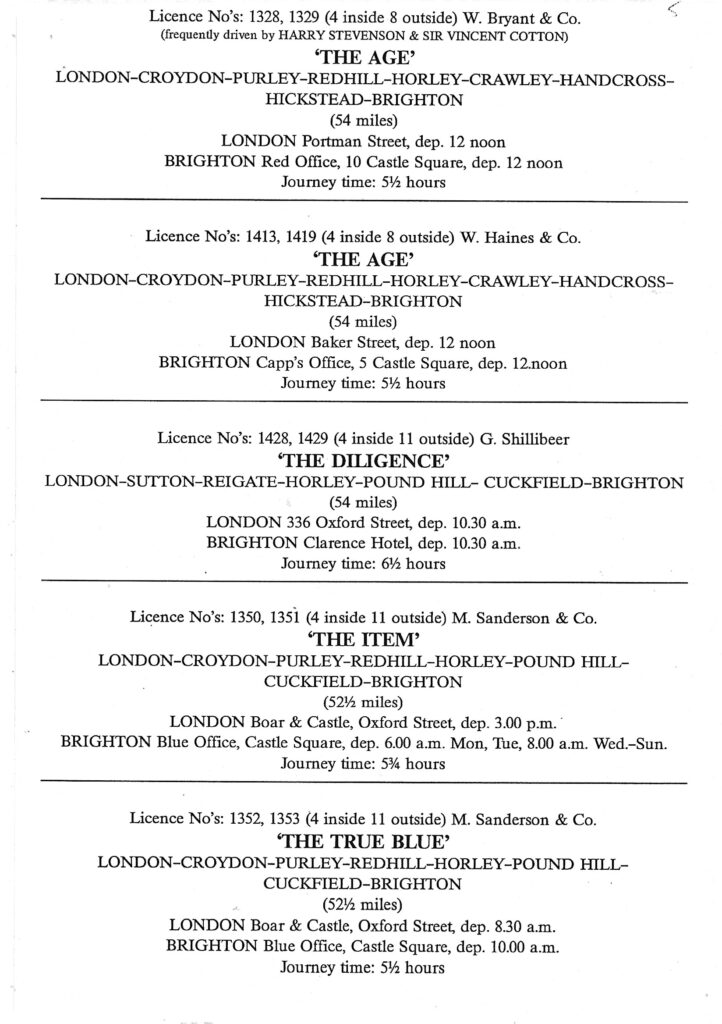
Below are some examples of the journeys made by coaches in this era which gives an idea of the routes and journey times involved.


This article was composed by Doug Cox, 2 April 2024 with material from the HLHS archive, Wikipedia and other sources.


Lee Street Chapel and Burial ground

The Chapel by the Mill and Lee Street Burial Ground.
Published online by Horley Local History Society
April 2024.
Mainly based on the work of Aubrey G F Cook.

Most of what we know about the history of the Chapel which once stood on the west side of the entrance to Mill Close off Lee Street, Horley is derived from a short booklet written by Aubrey G F Cook in 1986.
Aubrey was born in Vicarage Lane, Horley, and attended schools in Albert and Lumley Road. His first employment was in a grocery shop in Station Road East.
Most of his National Service was spent in an office at the Royal Military Academy Sandhurst.
After leaving the army, he studied at St Andrew’s College, Surbiton, and spent four years in the Scottish Border counties on Christian missions and camps for children with the Scottish Caravan Mission to Village Children. This was followed by two years of tent mission work in Suffolk with the Strict Baptists and then became Pastor of two churches in Suffolk and one In London. For the latter part of his working life he was employed by an Association concerned with the rights of Composers of music, the last 13 years being as their local representative.
In addition to The Chapel by the Mill (1986), he also published ‘My Wartime Horley’ in 1984 .
The small cemetery which was established adjacent to the Chapel site gradually fell into disrepair until an attempt was made to build houses over the site.
The story of what happened next is told in this newspaper article from August 1995.

In about 2015 the Friends of Lee Street Burial Ground decided that as Reigate and Banstead Borough Council had accepted responsibility for the burial ground maintenance, they no longer had a useful function and should disband. The residue of their fighting fund (£910.50) was offered to HLHS and accepted on the basis that we promised to keep a watching brief over the site.

The history of the Chapel and the names of families associated with it which follows is reproduced here exactly as Aubrey Cook wrote it.
It contains elements of his personal religious beliefs which are his alone and are not necessarily endorsed by HLHS.

PART ONE
‘BETHEL’
Where Lee Street runs into Mill Lane, Horley, can be seen a small overgrown graveyard with a few gravestones still standing while others lie flat on the ground being covered by nettles and moss. This is all that remains of what was once a meeting place for Baptists in the mid—1800 I s, for adjoining this quiet burial ground once stood BETHEL CHAPEL, a wooden building which housed a congregation of non-conformists.

Little is known of how the chapel came to be built by the mill, but previous to 1846 Baptists had been meeting for worship in a small wooden chapel, built 30 years earlier, about 3 miles away at Charlwood, and they were responsible for initiating this new chapel at Horley.
The earliest record dates from 1846 when on the 29th October a “Baptist Church Of Christ” was formed with seven persons “meeting for Divine Worship in the new Meeting House, Horley, Surrey”.
On that day Mr Edward Arnold of Cuckfield preached a sermon stating the nature of a “Gospel Church” and Mr Biddle of Brockham received into membership Edward Hiller, Sapphira Nye, Sarah Lanaway, Mary Woodham, Ann Brench, James Borne and John Denham.
In October 1847 the membership was added to by six women and two men, and by March 1848 another five women and one man, had joined making a total of 21.
Janes Borne and John Denman were appointed the first deacons, posts which would have followed a ballot by the members. Their duties would involve the general running of the day-to-day affairs of the church and announcing the numbers of the hymns used in the services, even, if necessary, reading each verse before it was sung (where people could not read) and if no instrument was available starting the singing with a pitchpipe or tuning fork.
EDWARD MILLER who had previously been baptised by Mr George Chapman at Dormansland, became the first minister. His part in the services would be to ‘fill in’ between the singing of the hymns by reading the Bible, leading in spontaneous extemporary prayers and preaching a lengthy doctrinal sermon.
WHAT DID THEY BELIEVE?
To set up a rival church to the Establishment meant they needed to have beliefs which were real and deep. They would have held basic Christian teaching with other denominations, such as that there is one God, who is a Trinity of 3 persons, the Father, Son (Jesus Christ) and the Holy Spirit, That God reveals His laws and ways through the Bible which He inspired men of His choosing to write. He sent His Son into the world, born in Bethlehem, teaching and finally dying on a cross at Calvary, near Jerusalem. He also rose from the dead within three days, was seen by His friends and returned to Heaven from where He will return at the completion of the earth’s allotted span.
They would also believe that the teaching of the Bible is that every person born into the world becomes a sinner which robs them of fellowship with a holy God, both in time and eternity. However, the sacrifice of His life by Jesus on the cross in God’s sight is sufficient to make the sinner clean and whole again, fit for Eternity, and there is no other way of achieving this.
The sinner has no desire to approach God until by the work Of the Holy Spirit within him he is convicted of sin and hears the welcoming and forgiving call of God, to which he responds by means of the faith God has given him. The emphasis would be on God’s eternal saving and keeping power, rather than man’s fickle and passing fancy.
WHAT WERE THE REQUIREMENTS FOR MEMBERSHIP?
It was no easy thing to join the church and perhaps this is why the actual membership was never large number, although the size of the congregation must have been reasonably good.
Before being admitted to membership it was required of the candidate to show some evidence of his being a Christian. This was first by a personal experience of having repented sin and trusting in Jesus Christ as Saviour.
A spoken testimony of this had to be given to two visitors appointed by the church, and then on their recommendation, to the church members at a specially arranged meeting.
Public testimony of the candidate’s faith in Jesus Christ was then arranged and the person was baptised (fully immersed in water) by the minister or a visiting preacher either in the river or the Baptism Pool inside the Chapel. The ‘right hand of fellowship’ was then given as a token of joining the church and then only was the person allowed to attend the Communion Service and take part in church meetings. Hence, these Baptists were. and are, called “Strict”, referring to the Communion being limited to some degree.
We believe that Jesus Christ as the Head of his own Church hath Instituted two standing ordinances, Baptism and the Lord’s Supper, that latter to be received only by those that have been baptised in the name of the Holy Trinity.
HOW WAS THE CHAPEL MAINTAINED?
Unlike modern churches with a weekly collection, they depended on the giving of the congregation only ONCE a QUARTER, and for 1848 this averaged 36p per quarter. At the first Anniversary special services were held when their funds were swelled by £3.45. However, in 1856 a 1d a week subscription was introduced.
Some idea of what life was like can be seen by the expenditure, In 1648 the outside of the chapel was painted in “once—over” for £1.25 and candles for the year amounted to 31p. Another expense was for “Ministers and stamps” of £1.27.
By 1850 a Piper stove had been installed and from then on coal was purchased.
THE ANNIVERSARY
This was the ‘big day’ of the year and the visiting preacher in 1850 received the sum of £1.70. 25p was paid to the caretaker for the tea and clearing away. Handbills inviting people to attend would be circulated to neighbouring chapels and for these they paid the printer 25p.
The burial ground was kept tidy by a twice-yearly mowing for which they paid one shilling (5p). Other items purchased were 2 brooms for 2.5p, a mop for 5p, and sand for 2p. What was the sand for? Most likely for the stables and perhaps the ‘privy’ as an entry in the records for 1854 reads “sand, carriage and cleaning out privy, 1/9d (9p).
The only records of the chapel being painted are in 1848, 1852, 1862 (outside only), 1862 (inside only) and 1870. It must have been good paint to last 8 or 9 years!
Evidently a purpose-built Baptistry (a tank let into the floor) was in use and this was filled with water from the gutters as in 1854 there was an “alteration in shoot to take water to Baptising” which cost 5p.
A vestry was provided for the minister’s use and 4 chairs were purchased in 1854 at 10p. It appears that this was an extension to the main building as in later records it was referred to as a separate item for insurance purposes.
A new stove was fitted in 1855 for 50p and this required a new chimney in 1858 for which Mr Bray was paid 27.5p.
The front board, which bore the words

BETHEL CHAPEL
ERECTED 1846

was set up in 1858 for 25p and in 1862 tassels were provided for the window blinds.
All this time repayments of a building loan from Mrs Miller were made at a rate of £2.50 per half-year, and in 1857 the chapel was insured with the Fire Office for 3/7d (18p).
After 44 years, with a membership of 3 (only one male) it was decided to form a committee of members and non-members including some well-known Horley businessmen, to erect a new building in Victoria Road, and this was opened in 1892 (see part two).
The question arose as to the use of the Chapel by the Mill, and it was decided to continue afternoon services once a month, and the balance still outstanding to Mrs Miller should be paid at 15p per week out of the rent of the cottage and stables.
In 1893 the Chapel cottage was repaired and notice given to Mr Flint, the occupier, to quit. He was given one week’s notice again in 1894 but it was agreed to let him stay if he paid his rent punctually. Evidently this didn’t work out and Mr Young was asked to try to persuade him to leave.
In 1895 Mrs Flint was the caretaker and for cleaning the Chapel twice a year was paid 20p.
The WC at the cottage was linked to the water main in 1898 but water was not laid on until 1920 when the cottage was let to Mr Simons. This was referred to as the “Caterham Water”. A small sink was also installed and it was all paid for by the Lee Street Fund and the Tea Fund (the latter, no doubt an over-subscribed fund held at the new Chapel). A further reference to the cottage being repainted was in 1936 and in more recent tines it was sold and demolished to make a grassed area in front of some new houses.
It appears that the only male church member on the new Chapel committee was Mr John Barnett and he was asked to manage the burial ground at Lee Street. His first duty was to attend to the drain which had been stopped up. In 1894 the fees for the burial ground were:
“Persons attending this chapel wishing to bury their friends there, five-shillings (25p); those not attending the chapel, ten shillings (50p). For the internment of children, two-shillings-and-sixpence (12.5p) and five shillings (25p) respectively”
The boundary needed marking out in 1896 and 2 posts were put up beside the stable. A barbed-wire fence and a hedge were planted on the west and north sides of the burial ground. The garden on the west side of the chapel, previously used by Mr Flint, was sown with grass seed and in 1897 his rent was reduced to 15p per week to compensate for this.
In 1899 the Horley auctioneers, Baker & Baker were selling the property adjoining the chapel and asked if the Baptists would like to sell the stables or let them for a term of years to their buyers. However, the stables were repaired with a new corrugated iron roof, back and sides, and let.
Insurance was then negotiated with the Phoenix Fire Office for the chapel and vestry £125, seats and furnishing £25, house £175, stables £25, in all £360.
When in 1900 Mr A King of Smallfield redecorated the chapel and cottage the rent of the latter was increased to 20p.
Only 2 trustees remained at the turn of the century; Mr Weller of Meadvale and Mr Wilkins of Holmwood (probably Abraham Wilkins who was baptised and joined the church in 1847 and therefore would have been an elderly man), and their views were sought as to the future of the building.
THE CHAPEL’S DAYS WERE NOW NUMBERED!
In August 1900 the chapel was in need of repair and the Management Committee at the Victoria Road Chapel agreed, with some opposition, to have the old building dismantled and sold. A memorial stone was to be erected where the chapel stood.
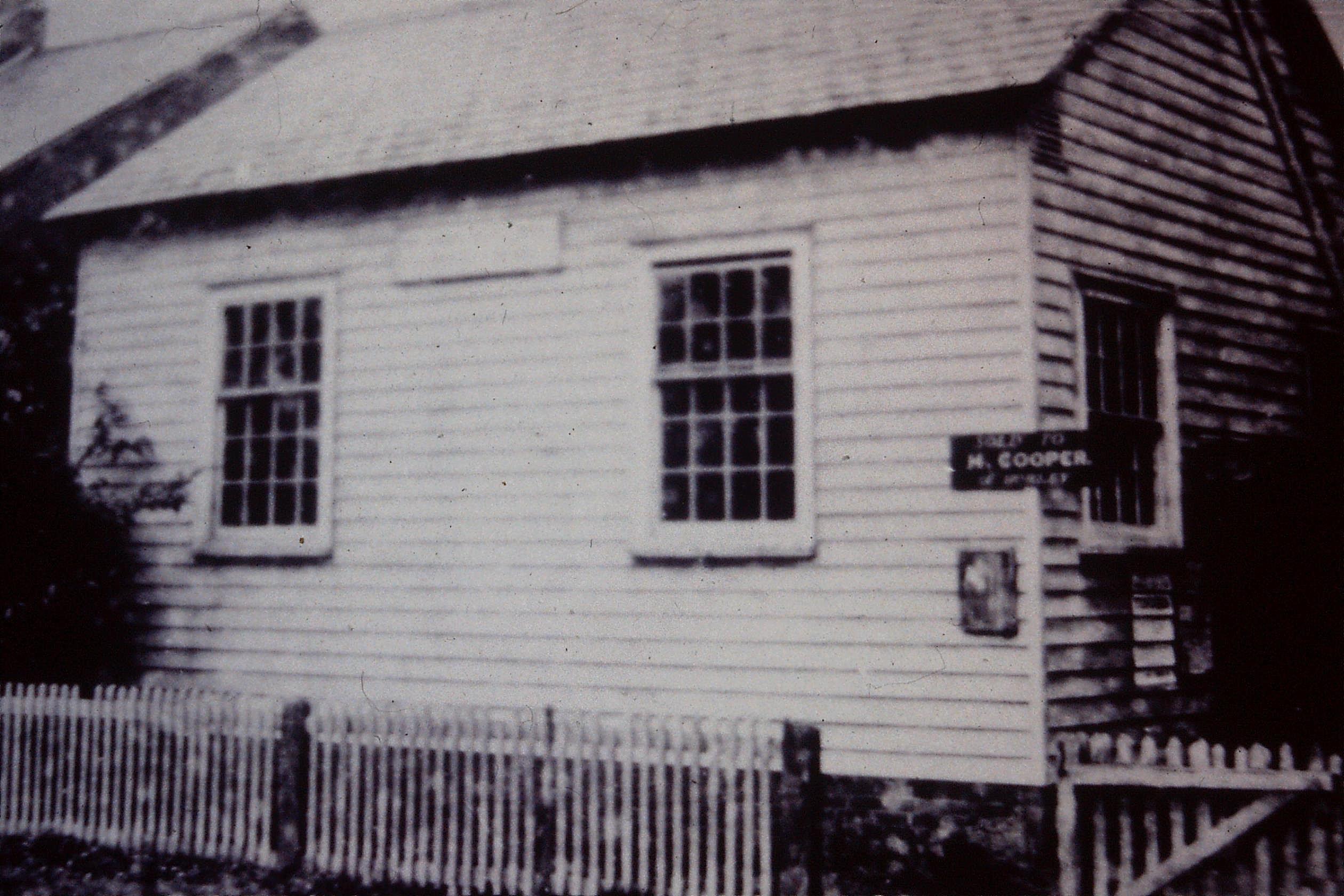
The highest bidder was Mr H Cooper for £9 and a photograph taken at the time shows his board on the front of the Chapel by the Mill which for over half a century had been a centre for worship in the spread-out village of Horley.

The Chapel showing the sign mentioned above.

HORLEY ON THE MOVE
Up until the end of the 19th Century Horley was a sleepy hamlet reaching from the banks of the River Mole to the Chequers Hotel. It had a Parish Church, a Water Mill, the Six Bells Inn, a departmental store, various workshops and a Strict Baptist Chapel – the Chapel by the Mill.
As the centre of Horley’s life moved away from the river side to occupy the clearing in Horne forest so the centre began to develop into Victoria Road- and of course, not to leave him out – Albert Road too!
To accommodate the newly laid London, Brighton and South Coast Railway lines a further road led to the first railway station which gave it name, Station Road now the High Street.
Two important features of Mill Lane were not to be left behind. One was W.H. Batchellor’s departmental store (with a brief stop by the railway level-crossing en route) and the other the Strict Baptists’ Chapel. Both became part of Victoria Road and a link between them continued for many years.

Over the years other well-known Horley shopkeepers and their families have been connected with the life of this chapel in the centre of Horley, including Stapleys (grocery and clothing), Uptons (furniture), Woods (tobacconists), Warnetts (cafe), Tribes, later Stubbs (confectionary), and one whose association has been the longest, throughout the history of the chapel in Victoria Road, Eades (ironmongery).

PART TWO
“PROVIDENCE”

On the 3rd March 1890 several friends from the little wooden Strict Baptist Chapel in Lee Street, Horley, met to form a committee to consider the building of a new chapel. Land next to Mr Whitmore’s house in Victoria Road had been offered at a reasonable price and several subscriptions had been promised. Some well-known names appear on the list of those appointed to handle the matter, being Messrs Batchellor, Barnett, W.H. Batchellor, E Bilcliff, W.S.J. Brown, Ridley, Thomas Stapley, Viger, Whitmore, Wonham, P.Wadey and Young. Mr Brown was elected as Chairman with Mr Barnett as Vice-chairman. The Treasurers were Messrs Stapley and Whitmore.
The next meeting was held at Mr Bilcliff’s house in Church Road on 30th October 1890 and it was decided to write to various people for subscriptions, some in Haywards Heath and Lewes. They also decided to ask the old chapel trustees to stand as trustees of the new building with Messrs Barnett, Brown, Wadey and W.H. Batchellor. It was also agreed to purchase the land from Mr Whitmore who had promised to pay for the conveyancing.

It was announced to a meeting held at Mr Wadey’s home in Albert Road, an 30th June 1891, that the prime cost of building was to be between £350 and £450.
On 2nd November 1891 at Mr W.H.Batchellor’s house in Station Road, the committee discussed alterations to the plans and included a baptistry under the Communion Table, which would have steps down into the water at both ends. It was also decided the front porch should be on the building line.
Evidently the proposed chapel was going to too much as on the 8th March 1892 suggestions were made to alter the plans, i.e the walls would be 14 feet with no buttresses, plain arches would be used over the windows, the span of the roof would go over the vestries, the baptistry would be cemented instead of using tiles, and the cupboard in the vestry would be dwarfted instead of going up to the ceiling’,
AIso there would be only 4 ventilator shafts in the roof instead of the ten originally planned. A further estimate was obtained from Mr Jennings which was £400 and this was accepted.
Within that same year, on 5th October, the Chapel was officially opened for worship. In the morning was a service of Thanksgiving and Recognition of the new Pastor, and a further service in the afternoon when Mr Hull was the preacher. A tent was erected in the chapel grounds where dinners and teas were served.
With the opening of the chapel the Building Committee decided to continue to run the business side “until the members were competent to appoint others”
Mr Bilcliffe was appointed to collect “seat rents” from those attending at “two shillings (10p) for 1 person, three shillings (15p) for 2 persons, four shillings (20p) for 3 persons, 4/6d (22p) for 4 and six shillings (30p) for 6 (no doubt per quarter) .
It was also decided to place a box under the gas burner in the porch for subscriptions.
It appears that Mr Barnett had the duty of making the hymn announcements during the services as he was to “provide a platform for himself in front of the pulpit”. (This must have been removed at a later date), The Pastor or preacher would spend the whole of the service in the raised pulpit. The first harmonium organ was purchased from Mrs Hacking for £8.
Large numbers of people must have been expected for the 1893 Chapel Anniversary as the dinners and teas were to be served in the Public Hall though which hall in Horley this refers to is uncertain.
On the 30th January 1893 we find that Messrs Eade & Eade sent in their bill receipted as a donation towards the building fund. so commenced a family association which continued throughout the history of the chapel.
No doubt the Pastor, Mr Hacking, was pleased to hear on 21st February 1893 that his salary was to be raised from seventeen shillings and sixpence ( 87p) to one pound a week!
Large numbers of people must have been expected for the 1893 Chapel Anniversary as the dinners and teas were to be served in the Public Hall though which hall in Horley this refers to is uncertain.
For water the chapel members relied on a well and Messrs. Young and Whitmore were asked to open and inspect it “as no water can be got”. This was used until 1906 when “Caterham water” was laid on for £6.0s .6d and ten shillings (50p) per year for the water supply. Mr. K. Jennings then connected the sink and WC to the sewer.
In the early days the chapel was heated by two “Petroleum Oilstoves” but in 1895 ‘coils’ – wrought iron pipes – were installed at the back of the chapel, with more pipes along each side and these remained there over the years. Eade and Sons’ offer to install the heating apparatus for £18 was accepted and had been promised by 4th November that year.
DISRUPTION !
Towards the end of 1893 it was agreed, by the Committee, with the members agreement, that they give the Pastor 3 months notice to terminate his duties and to return to him the £20 he gave towards the building fund.
Strange though it seems, in March 1894 the Committee (made up of non-members) decided that their meetings should now be open to members and it would be called the “Meeting for Managers”
No reason is given for the request for Mr, Hacking to leave but evidently the church at Southminster were ready to welcome him as their Pastor.
It is usual when transferring from one church to another for a letter to be sent commending the person to the fellowship the new church. However, in 1895 a request for dismissal was received from Mr & Mrs. Hacking to be sent to their new home address. Evidently the Southminster church did not recognise “a church that is ruled over by a Committee Of non-members” and therefore no application had been made by the church.
Once the Pastor ceased his regular work at the chapel they would have to find preachers take the Sunday services so it was agreed that visiting preachers would be paid ten shillings (50p), plus expenses, except for Pastors from other chapels who have to pay for another preacher to ‘supply’ for their congregation, “when they shall be paid whatever it costs them”.
This payment to visiting preachers was increased in 1916 to seventeen shillings (85p) and in 1919 to one guinea (£1.05). The highest it reached was in 1922 at £1.5s (£1.25p) when “the deacons held themselves responsible for the increase when prices were advancing in railway fares, etc”. But, due to lack of funds in 1934 it was reduced to £1.12s.6d (£1.62p) for weeknight meetings.
Visiting preachers included Mr Preston from the SmaIlfield chapel, Mr Bourne who was asked to take 24 Sundays in 1901, and some who were great favourites, Messrs Mockford, Light, Russell , Littleton, Popham and Flegs.
In 1914 it. was so difficult to obtain preachers that Mr Brooks was asked to take as many services as he could However, in 1911 they had two vacant Sundays and it was decided on these occasions “sermons would be read”.
One of the preachers, Mr J. Russell, was asked to act as councillor for the church in 1920, and many of the members at that time were baptised by him. He, and his family, gave the chapel a flagon for use at the Communion service in 1921, and the following year he asked to join the church. It was felt unnecessary to visit him “as he had preached from the pulpit”.
The members also commended some of their number as preachers to serve other chapels, when invited, and these were Mr Peter Wadey, Mr Burton (a tailor from Vicarage Lane), and an uncle of mine, Mr Reginald P. Cook, who became the Pastor of Zion Baptist Chapel in Trowbridge, Wiltshire.
Visiting preachers needed entertaining and Mr Alfred Eade undertook to do this for 2/6d (12.5p) from General funds, but he returned 6d (2.5p) of this to reduce the chapel debt.
Unlike many chapels of the period, throughout the years no tablets have been erected on the walls in memory of those who have taken sone worthy party in the life of the chapel. Only one notice ever hung on the inside walls and that referred to the fact that in 1894 the chapel had been licensed for the Solemnisation of marriages.
In October 1894 the notice board on the porch was worded as follows:

PROVIDENCE BAPTIST CHAPEL
Times of Divine Service
Sunday morning 11.0 Evening 6.30
Wednesday Evening Prayer Meeting
Sunday School Morning 9.45 Afternoon 2.30

This hardly altered over the following years, except when during the Second World War services were held in the afternoon for the regular worshippers (sometimes in the vestry) and evenings for the Forces from the nearby camps when the chapel was suitably ‘blacked—out’.
The first chapel cleaner to be appointed was Mrs King in October 1892 at thirteen shillings per quarter (65p). She requested to be released from her duties in June 1898 but was still the cleaner in 1900 when she made another request and as1 a result of this her wages were increased to one pound per quarter! In 1901, Mrs King made a further request….
As the nineteenth century draws to a close there are three items of interest. First, the chapel building debt had been lowered to £8. 12s. 6d.(£8.62p) Then, the matter of subscriptions to the Parish Nurse and a donation to the Hospital were left over to the next meeting… and the next… Finally, a special Prayer Meeting was arranged concerning the war in South Africa.

CHAPEL OUT OF DEBT!
On the 10th October 1900 it was announced the chapel was free of debt. Mr Wonham had accepted £100 in place of the £200 outstanding, Deeds were drawn up on the same terms as those for the Lee Street chapel. Big celebrations took place in March 1901 at which there was no collections and the tea was free to all friends!
Very little is known of the early days of the Sunday School, but a minute in January 1398 expressed the thanks of the Managers to the teachers.
In 1906 a public meeting was held in the chapel to consider building a new school room, and in 1907 the estimate obtained was for £270 of which £138 had been promised. With the opening of the hall in August the activities of the chapel could be increased. The hall was used for lectures, such as Mr Evans of Tunbridge Wells who spoke on “The Tabernacle” , Mr Watts of the Strict Baptist Mission in India. the Protestant Union, and the Sovereign Grace Union, “provided it was an instructional lecture and not of an aggressional character”!
It was on 20th April 1943 that my father, Arthur Cook, became Superintendent of the school, and it became quite a family concern as my mother was the organist with an auntie as a teacher. Also, other young-at-heart ladies of the congregation shared in this work. It was a very happy school and drew children from all over Horley.
One day each summer the week day schools closed and the Sunday Schools had an excursion to the seaside. The scholars assembled in their respective churches and paraded to the railway station where a special train was waiting.
The other big occasion of the year was the Sunday School Anniversary for which we each learnt a poem or a chapter of the Bible to recite before our parents and friends in the chapel. A tea was also served in the school room and prizes for attendance were given out by the visiting preacher.
Occasionally a weeknight meeting was arranged when a large white sheet was hung across the schoolroom and a ‘magic lantern’ lecture was given to the excited young audience. However, when a silent cinematograph film on the life of David Livingstone was shown it unfortunately didn’t receive full approval of some of the members!
In 1893 there were 12 members able to attend a church meeting and in 1920 the number was 13. Although the chapel may have been filled at the services at times it appears the membership was never very large.
Toward the end of 1925 a younger group became interested and at a Baptism Service on 5th January 1926 five were baptised. Then in 1934 6 persons were baptised at one service, “a man and wife, a husband and wife (parents of the previous couple) and then a mother and son”, and this was conducted by a favourite preacher at the chapel, Mr Mockford.
From time to time other individual baptisms took place, the most notable being that of Roland Barnett, who was brought in on a spinal carriage and lowered into the pool with the help of members of the Horley St John Ambulance.
Over the years well known Harley families have been associated with the chapel and taken an active part. One who is worthy of note is Mr W.H. Batchellor who owned the departmental store in Horley (now Collingwood & Batchellor) and for many years he led the services through by announcing the hymns. His opening sentence was “Let us commence the solemn worship of God this morning by singing hymn number
Peter Wadey was also a strong supporter over the years and the story is told how that his singing was so untuneful that he was asked to refrain from singing at the services. His reply, “How can I? My heart is in it!”

THE EADE FAMILY
One family, however, has a record far longer than any other – the Eades. In the early records the names of Amos, Alfred and Tom appear indicating the great service they gave to the chapel. To that list we must add the name of Royston, one of Tom I s sons. Roy, as he was affectionately known, was baptised by Mr Champion on the 30th May 1933 and was received into membership with his wife. Although the burden of the Charlwood Chapel was upon their shoulders, together with their two daughters, they gave a quiet but strong support to Providence Chapel, especially during the latter years. In the last years of the chapel’s history his two daughters continued the family’s active participation in the varied activities taking place, thus concluding a span of several generations.
in his early days, Kenneth Eade, the well—known Horley pianist, played the chapel organ.
Another member of the Eade family, Molly, took an active part, especially in the Sunday School, at least, until a fellow member, Kenneth Wood, asked her to be his bride and the chapel was honoured with their wedding ceremony.
Yet another wedding united the Eade family with the Wadey family as Amos Eade’s daughter Kittie married Mr Benjamin Wadey who also took a keen interest in the life at Providence.
MUSIC IN THE CHAPEL
For many years the hymns were sung from Gadsby’s Selection – a book used mainly by the Strict Baptists. This book contained words only and the tunes were selected from the Companion Tune Book, and it was quite common to see members of the congregation holding two books open when singing, one for the words and one for the music.
In 1933 new tunes were being introduced so it was agreed to have singing practice once or twice a month.
In 1937 a Mrs Pickett of Brighton made a gift of an organ which had to be ‘put in order’. Yet, in the school room stood a small pipe-organ which belonged to my father and had been, for a number of years, stored under the stairs in our home. Occasionally I had the task of pumping this when it was played for the school.
The suggestion of changing a hymn book usually meets with much opposition. In April 1944 it was suggested that with the extra Forces attending the services the number oi hymnbooks was insufficient and It might be time to change. In May it was left over to the next meeting. Again, in June, in fact, it was left until all members could agree! (Years later a change was made to “Gospel Hymns” and in the latter days these were found under the back seat..,!)
In 1982 the front pew was removed so that a small Yamaha electronic organ could be brought in and the singing took on a new pace. Also, songs with a modern tempo seemed far removed from the early days of Providence,
AFTER FIFTY YEARS – A NEW PASTOR!
Over the years it had been suggested that one or other of the preachers should be invited to take over as Minister of the chapel but the second to actually hold the post was Jack Hoad who commenced his ministry on 7th August 1943.
Jack Hoad ls dynamic character became obvious right from the start having laid down seven conditions upon which he accepted the invitation to come to Horley, to which the church members agreed !

Coming during the war he made the most of the opportunities available by being the first church in Horley to be completely blacked out. This allowed for services during the winter on Sunday evenings when service personnel from camps around Horley packed the building.

Jack Hoad also made a monthly visit to the Sunday School (following afternoon service) and a Women’s meeting was commenced. The high front hedge was removed and a new wall erected. Tuesday Prayer Meetings and Friday peaching services kept him very busy. In addition to which he worked three days of the week for the Trinitarian Bible Society.
Unfortunately a senior deacon who had been associated with the chapel for many years had a disagreement with the Pastor, causing a ‘rocking of the boat’ and a motion was passed by the church “That this church has full confidence in their Pastor”,
During this time it was agreed to end “seat rents” and a monthly collection was taken up instead.
Pastor Hoad’s ministry lasted at Horley until 1945 when he resigned, giving seven reasons for doing so.

Three other short Pastorates have taken place since with Mr David Ellis, Mr Len Holder and Mr Brian Ellis. Each brought to the chapel their particular ministry but maintaining the Strict Baptist tradition upon which the chapel had been built over the years. With declining church attendance generally they had no easy task.
From time to time the congregation was increased by people coming from other chapels who were keen to see the chapel prosper but these were dark and difficult days.
THE LAST DAYS
Due to a strange set of circumstances, I was drawn back to the chapel in 1981, and was asked to give some help to Gerald Edgerton and Ricky Bardon who were running a youth club in the school room. This was attended by a group of young people unaccustomed to church services but nevertheless they were prepared to attend evening worship, if only for somewhere to go.
It seemed that a last effort should be made for the chapel to fulfil a need for a place of worship in the centre of Horley. Much prayer was made, the building was redecorated, new lights installed, a new electronic organ used for the services, a different type of heating employed, visiting with leaflets in Horley, coffee mornings, a bookstall, invitations given out to Saturday morning shoppers and special meetings, but of the few that made the effort to enter the building not one came back a second tine. Why? And why was it that in 1983 it was felt that the chapel should be sold?
We may never know the answer to this question.
It has been suggested that as the chapel was built by a committee of non – members there could be a reason here, for “ except the Lord build the house they labour in vain that build it” (Psalm 127.1).
If this was so – a solemn lesson is taught here that if God ‘s hand is not in our work, or our lives, our labour could be “in vain” – worthless!
However, in His over – ruling of the mistakes in our labours and in our lives God can bring something worthwhile even if it is only a memory of a truth taught, a helpful word spoken or a kindly deed done, so that we can know that our labour “is not in vain in the Lord” (1 Corinthians 15.5)

Plan of PROVIDENCE Horley
Ve; Vestry
O:Organ
CT; Cornmunion
Table over
Baptism Pool

Mr Ray Ellis of Kemsing wrote the following to Aubrey after reading the booklet.

PASTOR DAVID ELLIS

My father’s pastorate of the Chapell began in January 1963 and the cause knew a measure of revival with much spiritual enthusiasm and many coming under the Gospel for the first time in their lives.
At that time the normal Sunday morning congregation consisted of 4 people (Mr & Mrs Upton, Mr Tom Eade and Mrs Carpenter) All meetings were held in the chapel vestry. There was no youth work associated with the Cause.
Immediately upon commencing his pastorate my father initiated a campaign of door-to-door evangelism on local housing estates as a prelude to opening a Sunday school. That Sunday School, which opened in March 1963 grew steadily. A Bible Class (run by Len Holder who was to succeed my father as pastor of Providence Chapel) was started and, in 1964, mid week needlework classes for the older girls began. In 1965 a youth club was formed. In 1966 this work had to be divided into two clubs because of the numbers attending. During 1965-1968 some 60 children regularly attended Sunday School and Bible Class, and 70 or so young people came to the youth clubs.
Fron the work among the young people during my father’s pastorate five teenagers, including myself, came to a saving knowledge of Jesus and were baptised,
During 1963 the chapel was redecorated, old windows were replaced. The JOY of the Lord filled the place as the sun was allowed to stream in. HIS house rang with praises, By the end of I965 the regular congregation rose to around 50.
Who can judge the effect upon the lives of the many people who heard the word as result of the Tent Mission or the contact with drug addicts and disturbed families? During my father’s ministry at Providence Chapel 13 people were baptised and 28 received into membership. There were weddings celebrated and babies dedicated, On a number of occasions I remember the building packed to the doors!

THE LEE STREET BURIAL GROUND

The following names are taken from a list believed to have been made by Os Brown and probably Jean Shelly in 1959.
These details were recorded directly from the headstones.
NOTE: When attempts were made to build on this site in the 1990’s many gravestones had already been removed before the intervention of Os Brown (of HLHS) and other local residents. It is quite possible that some gravestones were NOT replaced in their correct positions.
NOTE: Some inscriptions may be a dedication rather than a record of an internment.

Edward Miller (Minister of the Gospel) died 25th November 1873 aged 80
Mary (his wife) died 21st March 1847 aged 55
Caroline (his second wife) 6th October 1897 aged 90

Arthur Comber died 23rd August 1859 aged 22

James Bourne died 30th April 1870
Elizabeth (his wife) died 23rd November 1865 Aged 62
Mary Constable (their daughter) died 3rd March 1852 Aged 26
Stephen Bourne (their son) died 7th November 1862 Aged 27

Amos Eade died 31st October 1918
Jane (his wife) died 26th August 1939 Aged 94
Rose (their daughter) died 21st June 1922 Aged 51

Kittie Wadey (wife of Benjamin Wadey) died 13th December 1942

John Denman died 19th December 1890 Aged 76
Sarah Denman (his wife) died 13th October 1881 aged 62

Thomas Piper of Dicker, Sussex, died 13th December 1887

Jesse Bray of Hookwood died 28th August 1916 aged 88
Mary (his wife) died 20th February 1869
Their Children;
Harriet Ellen Brown died 28th April 1945 aged 45 Buried in Horley Churchyard.
George John Bray born 14th April 1862, died 25th November 1920.
Mary Jane Bray died 14th April 1940 aged 76.
Jesse Bray born 12th September 1860 died 21st October 1860.
Walter Bray died 9th March 1885 aged 27
Herbert Henry Bray 4th November 1886 aged 32
Eliza Bray (second wife of Jesse Bray) died 5th June 1902 aged 74

George Butler died 10th March 1946 aged 67
Agnes Mary Butler died 17th March 1956 aged 80

Ann Branch died 15th January 1863 aged 72

Henry Butler died 12th April 1910 aged 63
Jane (his wife) born 29th March 1850, died 5th March 1908
Their children: Thomas died September 1875
David died 20th July 1886
Leonard died 9th September 1892
Eli died 9th July 1894
Sarah died 12th November 1896
Henry Charles died 3rd January 1914 Aged 42

George Butler died 10th March 1946 aged 67
Agnes Mary Butler died 17th March 1956 aged 80

Ann Branch died 15th January 1863 aged 72
Robert Secker died 10th January 1914 aged 71
Susan Secker wife of Robert died 27th April 1921 aged 75

Frank Worger died 7th May 1942 Aged 45

William Comber died 17th July 1921 aged 70
Mary (his wife) died 2nd December 1921 aged 69.
Their sons: William died 13th May 1903 aged 20
Arthur died 18th December 1889 aged 1

Working the Night Shift at Monotype in WW 1

A Personal Account of

Working Night Shift at the Monotype

in

World War One

From the

autobiography of Benjamin Miles Potter
who worked there from 1915 to 1918

Edited by Brian Buss

© Horley local History Society

2012

1 Introduction

Benjamin Miles Potter was a young married family man in 1915 who lived close to the main road that ran between Turners Hill and East Grinstead in Sussex. He had been classed in the medical category C-3 when he had tried to volunteer to join the army before September that year just before conscription came into force in World War One. For the previous six months he had been employed as the third gardener at a large estate called Paddock Hurst at Worth, also in Sussex.
He had become very discontented at that time for several reasons. When interviewed for the job, he was promised living accommodation in the Lodge on the estate that had not come to pass. Also he was repeatedly receiving white feathers, as was the custom then, when others thought you were showing cowardice for not joining up. Yet because of his poor health the army would not accept him.
This situation made him return once again to the recruiting office in East Grinstead and because he could not be accepted for the infantry he begged to become a driver of horse drawn transports due to his love of horses and in the past he had even broken them in, but to no avail.
Instead they advised him to get a job in a munitions factory, the nearest being at Salfords, near Horley, some 10 miles north of Turners Hill. So after one o’clock on his next Saturday afternoon off, he cycled there and was taken on to work on the night shift at five and a half pence an hour (2.3p today).
Benjamin had agreed to work for Lanston Monotype Corporation Ltd in Honeycrock Lane at Salfords, two miles north of Horley in Surrey. It was the British outlet for the USA company of that name. It initially produced a patented method of typed casting machinery at Salfords from around 1902 and in WW1 it was contracted to undertake high precision munitions and this was what Benjamin was to be engaged on.
What follows is Benjamin’s own story of his wartime work there, told in his own words as part of his autobiography¹. He recorded his time there in extremely neat hand writing on twenty eight foolscap pages. (An extract of this is included) He did so in very few extremely long sentences using only commas. For ease of reading, section headings have been inserted along with paragraphs and punctuation. Also a few explanatory notes are inserted in italics where considered necessary. However it remains entirely verbatim and nothing whatsoever of his story has been changed.
As far as can be established, this Chapter of his autobiography has never been published within the local area of Horley or Salfords where this Company was the very first large engineering firm to be set up. It shortened its name slightly in 1931 to the Monotype Corporation Ltd but advancements in printing technology forced it to close down in 1992. Therefore this personal description of a discrete period of this company’s history is considered to be not only significant, but also essential to record it as part of Horley’s history before perhaps it is forgotten, as the original Autobiography resides some distance away in the West Sussex Record Office in Chichester that has kindly permitted this reproduction.
It is produced here in HLHS’s series of “History Notes” for inspection and reference within
Horley Library. For other titles in this series, please see HLHS’s website
www.horleyhistory.org.uk

¹ Chapter Twelve of The Autobiography of Benjamin Miles Potter of Horsham, c1958
West Sussex Record Office, Add Mss 25, 212

2

Benjamin Miles Potter starts work at Lanston Monotype

Corporation Ltd at Salfords in 1915

Keen to start

So on the following Monday in Sept 1915 I am laying in bed trying to get some sleep when everyone else all around me seems to be working and making as much noise as possible. Our house is about two yards off the main road from Turners Hill to East Grinstead, and every heavy vehicle passing shakes the house down, or so it seems. Although the blind is drawn my eyes won’t leave that crack of light at its very edges, telling me its daylight, so I cannot sleep. What with the excitement of working in a factory with machines and accurate tools, can you wonder my brain won’t stop working? So I just lay and wait to hear my wife’s footsteps coming up the stairs, to tell me it is four thirty, time to get up and have a bit of tea before starting off on the night shift.

I had oiled and pumped up my cycle before going to bed. I would allow myself one hour, so I got up and started just before it’s five, so as to clock in at ten minutes to six. It was a fairly good country road all the way, and although coasting along at a steady twelve miles an hour, I was always looking at every house on both sides of the road to see if one became vacant. The journey home was harder than going as it’s far more hilly, also one is a good deal more tired and ten miles seemed to drag. The night shift hours were from six at night until eight in the morning, making a fourteen hour shift with just two half hour breaks. There was also a day shift of ten hours, making the twenty four round the clock, but I could never understand why it was so unevenly divided, one would have thought the night shift would have been the shorter of the two as much more tiring working all the time in artificial lighting. They allowed ten minutes for clocking out and in. There were three gangways for doing this and you could clock or stamp your card in two seconds. My card was number 418 and my first wages after deductions came to about twenty six shillings.

How to use the machine and earn a bonus

I was working on the milling machines and supposed to be on a bonus job but although I worked as fast as I could, I did not get one penny bonus in my packet each week. Yet others doing the same kind of work as me could earn lots of bonus. Then when I spoke to old hands about this they said you never will earn any unless you do as others do and that is tip the charge hand. He will then twiddle that little knob you see there on the side of your machine then it’s easy to earn bonus money. But touch that knob yourself you will be sacked with one hour notice; what a swindle, what a racket. My work was to put pieces of machine guns in a jig that was fixed to a moving table. The jig had to be scrupulously clean with a camel hair sash tool (similar to a painter’s fine brush). You then turned on mystic (a proprietary cleaning and cooling fluid) from a can fitted with a tap hanging overhead to flow on, to keep the cutter and work cool while cutting the metal away. You pull a long wooden lever to start up the machine from a loose to a fixed pulley wheel on overhead shafting driven by a very large dynamo. For each two rows of shafting you turn a wheel to move the table along to get the work near the cutter, then the machine takes over while doing the actual cutting so very slowly you can scarcely see it is moving at all. Then when through the work the table stops, you pull the long lever to stop the machine, wind the table back, take the work out, clean the jig thoroughly, put in another piece and off you go again as before. But to leave one tiny piece of scrap metal in the jig, lay your piece of work on it and that piece of work will come out scrap. Do that a few times in one night and you would surely get the sack.

I saw each night the charge hand accepting gifts of cigarettes, money, small bottles of spirits, even cigars, all done to get him to twiddle the knobs, then they could earn bonus. If you have a sewing machine you would be sure to know that by twiddling the knob on the side the stitches can be lengthened and the work passes under the foot faster, well these machines work on the same principle. Normally we will say it takes twelve minutes for the table to pass with the work clamped on it to pass under the cutter and that is the time allowed for doing this job so surely you cannot earn any bonus. But let him twiddle the knob and he can make it pass under in four minutes so you can do three pieces now as quickly as you were doing one and you would be earning nearly double pay on that box of work. He will turn all the knobs back to normal before leaving off in the morning to make it the same for the day shift charge hands to get their pull out of the workers. So you can see if a charge hand does not get a tip, or even does not like you he can send you to Halifax or Coventry and you will never earn any bonus.

No matter how conscientious a worker you may be this kind of vile deceiving rankles my feathers, I swore I wasn’t going to give him any tips. He was much better paid than we were although they were only mere boys. They had been working these machines since they left school while doing Monotype work before the war (WW1) and their work was to set up the machines for each different operation. There is nothing much in setting up and working these machines, but why should this nonsense be allowed in otherwise a well organised factory. Every machine should have been set up at the same speed working on the same articles so that if you kept really busy you could do time and a half, then the slackers would loose the bonus. It would have made the work more interesting and fair to all.

Unsavoury practices, but some you had to copy

After only a few months on these machines more women and girls were coming in on night shift as the pay was better than the day shift being longer hours so I was transferred to the fitting benches. So now I will be feeling important as I will now be classed as an expert fitter.

Before we leave the machines I mentioned we had to use a sash tool to clean our machines and jigs to brush every particle of scrap metal away before fitting in a new piece. Whoa betide you should you lay your sash tool down and turn your back a minute for it will be whisked away in the twinkling of an eye. I lost two or three before I got the hang of it. I found these brush stealers worked in pairs. One would carry something very interesting in his pocket, walk round the machines until he comes to a man, or woman, or girl who has laid their sash tool down on the table of their machine. Then he would come and show you whatever he has got, gets your back to the machine while the other chap creeps up from the opposite way, hey presto you’ve had it. That means you have to pay sixpence to get a new one from the stores. For everything you want you must hand in an old or worn out one before you can get a free issue otherwise you must pay for it. I soon let them see that two can play that sort of game as you must have one you cannot work without it. I soon found that I could do it single handed and soon made up my losses. Although girls were fair game, I can honestly say that I never pinched a sash from them, I always went for a man.

A slap on the wrist

I used to carry my meals in a wicker basket with a lid, this I used to strap on my back carrier of my cycle. On reaching the cycle shed one morning I put it on my carrier and in my hurry to get away I forgot to put the strap round it, so of course when I arrived home it was missing. I could see by the strap, I had never strapped it on that morning. I felt sure that someone would pick it up and take it in the canteen I hoped, but they took it to the Foreman’s office.

On arrival at work that night as no one in the canteen knew anything about it I called at the Foreman’s office to see if anyone had reported finding it. They said a day worker had picked it up just outside the entrance gates to these works, but I could not have it until I had seen the works Foreman, as he wished to have a word with me at the work bench. A few minutes later he came up to me and said come to my office. I had seen many others do that and they never came back. My heart went pitter pat for I thought this is my marching orders. It appeared he had opened the basket and found my tools wrapped up in a cloth, hammer, sash tools two, and files two. He said that wasn’t I aware that all tools were the property of the Lanston Monotype and should never be taken outside our doors? I told him I had bought the ball peen hammer with my own money from a shop in Horley and could prove it with the bill if necessary. Also I had paid sixpence each for the sash tools at the stores as someone had stolen two of mine. That only left the two files and I had signed for them at the stores so if they had got lost I would had to pay for new ones anyway so there was nothing for him to worry about. I said they are much safer in my basket than in the drawer that I have to share with two other men, but he said it is the principle that matters, orders, be orders and there is a notice on the stores saying that no tools to be taken out of these works, so don’t let it happen again or you will get an hours notice to leave our works.

That was the nearest I ever got to receiving the sack here. I never heard one good word for this Foreman, not one liked him. As he was bald everyone behind his back called him old “Jacho” as that was the name of a hair restorer then. I think a better name would have been “Thatcho”.

I become a fitter and I’m still disgusted

Tonight I start on the benches as a fitter, this is a big leg up from being a milling machine hand, but I had not been working there long before I get another shock, for my horror and disgust I found the men were tipping the foreman to pick up all the best paying and bonus jobs. There were bottles of drink, the money, the cigarettes and cigars and anything else all being brought out from under the benches as soon as the foreman came round. I almost felt I could shoot them in cold blood. I felt so miserable about this and it can so happen that the worst workman get the best pay, nothing for merit and excellent work unless you do the low down. I only know two words that fit that kind of corruption, but I am afraid I must leave you to guess them as I know you will get them right.

Living nearer to Salfords and another family member

After going to and fro to Turners Hill each day for a few months I spotted an empty house at Weather Hill (now all one word, on the north western outskirts of Smallfield) and didn’t I tear there the next morning and I was lucky enough to get it. You see there were others coming all the way from Turners Hill besides me, I used to ride home with three of them.

I am now able to bring my Wife and Daughter much nearer to my work; I shall be living only about 3 miles from the factory. This was a great relief to both me and my Wife as my second baby was on the way. So at the end of the two years interval as planned my baby was born. Although my Mother had arrived well before hand to act as Midwife as she had done to scores of other people I felt much more at ease than I did with the first born, you see my Mother arrived late the first time, it was not her fault.

We have already decided this will be our last whether boy or girl, although it’s a boy we want. At the appointed time it arrives it is a boy. After seeing and listening to the perishing agony my Wife endured to bring that life into this world, convinced me no matter what happens she will not go through such suffering again. This last process completely ruins all the delightfulness of the waiting period and the final preparations that we have made to reproduce ourselves. Whatever is it that induces a woman to often go through this time and again, I cannot think?

More money, what I did to earn it and another rankle

Seeing the small wage I am earning, or better put getting, this is as much as a working man can bring up properly. After working here for about a year, we started to work Sundays and all, making a full seven nights a week, so then my wages jumped to the highest ever in my life and I wanted it with an extra mouth to feed. I was now bringing home about two pounds a week and I’ll own I did sometimes get some bonus although I did not give the foreman anything to get it. Every week more and more jobs were put on bonus; we also got a rise to seven pence (2.9p today) an hour.

I was doing very well on the benches fitting to half a thousandth of an inch on all different parts of a Vicker’s machine gun and the Lewis machine gun. We made all the parts from moulded casts to final sand blasting ready for assembling. They then went to Vickers for final assembly and testing. I seemed to take to this very different work like a duck to water. To make this a little more clear I was working at the next vice to a Mr Wilson of Beadingwood Lodge Horsham.

That gives you some idea how far some of the workers came from to work in this factory, they went to and from by train every day¹

——————————————————————————————————————————–

1 During WW1, Lanston Monotype asked the London Brighton & South Coast railway to construct a Halt at Salfords for the specific use of its workers. It was opened on 8 October 1915 with direct access across the railway into and out of the factory.

When we were both on the same work I could often do three pieces to his one. Mine would all pass through the inspection room, whereas some of his would be returned for correction. That meant if he was only earning his usual pay I was getting almost double that amount for you had to do twice as many for time and a half and thrice as many for double pay. I would always get to work early, go straight up to the stores and sign for a micrometer. That’s the instrument you measure up all your work with to half a thousandth of an inch. There were not a lot of these to be had, so early ones got them all. The others had to borrow ours to measure up their work, they were not allowed to take the micrometer away from my vice. Now if you would like to know what half a thousandth of an inch looks like, it’s the edge of a cigarette paper, while the edge or say thickness of an ordinary piece of newspaper measures two thousandth of an inch. On most of this work you are allowed a margin of error of about one thousandth, as some parts are scrap at one and a half. So you can see the advantage of having a micrometer laying beside you all night so that you can give a frequent check up on your work. You certainly must not take any chances on a job like this as every box of parts as soon as finished goes straight into the inspection room to be tested with machines that show up a margin of error of less than one ten thousandth of an inch. Should you by any chance send in a box of scrapped work you’ve had it. I have seen many get their marching orders at an hours notice in the middle of the night. Then they have to sit in the canteen until morning if they should come by train.

All parts start out at the beginning in boxes of one hundred and ten pieces. You must sign them out and sign them in again, stating number of pieces so you cannot easily get rid of any you have scrapped. I have seen men throw these inside water mills and take a chance they will not be missed, but they usually were. The limit is that at least one hundred pieces will go through all the operations on the machines, the benches and grinders. The average would be about thirty operations from casting to the final sand blasting. Take a lock frame for instance, there are seventy different operations and it’s only about four inches square, but very complicated. Some of the parts I often worked on were lock frames, side levers, lifting levers, extractors, triggers, firing pins, tumblers, fuse links and many more.

I took home from the scrap heap one piece of each kind to fit up a complete lock of a Vickers machine gun. I had to find three different springs all different kinds to make it work, as we did not make these at our works. Although I only saw one of these locks fitted up about three times I made mine work perfectly and I still have it.

Another thing that used to rankle me while I worked here, as I said I used to get in early each night and there were quite a few chairs standing about in the machine shop and first to get them liked to keep them for the night. At any slack time one was allowed to sit down, but there was only about one chair for every six persons. All chairs were exactly alike so you had a job to swear by them as being yours. I often got one of these chairs and put it under the bench at my vice. On coming out after the first hour break from the mess room I found my chair had been stolen. This happened three or four times and I had my suspicion of the man I thought used to pinch it as I knew him to be a late comer and I felt sure could not possibly get one. So I accused him of taking it, but he swore it was not my chair, so on the following night I took a piece of chalk in my pocket and I put BP on the back before putting it under the bench. On coming from the mess room first break sure enough it was gone again. I walked along to where the man was who I had accused the night before as I went up behind him there on the back for all to see was BP and sitting on it was Mr Brackpool one of the men I used to ride home with while living at Turners Hill each morning. I just said thank you as I grabbed the back leg of the chair and tore it from under him. I will own his backside hit that concrete floor a fair plonker and that was the nearest I ever came to a fight at the Lanston Monotype factory. I put the chair behind me and faced him as he jumped up in a trembling fury with his two fists clenched. I dared him to lay a hand on me if he did not want to be carried home and he thought better of it and swore a lot of abusive language. Although fists and stones may break my bones, names will never hurt me. I then turned the chair round and showed him the chalk marks and walked away with it. I never had another chair stolen all the time I was there.

The Fight I did witness

I did witness one of the one sided fights here I have ever seen. Two boys had evidently quarrelled in the shop, but you don’t dare fight without the risk of the sack. One was short the other much taller. The tall one was waiting outside the cloakroom door in the morning. Soon after the shorter boy came out not expecting to meet him evidently. He only got a few yards outside of the workshop when the tall one rushed at him and smashed punches at him left and right, he must have hit the short boy fifty times in the first minute. The tall boy was trembling like an aspen leaf in his blind rage; the short boy had now backed up against the cloakroom wall to prevent being knocked sprawling. He had not made any effort to return one blow, only used both hands and arms to protect his head as best he could and he did this quite well. I called on the tall boy to stop such a one sided fight, then I jolly neigh had twenty pitch into me for interfering as they called it. They said let them fight their own fight, but there was only one fighting and then after several minutes it happened. All the while he was trying to get punches at his head, but he had wrapped it up like a parcel and as the blows were being evenly rained upon him I think he got the timing of them. Just as he was delivering a terrific blow to the head, the (short) boy suddenly ducked and the (tall) boy’s fist went smash into the rough cast brick wall ready to break every bone in his hand. I think it nearly did for it was real massacre, the last punch he delivered I certainly could not feel any pity for him although he (the tall boy) was howling. The other boy walked away without shedding a tear, but I do not know how he stood up to all that pummelling, he certainly had pluck to bear pain if he couldn’t fight. I noticed it was a long time before the tall boy came back to work again. They were both about seventeen years old.

A Union and more pay

After being on the benches for several months I am now getting eight pence half penny per hour(3.5p today). We have now all joined a trade union and paying a contribution each week to have someone to fight our grievances for us and to improve the wretched conditions for we are aware they are the worst in the Country for this class of work. Very soon from then onwards conditions did really improve, for I was seldom getting less than three John Bradbury’s (£1 notes) in my pay packets. If you are over fifty you will remember these so I did not have to worry even if I did not get a bonus job. Anyway there was still some you could not earn any extra even though they were bonus jobs, they had been timed all wrong, perhaps purposely, for it was the day shift who set the different times. Each night you never was sure whether you would get any work at all or not as I spent many nights in there without doing a stroke of work. Often there was not enough work to go round, but you got your ordinary pay, yet the boys in the front line trenches were crying out for more machine guns. It nearly made your heart bled for someone had blundered somewhere.

Looking for more recruits

Every so often word came through for the firm to re-examine one hundred workers, fifty day and fifty night shift for recruits in the services. This was carried out in the medical room at the factory, so the Foreman came round the night before it was due asking each if we had been rejected or in C3 category. They found the deaf, the dumb, the half blind, the cripples and the weak hearts and what have you. Five times I got my marching orders for a re-examination, five times I was rejected. Two Doctors must have learnt by heart every mole or freckle I might possess on my entire body and out of the hundred examined not ten was ever passed. But if they had sent up the nice able bodied chaps that were sheltering there they would have passed at least ninety nine. I found out why for they said our boss Mr Pierpoint Morgan’s wife was German, so that was his little game. Then after about the second examination they took mine and many of the others, our protection badges¹ away. The Foreman asked us for them, goodness knows what for as some were totally rejected. The badges had printed on them, “On War Service” under the crown. Again I noticed none of the young able bodied men had lost theirs, so this made us all rather mad. After talking to some of the other men about it, I said they had no right to take our badges all the while we are on war work and I will set to work and make my own. The second night having it taken away I was wearing a new one. In the messroom that night you should have seen the others cluster round. Those that had lost theirs could hardly believe it possible that I had made it; they thought I had bought it somewhere until I showed them the solder at the back. They said dang it the front is perfect, then a chorus make me one. Much later on I heard they had received an order from the War Office to withdraw so many badges, so you see the trickery they used again to protect the well and able men.

So I did set to work each morning after I got home to make a few to use up the brass plate I had got. I sold them at a half crown each, but I could not satisfy half of those who wanted them. I might add I was able to borrow from stores the right size lettering to stamp “On War Service” round the edge, this was a great help, but I made the crown myself and I still got mine as good as ever it was.

This badge was found in the garden of a house in Haroldslea Horley in 2002 (P Cox) 

Other items I made

I also made a lot of broaches, tie pins and other trinkets and sold them at the factory. I would get a jeweller to take them home and dip them in pure gold as I finished them. It would vary on size from one shilling to five shillings per dip. I have one or two now and they are as good as when they were done after being worn hundreds of times. I have also got enough pieces of Vickers machine gun parts, all proportioned to three quarter of an inch scale to make a watch chain, yet I have never found time.

My deafness

I suppose this will not a little surprise you as although I am what most would call very deaf, not one I spoke with in the factory knew of this. I was very much at home and working here, more so than I had been for many years. I felt very bucked up as my deafness was so bad now that I could not hear anything spoken in the ordinary way or in general conversation at all. (Presumably this is why he was classified medically C-3.) This makes one feel they are being pushed out in the cold. I found I was being shunned by most people and a very very few people with any thought of help and patience to talk to one with deafness. Some almost treat it as a crime yet I’ll own I have never had that feeling that I have heard so many people accuse us of that we are always thinking just because we do not hear what others are saying that everyone near and around us are saying nasty horrid things about us. Of course they are not unless we deserve it

I’m sure you can realise the din and noise in this big factory was terrific as there was six rows of overhead shafting nearly one hundred yards long, driven by huge overhead electric dynamos. One for each double row of shafting with belts running to machines the whole way through and driving all kinds of machines. Milling machines, watermills, planers, drilling machines, grinders, screw cutting lathes, automatic lathes and so on to say nothing of all the noise on the benches with all their hammering and filing. I could even hear the conversation going on the benches opposite four or five yards away as they had to shout to make themselves heard. When they spoke to me outside I had to beg their pardon, they would say you blooming well heard me in the shop alright, what’s the matter now? When I said I was deaf they couldn’t believe me, of course its because the noise is not near so loud to me as it was to them and their voices was above the noise

Winning, finding and making things

It was usual to hold a raffle in the shop every week or two, only 3 pence a ticket. I won on three occasions, a small clock, a set of three cut throat razors in a case and a cash prize.

One morning as I was cycling home and had nearly arrived there, it was a very dark morning and I had got my light on, it showed something up laying in the middle of the road. I went back and picked up a nice new gentleman’s umbrella. I tried to find the owner but never did, I must have had it for more then twenty years before discarding it.

As they had no work for me to do one night I took a look round the shop scrap heap for a piece of metal. I found just the thing I wanted, a small piece of square metal rod about one foot long, so I set to work to make a tin opener. I had not seen one like it then but I have a similar one since. The finished article is a square piece of quarter inch metal rod about ten inches long sharpened to point at the far end and also bent. You push this through the top centre of the tin and then a three corner cutter slides along the square rod set to go just inside the edge of the tin top and then turn the wing nut on the cutter to fix it tight. Press the cutter down to pierce the tin top and with a handle fixed to the other end of rod, hold the tin firm with one hand while pulling the handle with the other then the top of the tin is taken out with the edge of the tin all bevelled, making it impossible to cut or hurt yourself in any way. It can be used left hand or right hand. I still have it after forty years use.

Lighting that could show up the Factory as a target

This massive building was all lit up with mercurial lighting which gives near daylight without throwing shadows. Every bit of the roof was glass and one could see the factory miles distant while on the ground as the sides were nearly all glass as well. They would not shut down and put the lights out unless they received word that the German planes or Zeppelins were within ten miles of the factory. Yet the height they used to fly even in those days we said they could easily shut off their engines and glide over the factory at that distance. All through the war they did not shut down for air raids half a dozen times.

I was always very glad to get home in the morning as night work is very tiring seven nights a week. Under artificial light every night for years it’s real cruelty when you enter bright sunlight, the tears roll down your cheeks and the pain is almost unbearable. For this work there was no vacation, it was real gruesome everlasting work without much rest for I was putting in ninety eight hours each week inside the factory and working ninety one of them. I can honestly say all my fifty seven years of my working life I have averaged between sixty and ninety hours per week and I still do in the summer sometimes.

Home life

I had a nice large garden to go with this cottage (at Wetherhill) and as two old lady’s (sic) lived next door they offered me theirs as well. I said old lady’s (sic) and I mean old, although one was a young girl of eighty odd, Mrs Chubb. The other was a dear old soul, her mother, Mrs Schalholm was a centenarian in fact she was one hundred and four years old before she died. Although a very quaint old lady she was nimble on her pins. Almost to the last she used to walk up and down the garden path frequently in the fine weather.

In all the three years of night work I put in at the factory I only lost one night’s work. That was because my wife and I with the children had been out visiting for the day and we did not get home early enough and my wife had to almost hold me back by main force to prevent me from going to work late. She begged me to stay at home just that one night; it was so very lonely for her in such an outlandish place. Right in front of our house was a large piece of open common and very often gipsies would camp there. My wife said they would come round to the back door late at night and knock on the door for water and matches and such like, but she was far to frightened to open it to them, so they had to go somewhere else for them.

Most food stuffs were either very bad, very scarce or on ration. I well remember one day my wife was about to make a pudding, she had tipped the flour into the mixing bowl in a heap. I passed her and saw it like that, but as I passed it again a few minutes later there was no heap, it was flattened out. As I had not seen my wife go near it I went and said to her “have you touched that flour since you poured it out?” She assured me she had not so I started to examine it thoroughly. I piled it up again, yes and sure enough it was moving. Well I thought that can’t be happening on its own. I then got a magnifying glass and to my horror I never saw anything quite like it before, not even skippery cheese had a look in on this lot. Mites, why they were there by the million, it looked just one mass of microbes. I said “have we been eating any of this stuff”, she said “yes I’ve made several puddings from it” yet we hadn’t suffered or even notice anything was amiss, so what the eye don’t see the heart don’t grieve and as there were none other to get, we went on eating it. You could not see anything wrong with it when it was cooked except I called it meat pudding instead of plain.

With my two large gardens I grew nearly all the vegetables we required. I had lovely crops of potatoes, they average a gallon a root, also onions were very fine, some over one pound each. There was one thing I grew that sticks out a mile from the rest, it was a plant of a heavy cropping tomato sent out by Poyders of St Albans. On one of their plants that I grew, an enormous truss formed about two feet square and I took the trouble to count just that one truss of buds, flowers and fruits, the first fruits were ripening and they were a little larger than walnuts, but there were well over five hundred on that single truss. Nearly every truss on the dozen plants had from one to two hundred and more. I won quite a bit of money at the factory. I offered ten shillings to three pence to anyone guessing within five of the correct number. No one got to within two hundred although some did chance a wild guess in the three hundred mark. After getting all the bets I could, I cut it off and took it down there and everyone was astounded.

It was all the craze while living here, making a concoction called Bee wine. The bees looked something like grains of tapioca. You had a few dozen in a two Ib jam jar filled with water. While they laid on the bottom of the jar they continually send up tiny bubbles, then after a while each will rise to the surface stay for a time, then fall to the bottom again and so there was this continual up and down all the time. After a few weeks you drew off the wine and drank it, then filled the jar with water to make more. The bees even multiplied and you would soon have several jars working and even some to give away. It tasted rather like ginger beer. (so what were the bees?)

One Saturday I set out to ride my cycle to Horsham as a Mr Wilson, a man I mentioned earlier, had told me there was a jam factory in East Street, so he offered to meet me in the Carfax and show me where to find it. He said each person could only have one seven pound stone jar, so I asked two neighbours to give me their names. They were quite willing to do so when I told them it was a terrible journey for just seven pounds of jam and so by showing the other two names and where I came from, they were quite willing to let me have three seven pounds of jam. I had two carriers on my cycle, one for a child on the front, another large one at the back. I put the jam on the back in a basket I had brought with plenty of wrapping, then cycled with Mr Wilson to his home at Beadingwood Lodge where he had been a butler for many years in the big house there. I bought from him a hen and twelve baby chicks for one pound. These I put on the front carrier and felt very proud of these two deals and thought it a good morning’s work, killing two birds with one stone.

I used to often go back to work with only four hours sleep in the afternoon by doing something all the other twenty. I would often work in the garden until dinner time at something or other. There was one thing I didn’t go short of that was meat. The butcher said he had lots of customers with large families who could not possibly take all their rations because of the price, so I used to call in and he would have it all packed ready for me and say that would be twelve shillings or what ever it was. He would mark my book and when I got home I would find a nice large leg of lamb or loin of pork, always something nice. I told him I was earning very good money, nearly always well over three pounds a week, even more with a good bonus job and my word I’m not half going to miss this wage when the war is over. The very best week I ever had our trade union fought for some back bonus we should have received. I said nothing to my wife about it, I threw the packet into her lap and when she opened it she nearly had a fit, as it contained well over seven pounds and that was a lot of money then. Did we go out and celebrate, no we did not and a good thing too for it was only a few months later the armistice was signed and so the war to end all wars was at an end, but it didn’t as we were all to find out some years later. After the war if anyone had asked me what had astounded me during the war I think I would say that massive gun the Germans used to shell Paris. It was an enormous thing, far the largest gun that had ever been made and everyone nick-named it Big Bertha, I don’t know why. It could throw a tremendous large shell at least about seventy miles at a terrific height yet never one fell on English soil.

Just across a small field behind our house lived an old retired farmer and his wife. I would often go over there to get some apples as he had a nice size orchard, then we would get talking on farming and such like. He would make me smile as I watched him cutting up all his rags into very small pieces and tearing up all his newspapers in a shed. I said “what ever are you going to all that trouble for?” “Oh” he said “all this is mixed with all the scraps that come from indoors, like tea leaves, egg shells and vegetable peelings, then they all go into my bean trench and I get wonderful crops from them” and he certainly did, I saw them.

One day he took me and showed me a rat trap he had made, in fact he had made several and was anxious to patent it as it was a wonderful rat catcher, but they said it was far too heavy and clumsy to be a good selling proposition. The one he showed me must have weighed between a quarter and a half a hundred weight. It was like one heavy box fitting inside another heavy box, the top one was lifted up and then delicately set so that if even a mouse went through the lower one, when half way through, the top one dropped on it and killed it, a rat or any other animal. It was so delicately set I quite believe a beetle would have sprung it.

The end of the War

So after the armistice we only had a few weeks to finish off the jobs that had already been started, then we were all given our marching orders, all except the young boys and girls who were retained as cheap labour to go back on Monotype work as before the war. So that all who had not got a job had to go on the dole. As I was one I had to go all the way to Redhill to sign on each day, a distance of six miles each way. I asked if they would help me get another job in the factory, but they said they could only help me to get another gardener’s job, the work that I left. I soon got fed up drawing the dole; this was more like charity, getting something for nothing so in the second week I was making my own enquiries. I heard they wanted a second gardener at Bridgeham less than half a mile away so I went straight off to see the head gardener. After a talk he said “you are the very man we want, go and see the boss Mr John Newton”. So I did and only a few minutes later I was engaged. This meant yet another move as a lodge went with the job and no catch as I actually saw the lodge and it was empty this time. What have we had to endure while living in this cottage, no electricity, no bathroom, cesspool drainage that had to be emptied by the householder when necessary, first time with mains water, coal fires and oil and candle lighting.

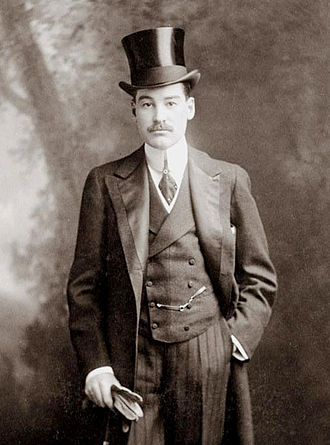
Metal detecting

The Weald and Downland Metal Detecting Club were invited to visit a farm in Horley, and among other items they found a William (I) “The Lion” of Scotland Cut Half Penny.
The coin was minted by the moneyers Hue and Walter, of Edinburgh and Perth, in the 13th century.

William I reigned 1165 to 1214.

The gold coin below is a worn Belgo Gallic stater. The reverse, if it had been more visible, would have shown a disjointed horse going left, with pellets in the field of the coin, along with symbols. The obverse would have shown a depiction of a long-haired Appollo. Most interesting. The coins were thought to have been minted in Northern France and brought over to this country. They do turn up in the South East  but less often elsewhere. The design was dated from between 150 to 50 BC. This was found in the same area as the Cut Half Penny.


( Photos: Mark Davison. )

Some years ago, the then owner of 2.5 acres of land in the Haroldslea area found a number of items with a metal detector. These are shown below:  ( Photos. P. Cox.)

The “Royal Dock Yard Battalion” existed around 1850. They were established as volunteers to guard the dockyards. It is a mystery why this item found its way to Haroldslea!

“On War Service” badge. These were worn by munition workers (probably in the munition works near Horley Station during WWI)

Military Buttons and a badge of the Royal Northumberland Fusiliers.

Buttons, mainly plain except top row which appear to be Livery Buttons, but all corroded.

Many old coins were also found, most too corroded to identify, but a few were identified, and are below:


A milk churn label belonging to John Ernest Furness who owned the Haroldslea estate 1919-1925
For more information see “Personalities.”

Iron Age Horley

Iron age Horley.


Archaeological surveys have been taking place in the area north of Langshott in connection with the Horley North East development known as “The Acres”.

The work by Archaeology South-East has revealed that there were Iron age “Round Houses” and agricultural activities in the area near Great Lake Farm and north of Tanyard Farm.

Below is an article from the Archaeology South-East web site reproduced with their kind permission.


Land Northeast of Horley

Excavations undertaken by Archaeology South-East near Horley in Surrey have completely changed our understanding of the prehistoric settlement of this little-studied region. Desk-based assessment and evaluation trial trenching led to an archaeological excavation carried out in four targeted areas of this housing scheme between December 2007 and July 2008. The excavations revealed new and exciting evidence of Middle and Late Iron Age, Romano-British and medieval settlement, farming and possible ritual practise along the banks of the Burstow Stream. Other than iron-working sites, prehistoric, Roman and medieval archaeology is rare in the Weald which has historically been conceived as being a wilderness throughout much of antiquity. Contrary to this, the results from the site appear to suggest that prehistoric, Romano-British and medieval origins in the area may have developed and extended along arterial waterways such as the Burstow Stream through the otherwise densely forested Weald. The location of the site with fertile farmland and both riverine and forest habitats available as valuable and abundant resources close to hand would have presented an attractive proposition to ancient settlers. The evaluation and excavation process has shown without a doubt the legitimacy that archaeological fieldwork can have in areas previously considered of lower archaeological potential.

Project Officer: Jim Stevenson, Dan Swift

Client: CPM Environmental Planning and Design

http://www.archaeologyse.co.uk/04-Projects/AbstractsGeneral/RecentAbstracts.asp


Here is a further report from Archaeology South East

Archaeological Investigations at Brook Wood, NE Horley

Phase 1 Excavation

Summary Report

ASE Project No. 3641

Introduction

Archaeology South-East were commissioned by Bovis Homes Ltd. to undertake a programme of archaeological work at the Brook Wood Horley development. This follows on from previous phases of work on wider residential development in the area. Work on this site began with a stage 1 desk based assessment (CPM 2000). This was followed by stage 2 geophysical survey (WYAS 2001). Archaeological evaluation (stage 3) was undertaken within the site during 2007 (Margetts, 2007). This revealed Iron Age, late medieval and post medieval evidence. The majority of the remains uncovered comprised ditches or gullies probably mostly of MIA/LIA date. Two removed field boundaries were also in evidence, one of which has a probable late medieval date assigned to its foundation as well as a late 19th century date for its decommission. Much post-medieval blast furnace iron slag was also recovered from the southern part of the site.


Methodology

This phase of work comprised large stripped areas centred on the development footprint as well as suspected Iron Age remains encountered during the evaluation stage. The general aim of the work was to identify, excavate, record and characterise any archaeological remains present in the excavated area. More specific aims included:


·To assess what evidence there is that changing environmental conditions, such as the flooding of the Burstow Stream, may have dictated settlement shift in the area during the MIA/LIA and Romano-British periods.

·To assess what was the Iron Age and Romano-British ‘network’ of sites in this region in light of the theory that these follow arterial waterways such as the Burstow Stream and the River Mole etc.

·To use any Middle and Late Iron Age pottery recovered to help to improve our knowledge of Iron Age material culture in the Weald.

·To attempt to relate any evidence of the medieval tannery *  Scheduled Ancient Monument site recorded in Scotchman’s Copse


Further aims were to identify and examine the evidence for continuity between past and present landscapes and to:


·Examine the relationship of cut features, particularly field / enclosure boundaries and trackways to the existing field boundaries, roads and lanes.

·Examine the documentary and cartographic sources and relate these, if possible to the excavated evidence.

·Particular attention should also be paid to the continuity of land use from the prehistoric / Romano-British period and the medieval landscape. This has been suggested for other areas of the Weald, particularly Kent (SERF seminar October 2007)

Area A Results

Residual Activity


The earliest activity at the site comprised Prehistoric activity of an early date including probable Mesolithic flint artefacts (including a microlith) found residually in features dated to later periods or collected from subsoil deposits. This probably represents transient hunter gather activity within the site


Phase 1 Iron Age


Activity relating to this phase comprised the majority of archaeological evidence encountered on site. Arrangements of ditches probably representing enclosures and field-systems of this date were encountered throughout the area on a general northeast and southwest alignment. Within some of these enclosures were encountered the remains of at least two roundhouses with partial remains of up-to two more found close by.


The only artefacts recovered relating to this activity comprised finds of pottery possibly of Mid to Late Iron Age date.


Fig 2: The largest and best preserved Iron Age Roundhouse


Phase 2 Late Medieval to Post Medieval


This phase is typified by boundary and drainage ditches relating to land division across the site. These can often be traced on cartographic evidence.


The large drainage/boundary ditches possibly have 15th to 16th century origins indicated by the presence of un-abraded pottery recovered from deposits filling the base of the features. Further finds of post medieval brick tile and glass as well as cartographic evidence indicate a late 19th century date for the boundaries removal.

Area B Results


Residual Activity


The earliest activity at the site comprised Prehistoric activity including flint artefacts found residually in features dated to later periods. This probably represents transient activity within the site.


Phase 1 Iron Age


Activity relating to this phase comprised the majority of archaeological evidence encountered. Arrangements of ditches probably representing enclosures and field-systems of this date were encountered throughout the area on similar alignments to ditches found during Area A. In contrast however these enclosures were not associated with settlement evidence (i.e. roundhouses and concentrations of artefacts) and more likely represent field-systems.


There was a distinct lack of artefactual evidence related to these field-systems their similarity to ditch features of Iron Age date encountered within Area A excavation area however makes a likely Iron age date for these features most probable.


Phase 2 Late Medieval to Post Medieval


This phase is typified by a single boundary/drainage ditch encountered in the south of the area.


The large drainage/boundary ditch was similar to features encountered in Area A however this example had a ceramic land-drain inserted into its base.


Undated Features

The majority of discrete features encountered on site did not provide any dating evidence and were largely unremarkable in nature. Several pits however displayed evidence of gully fed terminals and are likely to be industrial in nature although what this industry entails is unknown at present.


Conclusions

The bulk of the archaeological evidence is of probable Mid-Late Iron Age date (4th century BC to 1st century AD) being the period of most intensive land-use of the site. This is followed by a period of low intensity land-use until the present day.

The Iron Age activity clearly relates to an agricultural settlement and comprises a continuation of activity found during previous phases of archaeological work on the wider northeast Horley residential development.

Early indications based on boundary orientations and spatial analysis look to further suggest continuity of land-use patterns from the Iron Age to the post-medieval and even modern periods on the site. It also seems likely that settlement zones confirmed by the presence of the roundhouses show a predilection for being sited close to the course of the Burstow Stream.

The possible late medieval origins of some of the boundary/drainage ditches on site may indicate associations with the nearby Langshott Manor.

Some of the pits encountered on site may be industrial in nature and associations with nearby tannery * activity should not be discounted at this time.


Andy Margetts

Archaeology South-East

For full details see:

http://www.archaeologyse.co.uk/ReportLibrary/2009/2009002-2470-NE-Horley-PXA-APPROVED.pdf

14th May 2012

* Regarding the Moat in Scotchmans Copse, there is no evidence that it was used in connection with Tanyard Farm which was a tannery that existed in the late 18th c.

The moat within Scotchmans Copse has been in existence since before 1324 when it is mentioned in connection with Labbokland and Guldenland in the Chertsey Abbey Cartularies.

Also the field adjoining the moat was named Moat Field. (Peter Cox, H. L. H. S.)


Below is a picture of the site of a round house which was located about 100 metres north-east of Langshott Manor. Four of the post holes can be seen exposed by the archaeologists. (photo Peter Cox Horley Local History Society)


Below is what an Iron Age roundhouse looked like. This reproduction is at The Chiltern Open Air Museum. (photo P. C. C.)


Haroldslea; Bronze Age Cremation


Evidence of a Bronze Age cremation was found during the Mesolithic dig at Haroldslea.


A small quantity of ash containing bone fragments were examined at the Centre for Human Bioarchaeology at the Museum of London. They have confirmed that the bone fragments are human, from an adult and included cranial and leg-bone fragments. Most of the burial had been disturbed by ploughing.


In the picture below, the cranial fragments are on the left.


Included in the finds was a bronze age flint arrowhead,(pictured at the bottom) which had not been burnt, this seems to indicate that it was buried at the same time as the ashes were interned, but after the actual cremation. This arrowhead was in the soil above the ashes.

It was reported that in 1840 some land was being cleared by the tenant farmer and human bones were found, but there is no further information recorded as to where this was on the Haroldslea estate, or even if they could have been connected to this recent find.


This find was made near the moated site. The map reference is TQ2995 4245.