Category: About Horley

Railway Letter 1905

A letter addressed to Head Porter Pattenden, Horley Station dated 5 October 1905 from the General Manager, London Brighton & South Coast Railway, London Bridge Station, SE.

“My attention has been called to a case of attempted suicide on the part of a man named Wellbeloved (He obviously wasn’t) at Horley Station on the 5th ultimo, when, at considerable risk to yourself, you rescued him from his dangerous position when an approaching train was within 20 or 30 feet of him.

I have very much pleasure in commen-ding you for this very courageous act, and I have given instructions for it to be recorded in our staff register and to be mentioned in the Special Staff Notice.

I have also pleasure in enclosing £1 in recognition of your praiseworthy conduct on the occasion.”

Question: did he jump from one of the present platforms or from one of the previous station’s platforms?

Mr Pattenden lived at the time in Station Bungalow sited on the south side of the High Street entrance to the subway. His son kindly allowed the Society to copy this letter.

Extract from the Primrose League Gazette 21st January 1888

At a recent dinner in connection with the Horley Habitation [Sussex No. 1496] at the Chequers Assembly Room, there was a very large attendance of members, including several ladies; and Sir Trevor Lawrence, M.P., having, in felicitous terms, proposed “The Health of the Ladies”, and informed the company that the toast, somewhat unusually, was coupled with the name of a lady, – MISS MARRYAT, who was enthusiastically applauded, rose and said:

“Mr. Chairman, Mr. Vice-Chairman, and gentlemen, as none of the senior Dames of the League have risen to reply to this toast, I trust you will not consider me very presumptuous in rising to return thanks on behalf of my sex for the many nice things Sir Trevor Lawrence has said in his speech about us. [Cheers] I believe it is rather unusual for a lady to respond to this toast, but I fancy the custom has arisen somewhat in this way. It is not uncommon, I am told in London and other cities, for some 200 or 300 gentlemen to get together and have grand banquets all to themselves, while the ladies are banished to a gallery to look at them through the railings, feeding [laughter] just like you see the animals fed at the Zoological Gardens. [Much laughter.]

Well, having thus wilfully banished the fairer sex from their society, of course they go through the hollow farce of drinking the health of the banished ladies, they have put to some unhappy man to reply [laughter], but really on these occasions, when the noble beasts – I beg your pardon, the nobler sex [laughter] – unbend so much as to let us feed with them, I think the least we can do is relieve some unhappy man of the task and reply for ourselves. [Loud cheers and laughter] If, too, you will consider for a moment, you will see what an absurdity it is for a man – a bachelor too, I believe generally – attempting to reply to a toast on the subject of which he needs must be woefully ignorant. [laughter] For, if he is an old bachelor, his life has evidently been passed uncheered by the sunshine of a woman. If a young bachelor, he is probably too much taken up with admiration for himself to have had time to study the opposite sex. A married man, now, might know something about us, but I suppose they are never allowed to reply, because I imagine you gentlemen have the vulgar and erroneous notion that if were to dilate on our charms – as he undoubtedly would do – he would have a rough time of it when he got home. [Cheers and laughter]

I will only remark, in conclusion, that whatever may be in store for our sex in future – whether you admit us to many branches of science, arts and honours, or even give us women’s suffrage, and many other things from which we are now excluded – you may depend upon it that the higher the scale of duties and responsibilities to which you raise your women – and you will find us fit for them when the time comes – the higher you will raise yourselves in the scale of civilisation, and the greatest number of perfect English women you will produce. [Loud and prolonged cheering!]

High Street, Horley, Surrey

From 1812 to Today

High Street, Horley, SurreyHigh Street, Horley, Surrey


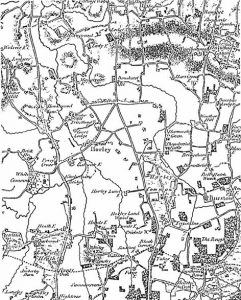
By 1812 with a population of a little under 1000, the huge common was enclosed. New roads were planned and the intervening land sold. However, Horley changed little even when two of its planned roads were turnpiked, one in 1809 and the other in 1816, to allow regular stage coach services to operate between London and Brighton.


In 1841, the railway was laid across the common and the first Horley station came into operation to serve its population that had by then reached 1500. From that location and from that date, the town of Horley grew steadily to a population of around 8000 by 1940. Whereas agriculture was its main industry prior to World War II, it changed rapidly after to become a dormitory town for London commuters and a place to house the growing workforce, and associated businesses, of Gatwick Airport. From its humble beginnings in 1930 as a recreational airfield, Gatwick first became a continental airport with its own terminal (now listed) building in 1936. Today, it is the UK’s second largest airport and over the last 80 years it has grown from just 186,000 passengers to over 46 million passengers in 2019. However, the global pandemic in 2020 saw international travel restricted and passenger numbers fall to 10 million for the year.


Depite the fact that Horley is now mainly a residential town with business services and some light industry alongside Gatwick Airport, it is still situated within pleasant rural surroundings from which it originally evolved. Something its population remains keen to safeguard.


St. Bartholemew's Church, Horley, Surrey

From Norman Times

St. Bartholemew's Church, Horley, Surrey

Following the Norman Conquest, Horley is not named in William 1st’s Domesday Book as it is thought to be included within the northern manor returns. After the Dissolution of the Monastries in 1539, Horley Manor passed to Henry VIII who gave or sold it to various people until 1602, when it became the property of Christ’s Hospital in London. A map of its purchase was produced in that year, the original of which is held today by the Guildhall Library in the City of London. This map clearly shows that Horley consisted of three separated settlements around the western and northern edges of a huge open common.


Ye Olde Six Bells, Horley, SurreyOne by the Church, parts of which are thought to be 14th century, along with today’s Six Bells Public House of 15th century origin; another where the Watermill once stood by the River Mole; and the third, along the northern boundary of the common (today called Horley Row) where several other properties can be seen, dating back to the 15th and 16th centuries.

Introduction

Horley is a small but busy town of over 20,000 people situated almost half way between London and Brighton on the south coast. It is mainly residential and sits astride both the main line railway and the A23 main road, between the two locations, close by London Gatwick Airport.

Horley lies on what is known as the Weald that consists mainly of heavy clay soil, a few miles south of high chalk Downs. The local area was thought to have been at one time densely forested so early settlers preferred to live on the drier North Downs. They only penetrated the muddy and overgrown Weald during dry summer months to feed their animals and to forage. When Christianity first came to southern England during Saxon times, Horley and its Manor came under the control of the Benedictine Abbey of St Peter at Chertsey, close by the River Thames. The Abbey also controlled many other manors on the North Downs, who in turn had claims on parts of Horley from earlier use of its land.