The Chapel by the Mill and Lee Street Burial Ground.
Published online by Horley Local History Society
April 2024.
Mainly based on the work of Aubrey G F Cook.
Most of what we know about the history of the Chapel which once stood on the west side of the entrance to Mill Close off Lee Street, Horley is derived from a short booklet written by Aubrey G F Cook in 1986.
Aubrey was born in Vicarage Lane, Horley, and attended schools in Albert and Lumley Road. His first employment was in a grocery shop in Station Road East.
Most of his National Service was spent in an office at the Royal Military Academy Sandhurst.
After leaving the army, he studied at St Andrew’s College, Surbiton, and spent four years in the Scottish Border counties on Christian missions and camps for children with the Scottish Caravan Mission to Village Children. This was followed by two years of tent mission work in Suffolk with the Strict Baptists and then became Pastor of two churches in Suffolk and one In London. For the latter part of his working life he was employed by an Association concerned with the rights of Composers of music, the last 13 years being as their local representative.
In addition to The Chapel by the Mill (1986), he also published ‘My Wartime Horley’ in 1984 .
The small cemetery which was established adjacent to the Chapel site gradually fell into disrepair until an attempt was made to build houses over the site.
The story of what happened next is told in this newspaper article from August 1995.
In about 2015 the Friends of Lee Street Burial Ground decided that as Reigate and Banstead Borough Council had accepted responsibility for the burial ground maintenance, they no longer had a useful function and should disband. The residue of their fighting fund (£910.50) was offered to HLHS and accepted on the basis that we promised to keep a watching brief over the site.
The history of the Chapel and the names of families associated with it which follows is reproduced here exactly as Aubrey Cook wrote it.
It contains elements of his personal religious beliefs which are his alone and are not necessarily endorsed by HLHS.
PART ONE
‘BETHEL’
Where Lee Street runs into Mill Lane, Horley, can be seen a small overgrown graveyard with a few gravestones still standing while others lie flat on the ground being covered by nettles and moss. This is all that remains of what was once a meeting place for Baptists in the mid—1800 I s, for adjoining this quiet burial ground once stood BETHEL CHAPEL, a wooden building which housed a congregation of non-conformists.
Little is known of how the chapel came to be built by the mill, but previous to 1846 Baptists had been meeting for worship in a small wooden chapel, built 30 years earlier, about 3 miles away at Charlwood, and they were responsible for initiating this new chapel at Horley.
The earliest record dates from 1846 when on the 29th October a “Baptist Church Of Christ” was formed with seven persons “meeting for Divine Worship in the new Meeting House, Horley, Surrey”.
On that day Mr Edward Arnold of Cuckfield preached a sermon stating the nature of a “Gospel Church” and Mr Biddle of Brockham received into membership Edward Hiller, Sapphira Nye, Sarah Lanaway, Mary Woodham, Ann Brench, James Borne and John Denham.
In October 1847 the membership was added to by six women and two men, and by March 1848 another five women and one man, had joined making a total of 21.
Janes Borne and John Denman were appointed the first deacons, posts which would have followed a ballot by the members. Their duties would involve the general running of the day-to-day affairs of the church and announcing the numbers of the hymns used in the services, even, if necessary, reading each verse before it was sung (where people could not read) and if no instrument was available starting the singing with a pitchpipe or tuning fork.
EDWARD MILLER who had previously been baptised by Mr George Chapman at Dormansland, became the first minister. His part in the services would be to ‘fill in’ between the singing of the hymns by reading the Bible, leading in spontaneous extemporary prayers and preaching a lengthy doctrinal sermon.
WHAT DID THEY BELIEVE?
To set up a rival church to the Establishment meant they needed to have beliefs which were real and deep. They would have held basic Christian teaching with other denominations, such as that there is one God, who is a Trinity of 3 persons, the Father, Son (Jesus Christ) and the Holy Spirit, That God reveals His laws and ways through the Bible which He inspired men of His choosing to write. He sent His Son into the world, born in Bethlehem, teaching and finally dying on a cross at Calvary, near Jerusalem. He also rose from the dead within three days, was seen by His friends and returned to Heaven from where He will return at the completion of the earth’s allotted span.
They would also believe that the teaching of the Bible is that every person born into the world becomes a sinner which robs them of fellowship with a holy God, both in time and eternity. However, the sacrifice of His life by Jesus on the cross in God’s sight is sufficient to make the sinner clean and whole again, fit for Eternity, and there is no other way of achieving this.
The sinner has no desire to approach God until by the work Of the Holy Spirit within him he is convicted of sin and hears the welcoming and forgiving call of God, to which he responds by means of the faith God has given him. The emphasis would be on God’s eternal saving and keeping power, rather than man’s fickle and passing fancy.
WHAT WERE THE REQUIREMENTS FOR MEMBERSHIP?
It was no easy thing to join the church and perhaps this is why the actual membership was never large number, although the size of the congregation must have been reasonably good.
Before being admitted to membership it was required of the candidate to show some evidence of his being a Christian. This was first by a personal experience of having repented sin and trusting in Jesus Christ as Saviour.
A spoken testimony of this had to be given to two visitors appointed by the church, and then on their recommendation, to the church members at a specially arranged meeting.
Public testimony of the candidate’s faith in Jesus Christ was then arranged and the person was baptised (fully immersed in water) by the minister or a visiting preacher either in the river or the Baptism Pool inside the Chapel. The ‘right hand of fellowship’ was then given as a token of joining the church and then only was the person allowed to attend the Communion Service and take part in church meetings. Hence, these Baptists were. and are, called “Strict”, referring to the Communion being limited to some degree.
We believe that Jesus Christ as the Head of his own Church hath Instituted two standing ordinances, Baptism and the Lord’s Supper, that latter to be received only by those that have been baptised in the name of the Holy Trinity.
HOW WAS THE CHAPEL MAINTAINED?
Unlike modern churches with a weekly collection, they depended on the giving of the congregation only ONCE a QUARTER, and for 1848 this averaged 36p per quarter. At the first Anniversary special services were held when their funds were swelled by £3.45. However, in 1856 a 1d a week subscription was introduced.
Some idea of what life was like can be seen by the expenditure, In 1648 the outside of the chapel was painted in “once—over” for £1.25 and candles for the year amounted to 31p. Another expense was for “Ministers and stamps” of £1.27.
By 1850 a Piper stove had been installed and from then on coal was purchased.
THE ANNIVERSARY
This was the ‘big day’ of the year and the visiting preacher in 1850 received the sum of £1.70. 25p was paid to the caretaker for the tea and clearing away. Handbills inviting people to attend would be circulated to neighbouring chapels and for these they paid the printer 25p.
The burial ground was kept tidy by a twice-yearly mowing for which they paid one shilling (5p). Other items purchased were 2 brooms for 2.5p, a mop for 5p, and sand for 2p. What was the sand for? Most likely for the stables and perhaps the ‘privy’ as an entry in the records for 1854 reads “sand, carriage and cleaning out privy, 1/9d (9p).
The only records of the chapel being painted are in 1848, 1852, 1862 (outside only), 1862 (inside only) and 1870. It must have been good paint to last 8 or 9 years!
Evidently a purpose-built Baptistry (a tank let into the floor) was in use and this was filled with water from the gutters as in 1854 there was an “alteration in shoot to take water to Baptising” which cost 5p.
A vestry was provided for the minister’s use and 4 chairs were purchased in 1854 at 10p. It appears that this was an extension to the main building as in later records it was referred to as a separate item for insurance purposes.
A new stove was fitted in 1855 for 50p and this required a new chimney in 1858 for which Mr Bray was paid 27.5p.
The front board, which bore the words
BETHEL CHAPEL
ERECTED 1846
was set up in 1858 for 25p and in 1862 tassels were provided for the window blinds.
All this time repayments of a building loan from Mrs Miller were made at a rate of £2.50 per half-year, and in 1857 the chapel was insured with the Fire Office for 3/7d (18p).
After 44 years, with a membership of 3 (only one male) it was decided to form a committee of members and non-members including some well-known Horley businessmen, to erect a new building in Victoria Road, and this was opened in 1892 (see part two).
The question arose as to the use of the Chapel by the Mill, and it was decided to continue afternoon services once a month, and the balance still outstanding to Mrs Miller should be paid at 15p per week out of the rent of the cottage and stables.
In 1893 the Chapel cottage was repaired and notice given to Mr Flint, the occupier, to quit. He was given one week’s notice again in 1894 but it was agreed to let him stay if he paid his rent punctually. Evidently this didn’t work out and Mr Young was asked to try to persuade him to leave.
In 1895 Mrs Flint was the caretaker and for cleaning the Chapel twice a year was paid 20p.
The WC at the cottage was linked to the water main in 1898 but water was not laid on until 1920 when the cottage was let to Mr Simons. This was referred to as the “Caterham Water”. A small sink was also installed and it was all paid for by the Lee Street Fund and the Tea Fund (the latter, no doubt an over-subscribed fund held at the new Chapel). A further reference to the cottage being repainted was in 1936 and in more recent tines it was sold and demolished to make a grassed area in front of some new houses.
It appears that the only male church member on the new Chapel committee was Mr John Barnett and he was asked to manage the burial ground at Lee Street. His first duty was to attend to the drain which had been stopped up. In 1894 the fees for the burial ground were:
“Persons attending this chapel wishing to bury their friends there, five-shillings (25p); those not attending the chapel, ten shillings (50p). For the internment of children, two-shillings-and-sixpence (12.5p) and five shillings (25p) respectively”
The boundary needed marking out in 1896 and 2 posts were put up beside the stable. A barbed-wire fence and a hedge were planted on the west and north sides of the burial ground. The garden on the west side of the chapel, previously used by Mr Flint, was sown with grass seed and in 1897 his rent was reduced to 15p per week to compensate for this.
In 1899 the Horley auctioneers, Baker & Baker were selling the property adjoining the chapel and asked if the Baptists would like to sell the stables or let them for a term of years to their buyers. However, the stables were repaired with a new corrugated iron roof, back and sides, and let.
Insurance was then negotiated with the Phoenix Fire Office for the chapel and vestry £125, seats and furnishing £25, house £175, stables £25, in all £360.
When in 1900 Mr A King of Smallfield redecorated the chapel and cottage the rent of the latter was increased to 20p.
Only 2 trustees remained at the turn of the century; Mr Weller of Meadvale and Mr Wilkins of Holmwood (probably Abraham Wilkins who was baptised and joined the church in 1847 and therefore would have been an elderly man), and their views were sought as to the future of the building.
THE CHAPEL’S DAYS WERE NOW NUMBERED!
In August 1900 the chapel was in need of repair and the Management Committee at the Victoria Road Chapel agreed, with some opposition, to have the old building dismantled and sold. A memorial stone was to be erected where the chapel stood.
The highest bidder was Mr H Cooper for £9 and a photograph taken at the time shows his board on the front of the Chapel by the Mill which for over half a century had been a centre for worship in the spread-out village of Horley.
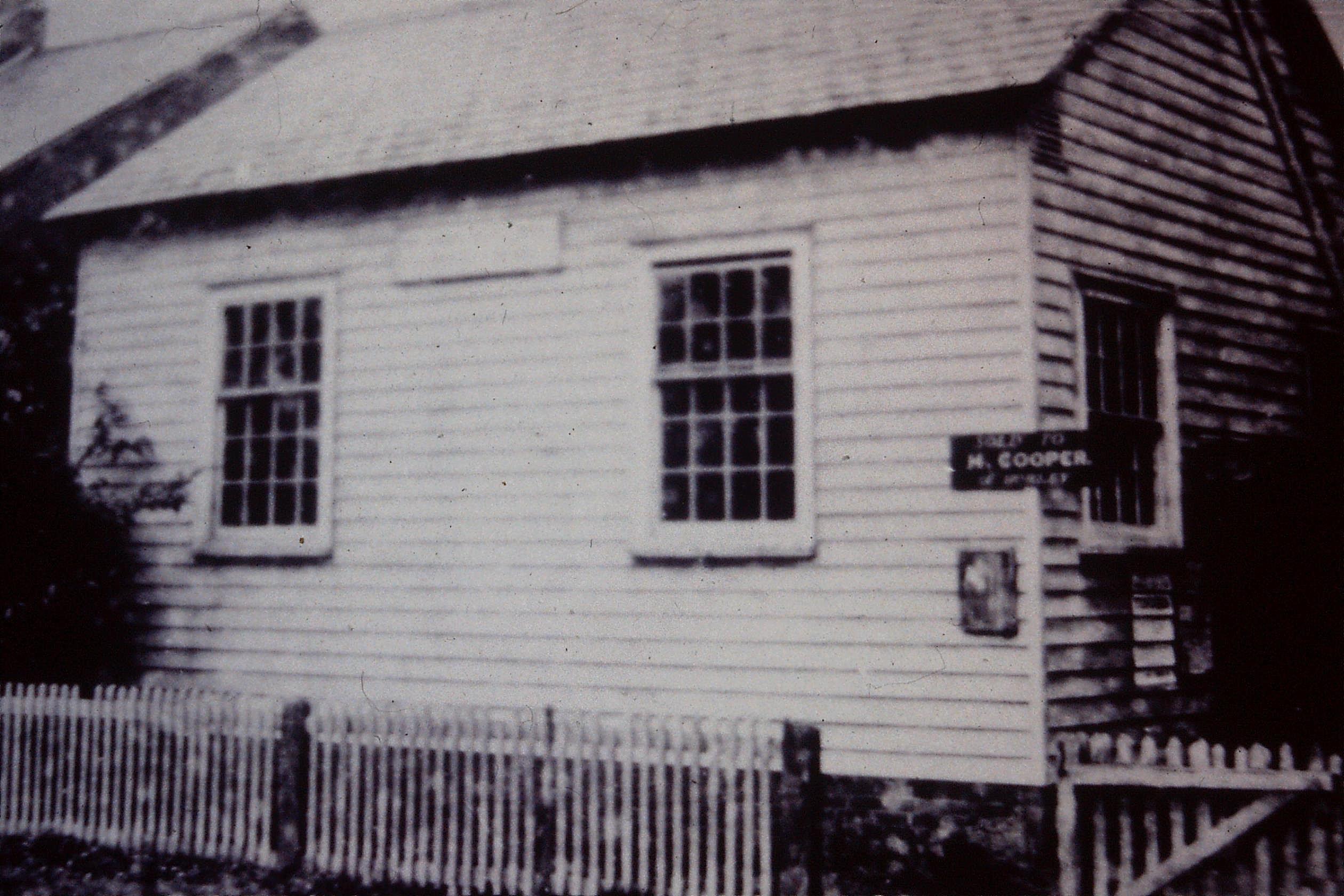
The Chapel showing the sign mentioned above.
HORLEY ON THE MOVE
Up until the end of the 19th Century Horley was a sleepy hamlet reaching from the banks of the River Mole to the Chequers Hotel. It had a Parish Church, a Water Mill, the Six Bells Inn, a departmental store, various workshops and a Strict Baptist Chapel – the Chapel by the Mill.
As the centre of Horley’s life moved away from the river side to occupy the clearing in Horne forest so the centre began to develop into Victoria Road- and of course, not to leave him out – Albert Road too!
To accommodate the newly laid London, Brighton and South Coast Railway lines a further road led to the first railway station which gave it name, Station Road now the High Street.
Two important features of Mill Lane were not to be left behind. One was W.H. Batchellor’s departmental store (with a brief stop by the railway level-crossing en route) and the other the Strict Baptists’ Chapel. Both became part of Victoria Road and a link between them continued for many years.
Over the years other well-known Horley shopkeepers and their families have been connected with the life of this chapel in the centre of Horley, including Stapleys (grocery and clothing), Uptons (furniture), Woods (tobacconists), Warnetts (cafe), Tribes, later Stubbs (confectionary), and one whose association has been the longest, throughout the history of the chapel in Victoria Road, Eades (ironmongery).
PART TWO
“PROVIDENCE”
On the 3rd March 1890 several friends from the little wooden Strict Baptist Chapel in Lee Street, Horley, met to form a committee to consider the building of a new chapel. Land next to Mr Whitmore’s house in Victoria Road had been offered at a reasonable price and several subscriptions had been promised. Some well-known names appear on the list of those appointed to handle the matter, being Messrs Batchellor, Barnett, W.H. Batchellor, E Bilcliff, W.S.J. Brown, Ridley, Thomas Stapley, Viger, Whitmore, Wonham, P.Wadey and Young. Mr Brown was elected as Chairman with Mr Barnett as Vice-chairman. The Treasurers were Messrs Stapley and Whitmore.
The next meeting was held at Mr Bilcliff’s house in Church Road on 30th October 1890 and it was decided to write to various people for subscriptions, some in Haywards Heath and Lewes. They also decided to ask the old chapel trustees to stand as trustees of the new building with Messrs Barnett, Brown, Wadey and W.H. Batchellor. It was also agreed to purchase the land from Mr Whitmore who had promised to pay for the conveyancing.
It was announced to a meeting held at Mr Wadey’s home in Albert Road, an 30th June 1891, that the prime cost of building was to be between £350 and £450.
On 2nd November 1891 at Mr W.H.Batchellor’s house in Station Road, the committee discussed alterations to the plans and included a baptistry under the Communion Table, which would have steps down into the water at both ends. It was also decided the front porch should be on the building line.
Evidently the proposed chapel was going to too much as on the 8th March 1892 suggestions were made to alter the plans, i.e the walls would be 14 feet with no buttresses, plain arches would be used over the windows, the span of the roof would go over the vestries, the baptistry would be cemented instead of using tiles, and the cupboard in the vestry would be dwarfted instead of going up to the ceiling’,
AIso there would be only 4 ventilator shafts in the roof instead of the ten originally planned. A further estimate was obtained from Mr Jennings which was £400 and this was accepted.
Within that same year, on 5th October, the Chapel was officially opened for worship. In the morning was a service of Thanksgiving and Recognition of the new Pastor, and a further service in the afternoon when Mr Hull was the preacher. A tent was erected in the chapel grounds where dinners and teas were served.
With the opening of the chapel the Building Committee decided to continue to run the business side “until the members were competent to appoint others”
Mr Bilcliffe was appointed to collect “seat rents” from those attending at “two shillings (10p) for 1 person, three shillings (15p) for 2 persons, four shillings (20p) for 3 persons, 4/6d (22p) for 4 and six shillings (30p) for 6 (no doubt per quarter) .
It was also decided to place a box under the gas burner in the porch for subscriptions.
It appears that Mr Barnett had the duty of making the hymn announcements during the services as he was to “provide a platform for himself in front of the pulpit”. (This must have been removed at a later date), The Pastor or preacher would spend the whole of the service in the raised pulpit. The first harmonium organ was purchased from Mrs Hacking for £8.
Large numbers of people must have been expected for the 1893 Chapel Anniversary as the dinners and teas were to be served in the Public Hall though which hall in Horley this refers to is uncertain.
On the 30th January 1893 we find that Messrs Eade & Eade sent in their bill receipted as a donation towards the building fund. so commenced a family association which continued throughout the history of the chapel.
No doubt the Pastor, Mr Hacking, was pleased to hear on 21st February 1893 that his salary was to be raised from seventeen shillings and sixpence ( 87p) to one pound a week!
Large numbers of people must have been expected for the 1893 Chapel Anniversary as the dinners and teas were to be served in the Public Hall though which hall in Horley this refers to is uncertain.
For water the chapel members relied on a well and Messrs. Young and Whitmore were asked to open and inspect it “as no water can be got”. This was used until 1906 when “Caterham water” was laid on for £6.0s .6d and ten shillings (50p) per year for the water supply. Mr. K. Jennings then connected the sink and WC to the sewer.
In the early days the chapel was heated by two “Petroleum Oilstoves” but in 1895 ‘coils’ – wrought iron pipes – were installed at the back of the chapel, with more pipes along each side and these remained there over the years. Eade and Sons’ offer to install the heating apparatus for £18 was accepted and had been promised by 4th November that year.
DISRUPTION !
Towards the end of 1893 it was agreed, by the Committee, with the members agreement, that they give the Pastor 3 months notice to terminate his duties and to return to him the £20 he gave towards the building fund.
Strange though it seems, in March 1894 the Committee (made up of non-members) decided that their meetings should now be open to members and it would be called the “Meeting for Managers”
No reason is given for the request for Mr, Hacking to leave but evidently the church at Southminster were ready to welcome him as their Pastor.
It is usual when transferring from one church to another for a letter to be sent commending the person to the fellowship the new church. However, in 1895 a request for dismissal was received from Mr & Mrs. Hacking to be sent to their new home address. Evidently the Southminster church did not recognise “a church that is ruled over by a Committee Of non-members” and therefore no application had been made by the church.
Once the Pastor ceased his regular work at the chapel they would have to find preachers take the Sunday services so it was agreed that visiting preachers would be paid ten shillings (50p), plus expenses, except for Pastors from other chapels who have to pay for another preacher to ‘supply’ for their congregation, “when they shall be paid whatever it costs them”.
This payment to visiting preachers was increased in 1916 to seventeen shillings (85p) and in 1919 to one guinea (£1.05). The highest it reached was in 1922 at £1.5s (£1.25p) when “the deacons held themselves responsible for the increase when prices were advancing in railway fares, etc”. But, due to lack of funds in 1934 it was reduced to £1.12s.6d (£1.62p) for weeknight meetings.
Visiting preachers included Mr Preston from the SmaIlfield chapel, Mr Bourne who was asked to take 24 Sundays in 1901, and some who were great favourites, Messrs Mockford, Light, Russell , Littleton, Popham and Flegs.
In 1914 it. was so difficult to obtain preachers that Mr Brooks was asked to take as many services as he could However, in 1911 they had two vacant Sundays and it was decided on these occasions “sermons would be read”.
One of the preachers, Mr J. Russell, was asked to act as councillor for the church in 1920, and many of the members at that time were baptised by him. He, and his family, gave the chapel a flagon for use at the Communion service in 1921, and the following year he asked to join the church. It was felt unnecessary to visit him “as he had preached from the pulpit”.
The members also commended some of their number as preachers to serve other chapels, when invited, and these were Mr Peter Wadey, Mr Burton (a tailor from Vicarage Lane), and an uncle of mine, Mr Reginald P. Cook, who became the Pastor of Zion Baptist Chapel in Trowbridge, Wiltshire.
Visiting preachers needed entertaining and Mr Alfred Eade undertook to do this for 2/6d (12.5p) from General funds, but he returned 6d (2.5p) of this to reduce the chapel debt.
Unlike many chapels of the period, throughout the years no tablets have been erected on the walls in memory of those who have taken sone worthy party in the life of the chapel. Only one notice ever hung on the inside walls and that referred to the fact that in 1894 the chapel had been licensed for the Solemnisation of marriages.
In October 1894 the notice board on the porch was worded as follows:
PROVIDENCE BAPTIST CHAPEL
Times of Divine Service
Sunday morning 11.0 Evening 6.30
Wednesday Evening Prayer Meeting
Sunday School Morning 9.45 Afternoon 2.30
This hardly altered over the following years, except when during the Second World War services were held in the afternoon for the regular worshippers (sometimes in the vestry) and evenings for the Forces from the nearby camps when the chapel was suitably ‘blacked—out’.
The first chapel cleaner to be appointed was Mrs King in October 1892 at thirteen shillings per quarter (65p). She requested to be released from her duties in June 1898 but was still the cleaner in 1900 when she made another request and as1 a result of this her wages were increased to one pound per quarter! In 1901, Mrs King made a further request….
As the nineteenth century draws to a close there are three items of interest. First, the chapel building debt had been lowered to £8. 12s. 6d.(£8.62p) Then, the matter of subscriptions to the Parish Nurse and a donation to the Hospital were left over to the next meeting… and the next… Finally, a special Prayer Meeting was arranged concerning the war in South Africa.
CHAPEL OUT OF DEBT!
On the 10th October 1900 it was announced the chapel was free of debt. Mr Wonham had accepted £100 in place of the £200 outstanding, Deeds were drawn up on the same terms as those for the Lee Street chapel. Big celebrations took place in March 1901 at which there was no collections and the tea was free to all friends!
Very little is known of the early days of the Sunday School, but a minute in January 1398 expressed the thanks of the Managers to the teachers.
In 1906 a public meeting was held in the chapel to consider building a new school room, and in 1907 the estimate obtained was for £270 of which £138 had been promised. With the opening of the hall in August the activities of the chapel could be increased. The hall was used for lectures, such as Mr Evans of Tunbridge Wells who spoke on “The Tabernacle” , Mr Watts of the Strict Baptist Mission in India. the Protestant Union, and the Sovereign Grace Union, “provided it was an instructional lecture and not of an aggressional character”!
It was on 20th April 1943 that my father, Arthur Cook, became Superintendent of the school, and it became quite a family concern as my mother was the organist with an auntie as a teacher. Also, other young-at-heart ladies of the congregation shared in this work. It was a very happy school and drew children from all over Horley.
One day each summer the week day schools closed and the Sunday Schools had an excursion to the seaside. The scholars assembled in their respective churches and paraded to the railway station where a special train was waiting.
The other big occasion of the year was the Sunday School Anniversary for which we each learnt a poem or a chapter of the Bible to recite before our parents and friends in the chapel. A tea was also served in the school room and prizes for attendance were given out by the visiting preacher.
Occasionally a weeknight meeting was arranged when a large white sheet was hung across the schoolroom and a ‘magic lantern’ lecture was given to the excited young audience. However, when a silent cinematograph film on the life of David Livingstone was shown it unfortunately didn’t receive full approval of some of the members!
In 1893 there were 12 members able to attend a church meeting and in 1920 the number was 13. Although the chapel may have been filled at the services at times it appears the membership was never very large.
Toward the end of 1925 a younger group became interested and at a Baptism Service on 5th January 1926 five were baptised. Then in 1934 6 persons were baptised at one service, “a man and wife, a husband and wife (parents of the previous couple) and then a mother and son”, and this was conducted by a favourite preacher at the chapel, Mr Mockford.
From time to time other individual baptisms took place, the most notable being that of Roland Barnett, who was brought in on a spinal carriage and lowered into the pool with the help of members of the Horley St John Ambulance.
Over the years well known Harley families have been associated with the chapel and taken an active part. One who is worthy of note is Mr W.H. Batchellor who owned the departmental store in Horley (now Collingwood & Batchellor) and for many years he led the services through by announcing the hymns. His opening sentence was “Let us commence the solemn worship of God this morning by singing hymn number
Peter Wadey was also a strong supporter over the years and the story is told how that his singing was so untuneful that he was asked to refrain from singing at the services. His reply, “How can I? My heart is in it!”
THE EADE FAMILY
One family, however, has a record far longer than any other – the Eades. In the early records the names of Amos, Alfred and Tom appear indicating the great service they gave to the chapel. To that list we must add the name of Royston, one of Tom I s sons. Roy, as he was affectionately known, was baptised by Mr Champion on the 30th May 1933 and was received into membership with his wife. Although the burden of the Charlwood Chapel was upon their shoulders, together with their two daughters, they gave a quiet but strong support to Providence Chapel, especially during the latter years. In the last years of the chapel’s history his two daughters continued the family’s active participation in the varied activities taking place, thus concluding a span of several generations.
in his early days, Kenneth Eade, the well—known Horley pianist, played the chapel organ.
Another member of the Eade family, Molly, took an active part, especially in the Sunday School, at least, until a fellow member, Kenneth Wood, asked her to be his bride and the chapel was honoured with their wedding ceremony.
Yet another wedding united the Eade family with the Wadey family as Amos Eade’s daughter Kittie married Mr Benjamin Wadey who also took a keen interest in the life at Providence.
MUSIC IN THE CHAPEL
For many years the hymns were sung from Gadsby’s Selection – a book used mainly by the Strict Baptists. This book contained words only and the tunes were selected from the Companion Tune Book, and it was quite common to see members of the congregation holding two books open when singing, one for the words and one for the music.
In 1933 new tunes were being introduced so it was agreed to have singing practice once or twice a month.
In 1937 a Mrs Pickett of Brighton made a gift of an organ which had to be ‘put in order’. Yet, in the school room stood a small pipe-organ which belonged to my father and had been, for a number of years, stored under the stairs in our home. Occasionally I had the task of pumping this when it was played for the school.
The suggestion of changing a hymn book usually meets with much opposition. In April 1944 it was suggested that with the extra Forces attending the services the number oi hymnbooks was insufficient and It might be time to change. In May it was left over to the next meeting. Again, in June, in fact, it was left until all members could agree! (Years later a change was made to “Gospel Hymns” and in the latter days these were found under the back seat..,!)
In 1982 the front pew was removed so that a small Yamaha electronic organ could be brought in and the singing took on a new pace. Also, songs with a modern tempo seemed far removed from the early days of Providence,
AFTER FIFTY YEARS – A NEW PASTOR!
Over the years it had been suggested that one or other of the preachers should be invited to take over as Minister of the chapel but the second to actually hold the post was Jack Hoad who commenced his ministry on 7th August 1943.
Jack Hoad ls dynamic character became obvious right from the start having laid down seven conditions upon which he accepted the invitation to come to Horley, to which the church members agreed !
Coming during the war he made the most of the opportunities available by being the first church in Horley to be completely blacked out. This allowed for services during the winter on Sunday evenings when service personnel from camps around Horley packed the building.
Jack Hoad also made a monthly visit to the Sunday School (following afternoon service) and a Women’s meeting was commenced. The high front hedge was removed and a new wall erected. Tuesday Prayer Meetings and Friday peaching services kept him very busy. In addition to which he worked three days of the week for the Trinitarian Bible Society.
Unfortunately a senior deacon who had been associated with the chapel for many years had a disagreement with the Pastor, causing a ‘rocking of the boat’ and a motion was passed by the church “That this church has full confidence in their Pastor”,
During this time it was agreed to end “seat rents” and a monthly collection was taken up instead.
Pastor Hoad’s ministry lasted at Horley until 1945 when he resigned, giving seven reasons for doing so.
Three other short Pastorates have taken place since with Mr David Ellis, Mr Len Holder and Mr Brian Ellis. Each brought to the chapel their particular ministry but maintaining the Strict Baptist tradition upon which the chapel had been built over the years. With declining church attendance generally they had no easy task.
From time to time the congregation was increased by people coming from other chapels who were keen to see the chapel prosper but these were dark and difficult days.
THE LAST DAYS
Due to a strange set of circumstances, I was drawn back to the chapel in 1981, and was asked to give some help to Gerald Edgerton and Ricky Bardon who were running a youth club in the school room. This was attended by a group of young people unaccustomed to church services but nevertheless they were prepared to attend evening worship, if only for somewhere to go.
It seemed that a last effort should be made for the chapel to fulfil a need for a place of worship in the centre of Horley. Much prayer was made, the building was redecorated, new lights installed, a new electronic organ used for the services, a different type of heating employed, visiting with leaflets in Horley, coffee mornings, a bookstall, invitations given out to Saturday morning shoppers and special meetings, but of the few that made the effort to enter the building not one came back a second tine. Why? And why was it that in 1983 it was felt that the chapel should be sold?
We may never know the answer to this question.
It has been suggested that as the chapel was built by a committee of non – members there could be a reason here, for “ except the Lord build the house they labour in vain that build it” (Psalm 127.1).
If this was so – a solemn lesson is taught here that if God ‘s hand is not in our work, or our lives, our labour could be “in vain” – worthless!
However, in His over – ruling of the mistakes in our labours and in our lives God can bring something worthwhile even if it is only a memory of a truth taught, a helpful word spoken or a kindly deed done, so that we can know that our labour “is not in vain in the Lord” (1 Corinthians 15.5)
Plan of PROVIDENCE Horley
Ve; Vestry
O:Organ
CT; Cornmunion
Table over
Baptism Pool
Mr Ray Ellis of Kemsing wrote the following to Aubrey after reading the booklet.
PASTOR DAVID ELLIS
My father’s pastorate of the Chapell began in January 1963 and the cause knew a measure of revival with much spiritual enthusiasm and many coming under the Gospel for the first time in their lives.
At that time the normal Sunday morning congregation consisted of 4 people (Mr & Mrs Upton, Mr Tom Eade and Mrs Carpenter) All meetings were held in the chapel vestry. There was no youth work associated with the Cause.
Immediately upon commencing his pastorate my father initiated a campaign of door-to-door evangelism on local housing estates as a prelude to opening a Sunday school. That Sunday School, which opened in March 1963 grew steadily. A Bible Class (run by Len Holder who was to succeed my father as pastor of Providence Chapel) was started and, in 1964, mid week needlework classes for the older girls began. In 1965 a youth club was formed. In 1966 this work had to be divided into two clubs because of the numbers attending. During 1965-1968 some 60 children regularly attended Sunday School and Bible Class, and 70 or so young people came to the youth clubs.
Fron the work among the young people during my father’s pastorate five teenagers, including myself, came to a saving knowledge of Jesus and were baptised,
During 1963 the chapel was redecorated, old windows were replaced. The JOY of the Lord filled the place as the sun was allowed to stream in. HIS house rang with praises, By the end of I965 the regular congregation rose to around 50.
Who can judge the effect upon the lives of the many people who heard the word as result of the Tent Mission or the contact with drug addicts and disturbed families? During my father’s ministry at Providence Chapel 13 people were baptised and 28 received into membership. There were weddings celebrated and babies dedicated, On a number of occasions I remember the building packed to the doors!
THE LEE STREET BURIAL GROUND
The following names are taken from a list believed to have been made by Os Brown and probably Jean Shelly in 1959.
These details were recorded directly from the headstones.
NOTE: When attempts were made to build on this site in the 1990’s many gravestones had already been removed before the intervention of Os Brown (of HLHS) and other local residents. It is quite possible that some gravestones were NOT replaced in their correct positions.
NOTE: Some inscriptions may be a dedication rather than a record of an internment.
Edward Miller (Minister of the Gospel) died 25th November 1873 aged 80
Mary (his wife) died 21st March 1847 aged 55
Caroline (his second wife) 6th October 1897 aged 90
Arthur Comber died 23rd August 1859 aged 22
James Bourne died 30th April 1870
Elizabeth (his wife) died 23rd November 1865 Aged 62
Mary Constable (their daughter) died 3rd March 1852 Aged 26
Stephen Bourne (their son) died 7th November 1862 Aged 27
Amos Eade died 31st October 1918
Jane (his wife) died 26th August 1939 Aged 94
Rose (their daughter) died 21st June 1922 Aged 51
Kittie Wadey (wife of Benjamin Wadey) died 13th December 1942
John Denman died 19th December 1890 Aged 76
Sarah Denman (his wife) died 13th October 1881 aged 62
Thomas Piper of Dicker, Sussex, died 13th December 1887
Jesse Bray of Hookwood died 28th August 1916 aged 88
Mary (his wife) died 20th February 1869
Their Children;
Harriet Ellen Brown died 28th April 1945 aged 45 Buried in Horley Churchyard.
George John Bray born 14th April 1862, died 25th November 1920.
Mary Jane Bray died 14th April 1940 aged 76.
Jesse Bray born 12th September 1860 died 21st October 1860.
Walter Bray died 9th March 1885 aged 27
Herbert Henry Bray 4th November 1886 aged 32
Eliza Bray (second wife of Jesse Bray) died 5th June 1902 aged 74
George Butler died 10th March 1946 aged 67
Agnes Mary Butler died 17th March 1956 aged 80
Ann Branch died 15th January 1863 aged 72
Henry Butler died 12th April 1910 aged 63
Jane (his wife) born 29th March 1850, died 5th March 1908
Their children: Thomas died September 1875
David died 20th July 1886
Leonard died 9th September 1892
Eli died 9th July 1894
Sarah died 12th November 1896
Henry Charles died 3rd January 1914 Aged 42
George Butler died 10th March 1946 aged 67
Agnes Mary Butler died 17th March 1956 aged 80
Ann Branch died 15th January 1863 aged 72
Robert Secker died 10th January 1914 aged 71
Susan Secker wife of Robert died 27th April 1921 aged 75
Frank Worger died 7th May 1942 Aged 45
William Comber died 17th July 1921 aged 70
Mary (his wife) died 2nd December 1921 aged 69.
Their sons: William died 13th May 1903 aged 20
Arthur died 18th December 1889 aged 1